Sep 28, 2026Business Solutions
Factory or Trading Company? How a Phone Case Buyer Tells
The same case costs and behaves differently depending on who molds it. Four questions that separate a factory from a trading company before you order.
A private-label buyer starting on iPhone cases told us they were selecting a manufacturing partner, and the word partner hides the first question a buyer should ask: am I talking to the factory that molds this case, or to a company that buys it from one? The answer changes your price, your lead time, and who fixes a problem when one shows up.
Last updated: September 28, 2026.
Why the Distinction Changes Everything
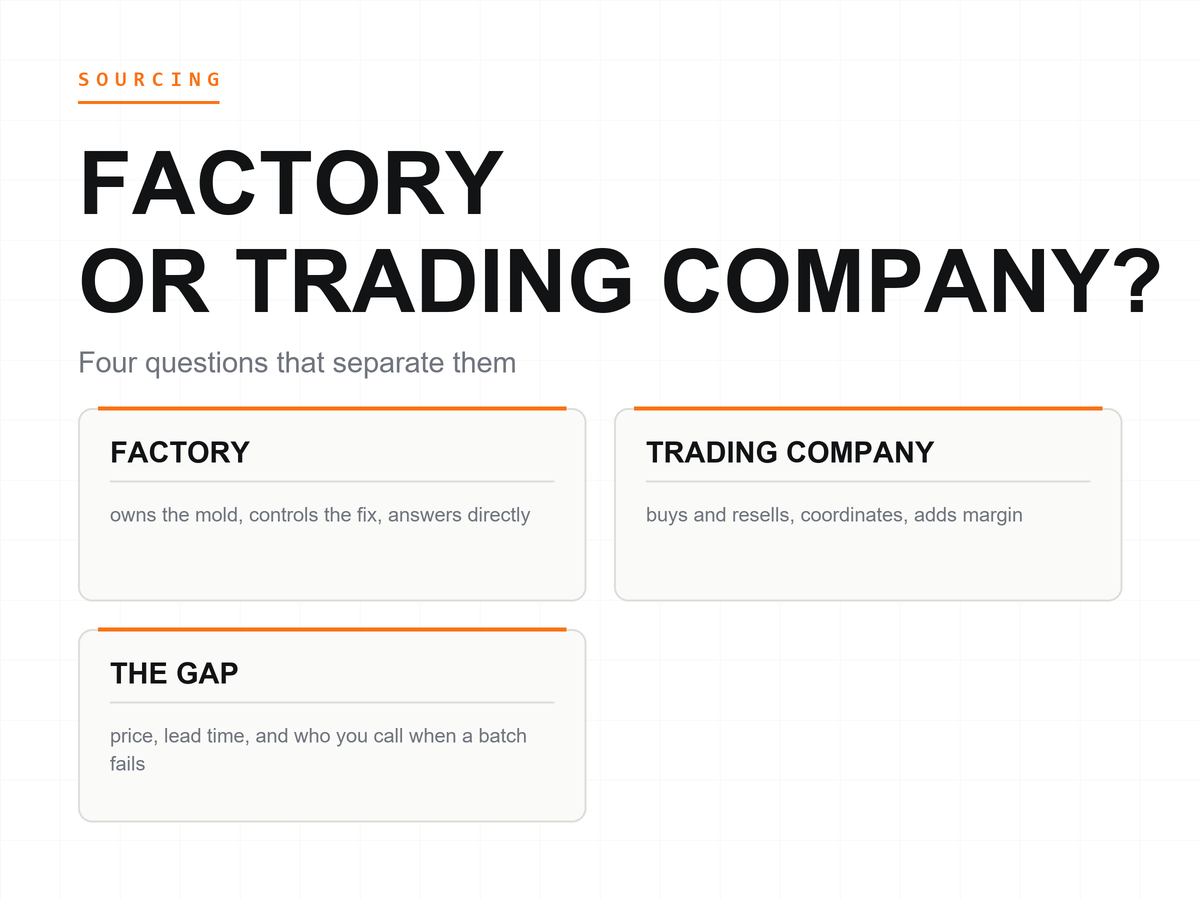
A factory molds the case on its own tooling. A trading company buys the case from a factory and resells it. Both can call themselves manufacturers, and the difference is invisible on a product page.
What changes is what each one controls. A factory controls the mold, the material, the tolerance, and the fix. A trading company controls none of those directly; it coordinates them, and it adds a margin for doing so. Neither is automatically the right choice — a good trading company can aggregate orders and handle logistics a buyer wants offloaded — but a buyer should know which one they are paying.
This matters most for the buyer in the middle of selecting a partner, because that is exactly when the two look identical and behave differently.
The Questions That Separate Them
Four questions sort a factory from a trading company, and all four are answerable in a first conversation.
The first is the tooling question. Ask whose mold the case comes from, and whether the factory that runs it is the company you are speaking to. A factory answers directly, sometimes with the mold number. A trading company answers around it.
The second is the sample question. Ask for a sample of the specific product and a production lead time for a modification, such as a different finish on our micro-matte build or a custom logo. A factory can adjust its own mold; a trading company has to relay your request and wait for an answer it does not own.
The third is the floor question. Ask to see the production floor, a photo, a live video, or the QC station. A factory shows you where the case is made — the way our slide camera-cover armor line comes off our own tooling. A trading company shows you a catalog.
The fourth is the fix question. Ask what happens when a batch fails inspection, and who owns the replacement. A factory fixes its own error. A trading company negotiates with a party you never signed with.
What a Trading Company Can Actually Offer
It would be wrong to write trading companies off, and honest buyers should hear what they do well.
A trading company aggregates, which matters when you want many categories — cases, glass, chargers, cables — in one order without managing four factories yourself. It handles consolidation, mixed SKUs, and the administrative work that a factory may not want to carry. For a buyer whose real problem is coordination rather than manufacturing, a trading company can be the correct answer.
The point is not that factories are good and traders are bad. The point is that the price, the lead time, and the accountability differ, and a buyer should know which one they are buying rather than discover it on the first warranty claim.
How the Price and Lead Time Differ
The same case usually costs less direct from the factory, because the trading company's margin is removed. That is the part buyers notice.
The lead time difference is subtler and matters more on a launch. A factory order runs when the mold is free and the line is scheduled, and changes happen in one conversation. A trading-company order adds a relay between you and the factory on every decision — a change, a sample, a complaint — and each relay costs days that a launch calendar does not have.
This is why the first conversation, not the price list, is where the distinction shows up. The price list is the one document a trading company can make look identical to a factory's.
Where the Risk Sits When Something Goes Wrong
The failure case is where the two companies diverge most, and it is the case a buyer should plan for rather than hope against.
When a factory ships a bad batch, the fix is theirs: they own the mold, they own the error, and they owe you the replacement or the credit under the terms you agreed. When a trading company ships a bad batch, the error belongs to a factory you never contracted with, and the trading company is in the middle of a negotiation it may not win. Your remedy depends on a third party.
That asymmetry is the real cost of a trading company, and it is invisible until the moment you need it. The buyers who ask the four questions up front are the ones who know, before any money moves, who they will be calling when the batch fails.
Common Questions From Buyers
Is it wrong to buy through a trading company?
No. A trading company is the right choice when your problem is aggregation and coordination rather than manufacturing control, and a good one adds value you would otherwise pay for anyway. What is wrong is not knowing which one you are dealing with, because the price and the accountability differ.
Can a trading company really not fix a defect?
It can push the factory it bought from, but it does not own the error, so the fix is a negotiation rather than an obligation. A factory's fix is direct. That difference is what the four questions are designed to surface before you are in the middle of it.
How do I verify the answer without a site visit?
Ask for a live video of the line, a photo of the mold with the case, or a sample modified to your request. Each of these is something a factory produces easily and a trading company produces awkwardly, and none of them requires you to travel.
What to Do Next
We mold our own cases, and the four questions above are ones we answer directly: the mold, the sample, the floor, and the fix. If you want to verify any of them before ordering, ask, and we will show you rather than describe.
Send us the models and finishes you are planning, and we will answer the tooling, sample, floor, and fix questions in one pass so you know who you are buying from.
Ask us the four questions and we will answer all of them before you order.
Apple, iPhone, Samsung, and Galaxy are trademarks of their respective owners, used solely to indicate compatibility. iFunSmart is an independent manufacturer of phone cases and accessories.