Oct 2, 2026Business Solutions
A Factory Tour by Video: What to Look For
A live video walkthrough can verify more than a catalogue. What to look at on a factory floor, which questions to ask, and what a camera cannot prove.
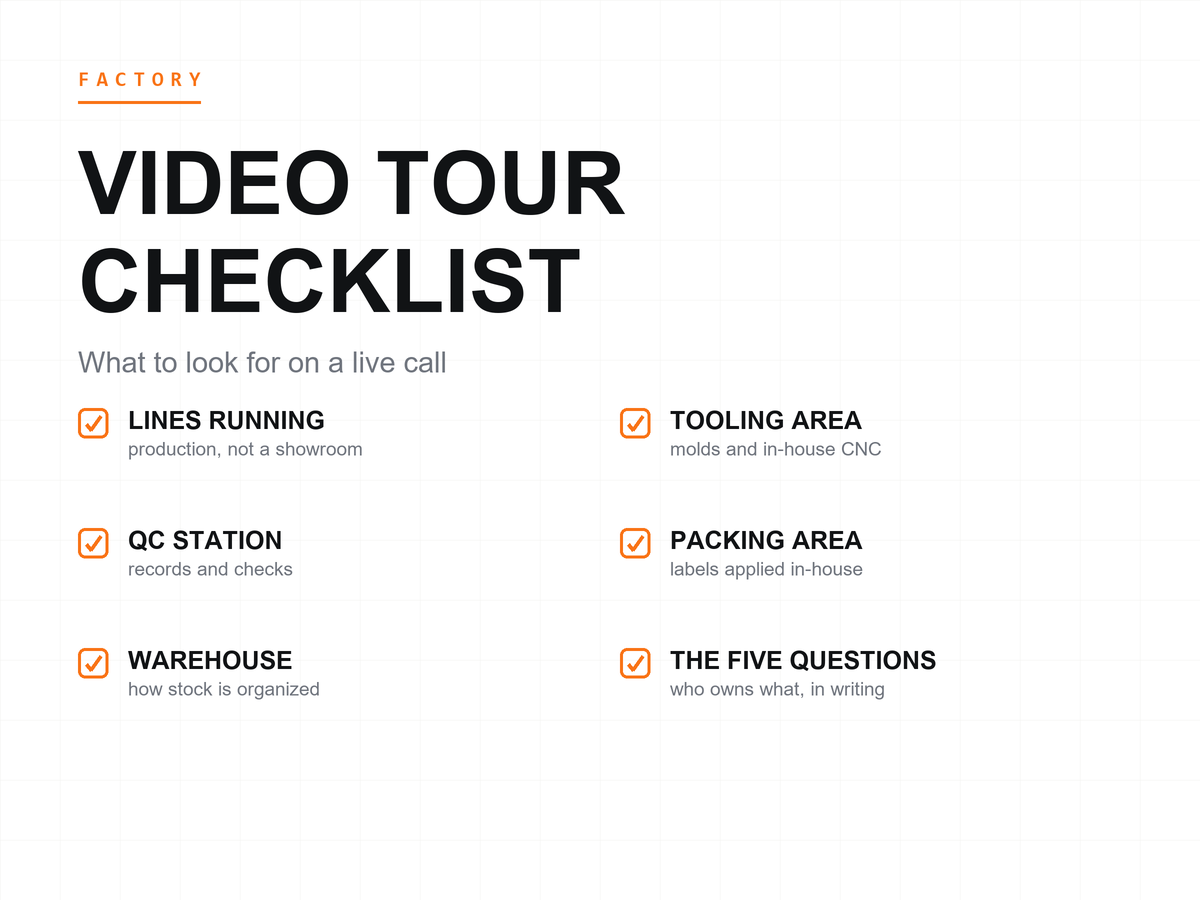
A live video walkthrough should show a factory at work, not a catalogue on a table. iFunSmart hosts these sessions from our Guangzhou floor on request, and the useful ones follow a short route: production lines running, the mold area, the QC station and its records, packing, and the warehouse. Here is what each stop tells you.
Last updated: October 2, 2026.
What a Video Walkthrough Can Prove
A remote factory walkthrough refers to a scheduled video call in which a person on the floor carries a camera past working areas while you watch in real time and ask for a closer look. That definition carries one rule above the rest. Live beats recorded. A recorded clip is edited by the party you are vetting. A live call hands the choice of where the camera turns back to you.
Start by asking the camera holder to walk rather than present. A working floor has sounds, motion, and people who did not rehearse for the call. Whether you are evaluating us or another supplier, look for the place where jobs queue up, not the corner where samples sit under lights.
Settle one more thing before the call: what the format cannot do. A camera walk does not verify ownership, financial health, or certifications, and it does not replace a third-party inspection report. Treat it as one layer of evidence. Whether a call can happen on the day you want depends on production and time zones, which is why the invitation comes as on request.
Reading the Production Floor
The production floor is the first stop because repetition is the thing a catalogue cannot show. Ask what is running right now, which model the line is set up for, and whether the camera can follow the process from molding to finishing without cutting away. A line with work at several stages says more than a finished case on a desk.
Then ask for the mold area. Tooling is a factory's real inventory. The area around it should look organized: racks, tags, and a record that ties each mold to a model, whether that model is an iPhone 18 Pro Max or something else on your list. We keep 1,000+ molds in our Guangzhou plant, and a buyer can ask to see the row that matches the product under discussion. A sample proves a shape exists. The mold proves the shape can be repeated.
If the factory machines its own tooling, ask to watch the CNC equipment run. We do our CNC work in-house and hold 1:1 precision molding as our fit standard. The purpose of this stop is not the brand of the machine. It is the schedule behind a correction. A factory that cuts its own tooling can answer for its own repair queue. One that outsources the work has to ask another company first. A build like our heavy-duty armor line starts in that mold row, which is where the tour should spend its time.
The QC Station and the Paper Trail
Quality control on camera is less about equipment than about habit. Ask for the inspection station, then ask how results are recorded. A useful stop shows a person checking units against a written standard, with a form or a file beside them that carries a date and a batch reference.
Records are the part a camera can capture and still miss. Ask how long inspection records are kept, where they live, and who can pull one for a batch that has already shipped. The answer matters months later, when a shipment has landed and someone needs to trace what happened before it left. A QC corner with no paper behind it is a background shot. Even a straightforward style such as our crystal clear MagSafe design should trace back to the batch it shipped in.
Buyers comparing factories before they schedule a call can read our earlier guide to choosing a reliable phone case factory.
Packing, Labels, and the Warehouse
The packing area deserves as much camera time as the machines, because a well-made case can still arrive damaged. Watch how finished pieces are bagged and boxed, whether packing stations sit apart from the inspection line, and how a mixed order is kept separated while it waits. We print and apply labels in-house, so a buyer can ask to watch a label matched to its carton and its scan check.
The warehouse closes the tour. Ask how cartons are marked, how batches are kept apart, and how the team finds one carton among many. A warehouse that can locate a specific batch on camera is running a system. One that cannot is running on memory, and memory holds until the first problem shipment.
Five Questions to Ask While the Camera Is Rolling
A tour is a conversation with visual aids. Ask these while someone stands at the relevant station, because an answer is harder to soften when the equipment sits behind it.
First, who opens the mold. Ask whether the tooling for your product is cut in this building, and who signs off when a dimension needs correcting.
Next, how records are kept. Ask to see one recent inspection record rather than a blank template, and ask who could retrieve it later.
Third, where shipping documents go. The factory should be able to describe, in its own words, who receives the file set and in whose name it travels. Your agreement decides the answer. The tour only confirms the team knows the flow.
Fourth, what happens when a batch fails inspection. Ask who decides the outcome, what happens to the units, and how that decision reaches you. The answer previews how a problem will be handled.
Fifth, who your contact is after the call. A named person with a backup beats a shared inbox, because the seam between sales and production is where messages fall through.
Common Questions From Buyers
What should I ask to see first on a factory video tour?
The production floor, while it is running. From there, the route should move to the mold area, the QC station with its records, the packing line, and the warehouse. A tour that starts and ends in a showroom with a table of samples is a catalogue with motion, and it says little about how your units will be made.
Can a video tour replace a third-party inspection?
No. An inspection report samples the production batch tied to your purchase, at the time it runs, under a standard both sides accepted beforehand. A walkthrough shows a floor on one day. The camera also cannot prove who owns the building, the machines, or the stock inside them, because a camera shows use, not ownership. Use the video to decide whom you want to work with, and use an inspection on the batch you actually buy.
Why is a recorded clip weaker than a live call?
Because the party being evaluated decides what the recording includes. Edits remove idle lines, quiet warehouses, and stations that exist for the camera. A live call limits that control. You can ask to revisit a stop, ask someone to open a cabinet, or ask a question the edit could not have anticipated. It is still not proof, but it is harder to stage.
What to Do Next
A video tour works when it is specific. Send the stops you want to see, the questions you want answered on camera, and the product line you are discussing. iFunSmart has built cases in Guangzhou since 2010, and we host live walkthroughs on request, so a buyer can look at the mold row, the QC station, and the packing line from a desk.
Send us the stops and questions you want covered, and we will schedule a live walkthrough of our Guangzhou floor on request.
Apple, iPhone, Samsung, and Galaxy are trademarks of their respective owners. iFunSmart is an independent manufacturer of phone cases and accessories and is not affiliated with, authorized, sponsored, or endorsed by Apple or Samsung.