Sep 30, 2026Business Solutions
FBA-Ready Phone Case Packaging: What Amazon Requires
Retail packaging sells the case; FBA packaging survives the warehouse. The barcode, bagging, carton and labeling specs to agree before production starts.
Amazon sellers of iPhone cases lose more time and money to packaging mistakes than to product defects, and most of those mistakes come from assuming that retail packaging and FBA-ready packaging are the same thing. They are not. Retail packaging sells the case to a customer; FBA-ready packaging survives the journey to Amazon's warehouse and passes receiving without a query. A case needs both, and they are specified separately.
Last updated: September 30, 2026.
Retail Packaging and FBA Packaging Do Different Jobs
Retail packaging is designed for the customer who opens it. FBA packaging is designed for the warehouse that handles it before the customer ever sees it.
The retail box carries your brand, the product photography, and the selling points. It is part of the product. The FBA layer is functional: it protects the retail box through Amazon's inbound process, carries the barcode Amazon scans, and presents the units in a condition that passes receiving without a query.
A case that arrives at Amazon in beautiful retail packaging with no prep has failed the second job, because the retail box alone is rarely strong enough for the journey and rarely carries the scan label where Amazon expects it. This is why the two layers are specified and quoted separately, and why a packaging conversation that only discusses the retail box is incomplete.
What Amazon's Inbound Process Actually Checks
Amazon's receiving process scans, weighs, and matches. Every unit needs to be scannable, every carton needs to match its manifest, and every shipment needs to arrive labeled to the specification of the fulfillment center it is sent to.
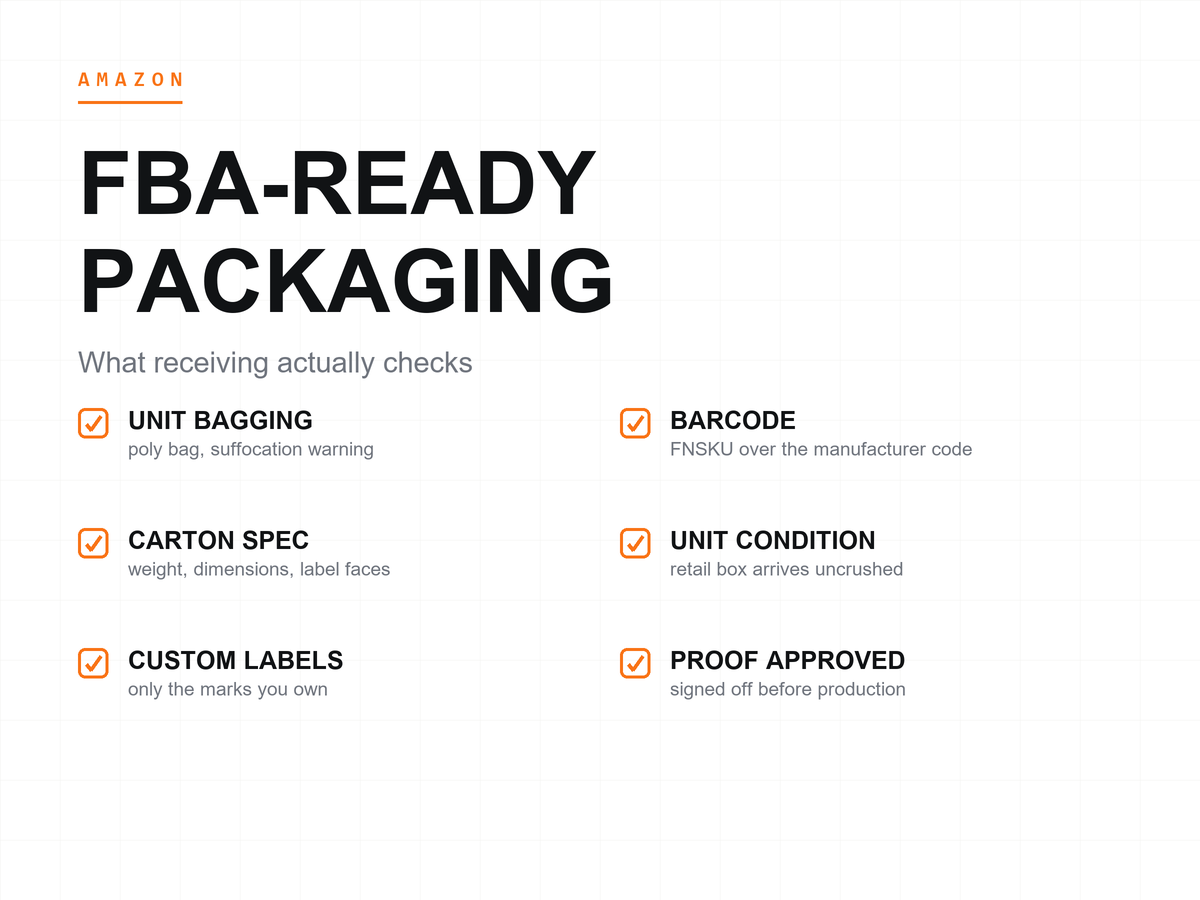
Three checks matter most for a phone case. The first is the scannable barcode: each unit needs either a manufacturer barcode that Amazon already recognizes or an FNSKU label applied over it, placed where it can be scanned without opening the package. The second is the carton specification: weight limits, dimensions, and label placement on the outside of every carton. The third is the unit condition on arrival, because crushed retail boxes generate unsellable inventory even when the cases inside are fine.
Each of these is a packaging specification, not a shipping decision, which is why they belong in the production conversation rather than in the freight booking.
How We Build FBA-Ready Packaging
Our packaging for Amazon-bound cases is built to the marketplace's receiving requirements, and the specification is agreed before production rather than improvised at the warehouse.
Each unit is poly-bagged to Amazon's specification, with a suffocation warning where required, and the FNSKU or manufacturer barcode is applied where it can be scanned. The same prep applies across our range, from a slim RFID card-holder case to a rugged armor build. The retail box, where the product carries one, is protected by the bag rather than relying on it. Cartons are packed to Amazon's carton weight and dimension limits, with the carton labels applied to the specified faces. The result is a shipment that passes receiving without queries and units that go straight onto the shelf.
The retail box, where a product carries one, is specified and quoted separately from this FBA layer, because it sells the case and the FBA layer protects it. Both are part of the packaging conversation, and both are quoted before production rather than after.
How to Plan Your Packaging Before Production
The packaging specification belongs in the order confirmation, alongside the case itself, because changes after production are the expensive kind.
Four specifications should be agreed before the run. The unit packaging: poly bag, retail box, or both. The barcode: manufacturer barcode, FNSKU over it, or both. The carton spec: pieces per carton, dimensions, and gross weight. And the labeling: which labels go on the units and which on the cartons, and where.
Buyers who agree those four specifications before production get shipments that pass receiving the first time. Buyers who leave packaging to the end get to choose between paying for repacking or shipping units that will fail the check. We have written before about how packaging sign-off gates production, and that sequence exists because it is the order that works.
Common Questions From Buyers
Do I need FNSKU labels if my case has a manufacturer barcode?
It depends on how your inventory is set up in Seller Central, not on the case. Amazon can use the manufacturer barcode for some programs and requires an FNSKU for others. Check your account settings for the specific SKU, then tell us which label to apply before production rather than after.
Can you ship directly to an Amazon fulfillment center?
Yes, and that is the normal arrangement for Amazon-bound orders: the shipment goes from our floor to the fulfillment center you nominate, with the cartons labeled to Amazon's specification. Tell us the fulfillment center and the shipment reference, and the cartons are labeled for that destination.
What if my retail packaging changes after I order?
Tell us before production starts. A packaging change affects the unit specification, the carton fill, and the label placement, and all three are cheaper to adjust before the run than after. This is why the packaging proof is approved before production rather than after the cases are made.
What to Do Next
We produce cases with FBA-ready packaging specified per order, and the barcode, bagging, carton, and labeling specifications are agreed before production rather than after it.
Send us your models and your fulfillment setup, and we will confirm the packaging specification for your order and quote it alongside the cases. Our [[compact packaging approach -> /posts/save-shipping-cost-compact-packaging-solution]] and our [[mixed-model carton planning -> /posts/mixed-model-container-math]] both feed into the same carton specification that FBA receiving checks.
Send us your fulfillment setup and we will confirm the FBA packaging specification for your order.
Apple, iPhone, Samsung, Galaxy, and Amazon are trademarks of their respective owners. iFunSmart is an independent manufacturer of phone cases and accessories and is not affiliated with, authorized, sponsored, or endorsed by Apple, Samsung, or Amazon.