Oct 18, 2026Business Solutions
Mixed Cartons: Labels and the Packing List
A mixed carton only saves time if receiving can find each SKU quickly. How to label cartons and write a packing list that survives the dock and the stockroom.
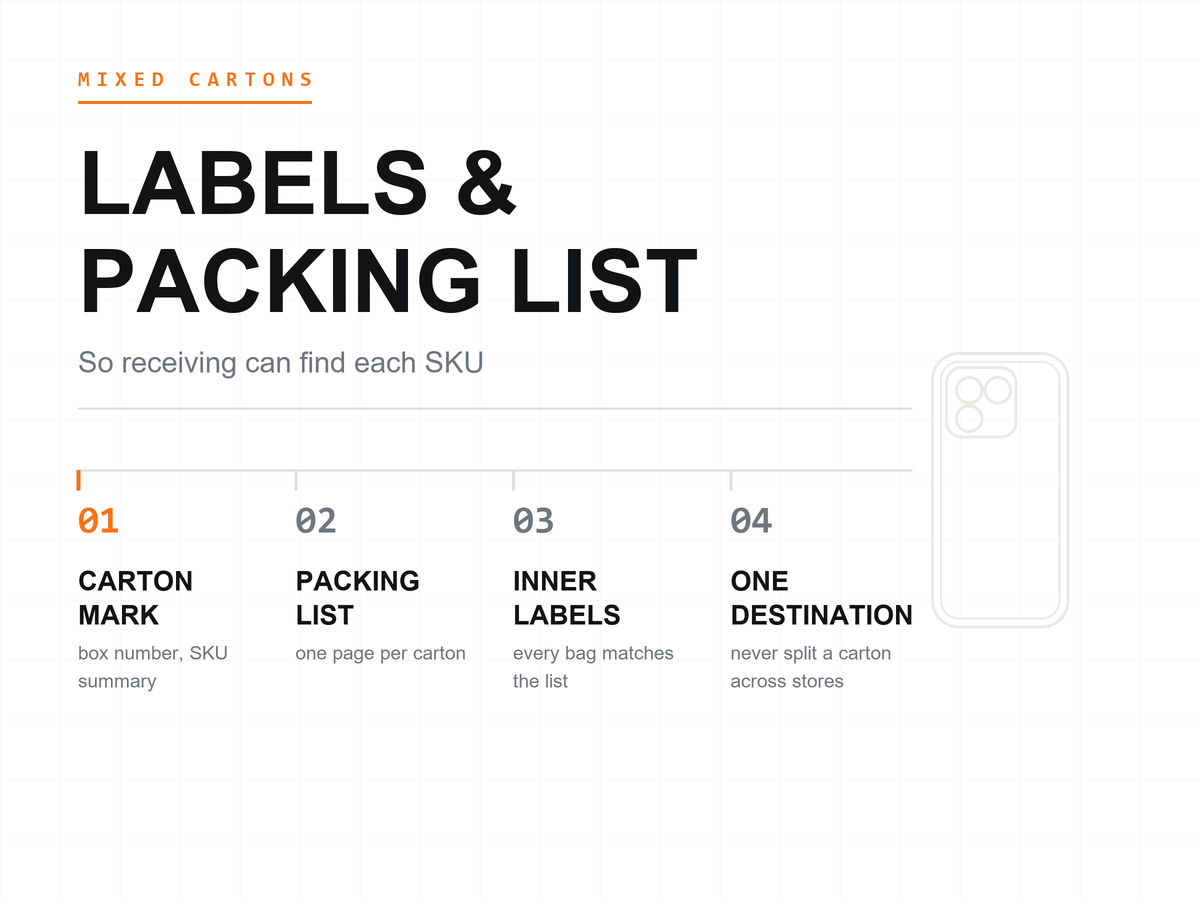
A mixed carton saves cartons, not sorting work. iFunSmart packs mixed orders in Guangzhou around one rule: the carton label and the packing list carry the same facts in the same order, so a receiver can find any SKU without opening every bag. What follows is how those two documents are built.
Last updated: October 18, 2026.
What a Mixed Carton Changes at Receiving
A mixed carton is a shipping carton that carries more than one SKU from the same purchase order. The box count falls, and the information load rises. At the dock, someone sees a sealed carton and must decide where it goes and what is inside without breaking the seal. The label answers the first question. The packing list answers the second.
When the documents disagree, the carton becomes a small investigation. Staff open bags to identify a model and count by hand. That work never appears in a quote, and a misplaced case can sit in the wrong bin until a customer request exposes it.
The fix is not a bigger label. It is a short chain of facts that stays consistent from the outside of the carton to the last bag inside.
The Carton Label: What Receiving Reads First
A carton label is a sorting instruction before it is a shipping record. The receiver reads it in a hurry, often with a scanner in one hand, so the first line should answer the first decision: where does this carton go. A destination code, written the way the receiver writes it, belongs at the top. The carton number and total count for that destination belong there too, so the receiver knows whether the set is complete.
The middle of the label carries the SKU and quantity summary. A receiver should see that the carton holds one model in two colors, or several models in one color, without opening it. The summary does not replace the packing list; it points the receiver to the right page.
The label also carries gross weight and outside dimensions, because the forwarder and receiving desk ask for them before the carton is opened. Buyers ask for them when booking freight, and a label that answers them saves messages later. The fields are fixed per order and confirmed in writing.
Placement matters as much as content. A label on a face that gets hidden when cartons are stacked only works on the first carton. Choose one face for every carton, and put the scannable carton number there with the destination code readable at arm's length.
We print and apply labels in-house, and the content and layout, including destination codes, come from the order confirmation rather than a default template. Label content and format are agreed per order in writing, and we do not publish a fixed carton-label template. A warehouse that sorts by store code and one that sorts by SKU need different labels.
The Packing List: One Page per Carton
A packing list is a shipping document that names every SKU in a shipment and the carton each line travels in. Build it for the dock: one page per carton, with the carton number at the top.
Each line names one SKU: its code, name, color or finish, and quantity. The code is the anchor. A name can vary between factory and buyer catalog, and a color word can mean different things to different people, but the SKU code should travel unchanged from the order confirmation to the carton label to the inner bag. When the code matches in all three places, a receiver can settle an identity question without a phone call.
The lines follow the physical packing order. If the packer lays the card-holder bags on top and the armor cases underneath, the list should read that way, so a receiver can work down the page while unloading. An alphabetical list is easier to file and slower to check. A list sorted by quantity is worse still.
The quantities on the list are those counted at packing, not those ordered. A short pack or an extra unit should be visible before the carton is sealed. Once it closes, the list and contents have to agree, and any difference becomes a claim rather than a correction.
Inside the Carton: Marks That Match the List
The chain continues inside. Every bag or compartment carries the same SKU code as its line on the packing list, so the first bag a receiver lifts can be matched to the first line. The mark needs to be readable in warehouse light and placed where a person holding the bag will see it.
Color and finish belong on the inner mark as well as the outer label. Two dark finishes can look alike through clear film, and a receiver who has to guess will open the bag. A bag whose label is missing is a bag that gets opened. That sentence is the whole argument for marking every unit, not just every carton.
How bags are arranged to stop hard edges rubbing finished faces is a separate packing question; the physical packing method for cases and accessories together has its own subject. This article asks only that each bag can be identified. The a card-holder SKU that travels in its own bag and the a bulky armor case that anchors the carton can sit in the same shipment, but the mark on each bag has to say which one it is before anyone opens either.
Sorting Logic: One Carton, One Destination
Receiving usually sorts a mixed shipment by destination first and by SKU second. The carton label should follow that sequence. If the dock reads the destination code first, that code goes first on the label; the SKU summary follows. The label is not a place for a design preference; it is a place to match the receiver's reading order.
A mixed carton serves one destination. Two stores in one carton save a carton and cost a split at the dock, and after the split the label no longer describes what the box holds. If a shipment covers several stores, number the cartons within each destination group and keep the packing list grouped the same way.
This is where the article stops. How many cartons a mixed order needs, and what that does to freight, is a container question with its own math. The label and the list do not change the freight calculation; they tell the receiver what arrived.
Common Questions From Buyers
What belongs on a mixed-carton label?
A destination code, the carton number and total count for that destination, an SKU and quantity summary, gross weight and outside dimensions, and a scannable carton number if the receiver's system reads one. The layout depends on how the receiver sorts, so the format is agreed per order.
How should the packing list be ordered?
In the order the carton is packed. One page per carton, one line per SKU, and the lines in the sequence a person will meet them while unloading. The list is a working document for the dock, so its order should follow the box rather than the office filing system.
Can one carton serve two stores?
No. A mixed carton is addressed to one destination, and a second store in the same carton creates a split before the goods reach either shelf. Use separate cartons per store, and let the packing list show the same destination groups as the labels.
What to Do Next
Before the run, send us the destination codes and the SKU list your receiver sorts by. Tell us which code, name, color, and quantity should appear on each page, and where the destination code sits on the carton. We will confirm the carton label and packing list format in writing before production, so the carton that leaves Guangzhou carries the same facts inside and out.
Send iFunSmart the destination codes and SKU list your receiver sorts by, and we will confirm the carton label and packing list format in writing before the run.
Apple and iPhone are trademarks of Apple Inc. iFunSmart is an independent manufacturer of phone cases and accessories and is not affiliated with, authorized, sponsored, or endorsed by Apple.