Oct 18, 2026Business Solutions
Reading Your Inquiry Log Like Data
The inquiries that did not close still say something useful. Keep a simple log and read it for demand gaps, listing readiness, and reorder timing.
An inquiry log turns the messages that did not become orders into a record you can read. iFunSmart sells to buyers, not to their inboxes, so the log is yours to keep; this is how to build one and what its patterns can tell you.
Last updated: October 18, 2026.
The Questions That Did Not Become Orders
A sale records what you carried. An inquiry records what somebody wanted, and the two records do not cover the same ground. The buyer who asked about a finish you never stocked, then bought nothing, has still told you where your range stops.
An inquiry log is a line-by-line record of the questions buyers sent, whether or not they bought, kept in one place so patterns can surface later. Treat it as a second sales report. It reports demand that never reached a cart.
Most buyers keep this file by accident, scattered across chat threads and inbox folders. The reading improves the moment the entries sit in one place with the same fields.
One boundary before the method: we do not see your inquiry log. Every question below is read on your side of the transaction, from messages that arrived to you.
What a Minimal Log Holds
Keep the fields small enough that you will fill them on the day the message arrives. A long template gets abandoned; a short one survives.
Each line carries the date, the channel the message came through, the type of buyer, the SKU or product class the question named, the question in the buyer's own words, what you answered, and what happened next. If the buyer explained why the answer was not enough, copy that reason into the line.
Two habits do most of the work. Write the question verbatim rather than your summary of it, and leave a field blank when you do not know the answer. A guessed reason poisons the reading later.
A mainline build such as a SKU customers ask about by name earns its own line every time a buyer names it. The same holds for a finish nobody has asked about yet; its absence from the log is information too.
Reading One: What Buyers Ask For That You Do Not Carry
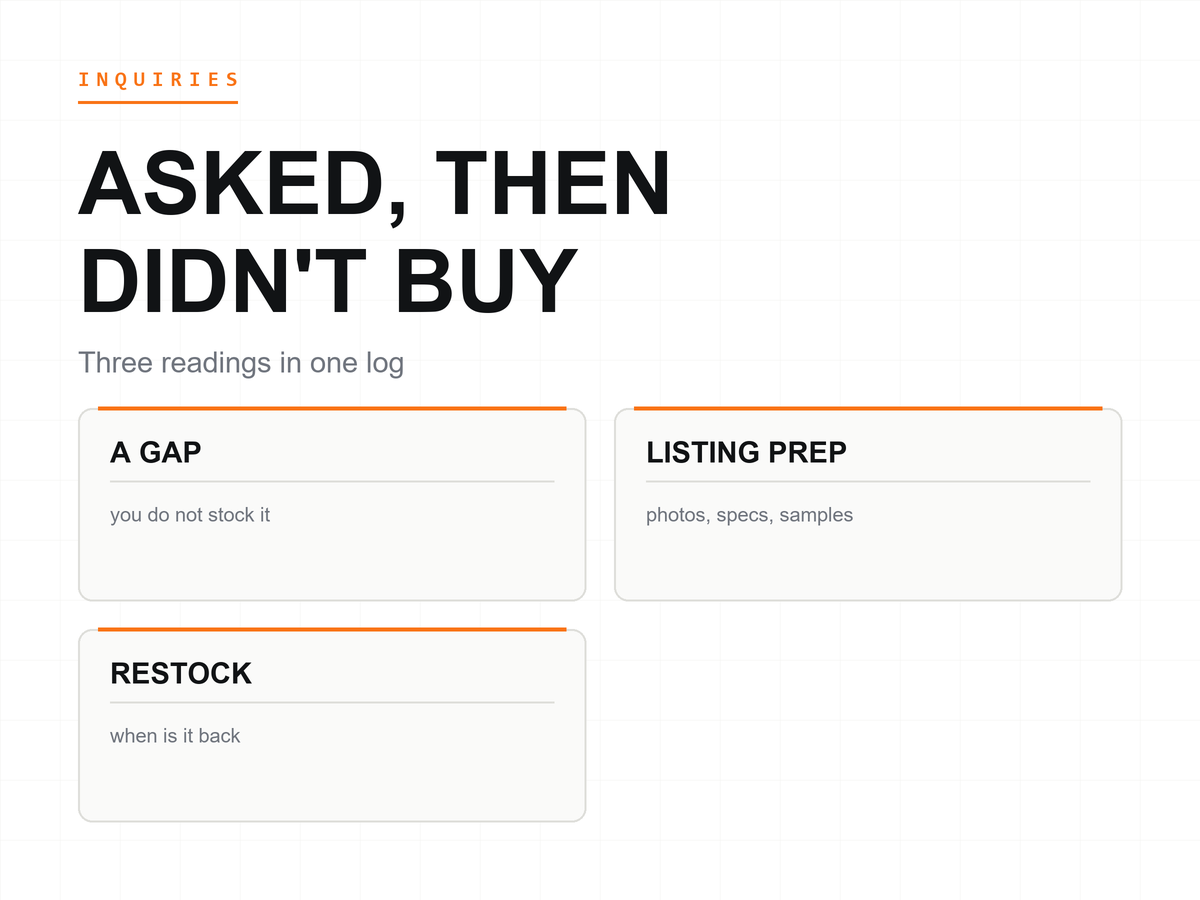
The first reading looks for a category gap. A buyer asks whether you have a certain build, you say no, and the conversation ends. That exchange is a demand record with a missing product attached.
Do not act on the first ask. A single inquiry is an anecdote, not a trend. What turns an anecdote into a gap is repetition: the same class of request arriving from different buyers, on different days, through more than one channel.
When that repetition appears, the useful next question goes to your supplier rather than to your catalogue. Does an existing mold already cover the class? A gap is cheaper to close when the shape exists in steel and only the finish or the color changes.
Keep this reading separate from a stockout. A buyer asking for something you never carried is describing your range. A buyer asking for something you sold out of is describing your supply, and that belongs in the third reading below.
Reading Two: Requests for Photos, Specs, and Samples
The second reading is about readiness. A buyer who asks for images, measurements, or a sample has moved past browsing and started preparing a listing or a launch.
The signal is strongest when the request carries an item code. Buyers ask for photos by item code when they are building a product page, and the code tells you they already have your line in front of them. We provide free HD images for the styles we have photographed, so that request is one we can answer; note which request turned into a listing.
These inquiries sit closest to a sale, and they fail for boring reasons: a slow reply, a missing angle, a spec table that does not match the question. Log the request and the answer separately. The distance between them is a service problem you can fix, not a demand problem you cannot.
A question about a specific build, such as the photography for a mainline SKU, can also tell you which models your buyers plan to list next. That is a preview of the next order, written before the order exists.
Reading Three: "Is It Back Yet?"
The third reading is urgency. A buyer writes to ask whether a shade is back in stock, or when it will arrive. The message names demand that outran supply, and it usually arrives after the shelf is already bare.
Log the shade, the model, the channel, and the date of the ask. Those entries form the pressure side of a restock decision. The log does not size the order and it does not book the production slot; those are separate decisions made from your own velocity and your freight plan.
A finish such as a shade that draws questions may collect these messages even while similar shades sit in stock. Read the exact color named. A buyer asking for one specific tone is not asking for the whole family.
Distinguish this from a visibility problem too. If the shade is on the shelf and the buyer cannot find it, the log points at your listing or your wall, not at your inventory.
Keeping the Reading Honest
Three habits keep the log from flattering you.
Keep won and lost inquiries in the same file. A file that holds only the conversations that closed is a success sample, and a success sample cannot show you the demand you missed.
Count buyers rather than messages. One buyer who writes again and again is still one buyer, and a chatty thread can look like a crowd.
Read on a calendar, not from memory. Pick a fixed interval you will actually keep, and read the log before every reorder conversation. Memory keeps the vivid message and drops the quiet one.
A last check: do not read silence as rejection. Some buyers leave without explaining, and the log should mark those as unknown rather than guessing why. The unknown rows are where a follow-up question earns its keep.
If you want to know whether a class your log keeps surfacing already exists in our mold library, ask and we will name what we hold.
Common Questions From Buyers
What should I write when the buyer never says why they left?
Write "unknown" and the date of your last reply. Then add the one question you would ask if the buyer returned. A log with honest gaps is more useful than one filled with reasons you invented.
How often should the log be read?
At an interval you can keep, and once more before any reorder conversation. The reading is cheap; the habit is the hard part. A log read only when a problem appears tells you less than a short one read on schedule.
Does iFunSmart keep or see this log?
No. The log lives with you, because the messages arrive to you. What we hold is the supply side: the molds, the finishes, and the production window behind a model your log keeps naming.
What to Do Next
The reading stays in your hands; the supply side stays with us. We mold cases in Guangzhou, the library holds 1,000+ molds, and we ship to buyers in 30+ countries, so a model or a finish your log keeps surfacing often maps to tooling that already exists.
Send us the models and colors your log keeps naming, and we will tell you which of them our existing molds already cover.
Apple and iPhone are trademarks of Apple Inc. iFunSmart is an independent manufacturer of phone cases and accessories and is not affiliated with, authorized, sponsored, or endorsed by Apple.