Oct 2, 2026Business Solutions
Fit Commitments: What Your Order Confirmation Should Say
What a fit commitment should say in writing: covered models, the evidence that triggers it, the reporting window, replacement handling, freight, and exclusions.
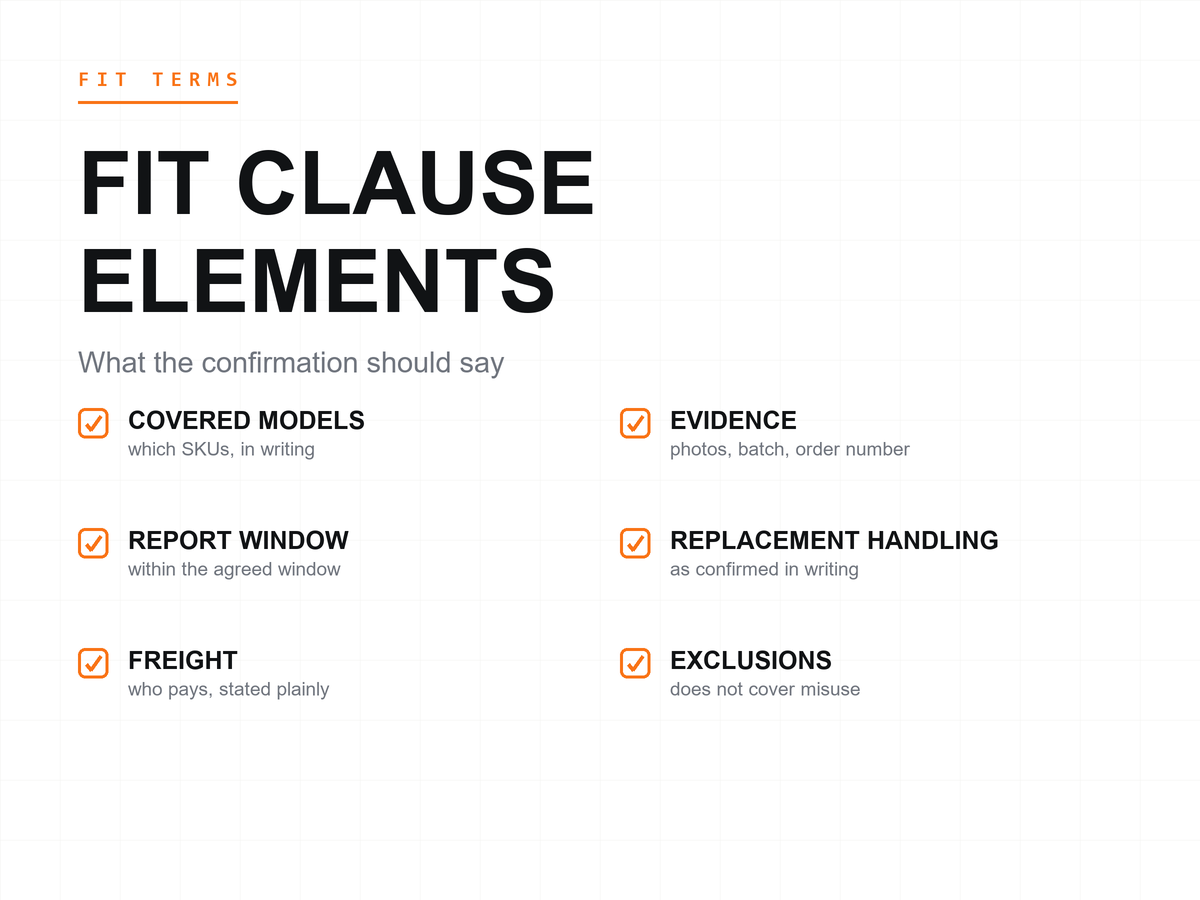
A fit commitment is a written promise, tied to named models and one order number, describing what happens if a case does not seat correctly on the handset it was ordered for. iFunSmart confirms these terms on the order confirmation, in writing, before production starts, so that both sides negotiate once and then work from the same page.
Last updated: October 2, 2026.
Why a Spoken Promise Needs Six Written Elements
Every buyer has heard a supplier say the cases will fit. Fewer buyers hold a document that says what happens when one does not. A fit guarantee that lives only in a chat window is a courtesy rather than a term, because nothing in it is confirmed in writing and nothing in it can be enforced later.
Written terms earn their keep after the cartons are open. The clause answers the questions a verbal promise leaves open: which models sit inside the commitment, what evidence starts a claim, how long a buyer has to report a problem, and who pays the freight when a remedy ships. The order confirmation is where those answers belong, because it is the document both sides settle before production starts.
Spoken promises are not dishonest. They are simply incomplete. A representative who says the cases will fit is describing an expectation, and the written clause is what turns that expectation into an instruction for the tooling bench and the QC station.
What Coverage and Trigger Evidence Should Name
Coverage is the first element, and vague coverage is the most common gap. A phrase like "all our phone cases" tells a buyer nothing about which SKUs are protected. A usable clause names the handsets the run was tooled for and the SKUs shipped against the order, because a case cut for one chassis will not seat on another. If your order mixes a clear magnetic build for the iPhone 18 Pro Max with a hinge-protection case for the iPhone Duo, the clause should name both lines instead of covering them with a single phrase about cases in general.
Trigger evidence is the second element. Fit problems are visible, so the standard package is a photo or short video of the case on the handset, the batch number printed on the packaging, and the order number from the confirmation. Together those items let a factory trace the run and let a buyer show which units are affected. We ask for all three, and we would rather write that expectation into the confirmation than debate it after a complaint.
Tell us which models you carry, and the fit terms that apply to them can be confirmed in writing at the sampling stage.
The Reporting Window, the Remedy, and Freight
The reporting window is the third element, and it belongs in the clause as a reference rather than an invented figure: within the window agreed in your order confirmation. A window that suits a stock replenishment and a window that suits a container moving by sea are not the same window. We do not publish a single window that fits every order, because the right length depends on the route, the shelf date, and the order itself. What matters is that the window is fixed before production rather than chosen after a problem appears.
The remedy is the fourth element. A free replacement sounds generous until the clause is read closely, and the written version should say which units it covers and which it does not cover, plus the form the remedy takes. That form might be a remake of the affected batch, a credit against a future order, or units added to the next production run. "We will take care of it" names no action and no owner, so it is not a remedy; the confirmation should name both.
Freight is the fifth element and the one most often left to goodwill. When a replacement run is agreed, it should be confirmed in writing on the order confirmation, together with who books the freight and who pays for it. On a small run, moving the units can cost more than making them, which is why freight deserves its own line rather than a handshake.
What the Commitment Does Not Cover
The sixth element keeps the rest honest: exclusions. A commitment that covers everything is one nobody can price, and buyers should treat it with suspicion. Our written terms exclude cases we did not produce, cases fitted to the wrong model, and damage that has nothing to do with fit, such as a cracked back from a drop. Each exclusion is verifiable from the evidence described above, which is why exclusions belong in the same clause as the promise.
Exclusions cut both ways, and that is the point. The buyer learns what is protected, and the factory states what it is committing to. A clause without exclusions gets tested by every edge case in the market, and the first thing to break is the part of the promise that was real.
Common Questions From Buyers
Does a fit commitment replace inspection on arrival?
No, and treating it that way costs buyers money. The commitment addresses fit problems that survive a case being seated on the correct handset; it does not replace the buyer's own check that carton counts, colors, and finishes match the order. Arrival inspection catches shipping damage and mix-ups before units reach a shelf, while fit terms catch the units made to the wrong tolerance. Run both, and record what you find against the order number.
What evidence should a buyer keep if a case does not fit?
Keep the case, the packaging with the batch number, the photo or video of the mismatch, and the order confirmation that names the window. Together those items answer every question a claim raises, and a buyer who photographs the problem before returning anything moves through the process faster, because the evidence exists in a form the factory can trace.
Is a fit commitment the same for every order?
No. Terms vary by order, and the order confirmation decides which version applies to yours. A repeat order for a proven line can carry terms that a first run for a brand-new handset cannot, because the tooling history and the evidence differ. That is why we confirm these terms in writing on each order confirmation before production starts instead of quoting one house policy, and why a verbal assurance is worth little on its own.
What to Do Next
Ask for the fit terms in writing before you pay a deposit, and read them next to the models you actually sell. A clause that names your models, your evidence, your window, and your freight arrangement is a working document. One that only offers reassurance is a sentence, not a term. The clause that governs is the one in your order confirmation, and anything a sales conversation adds is subject to it.
iFunSmart is a Guangzhou factory, founded in 2010, molding cases with 1:1 precision and in-house CNC tooling. Fit terms for your order are confirmed in writing before production starts, so the QC bench and your receiving team work from the same document.
Send us the models on your list, and we will confirm your fit terms in writing before production starts.
Apple, iPhone, Samsung, and Galaxy are trademarks of their respective owners. iFunSmart is an independent manufacturer of phone cases and accessories and is not affiliated with, authorized, sponsored, or endorsed by Apple or Samsung.