Oct 2, 2026Business Solutions
Foldable Case Protection: The Inner and Outer Screen
A foldable has two screens with two different failure modes. What a case, a hinge cover, and a film each protect, and what to specify in your order.
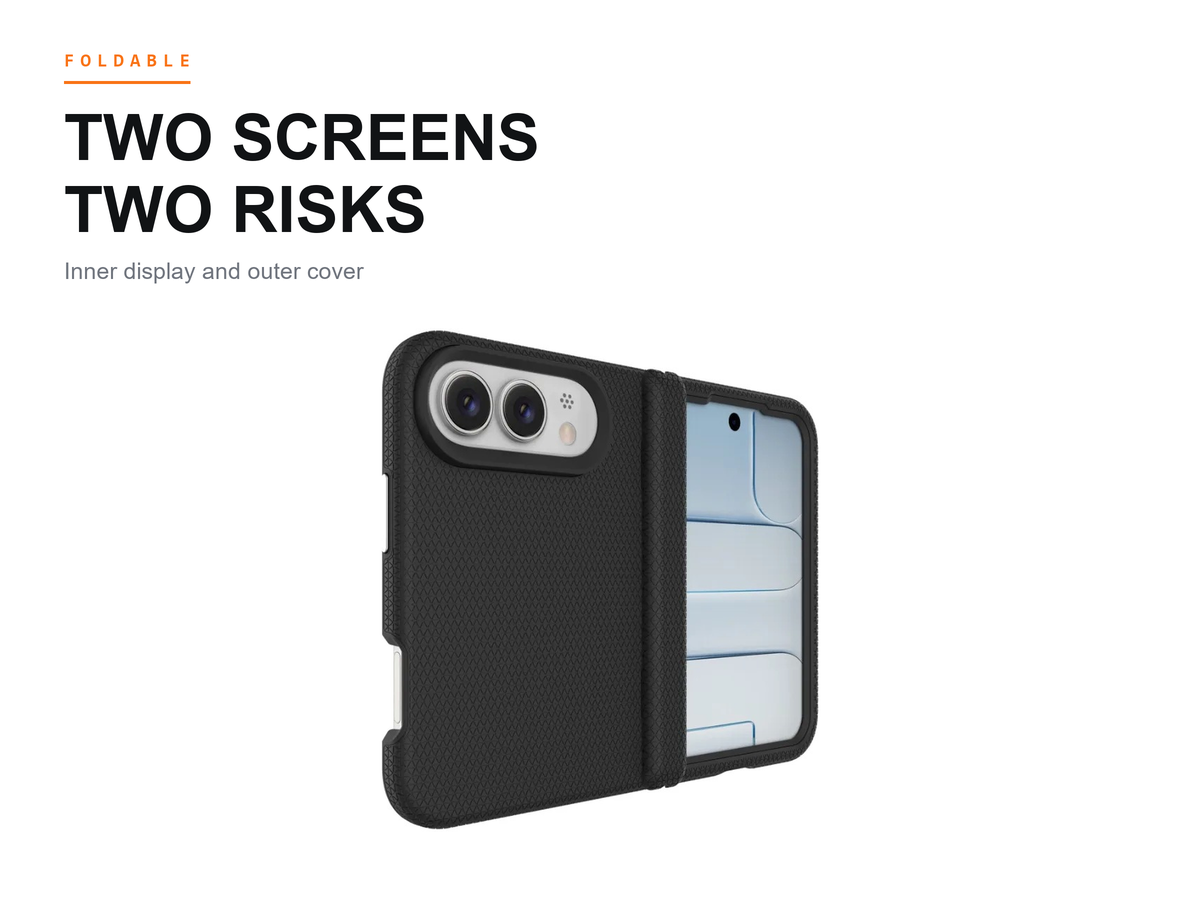
A foldable carries two screens, and they fail in different ways. On the iPhone Duo, the inner display bends along a crease and suffers from debris and pressure at the fold, while the outer cover screen takes the drops and edge hits. Case, hinge cover, and film each cover part of that work.
Last updated: October 2, 2026.
Two Screens, Two Kinds of Damage
The inner screen is the flexible display that folds along a crease. The cover screen is the flat panel on the outside half. Two panels with two structures, and each fails in its own way.
The inner display deserves the first look. Its surface faces the user whenever the device is open, so ordinary handling leaves scratches there, and grit reaches the crease, where a trapped particle works against the panel every time the phone closes. Pressure is the quiet risk: a key closed into the phone puts a point load near the center line, where the panel has the least room to absorb it.
The cover screen has a different profile. It is rigid, so it takes whatever the phone lands on: corner impacts, edge hits, face-down contact with the surface below. Drops are its main enemy, and the glass edge is where a drop finds its opening.
One screen is a surface-and-crease problem, the other an impact-and-edge problem. One product cannot answer both.
What the Case and the Hinge Cover Protect
A foldable case wraps the frame and back and takes drop energy at the corners, the same as a slab case. The extra duty is the fold: two halves that move against each other.
Hinge clearance is the room a case leaves around the joint so the device opens and closes without binding. A case that crowds that travel stresses the hinge every time the phone opens, which is why we run 1:1 precision molding on foldable tooling rather than stretching a slab mold to fit.
The raised edge is the second piece of the case job. A lip above each screen keeps the glass off flat surfaces when the device lies face down. On the cover side it works like a slab case lip; on the inner side it has to stay clear of the panel and the crease.
What the case does not do is cover the inner display while the device is in use. That surface stays exposed, and no lip changes it. A hinge-protection case for the iPhone Duo is built around hinge clearance: the joint stays free to rotate through its full angle, and the cover takes contact that would otherwise reach the moving parts.
What a Film Adds on Each Screen
A film gives a screen surface a sacrificial layer, and each screen needs a film that matches how it moves. The inner display folds, so its film has to be flexible enough to follow the crease; a rigid sheet would fight the fold. The cover screen stays flat, so it can take a rigid film, the same type stocked for slab phones.
The crease is where inner-screen films get into trouble. Adhesive that runs straight across the fold zone can lift as the phone opens and closes, and a lifted edge collects dust. That is why the film specification should state how the adhesive behaves around the fold zone, and why a sheet silent on the crease is worth a question.
One limit belongs here: a film is scratch protection, not drop insurance. A drop that would break the cover screen can still break it with a film on. The film changes where ordinary wear lands, and a film can be replaced while a display cannot.
The spring-hinge crystal case for the Duo shows the split in a finished build: the case handles the body, and the customer adds films.
What to Specify in Your Order
Four things belong in the specification for a foldable case order. Each one closes a gap that otherwise shows up as a complaint from the shelf.
Hinge clearance comes first. Name the model and ask how the opening space around the joint is set. A case adapted from a slab mold will not carry that setting, and the difference shows on the first open.
The film's crease behavior is next. Say where the adhesive stops: it should stay off the fold zone rather than run across it, and the cut should follow the panel. None of that shows in a photo.
Wrap height decides face-down clearance: how far does the case edge stand above each screen? On the cover screen a taller lip helps. On the inner side the edge must clear the panel when the halves close.
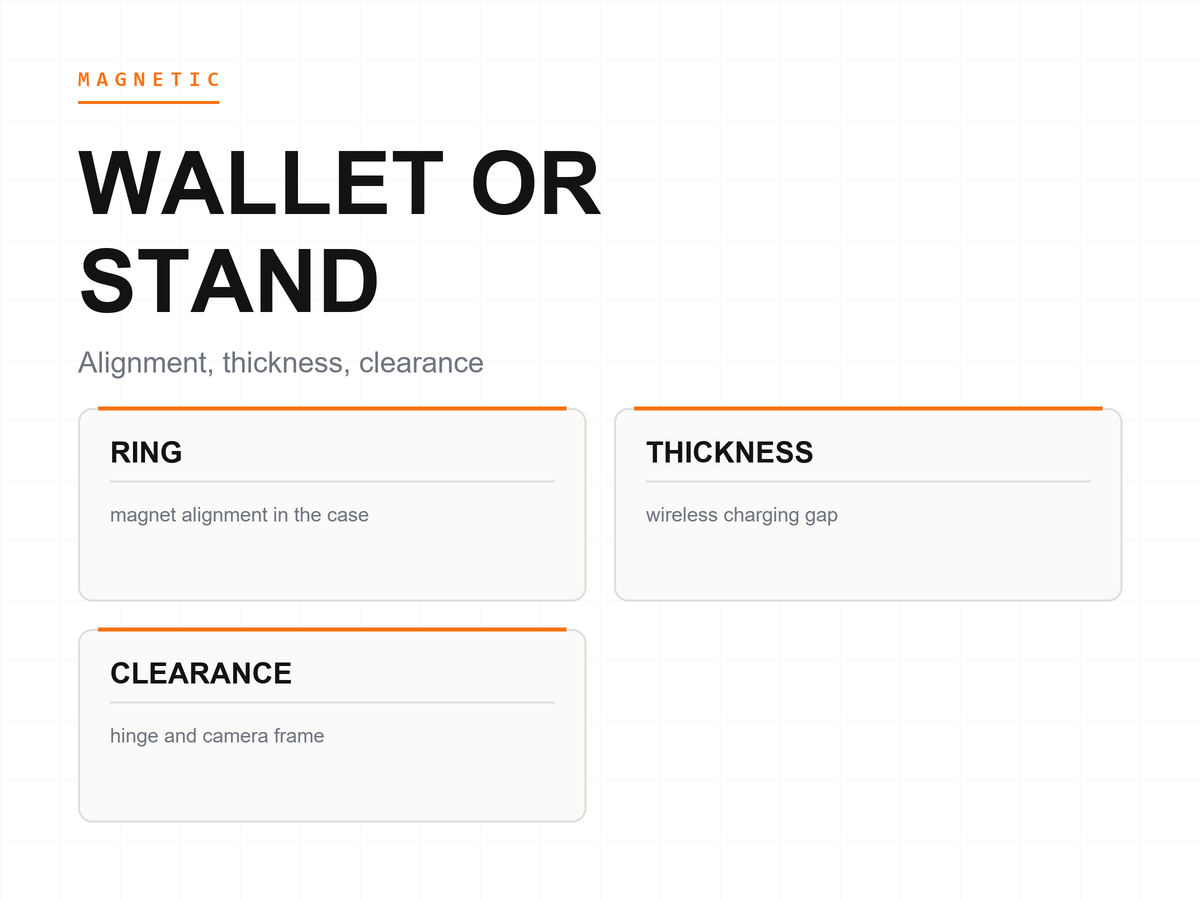
Magnet placement is the last item, and it interacts with thickness. A magnetic ring sits on the back, and the hinge line crosses that area, so where the ring sits is a placement question. How much wall thickness the case adds is a closure question. Buyers who sell mounts, wallets, or chargers should approve both in the spec sheet, not in the sample.
How to Check a Sample on Arrival
Check a foldable sample in a fixed order, starting with the mechanical checks, because those can damage a screen.
Open and close the fitted case through the full fold angle first. A sample that sticks at any angle is not ready for a run, so feel for the point where the hinge binds or the case resists. The closed profile comes next: the halves should meet evenly, with no gap on one edge and no stress line.
Move to the screens after that. With the device closed, look for anything from the case touching the inner panel or sitting near the crease. With it open, confirm the raised edges clear both screens and that any fitted film lies flat.
Finish with function. Confirm the magnets hold a wallet or a mount and that a wireless charge still runs with the case on. Press each button and cutout the case covers. That order puts the checks that can damage a screen ahead of the checks that only cause a return.
Common Questions From Buyers
Does the inner screen need a different film than the outer one?
Yes. The inner display folds, so its film follows the crease and has to stay seated through movement; flexible films are the usual choice. The cover screen is flat and rigid, so it can take a rigid film like the tempered sheets sold for slab phones. Ask how the adhesive is arranged around the fold zone, where lifting starts.
Can a hinge cover keep dust out of the fold?
It reduces the dust that reaches the joint, and that is the honest ceiling. A hinge cover is a moving part over a moving part, so it cannot seal the fold: the clearance that lets the device open also lets dust pass. No case we build makes a foldable dust-proof or water-proof, and a claim of a sealed hinge describes a laboratory, not a pocket.
How long will a foldable case last?
It depends on the hinge design, the film you pair with it, and how the end customer treats the device. We do not publish fold-cycle test data, so treat any durability figure as that supplier's own test conditions, not a promise about daily use. The practical check is a sample in your hands.
What to Do Next
Foldable protection is a three-part decision, and the parts get specified in different places. The case answers hinge clearance and wrap height, and the hinge cover takes movement and contact. The crease question belongs to the film. Buyers who raise all three at once get an answer that fits the device.
Send us the Duo models you plan to carry and the screens you want covered, and we will confirm what we can supply from our Guangzhou factory for the case, hinge, and film, with a sample first.
Send us the Duo models and your market, and we will confirm the case, hinge, and film specifications for your order.
Apple, iPhone, Samsung, and Galaxy are trademarks of their respective owners. iFunSmart is an independent manufacturer of phone cases and accessories and is not affiliated with, authorized, sponsored, or endorsed by Apple or Samsung.