Oct 3, 2026Business Solutions
Restocking a Sold-Out Color: The Second Order
A shade that sells out is good news that still needs handling. How to plan the restock of a hot color: slot, depth, and the mix it rides with.
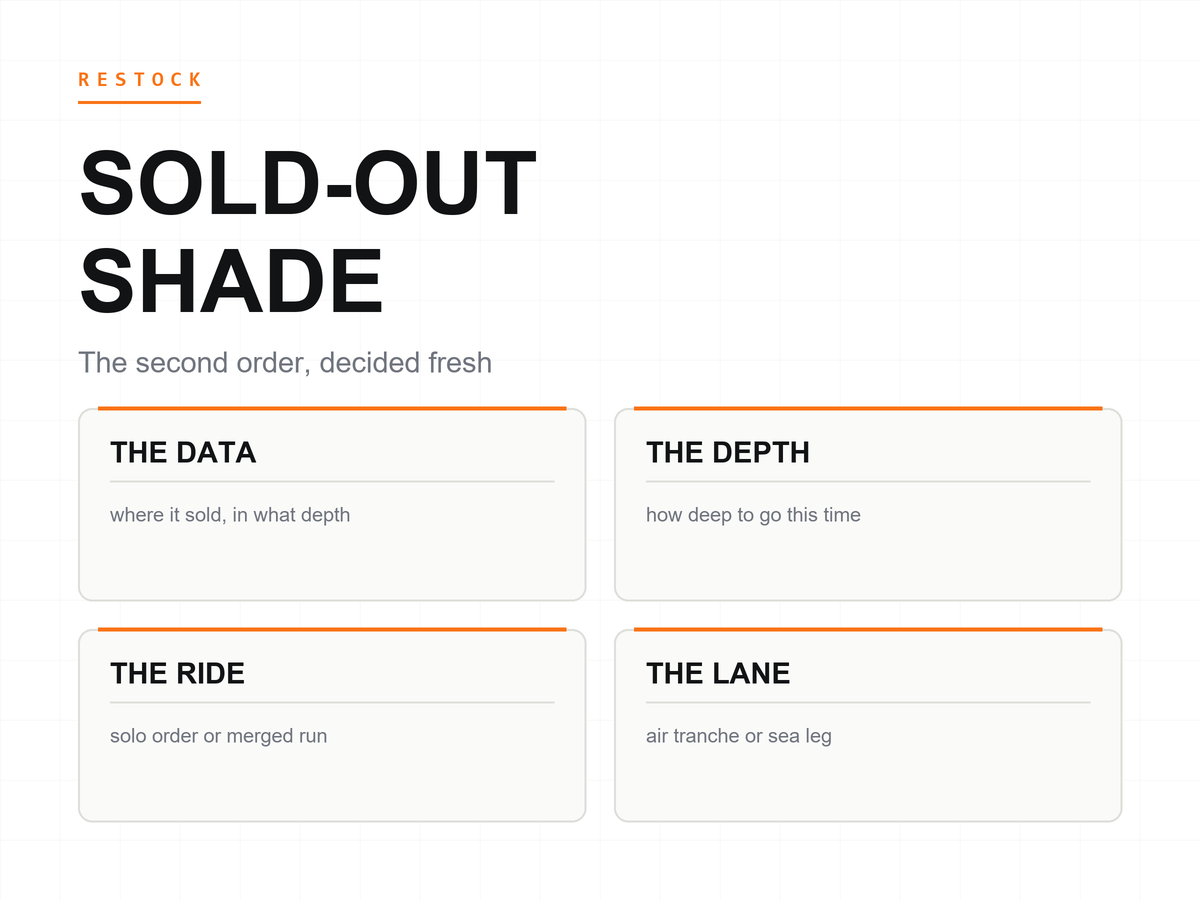
An iPhone case sells out in one shade, and the first question is whether that is a signal or a chore. The restock of a hot color is a second decision, not a copy of the first order: read where it sold out, size the depth from your own velocity, and settle the slot and freight before you commit.
Last updated: October 3, 2026.
A Sell-Out Is Data, Not a Verdict
The sell-out itself tells you almost nothing. The useful record is where it happened: which model, which market, which channel, and how deep the position was when it started. A shade that emptied in one market while other markets still hold stock is a market signal, not a shortage. A shade that emptied because the first order carried it thin is a depth signal, not a demand one. When the same shade empties in one channel and holds everywhere else, the signal points at the channel, not the color. Each reading points to a different second order, and the three do not merge into one clean verdict.
A sell-out restock decision is the choice of how much of a sold-out shade to buy again, through which production slot and freight leg, made from the record of how the shade sold rather than from the fact that it sold. The fact alone pushes buyers toward the wrong move, and the wrong move here is speed without a number.
Write down the date the shade emptied, the depth it started with, and the channels it left through. That line is the raw material for the decision, whether or not you kept it on purpose. One buyer told us they had sold through burgundy and light blue and wanted the next run produced and sent as soon as possible. That is the honest position most buyers stand in, and the one where the fast decision costs the most. The data comes first, and the data is yours.
Sizing the Depth From Your Own Record
How deep the second order goes is answered by your velocity and your replenishment cycle, not by how exciting the sell-out felt. If you run a trigger line for the shade — the stock level that starts the next purchase — the second order quantity falls out of it. If you do not, borrow the method once: velocity in your busiest stretch, the replenishment time you plan to use, and a buffer you can defend in a sentence. The result is a depth you can explain.
A sold-out shade is not a forecast of the next order. It may have sold out fast on a small position, in one channel, or ahead of a holiday, and none of those prove that the next, deeper order will move the same way. Depth belongs to the shade only after the record supports it, and the record is what separates a restock from a gamble.
The first order's split helps here. A shade that started as a small trial share and sold out has earned a reorder, not a promotion to the core. Treat the second order as the test's second round: bigger than the trial, still sized to close without pain if it stalls. The depth number depends on your velocity and your lane, and no supplier can set it for you.
If you want the production timing behind a specific finish, ask us and we will walk through it against your own numbers.
Alone, or Riding With the Regular Order
The next choice is the slot. A standalone run for one shade occupies its own production window and its own carton share. A merged run rides into the regular replenishment order and shares both. The merge is usually the cheaper way to bring a color back, and it has a scheduling advantage the price does not show: the shade does not wait for a slot of its own.
The merge also disciplines the depth. A shade ordered alone tends to be ordered with a round number attached to it. A shade riding with the regular order is sized as part of that order's mix, which is the sizing it deserves. The merged run keeps the shelf balanced too, because the hot shade arrives beside the core colors the same order carries rather than ahead of them.
From our range, a smoke-finished shade or a translucent matte option is the kind of position that sits inside a replenishment order without disturbing the schedule, because the mold already exists.
A standalone run makes sense in one situation: the shade's demand is tied to a moment, such as a holiday window or a device launch, and waiting for the regular order would cost more than the slot does. Outside that, the merge wins on schedule and on sizing.
Air Leg, Sea Leg, or a Split
The freight choice follows the shelf, not the mood. If the shade still has cover in most channels, the regular sea leg brings it back and the cost stays where you planned it. If the shelf is already bare where the shade earns its keep, the urgent part can take the air leg and the rest can ride the sea leg. The split logic that works for a launch week works for a color that ran dry.
A split does not fit every restock. A shade whose margin is thin loses more on the air leg than the bare shelf costs it, and a shade that sells steadily year-round can wait for the sea leg without pain. Both checks are yours to make before you book, and both are cheaper to make than an air bill is to explain.
Air shortens the transit leg and nothing else. It cannot reopen a production slot that has not started, so a fast freight leg behind a slow production start buys the same arrival date as a sea leg, at a higher cost. Settle the production slot first, then choose the leg.
Common Questions From Buyers
How do I know the sell-out was real demand?
Separate depth from velocity. A shade that sold out because it started thin has told you nothing yet; a shade that sold at a steady pace across the whole period and still emptied has told you plenty. Check the channel split too, because a sell-out concentrated in one channel is a signal about that channel, not about the color. Your own record answers the question better than any outside read could.
Should the restock be its own order or part of the next regular one?
Part of the next regular one, in most cases. A merged run shares the production window and the freight, and it sizes the shade as part of a mix rather than as a standalone hero. A standalone order pays off only when the shelf is bare and the regular order is too far out to catch it, and that is a freight question as much as a production one.
What if two shades sell out at once?
Rank them the way you rank any stockout: by what a bare shelf costs you, and let the stronger position go first. Stagger them into the production window rather than placing one urgent block, and check whether both can ride the same leg. A double sell-out feels like an emergency, and the cure is the same slow reading: where, how deep, how fast.
What to Do Next
A hot color restocks well when the factory behind it can move on existing tooling. We mold cases in Guangzhou, the library holds 1,000+ molds, and a reorder of a shade we already produce runs on the mold that made the first order. The scheduling advantage of a merged run is real precisely because the tooling is already committed; the only new work is the slot.
Send us the shade that sold out and where it sold, and we will confirm the production slot and freight timing for its restock.
Apple and iPhone are trademarks of Apple Inc. iFunSmart is an independent manufacturer of phone cases and accessories and is not affiliated with, authorized, sponsored, or endorsed by Apple.