Oct 17, 2026Business Solutions
Checking Magnet Ring Alignment by Eye
A magnet ring that sits off-centre loses half its grip. A visual and feel check buyers can run on a sample before committing to a bulk order.
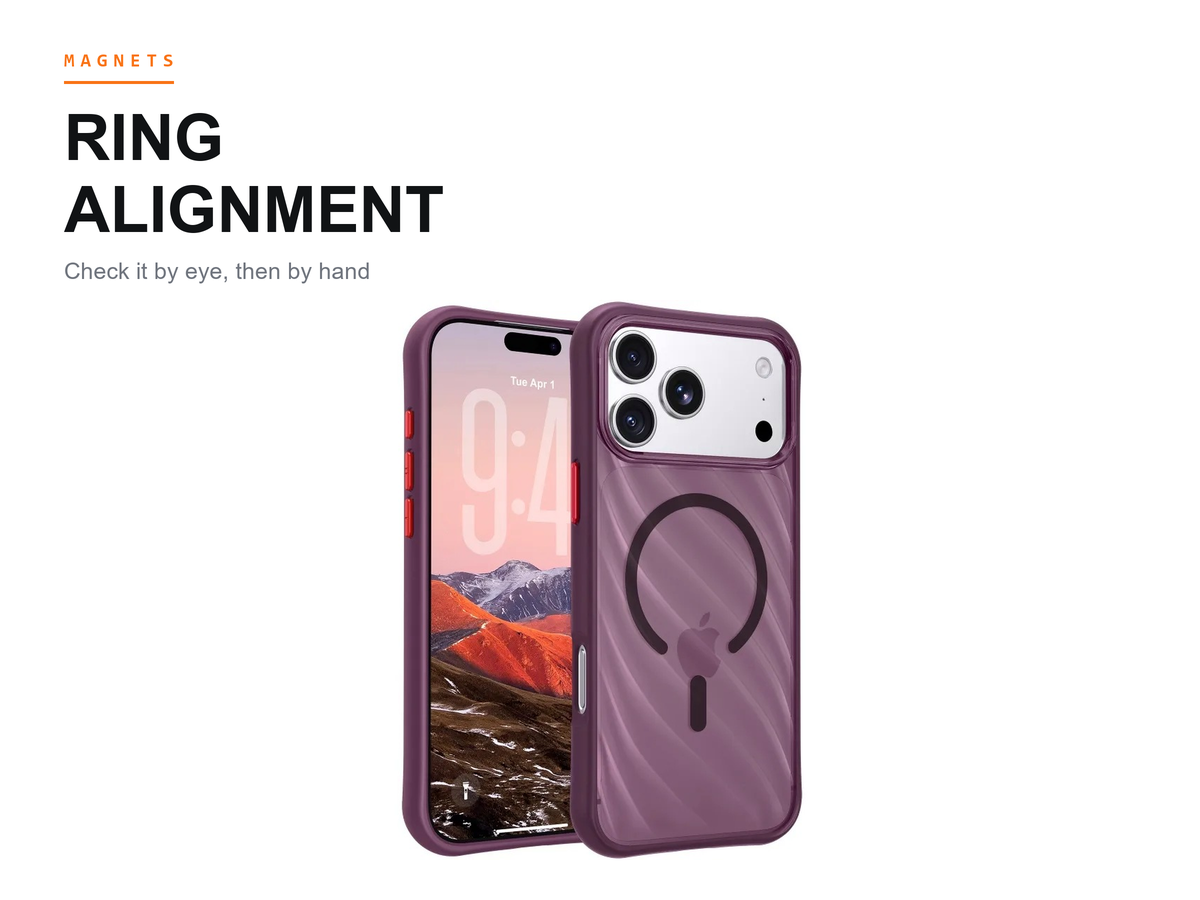
A magnet ring can sit off-centre and still pass a cosmetic check. iFunSmart checks alignment on iPhone samples by eye and by hand: sight the ring against the camera opening, lift each corner of a mounted accessory, then turn the accessory and watch for a wobble.
Last updated: October 17, 2026.
Why an Off-Centre Ring Passes Inspection
A magnet ring is a part of a magnetic case that a surface inspection cannot judge. The ring sits behind the back panel or inside a liner, and the shell can be square and clean while the circle underneath is shifted. Cosmetic inspection reads the surface. Alignment lives beneath it.
A centred ring means the case's ring axis matches the phone's coil axis. Ring offset is the gap between those axes. The phone's own magnet array surrounds the charging coil, and the case ring has to land on it. When the circles share a centre, the pull is even around the rim. When they do not, one side carries more of the load and the other lets go first.
The magnet grade does not settle the question. A case can state a high grade and still place its ring a little off, because the grade names the material while the position names the build. Even an N52 ring build belongs on the bench with the checks below.
A small offset may still hold a wallet but fail a stand. Test with the accessory you plan to sell, not with a bare case.
The Visual Check: Read the Ring Against the Openings
Start with the empty case face-down on a plain surface. A white sheet removes background clutter that hides a thin ring line. Look from the back at a low angle, not straight down, and compare the ring's circle against the camera opening and the outer edge. Those are fixed references: the distance from ring to left edge should read like the distance to the right edge, and the same top to bottom. If one side looks tighter from every viewing angle, the circle sits toward that side.
A clear back makes the check direct: the ring line shows through, and the phone's own array can be compared in the same view. A matte back hides the line. On a surface like a micro-matte MagSafe build, tilt the case under a lamp and look for the shallow circle the ring leaves in the panel rather than a printed edge. The inner liner works as a second reference when the outer back gives nothing.
Rotate the case on the surface and sight it from the opposite side. A real offset survives the second look; a reflection or a paint shadow does not.
The Feel Check: Which Corner Lets Go First
Seat a MagSafe accessory, press it flat, and run a thumb around the rim to settle it. Then lift at each corner in turn, gently, with the same amount of force. The corner that releases first is the weak corner, where the rings share the least material. On a centred pair the release feels similar all the way around, with no single corner giving way first.
Repeat the lift with the accessory loaded the way a customer carries it. A loaded wallet weighs more than an empty display unit, and the extra weight makes a weak corner easier to feel. A stand is a better lever still: its body hangs off the ring, so the first corner to let go under a stand tells you more than a flat wallet does.
The test is comparative. Run it on the sample, then on the case you sell today, and on a second sample if you have one. A corner that lets go first on every unit points to the design position. A corner that lets go on one unit and not another points to production variation, which is a different conversation with the supplier.
The Turn Check: One Centre or a Wobble
With the accessory seated, turn it slowly through a full circle and watch the gap between the accessory and the case. A centred pair turns around a common centre, so the gap stays even as the accessory travels. An offset pair does not. The far edge drifts outward and then back. The gap closes on one side and opens on the other, and the accessory looks like it is swinging a tail.
Turn it in both directions. A wobble that appears one way and disappears the other can come from the accessory's own edge, so repeat the turn with a second accessory if you have one. If the same side loses the gap with both accessories, the ring is the cause.
The turn check is also the one to run on a stand. A stand seats on the ring and then opens; if the ring is off-centre, the stand's base can sit slightly rotated even after the magnet has grabbed. Open the stand after the turn and compare its arc with a case you trust.
What to Ask Before a Bulk Order
Run the checks on a sample before a bulk order, and photograph what you see: the accessory seated, the first corner lifting, the gap at its widest and narrowest.
Then ask the supplier how the ring is positioned. The useful answer names the method: whether the ring is fixed in the tooling or placed during assembly, and whether the layout was drawn against your phone model. At iFunSmart, case tooling is cut with 1:1 precision molding and the ring position is set in the tool, so the position has one place to be right or wrong. The tool sets the design; the sample shows the result.
We do not publish ring offset tolerances. A number without the accessory, the phone model, and the case build beside it does not travel well. What we can do is describe how the position is set and how to verify it on the unit in your hand.
Put the requirement into the sample confirmation in words rather than figures: the ring should sit concentric with the phone's magnet array, verified on the sample with the accessory you plan to pair. That sentence is checkable.
Common Questions From Buyers
How do I check alignment without opening the case?
Use what the outside gives you. Sight the ring against the camera opening and the outer edge from a low angle, feel which corner releases first under an accessory, and turn the accessory to watch the gap. None of those steps needs the case opened. On an opaque sample, raking light and a stand reveal more than a straight-on look.
Does a small offset matter if the wallet still holds?
It depends on the accessory. A wallet spreads its load across the ring and can tolerate an offset that a stand will expose, because a stand hangs its weight on one edge. A wallet that holds at rest can still rotate in a pocket when the phone moves. If your range pairs cases with stands or mounts, test with the heaviest accessory you plan to sell.
When should alignment be checked, on the sample or in bulk?
On the sample first, then on a unit pulled from the production run. The sample confirms the design position; the production unit confirms the tool still holds it. Compare the two with the same accessory and the same lift. If the first corner to release changes between them, ask what changed in the tool or in assembly before the run ships.
What to Do Next
Settle the accessory first, because the check is only as good as the thing you attach. Then run the checks on a sample and write the result into the sample confirmation in words. Keep the photo set with the confirmation so the next batch has something to match.
Send iFunSmart the MagSafe accessories your buyers pair with a case, and we will check ring position on a sample before you commit the range.
Apple and iPhone are trademarks of Apple Inc. iFunSmart is an independent manufacturer of phone cases and accessories and is not affiliated with, authorized, sponsored, or endorsed by Apple.