Business Solutions
Inspection Clauses You Can Actually Use
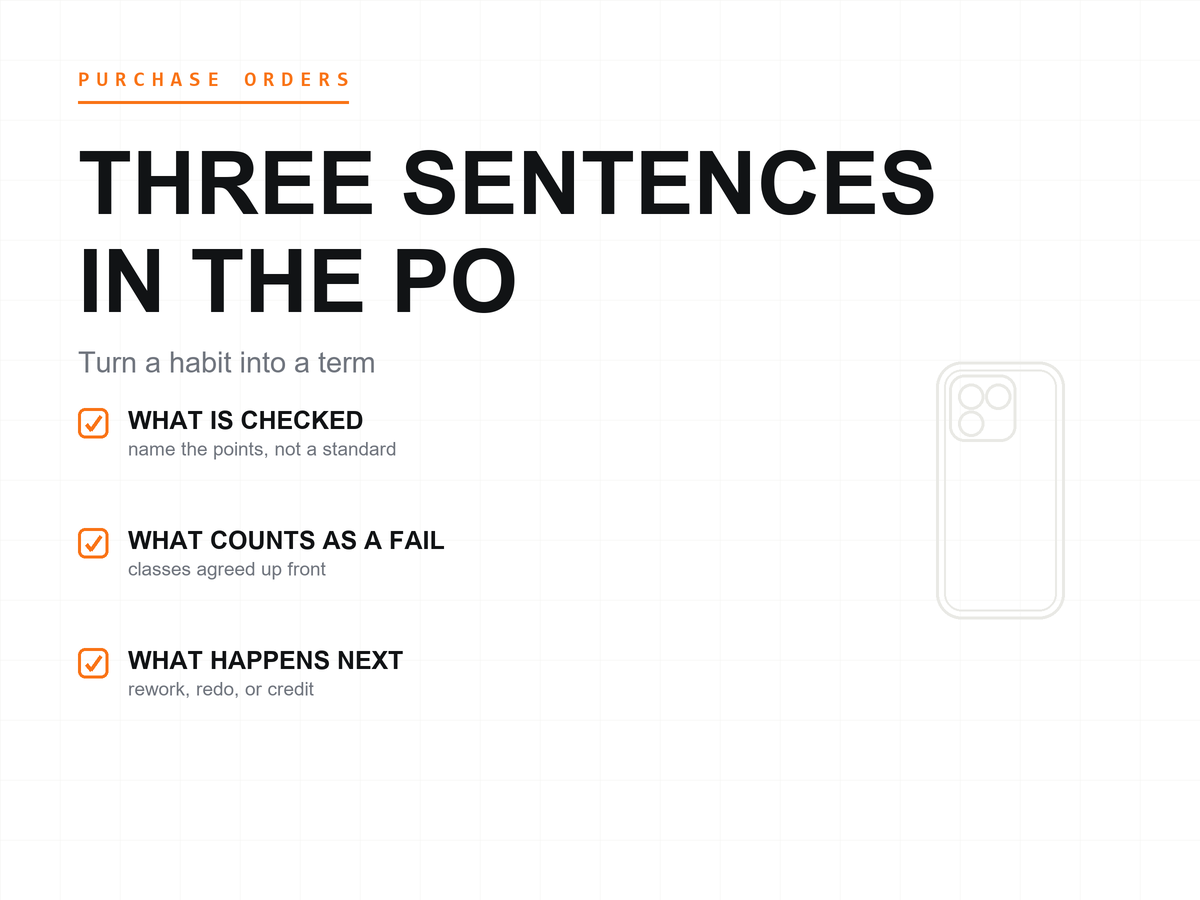
Three sentences in a purchase order turn an inspection habit into a binding term: what gets checked, what counts as a fail, and what happens next.
An inspection clause is the part of a purchase order that says what will be checked, what counts as a failure, and what happens after one. iFunSmart agrees inspection terms per order on the order confirmation, so that a checking habit becomes a term both sides can point to.
Last updated: November 3, 2026.
Why a Checking Habit Is Not a Clause
Inspection on a factory floor is an action. Someone picks up a case, turns it under a lamp, presses the buttons, and sets it in the pass pile. The work is real, and it happens whether or not any document mentions it.
A clause is not the action. It is the sentence both sides signed, and it is what gets read out loud when the two sides disagree about a batch. Consider two factories with identical floors. One checks every run. The other has agreed in writing what it checks. They are not making the same promise, even when the output looks the same. Habits do not survive a dispute on their own.
The purchase order is where the difference is settled. A buyer who has inspected cartons for years and has not written the method down is holding a habit. When a carton opens short or a batch arrives with a color drift, the habit has no answer to the question that now matters: what did we agree to, and what happens next.
A spoken assurance is not a term. Our article on the anti-yellowing clause argues that point for one specific promise, and the same logic covers inspection as a whole. A claim that lives in a chat window is a courtesy. A clause that lives in the purchase order is a condition.
The Three Sentences That Carry the Clause
A working inspection clause needs three sentences, each answering one question in words both sides can check later.
Start with what gets checked, and name the item instead of the standard. Cosmetic surfaces, opening positions, button feel, port insertion, and packaging integrity can be observed on a bench. "Per industry standard" cannot be observed by anyone, which is why it tends to appear in clauses that do not get tested. Items also differ by build. a card-holder build has a card slot and a stand that a generic surface check will walk past, so the sentence names slot depth and stand travel as well. A sentence copied from a plain iPhone shell will miss both.
The middle sentence decides what counts as a failure. Grading is agreed before production, usually as a tiered classification of critical, major, and minor defects, so that a scuff and a blocked camera opening do not land in the same bucket. The sampling approach belongs in this sentence too, and both sides agree it rather than assuming it from a catalog.
The last sentence answers what happens after a fail: rework, remake, an allowance, or a return. A remedy with no owner and no trigger is a sentence nobody can act on. The same line names who confirms the failure, at what point, and in what form. Photos of the defect, a retained sample, and the batch number on the carton are the usual evidence, and naming them in advance keeps the conversation about facts.
Three sentences. The clause is complete enough to use.
What the Record Keeps
A clause without a record is a promise with no memory. For each batch, the file should hold the inspection record, a retained sample, photos of any exception, and the release signature that let the goods ship.
The retained sample does more work than its size suggests. It is the physical answer to what the approved batch looked like, and it ends an argument about color or finish faster than any written description can. One sealed unit from the batch, labeled with the batch number, serves that purpose.
Photos carry the exceptions that a pass or fail line cannot. A short count, a dented corner, a print that drifted: each becomes a settled fact when the image shows the piece beside its carton label. The release signature is the least glamorous item in the file. It states that a named person looked at the batch and cleared it, and without that line every later defect turns into a question about who approved what.
The purpose of the file is not to satisfy an audit. It is to let the next batch be read against the previous one, which is how a good run becomes a standard rather than a lucky week. A record is evidence of a check, not a certificate of quality: an inspection record shows what was checked, not what was not.
Who Writes It and Where It Lives
The clause belongs in the purchase order or the order confirmation, and that document should say the terms on it govern the shipment. An appendix in a sales email, or a policy page on a website, is a reference rather than a term.
Written in that place, the clause travels with the order instead of with the relationship. A repeat run gets its own copy, with the models and finishes of that run named on it. When a finish, a model, or a carton changes, the clause is revised in the same message and does not carry over by default.
Buyers sometimes treat a supplier's standing policy as the clause. It is a starting draft. The version that governs is the one that reaches the order confirmation, and anything a sales conversation adds is subject to it.
Send the clause to your supplier and ask them to return it with the check items and the remedy named, before the deposit.
Common Questions From Buyers
What should an inspection clause say about sampling?
The clause should name how the sample is drawn and who agrees the plan. We do not publish a fixed AQL figure; the sampling plan is agreed per order in writing. The reason is practical. The right plan follows the item, the run size, and the market the goods are going into, and one number repeated to every buyer protects the seller more than the buyer. Ask for the plan in the order confirmation, beside the check items.
Should the clause follow the supplier's standard or the buyer's?
Either can work, provided one document wins. A buyer with a written standard should attach it to the purchase order and ask the supplier to confirm it line by line. A buyer without one can start from the supplier's standard and negotiate the check items, the grading, and the remedy. The failure mode is a clause that names two standards and settles neither. Name one, attach it, and keep the confirmed copy with the order.
How long should inspection records be kept?
Longer than the selling season, and through at least the next reorder. How long a record must be kept depends on the market, the retailer's terms, and the life of the claim, so no single retention period is published here. What matters is that the sample and the record stay together and can be found by batch number. A record nobody can locate is the same as no record.
What to Do Next
Write the three sentences before the next purchase order, not after the next complaint. It takes one page: the check items in observable terms, the grading, the sampling plan confirmed in writing, the remedy with its owner and its evidence. Attach that page to the order and keep the confirmed copy. The same discipline applies at the premium end of a range, where a premium line item carries metal buttons and a heavier build, and a finish check written for a plain shell will not ask who signed off on them.
We keep inspection records for the orders we run, and the sampling approach for your order is confirmed in writing with the order itself.
Send iFunSmart the models and check items for your next order, and we will return the inspection clause filled for that order, in writing, before production starts.
Apple and iPhone are trademarks of Apple Inc. iFunSmart is an independent manufacturer of phone cases and accessories and is not affiliated with, authorized, sponsored, or endorsed by Apple.