Business Solutions
Magnetic Claims You Can Actually Back Up
Strong magnets is a claim a buyer can test. How to write a magnetic selling point that survives a sample check, without numbers nobody can verify.
Two questions come up in buyer conversations with iFunSmart: is the MagSafe original, and does the case charge like the original. Both come from the same worry. A buyer fears a case that grips weakly or slows the charge, and reaches for a word that sounds like proof.
Last updated: November 3, 2026.
What the Buyer Is Testing For
The buyer asking whether a case is "original" is not asking about origin. They are asking whether the magnet ring will hold a wallet through a day in a pocket, and whether the charging coil will still work with the case on. Origin is the shortcut they use for the risk.
That distinction matters before a seller writes copy. A listing that answers the origin question directly has to lie or evade. A listing that answers the two tests behind it can be checked on a bench.
A verifiable magnetic claim is a statement about a case's magnet that a buyer can confirm on a sample without trusting a number. That definition does most of the work here. It rules out adjectives and borrowed authority. What remains is a short set of facts a seller can put in front of a buyer.
Why "Original" Is a Question You Cannot Answer
Original, in this context, means the accessory the phone maker sells, or the magnet array built into the phone itself. A case from an independent factory is neither. It is a separate product that sits between the phone and the charger.
So the honest answer to "is the MagSafe original" is no, followed by the part that matters. We do not claim original-equipment equivalence. A seller who answers yes is borrowing an authority the factory does not have, and the gap tends to surface later, in a marketplace review or a return conversation.
The question also carries a hidden assumption: that an original accessory is the only reliable one. Buyers repeat it because it is the benchmark they can name. The benchmark they can test is narrower, and it fits on a sample bench.
Three Lines That Survive a Sample Check
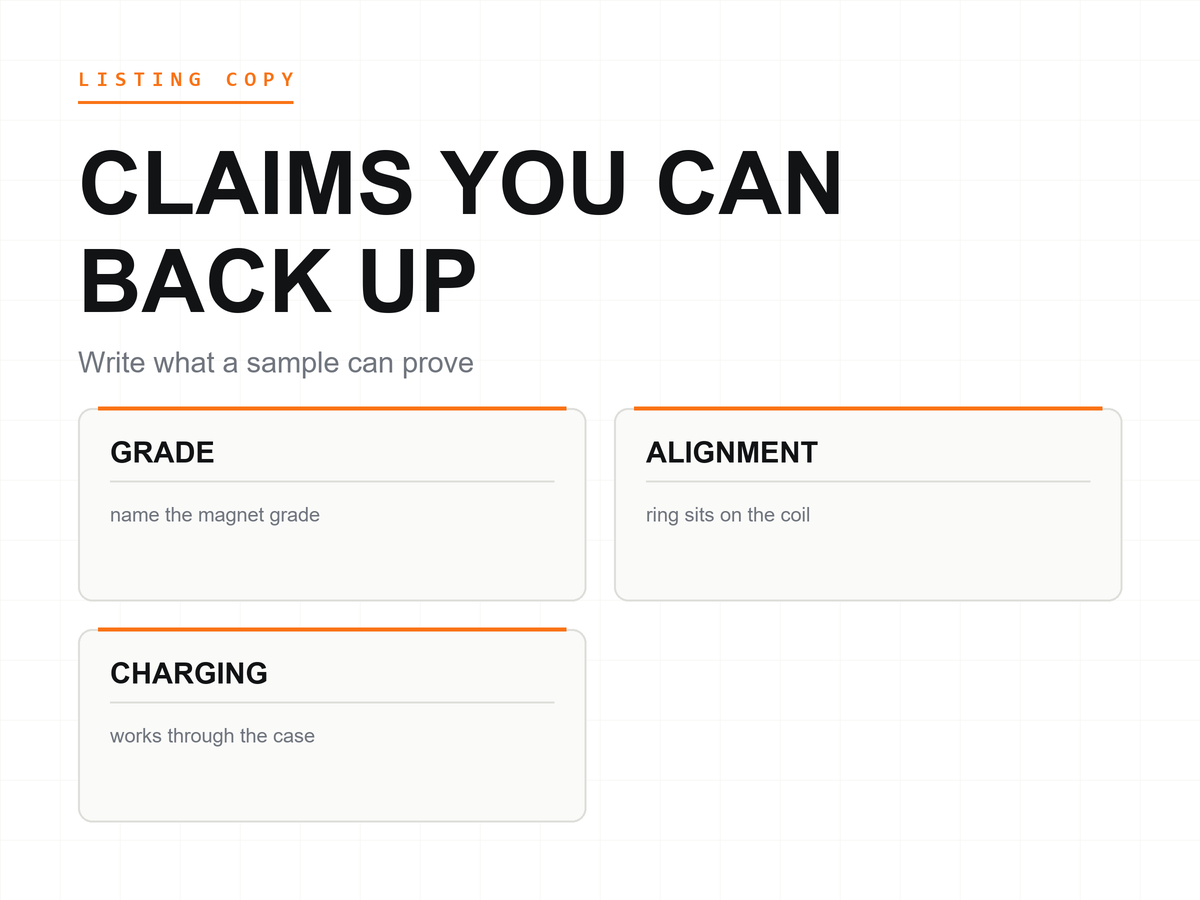
A strong magnet is not a specification. It is an impression. The specification is the set of facts a buyer can compare against the thing in their hand, and for a magnetic case those facts fit into three lines.
Start with the grade. A grade is a named material class, and a name can be checked against the packaging, the product page, and the order confirmation. iFunSmart lists an N52 ring build with the grade in the title and in the written spec, so a buyer has two documents to compare rather than one adjective to trust. If the grade appears in the listing but not in the spec, the listing is ahead of the factory.
Then there is position. The ring has to sit on the same axis as the phone's coil, and the hold has to read even when a buyer lifts each corner of a mounted accessory in turn. This is a test any buyer can run on a sample, and it is the reason a listing should describe alignment rather than strength. On a micro-matte build with a ring, the ring line sits under the surface finish, so the honest instruction is to check the sample rather than judge from a photo.
Charging is the third line, and the one where sellers overreach most often. A case should let a compatible wireless charger work with the phone in place. Thickness is the variable that decides how well that goes, and charging performance depends on the charger and the phone. A listing that says the case charges wirelessly, and stops there, tells the truth it can support.
Keep those three lines beside your draft and test each one on a sample before the listing goes live.
Words to Take Out of the Listing
Some words cost more than they earn. The first group is the vocabulary of borrowed authority: any term that presents the case as the phone maker's own product, and any badge name that belongs to a program the factory is not enrolled in. Each points at a relationship with the phone maker that an independent case factory does not have, and a careful buyer will notice the gap. Take them out, and put the grade and the alignment facts in their place.
Strength vocabulary fails in a different way. "Super strong" feels safe because it is vague, and vagueness is exactly what fails when a buyer lifts a loaded wallet off the ring on a sample bench. A magnet that holds a wallet in a warm room is a fact about that magnet, that case, and that accessory. "Super strong" describes none of them.
Then there is the charging comparison. A case that "charges faster" is making a claim with nothing to compare against, because no two buyers use the same charger, cable, or phone state. A listing that says the charge works through the case is checkable. A promise about speed is not.
Removing those groups leaves a shorter page and a stronger one. The buyer who wanted proof now has a grade, an alignment statement, and a charging statement that survive the sample.
Where Our Own Claim Stops
We build cases in Guangzhou, and the grade we build with can be confirmed in writing before an order. Ring position is set in the tool, which is why the alignment a buyer checks on a sample is the alignment the tool holds. Charging is left to the buyer's own pad, because the pad and the phone set the result as much as the case does.
The list of things we do not claim is just as deliberate. Listing copy for buyers is not a service we offer, and we do not promise approvals we do not hold. A single pull number meant to cover every case stays unpublished too, because that number would describe a magnet assembly rather than a product on a shelf. Charging speed against a phone used without a case is another comparison we leave alone.
A seller can hold the same line without losing a sale. The magnetic claim that survives a sample check is not the loudest one. It is the one a buyer can repeat to their own customer after the unboxing.
Common Questions From Buyers
Does a Higher Grade Make a Case Better?
Only up to the point where the design is sound. A higher grade in a ring that sits off the coil axis will still lose a corner under a stand. The grade helps when the position and the case thickness are right, and it cannot rescue either one. Treat the grade as one line in the specification, not the whole of it.
Can I Say the Case Charges as Fast as a Bare Phone?
We do not make that claim, and a listing should not either. Charging performance depends on the charger and the phone, and a case that adds thickness changes the gap between the coils. What a seller can say is that the case is built to let the charger work with the phone in place. A speed comparison needs a measured test and a named setup.
Should the Listing Show a Pull Number?
Only if the factory measured that number for the exact case being sold and will put the same figure in writing. A number taken from a magnet supplier's chart describes the magnet, not the assembled case, and the ring size and the case thickness change the result. A grade plus an alignment statement is more useful than a figure with no assembly behind it.
What to Do Next
Write the grade, the alignment, and the charging line for one model first. Test all three on a sample, and delete every word that asks the buyer to trust the factory instead of the sample.
Send iFunSmart the models and the magnetic line you plan to list, and we will put the grade we build with and the alignment check into the written specification.
Apple and iPhone are trademarks of Apple Inc. iFunSmart is an independent manufacturer of phone cases and accessories and is not affiliated with, authorized, sponsored, or endorsed by Apple.