Business Solutions
From Unboxing to First Release: The Case Line
The phone is out, and buyers want to know how a case reaches them. The sequence a new model goes through before its first production run is released.
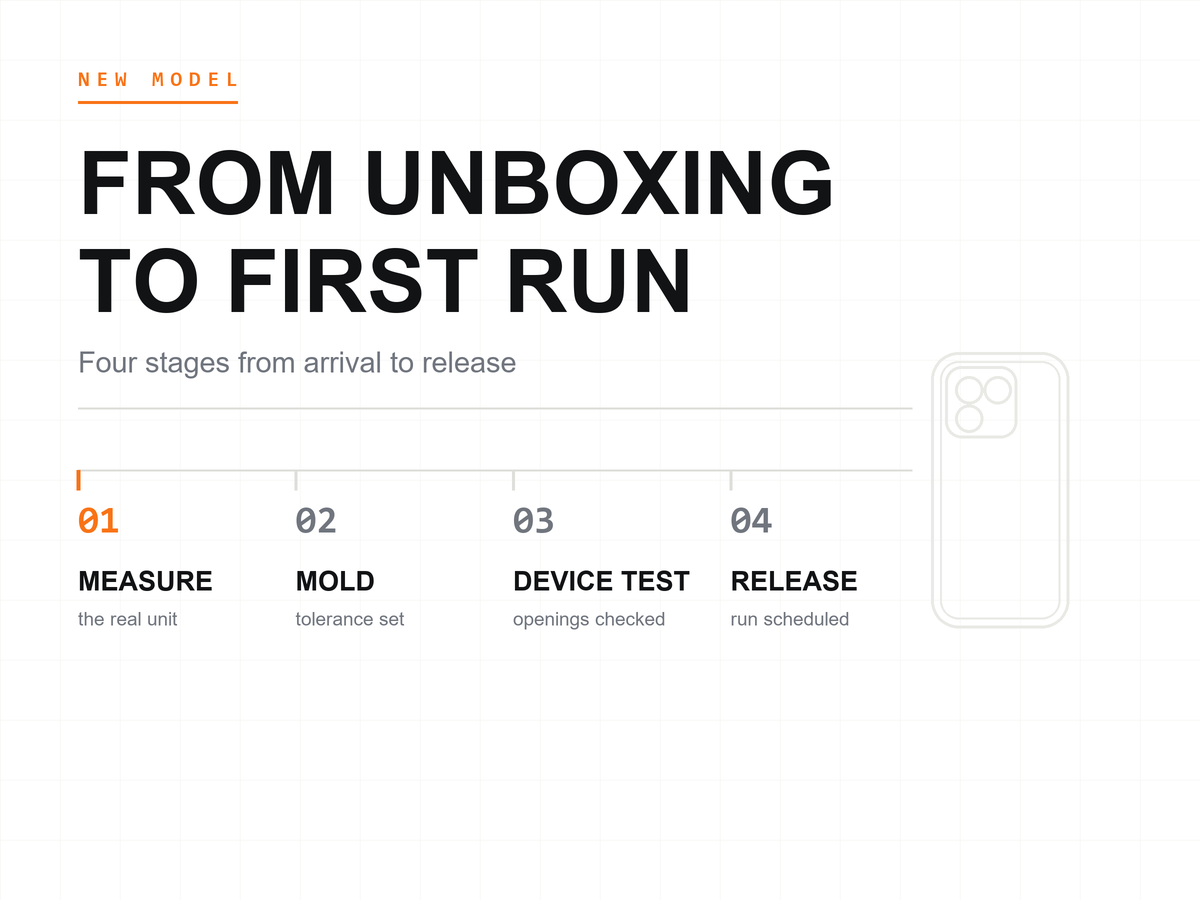
A new iPhone reaches iFunSmart as a retail unit, and a case for it passes six stages before its first production run is released. The useful answer to "how long" is not a date. It is how many stages remain, and which one is holding the model.
Last updated: November 3, 2026.
Why the Launch Window Puts Pressure on the Sequence
Demand for a new model is front-loaded, and a retailer who stocks late competes against every seller who stocked early.
That pressure is why buyers ask for a date. The date is the wrong instrument. Until the unit has been measured and checked, any date is a guess about steps owned by a mold, a device, and a confirmation round. A supplier who names a stage gives you something to plan against. One who names a date is guessing on your behalf.
What a buyer needs is a count of stages and the name of the current one.
The Release Sequence, Step by Step
The release sequence is the fixed order of checks a new model passes before its first production run is released. It starts with the retail unit in hand and ends with a first-article sample signed off. The order does not change between models. What changes is where a model stops.
The first stage is unboxing and dimension capture. Everything held before that point is reference and inference: published figures, dimension drawings, patterns from the previous generation. They narrow the guess. They do not replace a measurement. The first job is to measure the parts that touch the case: the outer profile at the corners, the camera plateau, button and port positions, and, on a foldable, the hinge and closed thickness. A case is cut one to one to the phone, so those measurements become the working numbers.
Tolerance and mold adjustment come next. A new model rarely differs from its predecessor everywhere. The work is to find where it does. When a change sits inside the tolerance an existing mold holds, the tool can be adjusted. When it does not, a new cavity is cut. This stage decides whether the model rides on the existing library or takes new steel.
Then the trial shot, and the first-article check that follows it. A first-article check is the inspection of the first part off a tool against the measured device, before any production quantity is accepted. The part is read for shape and wall sections, and for the marks a mold leaves when it is not settled. If the first article is wrong, nothing downstream is worth starting.
With the part sound, the case goes onto the retail unit. On a hinge build for the foldable, it is worked through the full fold, watched for binding and for lift at the crease. On any model the check covers the camera frame, button travel, port access, and magnet alignment. These failures do not show on a drawing. They appear when the part and the phone are in the same hand.
Sample confirmation comes after the device check. A physical sample goes to the buyer, or is confirmed in-house for a stock design. Comments come back. If they touch fit or structure, the model returns to the previous stage and the loop runs again. That is normal rather than exceptional.
The last stage is first release and production scheduling. Once the sample is signed, the first run is released against the line schedule. The gate does not soften for a mainline design: its tooling already exists, so the early stages are shorter, and the device check still stands between the sample and the run.
If you are weighing a launch purchase, ask which stage the model is on and what the next gate is. A stage name is a fact you can check later.
Where the Sequence Stalls
The stages are fixed. The time inside them is not, and two points absorb most of the delay.
The first is a dimension difference larger than expected. Early patterns can be close and still wrong at the tightest contact points. When the measured unit falls outside tolerance, the mold has to be changed. Urgency does not remove that step. The steel is corrected, a new first article is cut, and the checks resume from the point the change touched.
The second is the sample round. A remark about color or surface finish is cheap to settle. A remark about hinge pressure, camera clearance, or a button feel is structural, and it sends the model back to the device check. Buyers who consolidate comments into one reply save a round. Buyers who send a new note after each review add to them.
Either case sends the model back to the affected stage, and the following checks repeat. A model that needs a mold change restarts the check, not the clock. That is why a count of stages is more honest than a date, and why we do not publish a timeline in days.
What to Ask Instead of a Delivery Date
Three questions replace the date question, and any factory can answer them on the spot: which stage the model is on now, what the next gate is, and who is holding it.
The stage tells you how much work is behind the model; the next gate tells you what has to happen before the next report. The third answer matters most: a model waiting on a tool-room correction and one waiting on your own comment call for different decisions.
iFunSmart holds 1,000+ molds and cuts new tooling on its own CNC, with the equipment and production lines in our own workshop. A new model in a family we already tool enters the sequence with fewer unknowns. That does not remove the device check or the sample round, and it does not turn the sequence into a calendar. The answer depends on which step the model is on.
Common Questions From Buyers
How Long Does It Take From Unboxing to First Release?
We do not publish a timeline in days, because the two points that decide the schedule are not calendar events. A dimension difference can force a new cavity, and a sample comment can send the model back a stage. Ask for the current stage and the next gate. If a supplier quotes a figure before the unit is measured, treat it as an estimate and ask what it assumes.
Does a Large Mold Library Shorten the Sequence?
It shortens the early stages and leaves the late ones alone. A library of 1,000+ molds lets a new model in a known family be matched against existing tooling, and in-house CNC keeps new tooling off an external queue. The device check still happens on the retail unit, and the sample round still depends on the comments that come back.
What Does the First-Article Check Cover?
The first article is the first part from a tool, and the check confirms that it matches the measured device before production quantities are accepted. It covers the outer profile, the wall sections at the contact points, the camera opening, button and port positions, and, where the design carries one, the magnet ring. A case that fails here returns to the mold, not the packing line.
What to Do Next
Treat the release sequence as gates, not a countdown. Ask which gate the model has reached and what has to happen before the next one, then find out who owns it. Write the answers down, so the next conversation starts from the same facts. A buyer who tracks gates can decide when to commit stock. A buyer who tracks a date trusts a number no one in the chain controls.
Send iFunSmart the model you are planning for, and we will tell you which stage its case has reached, what the next gate is, and who is holding it.
Apple and iPhone are trademarks of Apple Inc. iFunSmart is an independent manufacturer of phone cases and accessories and is not affiliated with, authorized, sponsored, or endorsed by Apple.