Oct 7, 2026Business Solutions
Magnet Rings and Case Thickness vs Grip
The magnet grade is one variable; the ring size and the back plate thickness are two more. Why hold strength drops, and what to ask before ordering.
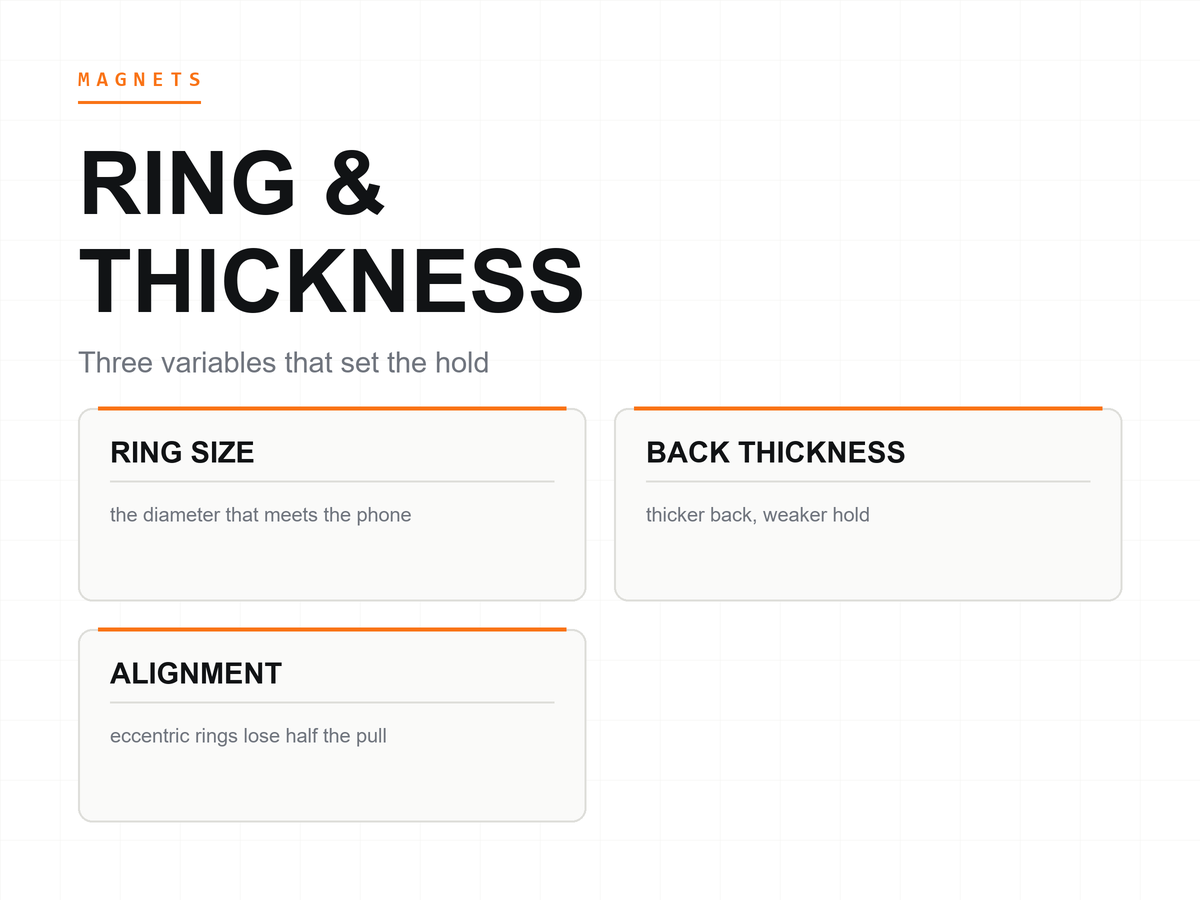
The grade on the magnet is one dial; the ring's size and the back plate's thickness are two more. iFunSmart gets asked about grip constantly, and most buyers stop at the grade. Hold strength is decided by all three together, so a quote should state all three, not one.
Last updated: October 7, 2026.
What Hold Strength Actually Means
Hold strength is the pull a case magnet delivers through the case body to the phone. It decides whether the phone stays on a vent mount when the car turns, whether a wallet stays shut inside a bag, and whether a charger keeps its coils lined up overnight. Buyers feel it as the snap when a case seats onto a charger; their customers report it as the phone sliding off a mount. All of it runs on one chain: the phone's magnet array, the gap, the case ring, and the back material in between. Hold strength means how much of the phone's pull survives that chain.
A grade statement only marks the material. It says nothing about the chain. Two cases built from the same grade can feel different in hand, because the ring diameter and the back plate sit between the magnet and the phone, quietly eating the pull. That gap is where grip is won or lost.
iFunSmart does not publish magnet force numbers. Hold depends on the phone model, the ring, and the back build, and one figure cannot carry all three. What a buyer can hold us to is structure: which ring, where, and behind what.
The Ring Size Dial
Apple places a circle of magnets inside the back of the iPhone, and a case ring has to pair with that circle. Diameter and position both matter. Diameter sets the contact area: a wider ring covers more of the phone's circle and offers more surface to the pull, while a narrow ring leaves part of the array unpaired, and unpaired surface does no work. Position matters just as much. A ring placed off-center loses pairing before the case leaves the packing line.
Bigger is not automatically better. A ring wider than the phone's own circle reaches past the magnets and adds nothing. Eccentricity — the gap between the ring's center and the array's center — costs more grip than a small diameter does. Diameter and position are one spec, not two.
When iFunSmart builds a magnetic case, the ring position follows the phone's own layout, and 1:1 precision molding keeps the ring where the design puts it. Ask a supplier for the ring drawing before you sample — the circle, its center, and the phone model it was drawn against.
The Back Plate Dial
Every layer of case material between the ring magnet and the phone weakens the pull. This is the rule buyers feel but rarely write down: the thicker the back, the weaker the hold. A hard shell, a TPU liner, a kickstand hinge — each layer adds distance to the gap, and the pull drops a step with each one. A grade cannot buy that distance back. A top-grade ring behind a thick, layered back performs like a quieter ring behind a thin one, because the gap, not the material, decides how much pull arrives.
The same distance hurts wireless charging. The charger's coil and the phone's coil talk across the case back, and a back that eats magnetic pull also stretches that link. Buyers who sell chargers and mounts feel the back plate in their returns, not in the spec sheet.
The iPhone Duo raises the stakes, because its buyers usually add structure. One Duo inquiry we handled asked for hinge protection and an integrated kickstand that works in portrait and landscape. Each of those mechanisms lives in the back plate and adds material behind the ring, so the structure list belongs in the same written spec as the magnet. A build with a hard PC back, like our a crystal clear MagSafe build, puts fewer layers between the ring and the phone than a back stacked with moving parts — and the difference shows up as grip, not cosmetics.
What to Ask Before You Order
Most purchase conversations pin the grade and stop there. The written spec should also carry the ring diameter, the ring position against the phone's array, and the back construction the ring sits behind. A supplier who answers the grade and stops has described the material, not the hold.
A recent private-label inquiry asked us to confirm the ring grade, with wireless charging compatibility on the same checklist. The structure questions — ring width, back build, alignment — were still open. That is the normal pattern, which is why the structure belongs in the spec next to the grade rather than after the samples arrive.
Where a grade is stated in the product line itself, like our an N52 ring build with detachable metal buttons, the same questions still apply. The ring in that case sits behind a specific back, and the back is part of the hold spec.
Then get the sample and make the checks physical. Snap the case onto the phone, seat it on a charger, mount it, and compare the feel against the case you sell today. A grip problem found on a sample costs a conversation. The same problem found in a container costs a season.
Common Questions From Buyers
Which matters more, the grade or the ring?
The ring. A grade marks the material's strength class; the ring's diameter and position decide how much of that material actually pairs with the phone. A case with a mid grade and a wide, well-centered ring can out-grip a case with a top grade and a small, off-center ring. Ask for both, and treat the grade alone as half a spec.
Does a thicker back weaken the hold?
It weakens it in steps, and the steps add up. Each layer of back material puts distance between the ring magnet and the phone's array, and distance costs pull. A thin hard back costs less pull than a back that stacks a shell, a liner, a kickstand, and a hinge cover. What changes between cases is how much material, and where. A case can be thick at the edges and thin behind the ring, protecting corners without eating much grip, so the question to ask is the build behind the ring, not the case's overall feel.
How do I check alignment before I commit?
Ask for the ring drawing, then check its center against the phone's array. The drawing shows the circle and its center, and the center should sit where the phone's own magnets sit. A sample makes the check physical: seat the case on a charger and feel whether it centers itself or hangs off the edge of the pull. At iFunSmart the ring position is fixed in the tooling rather than left to assembly, so alignment is settled before the first case is molded.
What to Do Next
Write the structure into the spec next to the grade. For each magnetic SKU you plan to carry, settle the ring diameter, the ring position against the phone's array, and the back construction behind the ring, and have each confirmed in writing before production. Then work through the lines you already carry and note which products state a full structure and which state only a grade. The shelf will not show the difference; the reviews will.
Tell us your models and the mounts and chargers your buyers use, and we will confirm the ring structure and back build for each SKU in writing.
Apple and iPhone are trademarks of Apple Inc. iFunSmart is an independent manufacturer of phone cases and accessories and is not affiliated with, authorized, sponsored, or endorsed by Apple.