
Oct 7, 2026Business Solutions
Matte Anti-Fingerprint Finishes: Buyer Checks
Matte should hide fingerprints, not shine under them. Fingertip and wear checks to run on samples before you commit a price band to a finish.
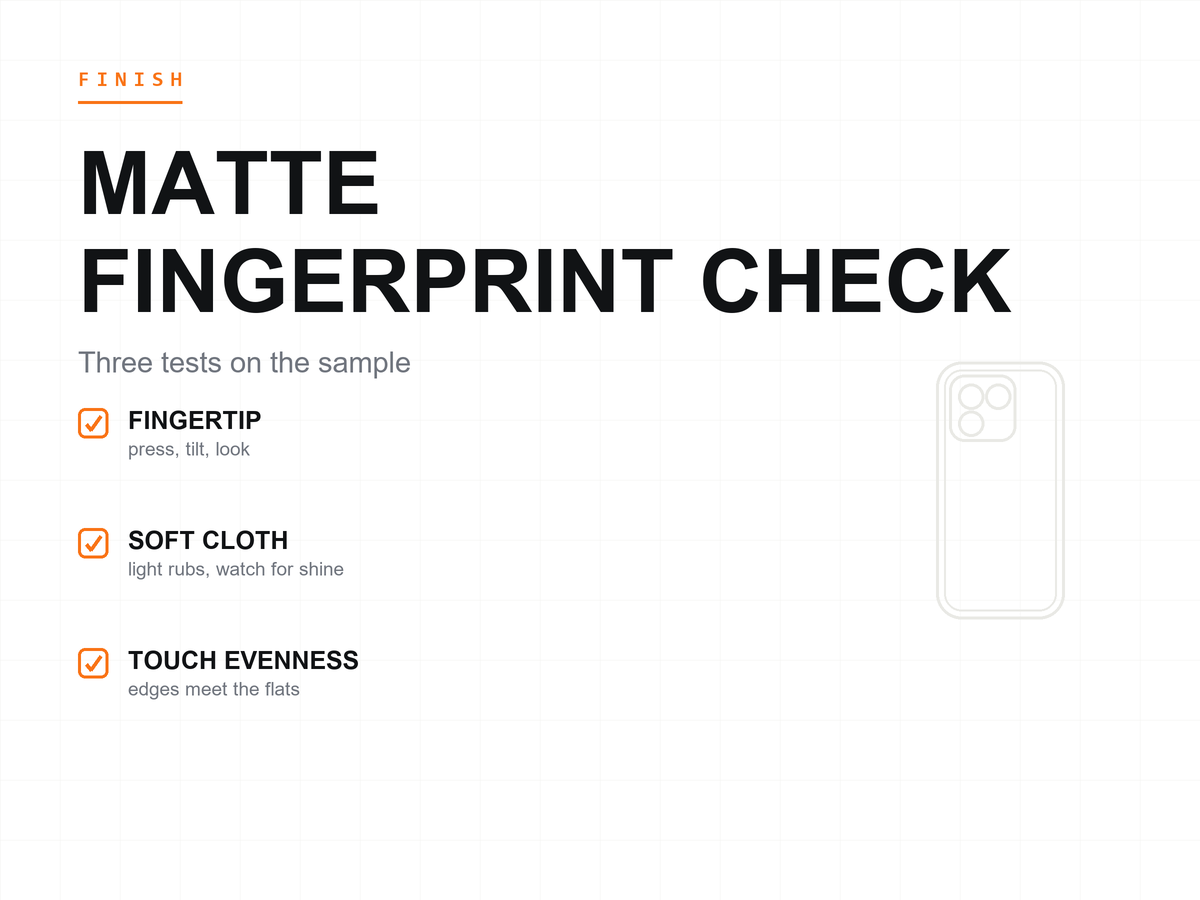
A matte finish is supposed to hide fingerprints and keep glare down, and a weak one does the opposite. Run three fingertip checks on the sample before you commit a price band to a finish. They take no equipment, and they are the checks we walk buyers through at iFunSmart in Guangzhou.
Last updated: October 7, 2026.
What an Anti-Fingerprint Finish Actually Does
An anti-fingerprint finish is a fine-textured surface treatment that spreads the oils a fingertip leaves into a faint, thin layer and scatters light instead of reflecting it, so prints read soft and glare stays down under store lamps. Gloss does the reverse: it turns every touch into a mirror and every shop lamp into a hotspot on the back of your stock. That pair of effects is the whole pitch, and it is why a finish can sell a case before anyone reads the spec line.
The word matte on a listing says nothing about how well the texture was done. Texture can be molded into the tool, sprayed on as a coating, or applied as a later treatment, and each route lands differently on evenness and wear. Photos cannot show the difference. A finish that hides prints on the day it leaves the factory can polish shiny inside a pocket within a season, which is why these checks belong on a sample in the hand and not on a listing page.
The First Check: The Fingertip Test
Press your thumb flat against the case back and hold it there, then tilt the case toward a lamp or a window. Read two things: how deep the mark sits, and what happens to it next. A well-made finish leaves a faint smudge that fades as the oil dries. A weak one prints a full thumbprint that sits there through the whole conversation.
Wipe the spot with a dry cloth and look again. If the print lifts and the surface reads exactly as it did before, the finish is doing its work. If a ghost of the mark stays, or the wiped patch looks cleaner — and therefore shinier — than the skin around it, the texture is already flattening. Run the press on the flat back first, then on the area around the camera, because coatings rarely fail in only one place. This is also the moment to feel what a proper finish reads like in the hand: a micro-matte MagSafe build from our own line is the reference we hand buyers who want a benchmark for fine, even texture before they compare samples from other factories.
The Second Check: The Wear Rub
Fold a soft cloth, press lightly, and rub one spot with a steady back-and-forth motion. Keep going until the coating tells you something — a change in sheen, a patch that catches the light differently, a tone that turns uneven. Do not count. The number of passes proves nothing by itself, because pressure, cloth, and coating all vary; what proves something is what the spot looks like when it changes.
Two failure signs matter. A bright spot is the first: a polished patch where the fine texture has flattened and the finish has started behaving like gloss. Show-through is the second: the coating wearing thin enough for the base layer to read as a different tone. Either sign after a short session of casual rubbing means the finish is spending itself quickly, and a finish that spends itself quickly will not survive pockets, belts, and counter displays.
The Third Check: Hand Feel and Evenness
Run your fingers across the whole shell — flat back, edges, corners, the camera surround. A consistent finish feels the same everywhere: a fine, dry grip with no drift into tackiness or slickness. Where the coating sits heavy, the surface turns draggy, and a draggy patch collects dust and lint from every pocket until the case looks old inside its own box. Where it sits thin, the surface slips and the fingerprint protection fades with it.
Then hold the case under light at a shallow angle and read the tone. An even finish reads as a single color; an uneven one breaks into patches, and customers will call those patches defects whether or not the coating is still doing its job.
When the Checks Raise a Doubt
The judgment is mechanical. Deep prints that stay, bright spots after a light rub, a hand feel that drifts from panel to panel — any of these means the coating process deserves a question before it gets your volume. Go back with the sample in one hand and your notes in the other. Ask each supplier to describe how the finish is applied and how it behaves once it reaches pockets and daily handling, and keep the answers next to the approved sample. Then either swap in a new sample or get the description written into your sourcing notes.
Common Questions From Buyers
Does a matte finish change how the case color reads?
It usually softens it. Matte scatters light, so colors read flatter and a little deeper than they do under gloss, and store lighting shifts the effect again. Matting a clear or translucent shell mutes the see-through look on top of that — a translucent matte option in our own line shows the trade-off in a single glance. How far the tone moves depends on the base material and the color under the finish, which is one more reason the judgment belongs on the sample rather than on renders.
Can a fingertip test replace a laboratory wear report?
It cannot. A fingertip check is a screening you run yourself; a laboratory wear report is a measurement a lab certifies, and no supplier should ask you to trade one for the other. We do not publish coating wear test data either — what we do is get samples to you early enough to run these checks before bulk. When a contract or a retail platform needs certified numbers, write the requirement into the purchase terms and let a lab produce them.
What should I ask a supplier about the finish?
Start with how the texture is formed — molded into the tool, sprayed, or applied afterward — because the answer predicts how evenly it lands and how it ages. The second question is coverage: whether the finish takes in the edges and the camera surround or only the flat back, since a case that mattes the back and polishes the sides reads inconsistent on a counter. Last, ask what the finish does after weeks of handling, and hold the approved sample as the standard the bulk has to match.
What to Do Next
Run the checks during the sampling round, on every finish you are considering, and write down what each one did next to the others. Keep the sample that passed. It becomes the standard you hold the bulk against when the cartons open, and it settles more arguments than any listing page will.
Ask iFunSmart for matte-finish samples and run these fingertip checks before you commit to a finish.
Apple and iPhone are trademarks of Apple Inc. iFunSmart is an independent manufacturer of phone cases and accessories and is not affiliated with, authorized, sponsored, or endorsed by Apple.