Oct 9, 2026Business Solutions
Mold Fees: Paying Once or Spreading It Out
A tooling charge can be paid in one sum or spread across orders. What the two structures mean for cash flow, and which points are negotiable.
A tooling fee on an iPhone case project can be paid in one sum, or spread across the orders that follow. iFunSmart, a Guangzhou case factory, treats the choice as a per-order negotiation settled in writing. Here is what each structure does to cash flow, and which points are open to talk.
Last updated: October 9, 2026.
What a Tooling Fee Actually Buys
A tooling fee is the charge for cutting the production mold that shapes a case. It covers the steel, the machining, and the engineering time that turn a design into a tool which runs for years. The fee is quoted separately from the unit price for a reason. Materials and printing repeat with every batch, while the tool is paid once and then keeps working, which is why the two figures deserve different treatment on a quote. Think of the fee as the cost of a shape coming into existence rather than a service charge on your order.
The fee also exists only when new steel has to be cut, so the first question is not how to pay it but whether it applies at all. Open-mold designs need no new tool, and no fee attaches to them. an open-mold design ready to tweak shows what that path already carries: a magnetic build with a metal camera frame, running on existing steel. Light customization rides the same path, and a finished SKU for light customization makes the point from the surface side, a color finish on a standard shape. The payment question begins where that path ends: a shape that exists nowhere else, with its own tool and its own fee.
Paying Once: What It Settles
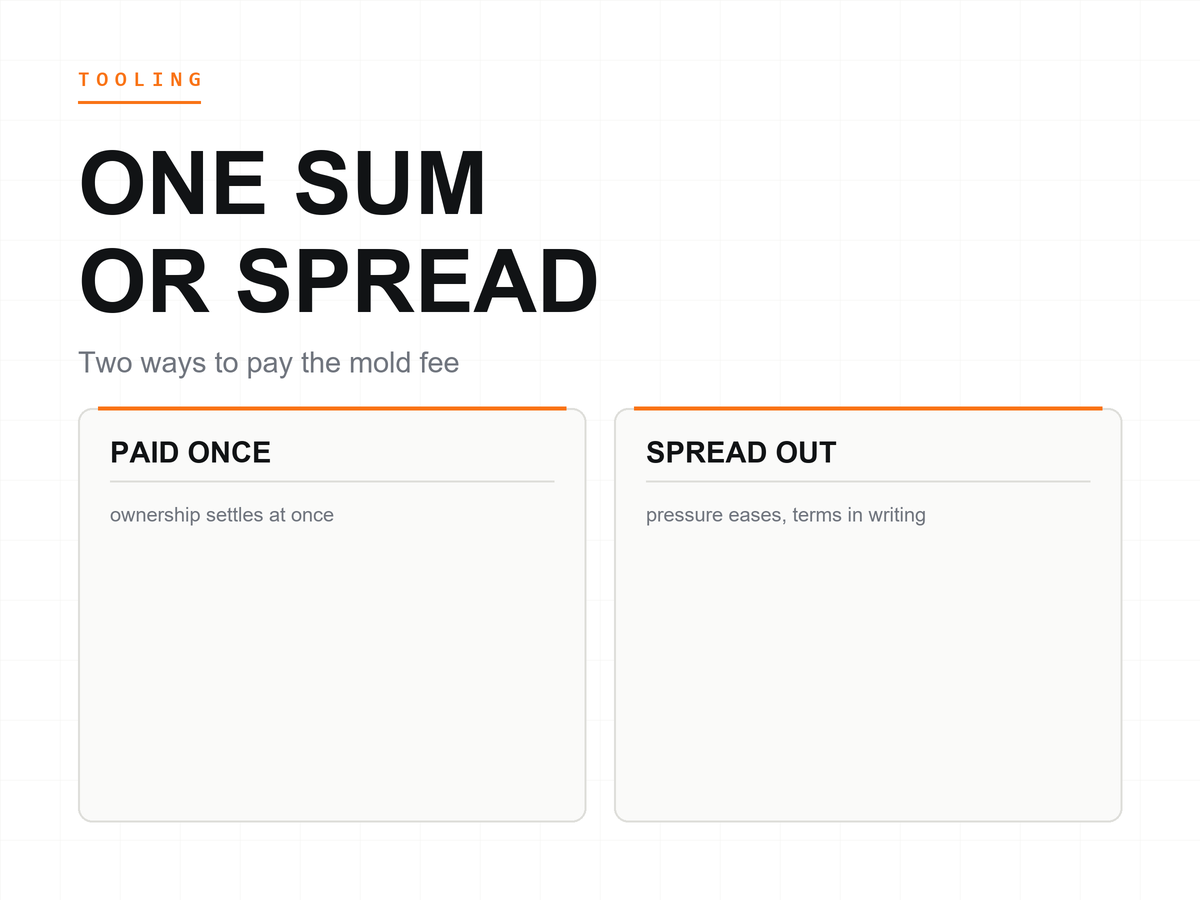
A one-time payment puts the whole fee down when the tool is confirmed. What it settles is the future. Ownership of the tool, what happens if ordering pauses, and the full-charge question all close at the start instead of waiting for installments to finish. The cost side is equally plain, because the cash leaves your account before units sell and the burden sits entirely at the front of the project. That structure fits a buyer with cash on hand and a design already proven.
Paying once does not settle everything, and it helps to be clear about the limits. It does not change the unit price. It does not grant exclusivity unless the contract writes it. Nor does it move the steel anywhere; the tool stays in the factory that runs it. What it does is remove the payment question from every later conversation. It is not automatically cheaper, and it is not automatically safer. The useful frame here is timing, not size.
Spreading It Out: What It Changes
Amortized tooling refers to a mold fee structured as installments attached to the orders that follow, instead of a single payment at the start. What changes is when the money moves. Cash leaves in steps, each step riding an order that already carries revenue, so the early pressure on working capital is smaller. A buyer whose cash arrives with the sell-through can often match the fee to the revenue instead of fronting it. What does not automatically change is the total. A spread is a schedule, not a discount.
The schedule itself is what deserves attention. It should name which orders carry an installment, what triggers each one, and what a pause in ordering means for the balance. A schedule that names each of those points is a plan; a schedule that names none of them is a bet. The ownership terms and the early-settlement terms still have to be written, and the confirmations from our cost-spread guide belong in the same document, because a fee paid in steps with unclear rules is a fee with unclear rules. A spread is not the better deal by definition; it is the better fit when cash arrives in waves rather than up front.
The Points That Are Actually Negotiable
The choice of structure is open, and so are the details around it. You can raise which orders carry an installment and what triggers each one, and you can raise early settlement: whether the balance can close before the schedule ends, and on what terms. These are negotiation points, not a published policy. On our side the stance is short. Payment structure is agreed per order in writing. We do not publish fee amounts or installment ratios, because both follow the design the tool is cut for.
A useful test runs through the whole conversation. Ask for each point on paper, and watch whether the answer comes back in writing. A supplier who explains a point and writes it down is describing a process. A supplier who changes the subject is asking you to fund a tool whose rules will be explained later. Whatever is agreed belongs in the order confirmation, on the same page as the ship dates, so the schedule that runs is the schedule both sides signed. Put the structure in writing before the tool is cut.
What Not to Assume
A spread looks cheaper up front, and a one-time payment looks cleaner on paper. Neither impression survives a read of the contract. Whether the total moves between the two structures depends on the terms, not on the structure itself, so do not assume a spread is more expensive or cheaper without the documents in front of you. Do not assume ownership follows payment automatically either; ownership is a written term, not a side effect of the schedule. And do not assume the fee can be waived just because the structure is negotiable. The tool costs what it costs, and the negotiable part is structure and timing.
A pause in ordering is worth the same care. Some schedules treat it as a neutral event, others as a trigger, and the difference only shows in the fine print. Compare schedules from different suppliers on paper, line by line, because no two spreads read alike. The structure you sign is the structure that runs, and the cheap place to learn that is the confirmation, not the dispute.
Common Questions From Buyers
Is spreading the fee more expensive than paying once?
Not automatically, in either direction. Whether the total moves depends on the contract: what each installment attaches to, what early settlement costs, and how the balance is defined. The structure changes when the money moves. The contract decides whether the total moves too. The same fee can read differently under two schedules, which is exactly why the comparison belongs on paper.
Can the payment structure be written into the order confirmation?
Yes, and it should be. On our side the confirmation is where the structure lives, so payment structure is agreed per order in writing alongside the ship dates and the completion terms. A verbal split protects neither side. A schedule that exists only in a chat message will be remembered differently by the two people who read it.
What if I want to settle the balance early?
Raise it while the structure is being agreed, not after. Early settlement is a point to negotiate, and the terms belong in the same confirmation as the schedule itself. A supplier who puts the answer on paper settles it; one who will not leaves it open.
What to Do Next
Settle the structure before the tool is cut. Agree which orders carry an installment, what triggers each one, and what early settlement looks like, then check that it all sits in the confirmation next to the ship dates. That page is the cheapest negotiation you will ever run. iFunSmart has molded cases in Guangzhou since 2010, and we write the fee structure for a custom tool the same way we write its dates: on paper, per order.
Send us your design and expected volumes, and we will put the tooling fee and its payment structure in one written confirmation.
Apple and iPhone are trademarks of Apple Inc. iFunSmart is an independent manufacturer of phone cases and accessories and is not affiliated with, authorized, sponsored, or endorsed by Apple.