Oct 9, 2026Business Solutions
Peak Season Space: Locking Slots and Splitting Loads
In launch season, cargo space tightens and production slots fill early. How buyers protect a peak deadline: early confirmation, a locked slot, and a split.
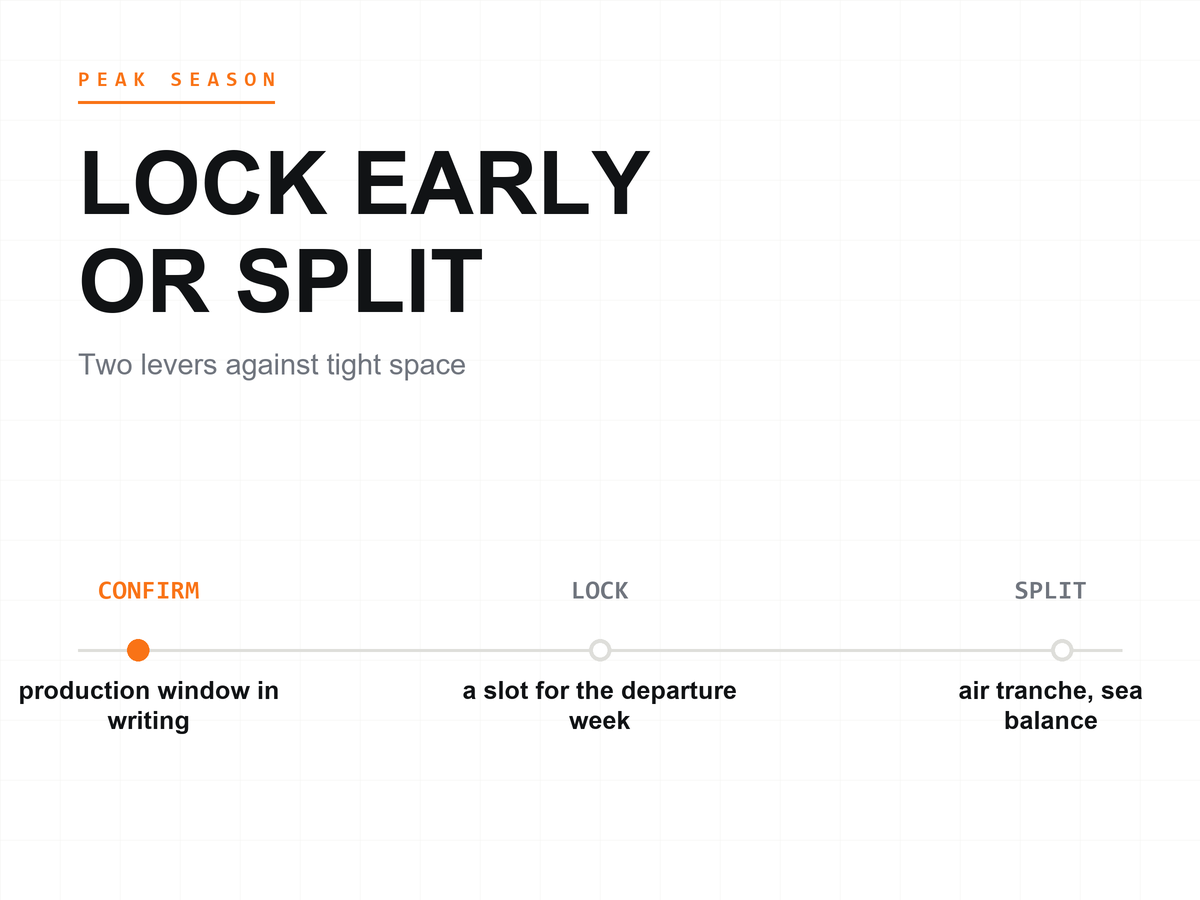
In launch season, two things run short before the goods do: cargo space and factory schedule. Buyers stocking iPhone 18 Pro or iPhone Duo cases protect a peak deadline with three moves: confirm early, lock the production slot, and split the load. A peak deadline is protected before the rush, not during it.
Last updated: October 9, 2026.
What Peak Season Actually Squeezes
Peak season is the stretch of the year when new-device launches and holiday restocking pull on the same shipping lanes at once. The fall launch window and the pre-holiday push before Christmas and Chinese New Year both compress the calendar, and every importer on your lane feels the same squeeze. That is the point buyers miss: the tightness is not one supplier having a busy month. It is the market doing what it does every year.
Two things run scarce in that stretch, and they belong to different hands. Cargo space belongs to the carriers. Vessels and aircraft lift a fixed amount, demand on the lane spikes, and bookings close earlier than they would in a quiet month. Production slots belong to the factory. Molding machines and assembly lines run in windows, and a launch window that nobody reserved can fill while you are still comparing samples.
What a buyer feels on the ground is the gap between the two. The goods are ready but the sailing is full, so the shipment slides to a later vessel and the shelf misses the launch window. Or the sailing is open but the goods are not finished, and the spot passes to someone whose order was confirmed first. Both versions cost the same thing: the peak.
The two scarcities compound. A late confirmation costs the production window first, and by the time the goods are ready the sailing you wanted is gone. Paying for the slot early is cheaper than paying for speed later.
Lock the Slot Early
A locked slot is a production window reserved on the order confirmation ahead of the rush. It names the models, the finishes, and the shipping week the goods are planned against, and it turns a promise into a line both sides signed.
This is something we do on our side of the fence. From our Guangzhou factory, we can lock a production slot in advance so everything arrives on time, and the mechanism is the order confirmation rather than a conversation. When you confirm the models, an iPhone 18 Pro launch usually starts with a mainline launch SKU, and the production window is then set down in writing with the shipping week it feeds.
A locked slot also covers the steps that sit between molding and loading. Packaging, labeling, and carton packing all occupy the same calendar, and a window that names only the molding day leaves the rest to luck. Because we print and apply labels in-house, the labeling step sits inside the window we control rather than outside it, and the confirmation can name the whole run rather than its first day.
Early locking is not a scare tactic, and we are not selling fear. The reason is arithmetic: a reserved window costs the same whether it is booked early or late, and the late booker is the one who finds the schedule full. Locking early removes the one variable the factory controls before it stops being controllable.
Split the Load When the Order Is Big
A large peak order rarely wants one shipping mode. The early stretch after a launch carries the sell-through, and the stretch after the peak does not, so buyers split the load: an urgent tranche by air for the first weeks, and the bulk by sea for the steady tail.
We have written the full arithmetic for sizing the tranches in our split-shipment guide, and it is not repeated here. What matters for this article is the order of operations. The split works only when both legs are planned from the start: the air tranche covers the gap until the sea tranche lands, and the two production windows sit on one confirmation rather than on two negotiations.
The split also changes what the slot locks. The urgent tranche is the one tied to a hard date, and for a Duo launch it is built around the SKUs your first customers name, such as a Duo launch pick. The sea tranche rides the window behind it. One confirmation, two legs, one deadline.
Splitting does not reduce the need to lock early. If anything it raises it, because two legs mean two bookings and two sets of documents, and both have to exist before the carrier's space is gone. The split buys flexibility on cost; the locked slot buys existence on the schedule.
Read the Season Like a Buyer, Not a Month
The costliest mistake in peak season is treating it as a normal month that happens to be busier. It is a different market, and two habits change with it.
The first is booking behavior. In a quiet month you book space when the goods are ready. In peak season the carrier's cutoff moves earlier, and your forwarder needs the carton plan and the shipping week before you think they do. Ask your forwarder for the booking window on your lane before you fix the arrival date.
The second is the boundary of what anyone can promise. We do not promise space availability: the space belongs to the carriers, and what we can lock is the production and the documentation side. A supplier who promises you a spot on a vessel is guessing on someone else's behalf. The honest division is this: we hold the window and the paperwork, the carrier holds the vessel, and the plan works only when both are booked in step.
You can check the season's pressure yourself without waiting for anyone's word. Your forwarder's booking window tells you how early space closes on your lane, and a lane that closes early is the market's calendar rather than a sales argument. That is the habit that separates a peak-season buyer from a monthly buyer: reading the lane, then deciding, rather than deciding, then asking whether space still exists.
Common Questions From Buyers
How early should I lock a production slot?
As soon as the models and the launch timing are fixed, and that point is usually earlier than it feels. The confirmation is what locks the window, and a confirmation sent early costs nothing extra. What it buys is the shipping week that matches the launch, instead of the one left after the schedule filled.
Can the factory hold cargo space for me?
No, and be wary of anyone who says otherwise. Space availability sits with the carriers, and we do not promise it. What we can hold is the production window and the documents: the carton plan, the shipping week, and the file your forwarder needs to book early. The earlier that file exists, the earlier your forwarder can secure what the carrier still has.
Do I split every order during peak?
No. The split earns its cost when the deadline is front-loaded and the order is large enough that a single mode would miss either the peak or the margin. A steady reorder with no launch window goes as one shipment, because it has nothing urgent to split off. The test is the one our split guide opens with: does part of this order carry a deadline the rest does not?
What to Do Next
The peak is predictable, which makes it planable. The space is the carrier's, the production window is ours, and both are reserved in advance or not at all.
Send us your models and your launch date, and we will lock the production slot on the confirmation and hand your forwarder the carton plan and shipping week they need to book early.
Send us your launch date and models, and we will lock the production slot before the season fills.
Apple and iPhone are trademarks of Apple Inc. iFunSmart is an independent manufacturer of phone cases and accessories and is not affiliated with, authorized, sponsored, or endorsed by Apple.