
Business Solutions
Packing List vs Invoice: The Three Counts
Three numbers travel with every order: invoiced, packed, and received. When they disagree, here is where the mismatch hides and how to trace it.
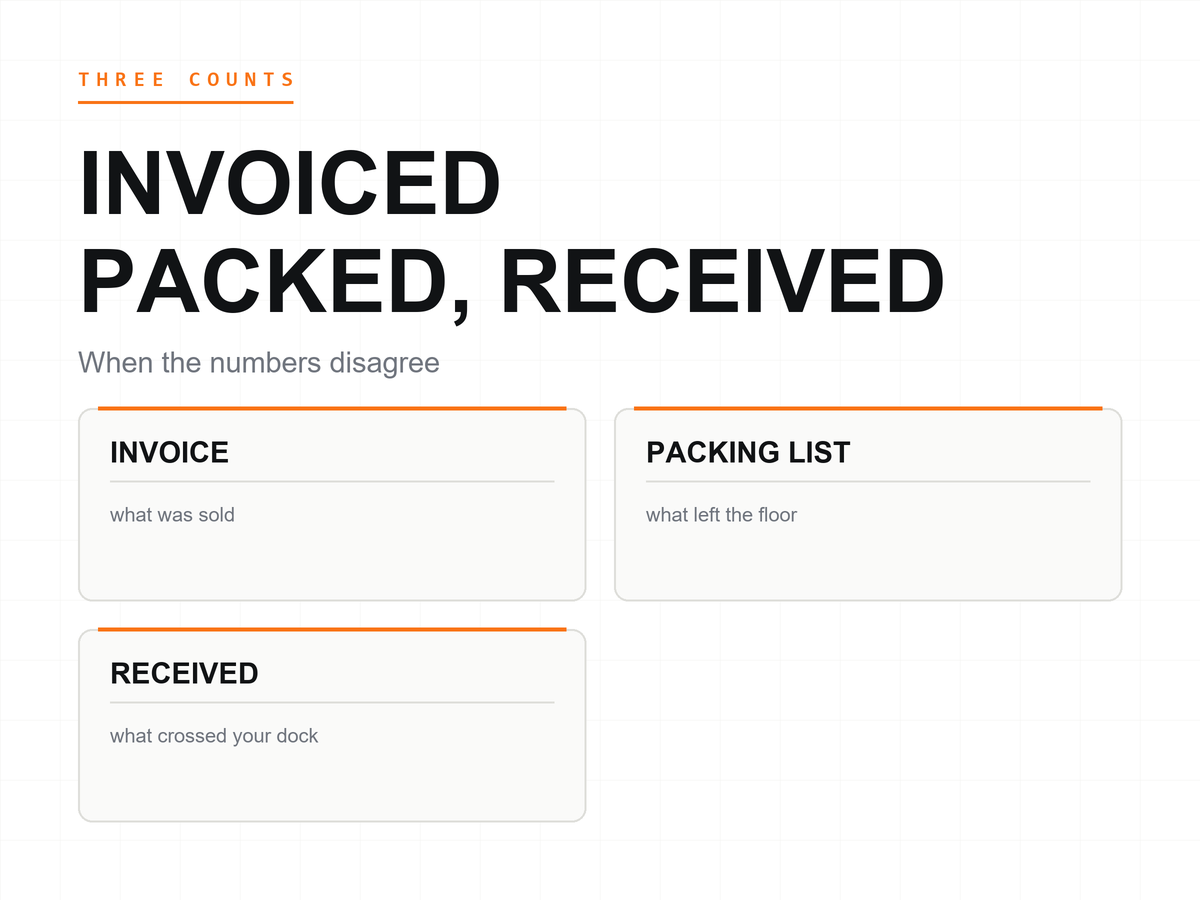
Three counts travel with every order: the number the invoice bills, the number the packing list says was packed, and the number you actually receive. When a shipment of iPhone cases arrives short or arrives with the wrong mix, the mismatch hides in one of those records. iFunSmart ships from Guangzhou, and this is how to trace it.
Last updated: November 19, 2026.
The Three Counts, Defined
The three counts are the invoiced quantity, the packed quantity, and the received quantity; a shipment is consistent when all three agree for every line item. In the clean case the invoice, the packing list, and your receiving notes tell one story. Goods leave, papers travel, cartons open, and each record repeats the others.
The counts sit on different documents, and each answers a different question. The invoice tells you what you are billed for. The packing list records what was loaded, carton by carton, so a receiver can find any SKU without opening every box. Your receiving notes record what actually crossed your dock. None stands in for another: an invoice proves a sale, not a carton; a sealed carton proves a pack, not a bill.
When the counts agree, nobody notices them. When they disagree, the disagreement takes one of three forms, and each hides in a different place. Paper leads; goods follow.
Where the Mismatch Hides
The first form is the short pack: the packing list shows fewer units than the invoice bills. Sometimes the run came up short; sometimes a carton meant for the order stayed behind on the floor. The difference exists before anything moves, and the papers already say so.
The second form is the over pack: cartons holding more units than the documents declare. This one feels like good news and rarely is. A carton gets topped up with extras from a neighboring run, and the papers are not updated to match. The units are welcome; the paperwork is not. Extra goods on smaller papers raise a question the receiver cannot settle alone; that question has a section below.
The third form is the cross-count. The totals match and the mix does not. Model A sits in the slot the packing list assigns to model B, and every number on every page still adds up. This is the quietest mismatch, because a receiver who checks only the grand total signs off a shipment that is wrong in detail. It is why a card-holder line item deserves its own row on the packing list: through clear film, one flat case reads much like another, and two rows can trade places without moving the total.
How those rows and carton labels are written belongs to the shipping side; our article on mixed carton labels covers it. This article starts where those cartons are sealed.
How to Trace a Disagreement
Start at the carton, not at the page. Match each carton number against the packing list, box by box, until the wrong box identifies itself. A mismatch located at a named carton is a fact; a mismatch reported as a feeling is an argument. If your dock records counts carton by carton, this step is half done.
Then go to the invoice lines. Ask whether a line came up short as a whole block, or whether the total held while colors traded places; lines fail differently depending on how they were packed. A line spread across the shipment leaves a thin gap in many boxes; a mainline line item packed into most cartons of a mixed order behaves that way. A narrow line leaves its carton light and the rest untouched.
Only now bring in the supplier, with evidence rather than an impression: the carton number, what the label said, and photographs taken before the box was sorted. How to photograph a receiving exception is its own subject; what matters here is that the carton kept its identity while the evidence was collected. How the gap gets made good is a commercial conversation, and it goes better with a box number than with a memory.
None of this replaces the check that runs before payment. A field-by-field pass over the document set is its own discipline; caught there, a mismatch costs a correction; caught at the dock, it costs a claim.
Preventing the Mismatch Before It Ships
Prevention starts in the order, not at the dock. Settle the counting rules in writing while production is still ahead of you. The packing list records what was actually packed, so the document follows the goods rather than flattering the invoice. And any difference beyond what the order allows is reported before the cartons are sealed, not discovered after they are opened. Buyers who have been caught once by a count gap ask for exactly this: carton-level figures up front, and a rule for when reality and paperwork drift apart.
A count rule agreed in writing helps only if the receiving team holds it too; put the rule where the cartons are opened.
At your end the habit is simpler than an audit: build the three-count comparison into the arrival routine, so the invoice, the packing list, and the received count meet in one record on the same day. Where that comparison sits in a receiving day is covered in our article on the three receiving stages; it belongs to the stage where the carton opens.
When Goods Exceed the Papers
The over pack found at your dock is not a windfall to shelve. The declaration traveled with the goods; the declared figures are what customs sees, and they must stay consistent. Papers that understate the cartons leave the extra units in a category nobody has cleared: not sellable stock, not scrap, not a gift the shipment left behind.
So keep the extras sealed in their cartons, named by carton, out of sellable stock, and consult a customs broker before anything else. Do not destroy the units, do not move them quietly onto the shelf, and do not adjust the papers after the fact to make the numbers comfortable. The entry on file decides what those units are, and the person qualified to say so is the broker who knows your terms. We do not give customs or legal advice.
The discipline that protects a shortage claim protects an overage too: the goods stay identified, the carton stays named, and nothing gets hidden so the story looks tidier.
Common Questions From Buyers
Does a matching total mean the shipment is right?
No. The total settles only that units and boxes agree; it says nothing about which model sits in which slot. The cross-count hides inside a clean total, which is why the line items, not the grand total, close the check.
Which paper wins when the counts disagree?
None of them wins on its own. The order confirmation sets what was agreed, the packing list records what moved, and the invoice states what is billed; the gap between them is what the supplier conversation is for. What a receiver should not do is quietly edit one document to make the others comfortable; the edit destroys the difference the conversation needs to see.
What should I do with units that arrived beyond the papers?
Keep them sealed, keep them named by the carton they came in, and keep them off the shelf until someone qualified has looked at the entry. Ask a customs broker before destroying, returning, or absorbing them into stock. We do not give customs or legal advice; a shelf decision made in a hurry cannot be taken back.
What to Do Next
Add the three-count comparison to the arrival record you already keep: invoiced, packed, received, one line per line item, with the carton number beside any line that fails. Hand the rule to the receiving team before the next shipment leaves, not after it lands. A mismatch traced in the opening hour becomes a conversation; found at stocktake, a loss.
Send iFunSmart the invoice, the packing list, and your receiving notes from one arrival, and we will show you where the three counts drifted.
Apple and iPhone are trademarks of Apple Inc. iFunSmart is an independent manufacturer of phone cases and accessories and is not affiliated with, authorized, sponsored, or endorsed by Apple.