Business Solutions
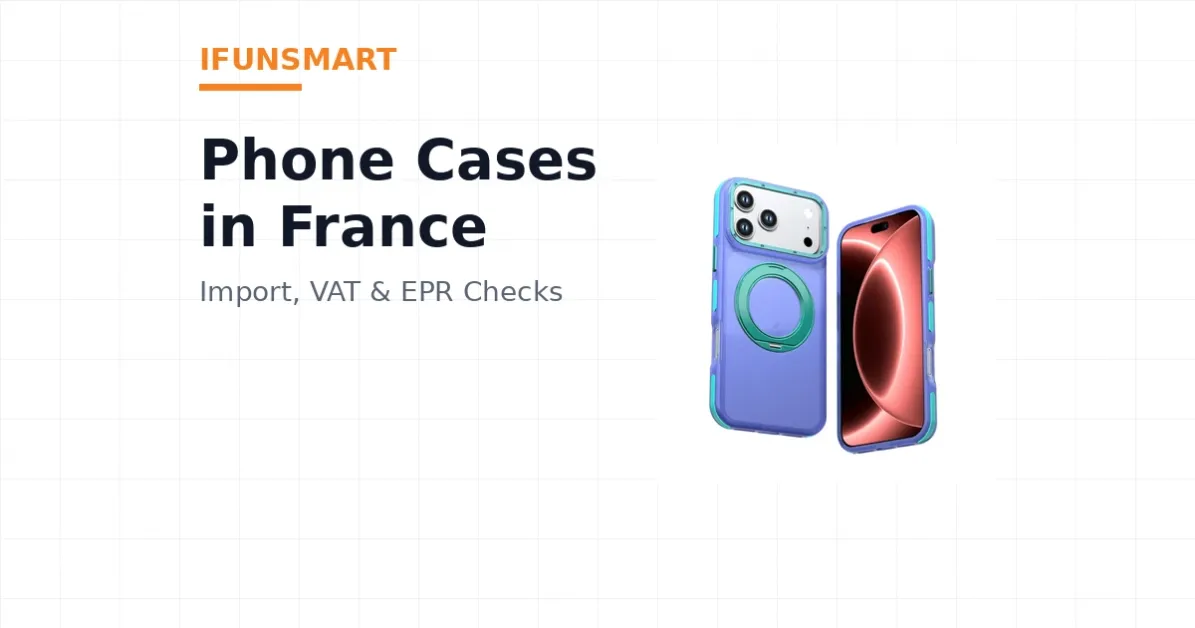
Phone Cases in France: Import, VAT & EPR Checks
France is the EU's second-largest phone market. Import VAT 20%, duty 6.5% on plastic cases, packaging EPR via Citeo and French-only labelling — what a distributor must clear before the first order.
BLUF
France takes 20% import VAT from the first euro and 6.5% duty on plastic phone cases under HS 3926 90 97 90. Packaging EPR runs through Citeo with a SYDEREP IDU, and consumer labelling must be in French. Clear those four checks in the supply contract before you order.
Short answer
France is the EU's second-largest phone market, and it is also one of the most paperwork-heavy. A distributor importing phone cases into France clears four gates before the first order ships: import VAT at 20% from the first euro, customs duty at 6.5% for plastic cases under HS 3926 90 97 90, packaging EPR through Citeo with a SYDEREP IDU, and French-language labelling under the Loi Toubon. None of those gates is a reason not to sell in France — the demand is real, with 19.3 million smartphones imported in 2025 worth EUR 5.35 billion — but each gate has an owner, and the supply contract should say who that owner is before the goods leave China.
The single most important fact for a bulk buyer is that the old small-parcel route is gone. The EUR 150 duty exemption was abolished on 1 July 2026, so a sample parcel or a small direct-to-consumer shipment that used to clear duty-free now carries duty — and from 1 November 2026 a EUR 2 handling fee on top, for distance sales. A normal wholesale shipment was never duty-free above EUR 150 and is unaffected in kind: it pays the normal tariff duty plus 20% import VAT, exactly as before. What changed is the economics of small parcels, which pushes buyers toward consolidated bulk shipments — which is where a distributor already lives.
The second fact is that France treats the importer as the producer for packaging. The business that first makes the packaging available on the French market holds the EPR obligation — for a bulk shipment from China, that is normally the French importer or distributor, not the factory. The factory can supply the packaging details, the materials and the Triman artwork, but the IDU, the declaration and the fee sit with whoever first places the packaged product on the French market. Get that line into the supply contract, in writing, before the first order.
Our most common MOQ is 50 pcs per colour per model, bulk distributor orders start at 500 pcs per order in total, and samples are free for distributors. Payment terms are T/T and Western Union only — the full terms are in the checklist in section 6. The rest of this guide is the France market in numbers, the VAT and duty maths, what the EUR 150 abolition actually changed for a bulk buyer, packaging EPR and labelling, GPSR and WEEE, and the first-order checklist — in that order, because a distributor who clears the paperwork first orders the cases their shop buyers can actually sell.
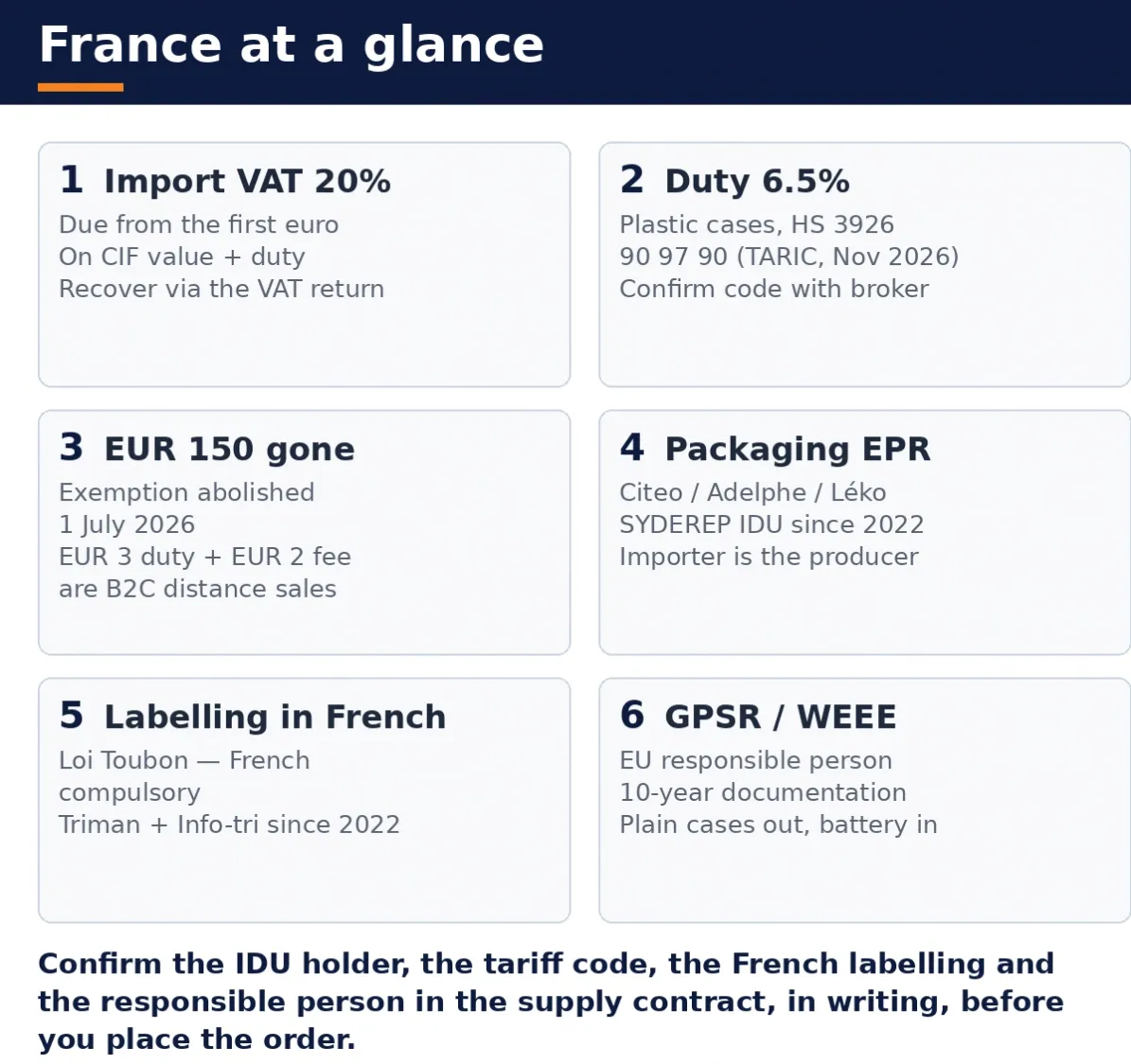
France at a glance
Check | What applies in France | What to do |
|---|---|---|
Import VAT | 20% from the first euro, on CIF value + duty | Register for VAT; recover it through the VAT return |
Duty, plastic cases | 6.5% MFN, HS 3926 90 97 90 (TARIC, Nov 2026) | Confirm the code and rate with your broker or a BTI |
EUR 150 exemption | Abolished 1 July 2026 | No duty-free small parcels; consolidate samples into the bulk shipment |
Packaging EPR | Citeo/Adelphe/Léko, SYDEREP IDU, French mandataire since 10 July 2026 | Put the IDU holder in the supply contract |
Labelling | French compulsory (Loi Toubon); Triman + Info-tri since 2022 | French instructions and sorting marks on the pack |
GPSR / WEEE | EU responsible person, 10-year documentation; plain cases outside WEEE, battery cases inside | Name the responsible person; check battery styles separately |
1. Why France is worth the paperwork
France imported 19.3 million smartphones in 2025, worth EUR 5.35 billion — an average import value of about EUR 277 per unit — and 91% of people aged 12 and over in France had a smartphone in 2025. That is the demand a phone-case distributor is selling into: a replacement market, under price pressure, where the phone is already in the buyer's hand and the case is the accessory that follows. There is no verified figure for the French phone-case market itself — no public source breaks out case units or value for France — so the smartphone import volume is the demand proxy, and it is a large one.
The installed base splits roughly two-to-one toward Android. In October 2026, Android held about 64.2% and iOS about 35.8% of mobile operating-system page views in France — a StatCounter-derived figure, which measures web page views, not devices sold, so treat it as the shape of the market rather than a sales count. The vendor picture from late 2025 is similar: Apple about 34%, Samsung about 32% and Xiaomi about 11.5%, with Apple and Samsung together above 65%. The Samsung Galaxy S25 was the best-selling model in France in September 2025. For a distributor, the practical read is simple: stock Samsung and Apple first, Xiaomi second, and do not build a range around a single brand.
The channels are concentrated. Amazon.fr is the largest e-commerce site in France, with 203.8 million visits in August 2026. Fnac and Darty, whose joint marketplace is the leading consumer-electronics omnichannel retailer in France, drew 34.1 million visits the same month. Cdiscount, the leading home-grown generalist marketplace, drew 27.0 million, and eBay.fr 21.7 million. Boulanger, with about 176 stores, is the other established electronics retailer a distributor's shop buyers will name. A distributor selling into France is therefore selling into a market where the buyer already knows Amazon.fr, Fnac, Darty and Cdiscount — and where the listing that lacks French labelling or a responsible person gets delisted before it sells.
That is why this guide spends most of its length on paperwork rather than on styles. The styles a distributor orders for France are the same styles that sell everywhere — clear magnetic, ring-stand, armor, leather wallet — and the dedicated guides for each of those styles are linked at the end. What is different about France is the compliance stack around the order, and the distributor who clears it once can repeat it on every reorder.
2. Import VAT and duty: the maths on a bulk order
Import VAT in France is 20% — the standard rate — and it is due from the first euro. The old EUR 22 import-VAT exemption was abolished on 1 July 2021, so every import into the EU carries VAT whatever its value, and no reduced rate applies to phone cases: the reduced rates cover specific goods such as food and books, not accessories. The VAT base is the CIF value — cost plus insurance plus freight to the point of entry — plus the customs duty. Duty is charged first, VAT is charged on the sum, and a VAT-registered importer recovers the import VAT through the normal VAT return.
Duty for plastic phone cases is 6.5%. The commodity code is HS 3926 90 97 90 — other articles of plastics — and the 6.5% rate is the erga omnes most-favoured-nation rate from China, with no anti-dumping duty in force for this origin. That figure comes from the Tarific TARIC mirror, synchronised 20 November 2026, plus two UK advance tariff rulings that classify plastic smartphone cases — including a 3-in-1 protective case with a card compartment and stand — under the same code. It is not a direct EUR-Lex TARIC lookup, so the article states it as "6.5% per TARIC, November 2026" and tells the buyer to confirm the code and the rate with their broker, or with a Binding Tariff Information decision, before quoting a landed cost. A BTI is valid EU-wide for three years and is the only way to get legal certainty on a classification.
Two warnings belong here. First, the 6.5% rate and the 3926 90 97 90 code are verified for plastic cases — TPU, silicone, clear PC and hybrid builds. Leather cases fall under a different chapter of the tariff and their code and rate were not verified for this guide, so a distributor ordering leather wallets or folio cases should ask the broker to confirm the 10-digit code for those styles specifically, and never assume the plastic-case rate applies. Second, the commodity code is 10 digits on the import declaration: six digits of HS worldwide, two more for the EU Combined Nomenclature, and two more for TARIC. The declaration also needs the importer's EORI number — one EORI works in all 27 EU countries — and a non-EU business normally works through an indirect customs representative, because the person lodging the declaration must normally be established in the EU.
The worked maths, with no figures invented: duty equals the CIF value multiplied by the rate, and import VAT equals the CIF value plus duty, multiplied by 20%. A distributor who knows the CIF value of the shipment can run that calculation in one line. What the distributor cannot do is quote a landed cost from a rate they have not confirmed — so confirm the code first, then quote.
3. The EUR 150 exemption is gone: what actually changed
Until 30 June 2026, consignments with an intrinsic value of EUR 150 or less were exempt from customs duty when imported into the EU. That exemption was abolished on 1 July 2026 by Council Regulation (EU) 2026/382. In its place, for distance sales of imported goods to EU consumers, a temporary flat duty of EUR 3 per item applies from 1 July 2026 until 1 July 2028, when normal tariff duties return and the EU Customs Data Hub for e-commerce is expected to be operational. "Per item" here means per declaration line — goods in a consignment sharing the same tariff classification, description and origin — not necessarily per physical case, so a distributor should not write "EUR 3 per case" without that qualification.
From 1 November 2026, a EUR 2 Union handling fee also applies to distance sales — permanent, non-refundable, per item or declaration line, with no value threshold, so it applies to consignments over EUR 150 as well. Product identifiers became mandatory on import declarations for distance sales from the same date: the product's own code, the manufacturer's model or part number, and the barcode or EAN/GTIN where one exists. The EUR 3 duty and the EUR 2 fee are distance-sale measures — they are owed by the declarant or business, not collected from the consumer at the door — and B2B imports do not pay the EUR 2 fee.
For a bulk buyer, the honest summary is that almost nothing changed at the bulk level and everything changed at the small-parcel level. A commercial B2B shipment was never duty-free above EUR 150 and still pays the normal tariff duty plus 20% import VAT — the EUR 3 and EUR 2 charges do not apply to it. What changed is the route a buyer used to use for samples and small test parcels: a low-value parcel from China that used to clear duty-free now carries duty, and for a distance sale the handling fee as well. The practical response is to consolidate samples into the bulk shipment or route them through an EU warehouse, rather than ordering sample parcels one at a time and paying duty and fees on each. The IOSS scheme, which some buyers ask about, covers B2C consignments of EUR 150 or less only; it does not apply to B2B wholesale imports, which clear under the standard procedure with the importer's EORI and VAT number. The EUR 45 gift exemption between private individuals still exists and is irrelevant to a commercial buyer.
4. Packaging EPR: the importer is the producer
France runs packaging through extended producer responsibility — REP Emballages — under the Environmental Code, as amended by the AGEC anti-waste law of 10 February 2020, and since 12 August 2026 under the EU Packaging and Packaging Waste Regulation (EU) 2025/40, which applies directly in France. The rule that matters most to a distributor is the definition of the producer: the business that first makes the packaging available on the French market. For a bulk shipment of phone cases from China, that is normally the French importer or distributor, not the factory. If the factory sells direct to French end users, or through a marketplace, the factory is the producer instead — and since 10 July 2026, under Law 2026-602 of 8 July 2026, every EPR producer not established in France must appoint a representative established in France, by written mandate.
Registration runs through the eco-organisme, not directly with the state. Every producer subject to packaging EPR has held an identifiant unique — an IDU — from SYDEREP, the producer register operated by ADEME, since 1 January 2022, one IDU per scheme. The eco-organisme registers the producer in SYDEREP and issues the IDU; a producer cannot self-register except under an approved individual system. For household packaging the approved eco-organismes are Citeo, Adelphe and Léko, approved from 1 January 2025 to 31 December 2029; for professional packaging the approved bodies are Citeo Pro, Léko Pro and Twiice, with obligations from 1 January 2027. Marketplaces must check their sellers' IDUs, and a marketplace is the producer for a third-party sale unless it holds proof of the seller's IDU.
The annual declaration counts the packaging placed on the market in consumer sales units, and the eco-contribution varies by material with eco-modulation — a bonus or penalty for recyclability. Under 10,000 consumer sales units a year, Citeo and Adelphe charge a flat EUR 110 excluding VAT. Per-kilogram rates vary by material and are too volatile to quote in a guide, so this article states only the flat fee and tells the buyer to confirm the rate for their material with the eco-organisme. Breaches carry administrative fines of up to EUR 7,500 per unit or tonne for a company, daily penalties of up to EUR 20,000, and up to EUR 30,000 for register or IDU failures.
The visible part of the obligation is the Triman logo and the Info-tri sorting instructions, mandatory since 1 January 2022 on household products under an EPR scheme, including household packaging. The Triman logo signals that a sorting rule exists — it does not certify that the packaging is recyclable — and the Info-tri instructions are given per separable packaging component, using the official artwork and wording issued by the packaging eco-organisme. Small items have digital-only exceptions: where the largest face is under 10 square centimetres the marking may be wholly digital, and between 10 and 20 square centimetres the Triman may be physical while the Info-tri is digital. One change is pending: the European Commission referred France to the Court of Justice on 17 July 2025, arguing the national marking is a trade barrier, and the EU harmonised sorting label applies from 12 August 2028 at the earliest. Triman remains mandatory until then.
For a distributor, the action is contractual, not technical. The supply contract should name who holds the IDU for the packaging, who files the annual declaration, and who supplies the Triman and Info-tri artwork for the retail pack. The factory can supply the packaging materials, the weights and the artwork — the distributor holds the registration. A distributor who buys cases in bulk and repacks them in France should check whether the repackaging makes them the producer for the new packaging as well, and confirm that in writing with the eco-organisme before the first repacked shipment.
5. GPSR, French labelling and WEEE: what the pack must carry
The General Product Safety Regulation (EU) 2023/988 has applied since 13 December 2024, replacing the old General Product Safety Directive, and it applies directly in France. It covers almost all non-food consumer products, including phone cases, sold through any channel including online and distance sales. It is a safety framework, not a certification — this article does not claim iFunSmart holds any GPSR certification, because GPSR compliance is not a certificate.
Three GPSR duties matter to a distributor. First, a product may only be placed on the EU market if an economic operator established in the EU is responsible for it: the manufacturer if EU-established, otherwise the importer, an authorised representative under written mandate, or a fulfilment service provider. That operator's name, postal address and electronic address must appear on the product, the packaging, the parcel or an accompanying document. For a non-EU manufacturer with no EU importer or authorised representative, the importer is the responsible person. Second, the manufacturer must carry out an internal risk analysis and keep the technical documentation for 10 years, mark the product with its name or trade mark and contact details, and provide instructions and safety information in a language consumers in the country of sale easily understand — for France, that means French. Third, online offers must clearly show the manufacturer details, the EU responsible person where the manufacturer is outside the EU, the product identifier, and the warning and safety information in the language of the country of sale — and marketplaces must delist offers that lack them. Importers must check before placing a product on the market that it is safe, identifiable and labelled with the manufacturer's details, add their own name and contact details, and keep supplier and customer records for six years.
French-language labelling is a separate, older obligation. The Loi Toubon, Law 94-665 of 4 August 1994, Article 2, makes French compulsory in the description, offer and presentation of a product, in its instruction manual or user guide, and in the description of the scope or terms of its warranty. Other languages may be added alongside French, but the French version must be as legible, audible and intelligible as the foreign one. The rule covers the product name unless it is a registered trademark, the description, the instructions for use, the safety warnings, the warranty terms, the advertising and the product information on sites selling to French consumers — including e-commerce and marketplace listings. Imports are not a loophole: French customs check French labelling at clearance and the DGCCRF, the consumer protection authority, checks at every stage of distribution, including e-commerce. Fines run to EUR 750 per breach for an individual and EUR 3,750 for a company, multiplied by the number of breaches. Invoices and documents exchanged between professionals who are not end users fall outside the consumer rules and two companies may contract in English — but consumer-facing labelling and instructions for goods resold to French consumers must still be in French, and the distributor cannot rely on the business-to-business contract language to cover it.
WEEE is the third gate, and for most phone cases it is the one that does not apply. The WEEE Directive defines electrical and electronic equipment as equipment that depends on electric currents or electromagnetic fields in order to work properly — and a plain protective case made of TPU, silicone, leather, clear PC or an aramid-style build, even with a magnetic ring or a stand, does not depend on electric current to work. A plain case therefore falls outside the WEEE definition, and no WEEE registration is needed for the case itself. No source was found that explicitly lists phone cases as in or out of scope, so this guide phrases it as a conclusion from the definition and tells the buyer to confirm edge cases with the eco-organisme.
Battery cases are the exception, twice over. A case with a built-in battery works via electric current, so it is electrical equipment — and portable batteries are a separate French EPR stream, with producers registering, declaring, displaying the barred-bin pictogram and citing their producer number in the terms of sale. The French battery producer organisations are Batribox and ecosystem. Chargers, cables with electronics and MagSafe wireless chargers are also electrical equipment and fall in scope, with the French WEEE producer organisations ecosystem and Ecologic. A passive MagSafe case — magnets only, no circuit and no battery — is not electrical equipment by the definition; a case with an LED, an NFC chip or a charging circuit arguably is. That is a grey area, and the buyer should check it with ecosystem before ordering that style for France.
Case type | WEEE / EEE | Packaging EPR | CE marking | GPSR |
|---|---|---|---|---|
Plain case (TPU, silicone, leather, clear, magnetic ring or stand, no electronics) | Outside the WEEE definition | Yes — the importer is normally the producer | No CE marking on a plain case | Yes — EU responsible person, French instructions, 10-year documentation |
Magnetic case with a charging circuit, LED or NFC chip | Arguably in scope — check with ecosystem | Yes | Check the electronics, not the case | Yes |
Battery case (built-in battery) | In scope twice — EEE and batteries EPR | Yes | Mandatory on the battery case | Yes |
Charger or wireless charging pad | In scope as EEE | Yes | Yes | Yes |
6. The first-order checklist for a France distributor
A distributor's first order for France is a paperwork order as much as a product order. The eight checks below are the ones to clear before the deposit is paid, and each one names the document or the written confirmation to ask for.
- Confirm who holds the packaging IDU. The supply contract should name the IDU holder for the packaging, who files the annual declaration and who pays the eco-contribution. For a bulk shipment from China, that is normally the French importer — confirm it in writing, and confirm the French mandataire if the producer is not established in France.
- Confirm the tariff code and the duty in writing. Ask the broker to confirm HS 3926 90 97 90 and the 6.5% rate for the plastic styles, and a separate code for any leather styles, before quoting a landed cost. A Binding Tariff Information decision is the only way to get legal certainty on a classification.
- Confirm the French labelling on the pack. The retail pack needs French instructions and safety information, the manufacturer's name and contact details, the EU responsible person's details, the product identifier and the Triman logo with Info-tri sorting instructions. Ask for a photo of the finished pack before the bulk run, not after.
- Name the EU responsible person. The GPSR responsible person must be established in the EU and named on the product, the packaging, the parcel or an accompanying document. If the distributor is the importer, the distributor is the responsible person — say so in the contract.
- Check the battery styles separately. Plain cases fall outside WEEE; battery cases fall inside it twice over, and cases with a charging circuit, LED or NFC chip are a grey area. Confirm with ecosystem before ordering a battery or electronic style for France.
- Consolidate the samples. The EUR 150 duty exemption is gone, so a sample parcel now carries duty. Put the samples into the bulk shipment or route them through an EU warehouse instead of ordering sample parcels one at a time.
- Confirm the styles, the models and the magnet figure in writing. Stock Samsung and Apple first, Xiaomi second. Confirm the magnet figure per style in writing — it differs by style — and confirm the fit for the exact models in the order, because a case that fits the wrong model is a return, not a sale.
- Confirm the payment and the sample terms in writing. Our payment terms are T/T and Western Union only. New customers may pay a 30% deposit first; after the goods are ready the factory sends photos, a video and the packing list; the customer pays the balance, then the goods ship. Samples are free for distributors, and our most common MOQ is 50 pcs per colour per model, with bulk distributor orders starting at 500 pcs per order in total.
FAQs
Q1: What is the import duty on phone cases in France?
For plastic phone cases — TPU, silicone, clear PC and hybrid builds — the duty is 6.5% under HS 3926 90 97 90, the most-favoured-nation rate from China, per the TARIC mirror of November 2026. Import VAT is 20% on the CIF value plus duty, due from the first euro. Confirm the code and the rate with your broker, or with a Binding Tariff Information decision, before quoting a landed cost — and ask the broker for a separate code for leather cases, which fall under a different chapter.
Q2: Do I need an EPR registration to sell phone cases in France?
For the packaging, yes, if you are the business that first makes the packaging available on the French market — which, for a bulk shipment from China, is normally the French importer or distributor. You register through an eco-organisme such as Citeo, Adelphe or Léko, which issues the SYDEREP IDU and files the annual declaration. Under 10,000 consumer sales units a year the flat fee is EUR 110 excluding VAT. If the producer is not established in France, a French representative must be appointed by written mandate. Ask us for the packaging materials and weights for your styles, and confirm the IDU holder in the supply contract.
Q3: Do plain phone cases fall under WEEE in France?
No — a plain protective case made of TPU, silicone, leather, clear PC or an aramid-style build does not depend on electric current to work, so it falls outside the WEEE definition of electrical and electronic equipment. Battery cases are different: they fall in scope twice over, as electrical equipment and under the batteries EPR stream. Cases with a charging circuit, an LED or an NFC chip are a grey area — check with ecosystem before ordering that style for France.
Q4: What labelling must a phone case carry to sell in France?
Consumer-facing labelling must be in French — the Loi Toubon makes French compulsory in the description, the instructions, the safety warnings and the warranty terms — and the pack must carry the Triman logo with Info-tri sorting instructions, mandatory since 1 January 2022. Under GPSR the pack or an accompanying document must also name the manufacturer, the EU responsible person and the product identifier. Ask for a photo of the finished retail pack before the bulk run.
Q5: Can I still send small sample parcels to France duty-free?
No. The EUR 150 duty exemption was abolished on 1 July 2026, so a sample parcel now carries duty, and for distance sales a EUR 2 handling fee applies from 1 November 2026. A normal B2B wholesale shipment pays the normal tariff duty plus 20% import VAT and is unaffected in kind. The practical fix is to consolidate samples into the bulk shipment or route them through an EU warehouse, and to confirm the sample terms in writing before the order.
About iFunSmart
iFunSmart — Ifun Electronics Technology Co., Ltd, Guangzhou, China — has made phone cases since 2010: 1000+ designs, 500+ models, 500K+ pcs/month capacity, exported to 30+ countries. Our most common MOQ is 50 pcs per colour per model, and it varies by product line. Bulk distributor orders start at 500 pcs per order in total, and samples are free for distributors. Payment terms are T/T and Western Union only — 30% deposit first for new customers, then photos, a video and the packing list when the goods are ready, then the balance, then the goods ship. Contact us on WhatsApp +86 13632248734 or at contact@ifunsmart.com, and we will reply within 24 hours.
Read more
- Phone Cases in Germany: VerpackDG, WEEE & Import Checks — https://www.ifunsmart.com/posts/phone-cases-in-germany-verpackdg-weee-import-checks
- Phone Cases in Canada: Import, GST & Bilingual Packaging — https://www.ifunsmart.com/posts/phone-cases-in-canada-import-gst-bilingual-packaging
- Selling Phone Cases in the UK: UKCA, VAT & Import Checks — https://www.ifunsmart.com/posts/phone-cases-uk-ukca-vat-import-guide
- Selling Phone Cases in the EU: GPSR, REACH & RoHS Documents — https://www.ifunsmart.com/posts/selling-phone-cases-eu-2026-gpsr-reach-rohs-documents
- Importing Phone Cases: Documents & Checks First — https://www.ifunsmart.com/posts/importing-phone-cases-documents-checklist
- Phone Case Payment Terms: What a First Order Costs — https://www.ifunsmart.com/posts/phone-case-payment-terms-first-order
- Phone Case Warranty & Returns: What to Ask Before Ordering — https://www.ifunsmart.com/posts/phone-case-warranty-returns-what-to-ask-before-ordering
- Phone Case Quality Check Before Shipment: The Checklist — https://www.ifunsmart.com/posts/phone-case-quality-check-before-shipment-checklist