Business Solutions
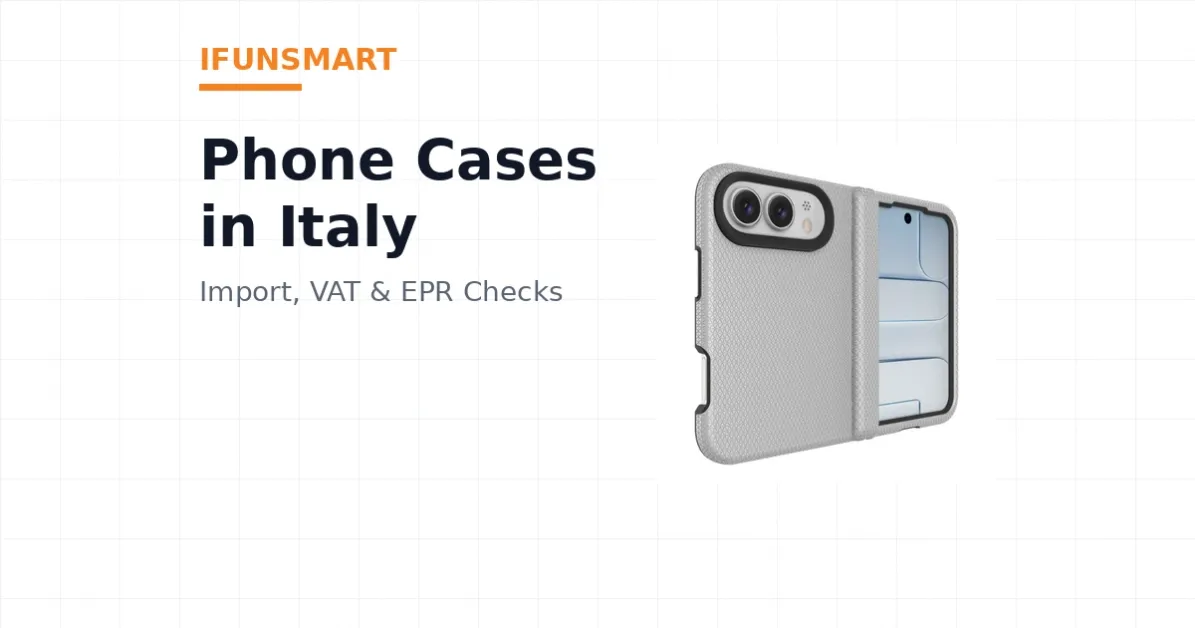
Phone Cases in Italy: Import, VAT & EPR Checks
Italy charges 22% import VAT from the first euro and 6.5% duty on plastic cases. Packaging EPR runs through CONAI, and consumer labelling must be in Italian — what a distributor must clear first.
BLUF
Italy charges 22% import VAT from the first euro and 6.5% duty on plastic phone cases under HS 3926 90 97 90. Packaging EPR runs through CONAI, and consumer labelling must be in Italian. Clear those four checks in the supply contract before you order.
Short answer
Italy is a large market for phone cases, and it is also one of the most paperwork-heavy. A distributor importing phone cases into Italy clears four gates before the first order ships: import VAT at 22% from the first euro, customs duty at 6.5% for plastic cases under HS 3926 90 97 90, packaging EPR through CONAI, and Italian-language labelling under the Consumer Code. None of those gates is a reason not to sell in Italy — the demand is real, with Amazon.it alone taking about 52% of Italian e-commerce GMV and Italian e-commerce revenue at EUR 38.5 billion in 2025 — but each gate has an owner, and the supply contract should say who that owner is before the goods leave China.
The single most important fact for a bulk buyer is that the old small-parcel route is gone. The EUR 150 duty exemption was abolished on 1 July 2026, so a sample parcel or a small direct-to-consumer shipment that used to clear duty-free now carries duty — and from 1 November 2026 a EUR 2 handling fee on top, for distance sales. A normal wholesale shipment was never duty-free above EUR 150 and is unaffected in kind: it pays the normal tariff duty plus 22% import VAT, exactly as before. What changed is the economics of small parcels, which pushes buyers toward consolidated bulk shipments — which is where a distributor already lives.
The second fact is that Italy treats the importer as the producer for packaging. The business that first makes the packaging available on the Italian market holds the EPR obligation — for a bulk shipment from China, that is normally the Italian importer or distributor, not the factory. The factory can supply the packaging details, the materials and the labelling artwork, but the CONAI registration, the declaration and the fee sit with whoever first places the packaged product on the Italian market. Get that line into the supply contract, in writing, before the first order.
Our most common MOQ is 50 pcs per colour per model, bulk distributor orders start at 500 pcs per order in total, and samples are free for distributors. Payment terms are T/T and Western Union only — the full terms are in the checklist in section 6. The rest of this guide is the Italy market in numbers, the VAT and duty maths, what the EUR 150 abolition actually changed for a bulk buyer, packaging EPR and labelling, GPSR and WEEE, and the first-order checklist — in that order, because a distributor who clears the paperwork first orders the cases their shop buyers can actually sell.
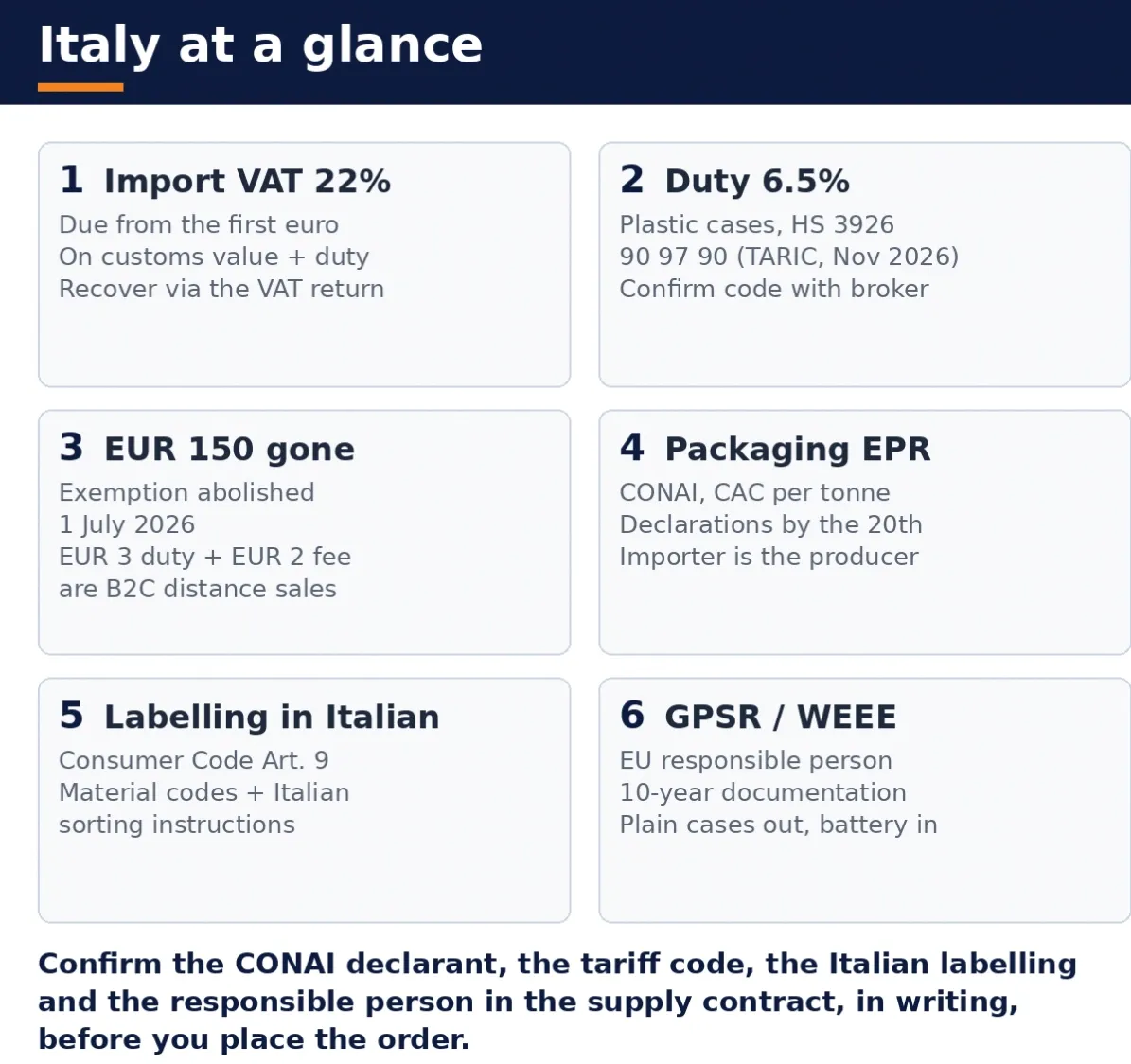
Italy at a glance
Check | What applies in Italy | What to do |
|---|---|---|
Import VAT (IVA) | 22% from the first euro, on customs value + duty + charges | Register for VAT; recover it through the VAT return |
Duty, plastic cases | 6.5% MFN, HS 3926 90 97 90 (TARIC, Nov 2026) | Confirm the code and rate with your broker or a BTI |
EUR 150 exemption | Abolished 1 July 2026 | No duty-free small parcels; consolidate samples into the bulk shipment |
Packaging EPR | CONAI, CAC per tonne by material, declarations by the 20th | Put the CONAI declarant in the supply contract |
Labelling | Italian compulsory for mandatory consumer information; material codes + Italian sorting instructions on packs | Italian instructions and sorting marks on the pack; no Triman — France-only |
GPSR / WEEE | EU responsible person, 10-year documentation; plain cases outside WEEE, battery cases inside | Name the responsible person; check battery styles separately |
1. Why Italy is worth the paperwork
Italy is a replacement market, under price pressure, where the phone is already in the buyer's hand and the case is the accessory that follows. The installed base splits roughly two-to-one toward Android. In January to September 2026, iOS held about 35% and Android about 65% of mobile operating-system page views in Italy — a StatCounter-derived figure, which measures web page views, not devices sold, so treat it as the shape of the market rather than a sales count. The brand picture from a late-2025 to 2026 survey is similar: Samsung first, followed by Apple, then Xiaomi. The exact brand percentages are behind a paywall and are not quoted here — the ranking is enough for a distributor's first decision: stock Samsung and Apple first, Xiaomi second, and do not build a range around a single brand. There is no verified figure for the Italian phone-case market itself — no public source breaks out case units or value for Italy — so the channel and device figures in this section are the demand proxy, and they are large ones.
The channels are concentrated. Amazon.it is Italy's dominant marketplace, with about 175 million visits a month and about 52% of the entire Italian e-commerce market by GMV — EUR 25.02 billion in 2025, up 12.8% year on year — while Italian e-commerce revenue as a whole was EUR 38.5 billion in 2025 and is forecast at EUR 41.3 billion in 2026. eBay.it draws more than 16 million unique monthly visitors and is strong in new and used goods. MediaWorld, the Italian arm of MediaMarktSaturn, is the electronics marketplace with about 15 million unique visits a month, and Unieuro is the leading Italian electronics retailer online and offline, although its marketplace had still not launched as of mid-2026. A distributor selling into Italy is therefore selling into a market where the buyer already knows Amazon.it, eBay.it and MediaWorld — and where the listing that lacks Italian labelling or a responsible person gets delisted before it sells.
Italian consumers also have strong statutory rights, and the distributor's shop buyers will hear about them. The legal guarantee for lack of conformity runs for two years from delivery, and distance buyers have a 14-day right of withdrawal. Those rights sit with the seller who faces the consumer — the distributor's retail customer — but they shape what the distributor should ask the factory for: a sample approval in writing, a clear statement of what the case is made of, and a packing list that matches the goods. A case that arrives wrong is a return under a two-year guarantee, not a negotiation.
That is why this guide spends most of its length on paperwork rather than on styles. The styles a distributor orders for Italy are the same styles that sell everywhere — clear magnetic, ring-stand, armor, leather wallet — and the dedicated guides for each of those styles are linked at the end. What is different about Italy is the compliance stack around the order, and the distributor who clears it once can repeat it on every reorder.
2. Import VAT and duty: the maths on a bulk order
Import VAT in Italy is 22% — the standard IVA rate — and it is due from the first euro. The old EUR 22 import-VAT exemption was abolished on 1 July 2021, so every import into the EU carries VAT whatever its value, and no reduced rate applies to phone cases: the reduced rates of 10%, 5% and 4% cover specific goods such as food and books, not accessories. The VAT base is the customs value — normally the transaction value, price paid plus freight and insurance to the first EU entry point — plus the customs duty and other customs charges up to the first destination in Italy. Duty is charged first, VAT is charged on the sum, and a VAT-registered importer recovers the import VAT through the normal VAT return. Import VAT is collected by Italian customs, the Agenzia delle Dogane e dei Monopoli (ADM), not by the domestic tax agency, and since October 2024 import IVA is a border duty under the new national customs code, Legislative Decree 141/2024.
Duty for plastic phone cases is 6.5%. The commodity code is HS 3926 90 97 90 — other articles of plastics — and the 6.5% rate is the erga omnes most-favoured-nation rate from China, with no anti-dumping duty in force for this origin. That figure comes from the Tarific TARIC mirror, synchronised 20 November 2026, and it is the same rate in every EU Member State, because Italy is in the EU customs union and the Common Customs Tariff applies identically in Italy and Germany — duty is charged once, when the goods first enter the EU, and goods in free circulation then move between Member States duty-free. A UK advance tariff ruling that classifies a clear TPU smartphone case under the same code corroborates the classification. It is not a direct EUR-Lex TARIC lookup, so the article states it as "6.5% per TARIC, November 2026" and tells the buyer to confirm the code and the rate with their broker, or with a Binding Tariff Information decision, before quoting a landed cost. A BTI is valid EU-wide for three years and is the only way to get legal certainty on a classification.
Two warnings belong here. First, the 6.5% rate and the 3926 90 97 90 code are verified for plastic cases — TPU, silicone, clear PC and hybrid builds. Leather cases fall under a different chapter of the tariff and their code and rate were not verified for this guide, so a distributor ordering leather wallets or folio cases should ask the broker to confirm the 10-digit code for those styles specifically, and never assume the plastic-case rate applies. Cases with a built-in battery or electronics may classify differently again. Second, the commodity code is 10 digits on the import declaration: six digits of HS worldwide, two more for the EU Combined Nomenclature, and two more for TARIC. The declaration also needs the importer's EORI number — one EORI works in all 27 EU countries, and for an Italian company it is automatic, IT plus the partita IVA. A non-EU business normally works through a customs representative, because the person lodging the declaration must generally be established in the EU — direct representation, where the representative acts in the buyer's name, or indirect representation, where it acts in its own name and is jointly liable for the customs debt. Declarations in Italy are digital, through AIDA 2.0, and the standard import declaration is the H1.
One more point on where the goods clear. If the shipment is discharged at Rotterdam, Antwerp or Hamburg and cleared there, the import VAT belongs to that Member State even if the goods are then trucked to Italy; if the goods travel under T1 transit and are cleared in Italy, Italy collects. A distributor who buys on a DDP basis should ask, in writing, where the goods are cleared and who holds the EORI — because that decides whose VAT return the import VAT sits in.
The worked maths, with no figures invented: duty equals the customs value multiplied by the rate, and import VAT equals the customs value plus duty plus charges, multiplied by 22%. A distributor who knows the customs value of the shipment can run that calculation in one line. What the distributor cannot do is quote a landed cost from a rate they have not confirmed — so confirm the code first, then quote.
3. The EUR 150 exemption is gone: what actually changed
Until 30 June 2026, consignments with an intrinsic value of EUR 150 or less were exempt from customs duty when imported into the EU. That exemption was abolished on 1 July 2026 by Council Regulation (EU) 2026/382. In its place, for distance sales of imported goods to EU consumers, a temporary flat duty of EUR 3 per item applies from 1 July 2026 until 1 July 2028, when normal tariff duties return and the EU Customs Data Hub for e-commerce is expected to be operational. "Per item" here means per declaration line — goods in a consignment sharing the same tariff classification, description and origin — not necessarily per physical case, and sources differ on the exact counting unit, so a distributor should not write "EUR 3 per case" without that qualification and should confirm the broker's reading.
From 1 November 2026, a EUR 2 Union handling fee also applies to distance sales — permanent, non-refundable, per item, with no value threshold, so it applies to consignments over EUR 150 as well. Product identifiers became mandatory on import declarations for distance sales from the same date: the product's own code, the manufacturer's model or part number, and the barcode or EAN/GTIN where one exists. The EUR 3 duty and the EUR 2 fee are distance-sale measures — they are owed by the declarant or business, not collected from the consumer at the door — and B2B imports do not pay the EUR 2 fee.
Do not confuse the EU fee with Italy's own EUR 2 fee. Italy's 2026 Budget Law created a EUR 2 administrative contribution per consignment of EUR 150 or less from outside the EU, but it was postponed four times — from 1 January to 1 July to 1 October to 1 December 2026 and then to 1 January 2027 — and the 2027 Budget Bill proposes repealing it entirely before it ever applied. As of late November 2026 it is not in force. A distributor who reads an older guide that still lists 1 December 2026 as the start date is reading superseded news — check the current position before quoting it to a customer.
For a bulk buyer, the honest summary is that almost nothing changed at the bulk level and everything changed at the small-parcel level. A commercial B2B shipment was never duty-free above EUR 150 and still pays the normal tariff duty plus 22% import VAT — the EUR 3 and EUR 2 charges do not apply to it. What changed is the route a buyer used to use for samples and small test parcels: a low-value parcel from China that used to clear duty-free now carries duty, and for a distance sale the handling fee as well. The practical response is to consolidate samples into the bulk shipment or route them through an EU warehouse, rather than ordering sample parcels one at a time and paying duty and fees on each. The IOSS scheme, which some buyers ask about, covers B2C consignments of EUR 150 or less only; it does not apply to B2B wholesale imports, which clear under the standard procedure with the importer's EORI and VAT number. The EUR 45 gift exemption between private individuals still exists and is irrelevant to a commercial buyer.
4. Packaging EPR: CONAI and who pays
Italy runs packaging through extended producer responsibility under Legislative Decree 152/2006, the Environmental Code, and since 12 August 2026 under the EU Packaging and Packaging Waste Regulation (EU) 2025/40, which applies directly in Italy. The system is run by CONAI, the national packaging consortium, with material consortia underneath it — Corepla for plastic, Comieco for paper, Ricrea for steel, CiAl for aluminium, Rilegno for wood, Coreve for glass and Biorepack for compostable plastic. The rule that matters most to a distributor is the definition of the producer: the business that first makes the packaging available on the Italian market. For a bulk shipment of phone cases from China, that is normally the Italian importer or distributor, not the factory. If the factory sells direct to Italian end users, the factory is the producer instead — and since 12 August 2026, under Article 45(3) of the PPWR, a producer established in another Member State or a third country selling packaged products directly to Italian end users must appoint an EPR authorised representative established in Italy.
The contribution is the CAC — Contributo Ambientale CONAI — charged per tonne by material, on the first transfer in Italy. Declarations go to CONAI monthly, quarterly or annually, by the 20th of the month following the reference period, depending on the previous year's contribution per material. Empty packaging is declared on form 6.1; filled packaging — goods already packed, primary, secondary and tertiary — on form 6.2. The 2026 CAC range runs from EUR 5 per tonne for steel to EUR 922 per tonne for the least recyclable plastics, with plastic bands increased from 1 October 2026. Only the range is quoted here — confirm the rate for your material on conai.org. A simplified procedure exists for importers of filled packaging — contribution calculated on actual weight by material, or on the value of the goods, reported at 0.11% for non-food products from 1 October 2026 — but that figure comes from a single secondary source, so confirm it on conai.org before relying on it.
For a foreign company, the route depends on the channel. If a non-Italian company sells to an Italian importer or distributor, the Italian importer normally declares and pays the CAC, and the foreign seller generally has no direct CONAI duty. If a non-Italian company sells directly to Italian end users, it is the producer for EPR purposes and needs the Italian authorised representative described above. Under the national CONAI rules, foreign-company membership is framed as voluntary, and a foreign company that joins elects a special domicile in Italy — which is not the same legal appointment as a PPWR authorised representative. CONAI's dedicated route for companies established abroad is the email aziendaestera@conai.org, where the special foreign-company membership form can be requested. Some guides state flatly that any seller without an Italian establishment must appoint an authorised representative — that conflates the direct-to-consumer duty with the older CONAI declaration route. This guide follows the B2B/B2C distinction instead. Marketplaces have their own route: CONAI recognises simplified arrangements agreed between platforms and EPR systems, so a foreign seller using a platform's service may have the contribution handled by the platform — ask the marketplace in writing whether it operates a CONAI arrangement covering the sales, and if it does not, join CONAI and meet the obligations directly.
Two dates to keep separate. The PPWR has applied since 12 August 2026, and Italy's Law 36/2026 delegates the Government to adapt Italian law to it — the CONAI contribution system continues underneath. Separately, a EUR 0.45 per kilogram tax on single-use plastic packaging, known as MACSI, is scheduled to start on 1 January 2027 after repeated postponements. It is not in force, so do not budget it as a current cost — but do not be surprised by it either.
For a distributor, the action is contractual, not technical. The supply contract should name who declares and pays the CAC for the packaging, who files the declaration, and who supplies the packaging materials and weights for the retail pack. The factory can supply the packaging materials, the weights and the artwork — the distributor holds the registration. A distributor who buys cases in bulk and repacks them in Italy should check whether the repackaging makes them the producer for the new packaging as well, and confirm that in writing with CONAI before the first repacked shipment.
5. GPSR, Italian labelling and WEEE: what the pack must carry
The General Product Safety Regulation (EU) 2023/988 has applied since 13 December 2024, replacing the old General Product Safety Directive, and it applies directly in Italy. It covers almost all non-food consumer products, including phone cases, sold through any channel including online and distance sales, and it reaches sellers outside the EU whose online offers target EU consumers. It is a safety framework, not a certification — this article does not claim iFunSmart holds any GPSR certification, because GPSR compliance is not a certificate. Italy's supervisor for general product safety is the Ministry of Enterprises and Made in Italy (MIMIT).
Three GPSR duties matter to a distributor. First, a product may only be placed on the EU market if an economic operator established in the EU is responsible for it: the manufacturer if EU-established, otherwise the importer, an authorised representative under written mandate, or a fulfilment service provider where none of the others exists. That operator's name, postal address and electronic address must appear on the product, the packaging, the parcel or an accompanying document, and in every online offer. For a non-EU manufacturer with no EU importer or authorised representative, the importer is the responsible person. Second, the manufacturer must carry out an internal risk analysis and keep the technical documentation for 10 years, mark the product with its name or trade mark and contact details, and provide instructions and safety information in a language consumers in the country of sale easily understand — for Italy, that means Italian. Third, online offers must clearly show the manufacturer details, the EU responsible person where the manufacturer is outside the EU, the product identifier, and the warning and safety information in the language of the country of sale — and marketplaces must delist offers that lack them. Importers must check before placing a product on the market that it is safe, identifiable and labelled with the manufacturer's details, add their own name and contact details, and keep supplier and customer records for six years.
Italian-language labelling is a separate, older obligation. Article 9 of the Consumer Code, Legislative Decree 206/2005, requires all information intended for consumers to be given at least in Italian, and where information is given in more than one language the Italian text must be no less visible and legible than the other languages. Article 6 lists the mandatory indications — the product name, dangerous substances, composition materials, instructions and precautions for use where relevant — and marketing a product or packaging without those indications in clearly visible, legible form is prohibited. A Court of Como ruling of 29 May 2024 held that the translation duty should be limited to the mandatory information, and revoked a confiscation order where the mandatory information was in Italian but additional information was not — but that is the first Italian ruling on the point, and law firms still advise translating all label information until the legislator clarifies. The safe course is to translate everything. Imports are not a loophole: customs check labelling at clearance and the market-surveillance authorities check at every stage of distribution, including e-commerce. Invoices and documents exchanged between professionals who are not end users fall outside the consumer rules and two companies may contract in English — but consumer-facing labelling and instructions for goods resold to Italian consumers must still be in Italian, and the distributor cannot rely on the business-to-business contract language to cover it.
Italy also has its own packaging labelling system, and it is not the French one. Since 1 January 2023, under Article 219(5) of Legislative Decree 152/2006 as amended by Legislative Decree 116/2020, all packaging must carry the material identification code from Commission Decision 97/129/EC — PAP 20 for corrugated cardboard, PAP 21 for non-corrugated fibreboard, LDPE 4, PP 5 — and packaging for household consumers must also carry sorting instructions in Italian, such as "Raccolta plastica" or "Raccolta carta", with a recommendation to add "check local rules" wording. The sorting information may be provided through digital channels — an app, a QR code or a website — where the pack allows; for B2B-only packaging the material code alone is required, and for neutral B2B packaging the code may be shown on the transport documents. Fines for breach run to EUR 5,000–25,000. Do not put Triman or Info-tri on an Italy-only pack: Triman with Info-tri sorting instructions is a French requirement under France's AGEC law, mandatory since 1 January 2022 for household products sold to consumers in France, and the European Commission has referred France to the Court of Justice over it. The EU harmonised sorting label applies from 12 August 2028 at the earliest. Until then France and Italy each require their own labelling — a single EU pack does not yet exist.
WEEE is the third gate, and for most phone cases it is the one that does not apply. The WEEE Directive defines electrical and electronic equipment as equipment that depends on electric currents or electromagnetic fields in order to work properly — and a plain protective case made of TPU, silicone, leather, clear PC or an aramid-style build, even with a magnetic ring or a stand, does not depend on electric current to work. A plain case therefore falls outside the WEEE definition, and no WEEE registration is needed for the case itself. This is a conclusion from the definition, so confirm edge cases with the collective scheme.
Battery cases are the exception, twice over. A case with a built-in battery works via electric current, so it is electrical equipment — and portable batteries are a separate Italian EPR stream, with producers registering in the National Register of Producers of Batteries and Accumulators at registropile.it, reporting annual sales volumes, financing collection, and labelling batteries with the crossed-out wheelie-bin symbol. Producers of electrical equipment must register in the National Register of producers of EEE, the Registro AEE, join a collective scheme and the Coordination Centre, report volumes placed on the market, finance collection and treatment, and mark products with the crossed-out wheelie-bin symbol — the WEEE registration number format is IT plus 14 digits. A producer based in another Member State or a third country selling electrical equipment to end users in Italy must appoint an authorised WEEE representative resident in Italy; a third-country producer selling to Italian trade intermediaries may appoint one, or the Italian intermediary may instead carry the producer duties. Chargers, cables with electronics and MagSafe wireless chargers are also electrical equipment and fall in scope. A passive MagSafe case — magnets only, no circuit and no battery — is not electrical equipment by the definition; a case with an LED, an NFC chip or a charging circuit arguably is. That is a grey area, and the buyer should check it with the collective scheme before ordering that style for Italy.
Case type | WEEE / EEE | Packaging EPR | CE marking | GPSR |
|---|---|---|---|---|
Plain case (TPU, silicone, leather, clear, magnetic ring or stand, no electronics) | Outside the WEEE definition | Yes — the importer is normally the producer | No CE marking on a plain case | Yes — EU responsible person, Italian instructions, 10-year documentation |
Magnetic case with a charging circuit, LED or NFC chip | Arguably in scope — check with the collective scheme | Yes | Check the electronics, not the case | Yes |
Battery case (built-in battery) | In scope twice — EEE and batteries EPR | Yes | Mandatory on the battery case | Yes |
Charger or wireless charging pad | In scope as EEE | Yes | Yes | Yes |
6. The first-order checklist for an Italy distributor
A distributor's first order for Italy is a paperwork order as much as a product order. The eight checks below are the ones to clear before the deposit is paid, and each one names the document or the written confirmation to ask for.
- Confirm who declares and pays the CONAI contribution. The supply contract should name the CONAI declarant for the packaging, who files the declaration and who pays the CAC. For a bulk shipment from China, that is normally the Italian importer — confirm it in writing, and confirm the Italian authorised representative if the producer sells direct to Italian end users.
- Confirm the tariff code and the duty in writing. Ask the broker to confirm HS 3926 90 97 90 and the 6.5% rate for the plastic styles, and a separate code for any leather styles, before quoting a landed cost. A Binding Tariff Information decision is the only way to get legal certainty on a classification.
- Confirm the Italian labelling on the pack. The retail pack needs Italian instructions and safety information, the manufacturer's name and contact details, the EU responsible person's details, the product identifier, the Decision 97/129/EC material code and the Italian sorting instructions. Ask for a photo of the finished pack before the bulk run, not after.
- Name the EU responsible person. The GPSR responsible person must be established in the EU and named on the product, the packaging, the parcel or an accompanying document, and in every online offer. If the distributor is the importer, the distributor is the responsible person — say so in the contract.
- Check the battery styles separately. Plain cases fall outside WEEE; battery cases fall inside it twice over, and cases with a charging circuit, LED or NFC chip are a grey area. Confirm with the collective scheme before ordering a battery or electronic style for Italy.
- Consolidate the samples. The EUR 150 duty exemption is gone, so a sample parcel now carries duty. Put the samples into the bulk shipment or route them through an EU warehouse instead of ordering sample parcels one at a time.
- Confirm the styles, the models and the magnet figure in writing. Stock Samsung and Apple first, Xiaomi second. Confirm the magnet figure per style in writing — it differs by style — and confirm the fit for the exact models in the order, because a case that fits the wrong model is a return, not a sale.
- Confirm the payment and the sample terms in writing. Our payment terms are T/T and Western Union only. New customers may pay a 30% deposit first; after the goods are ready the factory sends photos, a video and the packing list; the customer pays the balance, then the goods ship. Samples are free for distributors, and our most common MOQ is 50 pcs per colour per model, with bulk distributor orders starting at 500 pcs per order in total.
FAQs
Q1: What is the import duty on phone cases in Italy?
For plastic phone cases — TPU, silicone, clear PC and hybrid builds — the duty is 6.5% under HS 3926 90 97 90, the most-favoured-nation rate from China, per the TARIC mirror of November 2026. Import VAT is 22% on the customs value plus duty and charges, due from the first euro. Confirm the code and the rate with your broker, or with a Binding Tariff Information decision, before quoting a landed cost — and ask the broker for a separate code for leather cases, which fall under a different chapter.
Q2: Do I need a CONAI registration to sell phone cases in Italy?
For the packaging, yes, if you are the business that first makes the packaging available on the Italian market — which, for a bulk shipment from China, is normally the Italian importer or distributor. You register with CONAI, declare the packaging placed on the market and pay the CAC per tonne by material — Italy charges by weight, so ask CONAI for the rate for your material. If the producer is not established in Italy and sells direct to Italian end users, an Italian EPR authorised representative must be appointed by written mandate. Ask us for the packaging materials and weights for your styles, and confirm the CONAI declarant in the supply contract.
Q3: Do plain phone cases fall under WEEE in Italy?
No — a plain protective case made of TPU, silicone, leather, clear PC or an aramid-style build does not depend on electric current to work, so it falls outside the WEEE definition of electrical and electronic equipment. Battery cases are different: they fall in scope twice over, as electrical equipment and under the batteries EPR stream, with registration in the Registro AEE and the battery register. Cases with a charging circuit, an LED or an NFC chip are a grey area — check with the collective scheme before ordering that style for Italy.
Q4: What labelling must a phone case carry to sell in Italy?
Consumer-facing labelling must be in Italian — the Consumer Code makes Italian compulsory for the mandatory consumer information, and translating everything is the safe course. The pack must also carry the Decision 97/129/EC material identification code, and household packs must carry the sorting instructions in Italian. Under GPSR the pack or an accompanying document must also name the manufacturer, the EU responsible person and the product identifier. Do not put Triman on an Italy-only pack — Triman is a French requirement. Ask for a photo of the finished retail pack before the bulk run.
Q5: Can I still send small sample parcels to Italy duty-free?
No. The EUR 150 duty exemption was abolished on 1 July 2026, so a sample parcel now carries duty, and for distance sales a EUR 2 handling fee applies from 1 November 2026. A normal B2B wholesale shipment pays the normal tariff duty plus 22% import VAT and is unaffected in kind. The practical fix is to consolidate samples into the bulk shipment or route them through an EU warehouse, and to confirm the sample terms in writing before the order.
About iFunSmart
iFunSmart — Ifun Electronics Technology Co., Ltd, Guangzhou, China — has made phone cases since 2010: 1000+ designs, 500+ models, 500K+ pcs/month capacity, exported to 30+ countries. Our most common MOQ is 50 pcs per colour per model, and it varies by product line. Bulk distributor orders start at 500 pcs per order in total, and samples are free for distributors. Payment terms are T/T and Western Union only — 30% deposit first for new customers, then photos, a video and the packing list when the goods are ready, then the balance, then the goods ship. Contact us on WhatsApp +86 13632248734 or at contact@ifunsmart.com, and we will reply within 24 hours.
Read more
- Phone Cases in Germany: VerpackDG, WEEE & Import Checks — https://www.ifunsmart.com/posts/phone-cases-in-germany-verpackdg-weee-import-checks
- Phone Cases in France: Import, VAT & EPR Checks — https://www.ifunsmart.com/posts/phone-cases-in-france-import-vat-epr-checks
- Phone Cases in Canada: Import, GST & Bilingual Packaging — https://www.ifunsmart.com/posts/phone-cases-in-canada-import-gst-bilingual-packaging
- Selling Phone Cases in the UK: UKCA, VAT & Import Checks — https://www.ifunsmart.com/posts/phone-cases-uk-ukca-vat-import-guide
- Selling Phone Cases in the EU: GPSR, REACH & RoHS Documents — https://www.ifunsmart.com/posts/selling-phone-cases-eu-2026-gpsr-reach-rohs-documents
- Importing Phone Cases: Documents & Checks First — https://www.ifunsmart.com/posts/importing-phone-cases-documents-checklist
- Phone Case Payment Terms: What a First Order Costs — https://www.ifunsmart.com/posts/phone-case-payment-terms-first-order
- Phone Case Warranty & Returns: What to Ask Before Ordering — https://www.ifunsmart.com/posts/phone-case-warranty-returns-what-to-ask-before-ordering