Business Solutions
Selling Phone Cases in the UK: UKCA, VAT & Import Checks
Plain phone cases need no UKCA mark in Great Britain — CE is recognised indefinitely. The real work is EORI, commodity code, import VAT and UK REACH. The checks UK buyers ask for first.
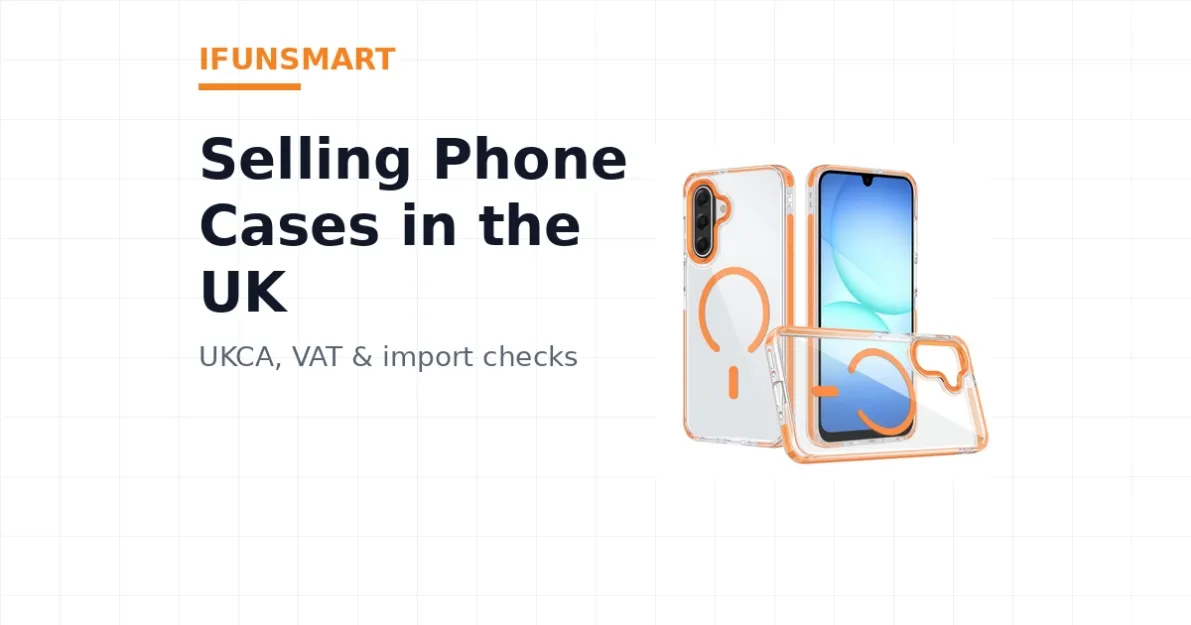
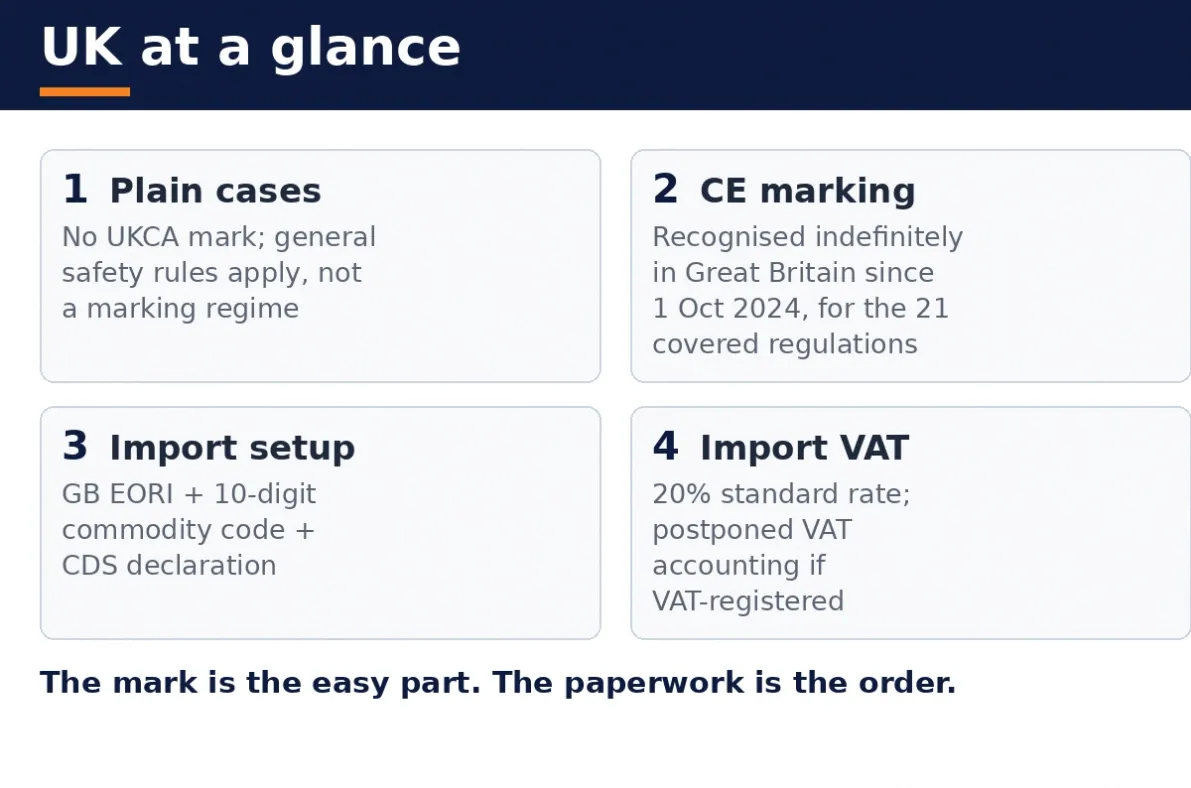
The short answer: A plain phone case — TPU, PC, liquid silicone or leather, with no battery and no electronics — needs no UKCA mark to sell in Great Britain. The case falls under the UK's general product safety rules, not under a marking regime. The marks matter for the electronic accessories around the case: chargers, power banks and MagSafe chargers. And since 1 October 2024, CE marking is recognised in Great Britain indefinitely for the product regulations it covers, so a CE-marked charger does not need re-marking for the GB market. The work a UK buyer actually has to do is on the import side: a GB EORI number, the right 10-digit commodity code, a customs declaration, and import VAT.
Send model, style, quantity and country on WhatsApp https://wa.me/8613632248734 — we reply within 24 hours with MOQ, sample cost and lead time for that model.
1. Do phone cases need a UKCA mark?
No — not a plain case. This is the first thing to get right, because it is the most common misunderstanding in a UK order.
UKCA (UK Conformity Assessed) is the marking for goods placed on the market in Great Britain — England, Scotland and Wales — that previously needed the CE mark. It covers around twenty product groups, including electrical and electronic equipment and radio equipment. A phone case made of TPU, PC, silicone or leather is none of those. It is a consumer product, covered by the General Product Safety Regulations 2005, which require only that the product placed on the market is safe. The safety rules do not permit a CE or UKCA mark on a product that does not require one — putting a UKCA mark on a plain case is not extra safety, it is a wrong mark.
What does need a mark is anything in the order with electronics in it: a charger, a power bank, a MagSafe charging pad or a case with a built-in battery is electrical or radio equipment, and the marking regimes apply to it. Ask the factory which items fall under a marking regime and which do not — a supplier who stamps UKCA on everything is not being careful. Read more: https://www.ifunsmart.com/posts/phone-case-materials-tpu-pc-
2. UKCA vs CE since 1 October 2024 — what changed
The rules changed in 2024, and most guides written before that date are now out of date.
Under The Product Safety and Metrology etc. (Amendment) Regulations 2024, in force since 1 October 2024, Great Britain recognises CE marking indefinitely for 21 product regulations — among them radio equipment, machinery, ecodesign and RoHS. A CE-marked product that meets EU requirements can be placed on the Great Britain market without a UKCA mark, and there is no end date. UKCA remains valid, and a product can carry both marks — but for most covered products UKCA is now a choice, not an obligation.
Two details matter. Until 31 December 2027 the UKCA mark may sit on a label or an accompanying document rather than on the product itself, for most regimes — that date is a labelling easement, not a deadline after which CE stops being accepted. And Northern Ireland is different: it follows EU rules under the Windsor Framework, so CE is the mark there and UKCA alone is not accepted.
For a phone-case order that means: if the electronic accessories already carry a valid CE mark for the EU, the same marking is accepted in Great Britain, and no re-marking is needed. Ask the factory to confirm, in writing, which regime each item falls under and what mark it carries. Read more: https://www.ifunsmart.com/posts/selling-phone-cases-eu-2026-gpsr-reach-rohs-documents
3. What the UK actually asks for: safety and materials
With no mark to put on a plain case, the UK buyer's checks move to safety and materials — and to who is responsible for them.
Under the General Product Safety Regulations 2005, the producer is the manufacturer if it is based in the UK; if the manufacturer is outside the UK, the producer is its UK representative — or, with no UK representative, the first importer into the UK. For a UK distributor importing cases from China, that usually means the importer is the producer in UK law, with the traceability and monitoring duties that go with it. Great Britain has no general rule requiring a UK Responsible Person, unlike the EU's new GPSR, which has required an EU-based responsible person since 13 December 2024 — but the same stock sold into the EU or Northern Ireland must meet the EU rules.
On materials, Great Britain runs its own chemicals regime, UK REACH, separate from EU REACH, with the duties falling on the importer. Ask the factory for the material composition of each case and whether any substance of very high concern is present, so the importer can meet its own duties. This article is educational only: iFunSmart does not hold GPSR, REACH or RoHS certifications, and no certificate is claimed here — ask for the material information, in writing, before the order. Read more: https://www.ifunsmart.com/posts/phone-case-factory-vs-trading-company
4. Importing into Great Britain: the five steps
The marking question takes five minutes. The import setup takes longer, and it is where a first UK order usually stalls.
Get a GB EORI number. An EORI number identifies the business to customs, and every commercial import declaration into Great Britain needs one belonging to the importing business — an EU EORI number does not work. Apply free on GOV.UK before the first shipment; HMRC usually issues it straight away, though checks can take up to five working days.
Find the commodity code. Every product has a 10-digit commodity code, which decides the customs duty, the VAT rate and whether any licence applies. The code is the importer's responsibility even if a broker enters it — a wrong code means the wrong duty, and HMRC will collect any underpayment later. Look it up on the UK Trade Tariff and confirm it with your broker before the goods ship. Goods from China normally pay the standard UK Global Tariff rate, as China has no preferential trade agreement with the UK.
Make the import declaration. Every commercial import needs a declaration on HMRC's Customs Declaration Service. Most importers use a customs broker or freight forwarder, who will need the GB EORI number, the commodity code, the commercial invoice and the freight and insurance costs.
Pay duty and import VAT. Customs duty is charged on the customs value — the goods plus freight and insurance to the UK — at the rate for the commodity code. Import VAT is charged at the standard rate of 20% on the customs value plus duty plus delivery costs to the first destination in the UK. If the business is VAT-registered, it can use postponed VAT accounting and declare and reclaim the import VAT on the same VAT return instead of paying it at the border. Shipments worth £135 or less follow different rules: no customs duty on most goods, with VAT charged at the point of sale.
Keep the records. File the declaration, invoice, commodity code and duty and VAT evidence with the order — HMRC requires import records to be kept. Read more: https://www.ifunsmart.com/posts/importing-phone-cases-documents-checklist and https://www.ifunsmart.com/posts/phone-case-freight-ddp-air-vs-sea
5. What to order for the UK market
The UK is a model-driven market: the cases that sell are the ones that cover the phones UK customers actually own, in the colours UK retail wants.
Cover the current models first. iPhone 18 Pro and Pro Max, Galaxy S25 and S26, and the Z Fold and Z Flip lines are the models buyers ask about first. Send the factory your model list and get written confirmation of which designs cover each model and generation — a case for the wrong generation is dead stock. Read more: https://www.ifunsmart.com/posts/phone-case-model-mould-coverage
Order at distributor depth. MOQ is 50 pcs per colour per model, so a first order can test a model and colour. For distributors, bulk orders start at 500 pcs per order in total, and samples are free. Read more: https://www.ifunsmart.com/posts/bulk-phone-case-orders-volume-guide and https://www.ifunsmart.com/posts/phone-case-moq-50-per-colour-first-order
6. The questions to ask the factory before you order for the UK
Ask for these six things, in writing, before you pay: which items fall under a UKCA or CE marking regime and which do not, and what mark each marked item carries; the material composition of each case and whether any substance of very high concern is present; the exact models and generations covered, on one shared model list; the commodity code for each item; the packaging, and whether custom retail packaging is available; and a sample fitted on the phones it is made for — not a catalogue photo. If any answer is vague, the order is not ready.
New customers pay 30% deposit by T/T or Western Union; after the goods are ready we send photos, a video and the packing list, and you pay the balance before the goods ship. Send us your model list — we confirm what is covered, within 24 hours. Read more: https://www.ifunsmart.com/posts/phone-case-payment-terms-first-order
FAQ
Do phone cases need a UKCA mark to sell in the UK? No — not a plain case. A case made of TPU, PC, silicone or leather, with no battery and no electronics, is a consumer product under the UK's General Product Safety Regulations 2005, not a product under a marking regime — and the safety rules do not permit a UKCA mark on a product that does not require one. Chargers and power banks in the same order do fall under marking regimes.
Is CE marking still accepted in Great Britain? Yes — indefinitely, for the 21 product regulations covered by the 2024 Amendment Regulations, in force since 1 October 2024. A CE-marked product that meets EU requirements can be placed on the Great Britain market without a UKCA mark. Northern Ireland is different: it follows EU rules under the Windsor Framework, so CE is the mark there.
What is a GB EORI number and do I need one? A GB EORI number identifies your business to UK customs. Every commercial import declaration into Great Britain needs one belonging to the importing business — an EU EORI number does not work. Apply free on GOV.UK before your first shipment; HMRC usually issues it straight away, though checks can take up to five working days.
How much import VAT do I pay on phone cases from China? Import VAT is charged at the standard rate of 20% on the customs value plus duty plus delivery costs to the first UK destination. A VAT-registered business can use postponed VAT accounting and declare and reclaim the import VAT on the same VAT return. Shipments worth £135 or less follow different rules, with VAT charged at the point of sale.
What should I ask the factory before ordering for the UK? Six things, in writing: which items need a UKCA or CE mark and which do not; the material composition of each case; the exact models and generations covered; the commodity code for each item; the packaging; and a sample fitted on the phone it is made for.
About iFunSmart
Ifun Electronics Technology Co., Ltd, Guangzhou, since 2010. A phone case factory — 1,000+ designs, 500+ models, 500K+ pcs/month, exported to 30+ countries — supplying wholesalers, importers and distributors in the UK and across Europe. Our 2700GS Magnetic Case for iPhone 18 Pro Max uses N52 magnets at up to 2700 Gauss. MOQ is 50 pcs per colour per model; bulk orders from 500 pcs per order in total; free samples for distributors. Ask us for a live video call from our production line, our mould and model list, or a sample — we reply within 24 hours. WhatsApp https://wa.me/8613632248734 — Email contact@ifunsmart.com