Importing Phone Cases: Documents & Checks First
First container? Get the documents right before you pay: commercial invoice, packing list, certificate of origin, test reports and customs codes — what to ask your supplier for, and what to check.
The short answer: Before your first container leaves the factory, six documents decide whether customs clears it or holds it: invoice, packing list, transport document, certificate of origin, test reports and the customs declaration. Agree them in writing before the deposit — not after the goods are on the water.
1. What documents does a first phone case import need?
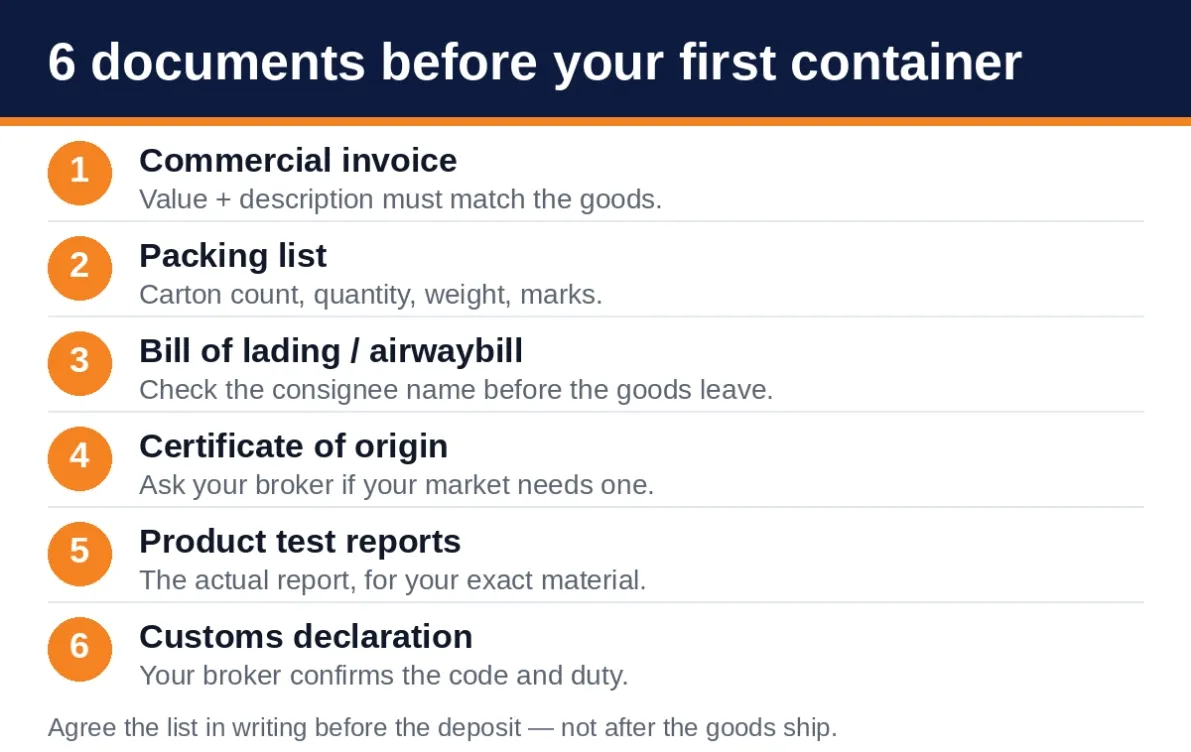
A first import is mostly paperwork. These are the six documents to ask for — and to check — on your first order:
Commercial invoice. The supplier's invoice: seller and buyer names, goods description, model and style, quantity, unit price, total value, currency and payment terms. Customs uses it to value the shipment, so the description and value must match the goods.
Packing list. What is actually in each carton: carton count, quantity per carton, net and gross weight, and the model, style and colour inside each carton. When the goods arrive, you count cartons against this list first — before you open anything.
Bill of lading or airwaybill. The transport document from the carrier: sea shipments travel on a bill of lading, air shipments on an airwaybill. It proves the goods were shipped, names the consignee, and is the document you present to collect the goods. Check the consignee name before the goods leave — a wrong name is a slow, expensive fix.
Certificate of origin. A document stating where the goods were made. Some markets ask for it; others do not. Ask your broker whether your market needs one, and ask the supplier in writing whether it can provide one — before the deposit, not after the goods ship.
Product test reports, if your market asks for them. Ask your broker or your buyer which reports your market requires for phone cases, then ask the supplier to show the actual report for the exact material and model you are ordering. A report for a different material does not cover your order.
Customs declaration. Filed by your broker or forwarder from the invoice, the packing list and the goods description. The broker confirms the customs code — the factory declares the goods, the quantity and the value; the code and the duty are confirmed by your broker, not by the factory. Read more
If a supplier cannot name these documents, or says "don't worry" without putting the list in writing, stop. A real factory answers the document question in one message.
2. Which documents come from the supplier — and which are yours?
Split the list in two — the most common first-import mistake is assuming the supplier handles the buyer's half.
The supplier provides: the commercial invoice, the packing list, the transport document (through the forwarder), and — if agreed — the certificate of origin and any product test reports it holds. Ask us which documents we can provide for your order before the deposit — we confirm each one in writing.
You provide, through your broker or forwarder: the customs declaration and the import registration or licence your country requires. Your broker tells you what your country needs — it is different in every market.
The forwarder sits between the two. On FOB terms, you or your forwarder book the freight; on CIF or DDP terms, the supplier's side arranges it. Either way, agree in writing who books the freight, who pays for it, and who holds the transport document — before the deposit.
3. What should you check on the invoice and packing list before the balance?
You pay the balance after the goods are ready — the last moment you have real leverage. Use it to check the two documents that decide whether the shipment clears customs and matches what you ordered.
On the commercial invoice, check five things. Buyer and seller names spelled exactly as on your company registration. Goods description that names the actual product — "phone cases", not a vague line. Model, style and colour as agreed in the quotation. Quantity and total value matching the order. Payment terms as agreed — T/T or Western Union, 30% deposit, balance after the goods are ready and the evidence is sent.
On the packing list, check four things. Carton count, and the quantity inside each carton. Net and gross weight per carton. Model, style and colour per carton — not just a total. Carton marks, so you can find a model without opening every box.
Then check both documents against the evidence. After the goods are ready, we send photos, a video and the packing list of the actual goods — and only then is the balance paid. If the list says one thing and the photos show another, do not pay the balance until it is corrected. Read more
4. What about compliance documents — GPSR, REACH and RoHS?
These are market rules, not factory certificates you buy with the order. GPSR, REACH and RoHS are EU rules about product safety and substances. What your market requires depends on the product, the material and the country — and it changes. Your broker or your buyer tells you what applies; a factory in China cannot decide that for you.
Ask for the actual report, not the claim. If a supplier says its cases are "REACH compliant" or "RoHS compliant", ask to see the test report — and check that it covers the exact material you are ordering, that it is recent, and that the name on it matches the supplier you are paying. A report for a different material, or a certificate with no report behind it, does not cover your order.
What we can and cannot say. iFunSmart does not hold GPSR, REACH or RoHS certificates, and we do not claim to. We tell you plainly which documents we can provide for your order, and confirm them in writing before the deposit. If your market needs a test report we do not hold, we say so — so you can arrange the testing yourself. A supplier that claims every certificate for every material is not a safer supplier; it is a supplier you cannot check. Read more
5. How do customs codes and duties work for phone cases?
Short version: the factory declares the goods; your broker confirms the code and the duty. Do not let anyone quote you a duty rate as a promise.
The customs code. Every product has a customs code — the classification your broker uses to declare the goods. The code depends on the material and the construction, and it is your broker who confirms which code applies to your shipment. Ask the supplier for an accurate goods description — material, style, model — so the broker can classify it correctly. A wrong description is how shipments get held.
The duty and tax. Duty and import tax depend on your country, the code, and the declared value. No factory can promise you a duty rate — the rate is set by your customs authority, not by the supplier. Ask your broker for the rate before you order, using the real invoice value, and never agree to a lower declared value to "save duty": an undervalued invoice is a customs offence in most markets, and it is you, the importer, who carries the risk.
The terms decide who pays what. Under EXW you collect the goods yourself; under FOB the supplier delivers them to the port; under CIF the supplier also arranges freight and insurance; under DDP the supplier's side delivers to your door including duty. The trade term is agreed in the quotation — read it line by line before the deposit. Read more
6. What final checks happen before the container leaves?
The container leaves once. Check everything before it does.
Check one: the order against the quotation. Model, style, colour, quantity per colour, packaging, payment terms — the quotation is the order. Anything agreed by message and left out of it is not agreed.
Check two: the documents against the goods. Invoice, packing list and the photos and video of the actual goods — do they match? If they do not match, the balance waits.
Check three: the shipping details against your broker. Consignee name, port or airport, forwarder, and who holds the bill of lading. Send your broker the invoice and packing list before the goods leave, so the declaration is filed from the real documents.
Check four: the marks on the cartons. Model, quantity and destination on the outside of each carton, so your warehouse can receive the shipment without opening every box.
Pass all four and the container can leave. Miss one, and you will be fixing it from the other side of the world, after the money has moved. Read more
FAQ
What documents do I need for my first phone case import?
Commercial invoice, packing list, bill of lading or airwaybill, certificate of origin (if your market needs one), product test reports your market asks for, and the customs declaration your broker files. Agree the list in writing before the deposit.
Who provides the certificate of origin?
The supplier, if agreed — ask in writing before the deposit. Your broker tells you whether your market needs one at all.
Do I need REACH or RoHS certificates to import phone cases into the EU?
It depends on your market and material — ask your customs broker or buyer what applies. If a supplier claims compliance, ask to see the actual test report for the exact material you are ordering. iFunSmart does not hold GPSR, REACH or RoHS certificates and does not claim to.
Who confirms the customs code and duty rate?
Your customs broker — using the supplier's goods description, quantity and value. A factory cannot promise a duty rate.
What should I check before paying the balance?
The invoice and packing list against the quotation, and both against the photos and video of the actual goods. Pay the balance only when the documents match the goods.
About iFunSmart
Ifun Electronics Technology Co., Ltd, Guangzhou, since 2010. A phone case factory — 1,000+ designs, 500+ models, 500K+ pcs/month, exported to 30+ countries. MOQ 50 pcs per colour per model; bulk and distributor orders from 500 pcs per order in total; free samples for distributors. Ask us for a live video call from our production line, our mould and model list, or a sample — we reply within 24 hours. New customers pay 30% deposit by T/T or Western Union; we send photos, a video and the packing list before the balance. WhatsApp https://wa.me/8613632248734 — Email contact@ifunsmart.com