Oct 2, 2026Business Solutions
Stocking a Store Wall: A Phone Case Assortment Plan
A store wall is an assortment decision, not a stockroom dump. How to plan model mix, price bands, depth, and refresh cadence for a physical phone shop.
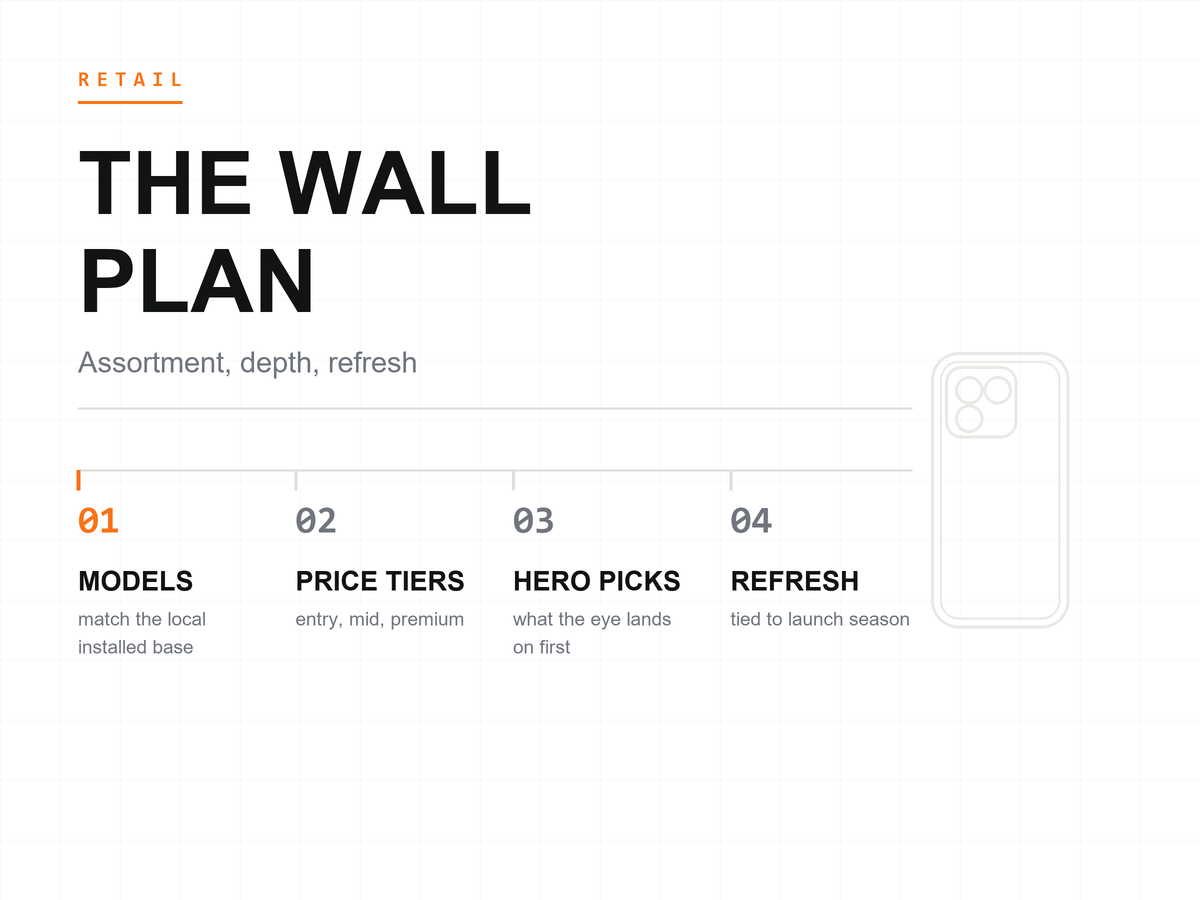
A store wall is an assortment decision, not a stockroom dump. The wall that sells is planned in four layers: model mix, price bands, color width, and refresh cadence, each sized to the customers who walk past it. iFunSmart supplies phone shops and independent retailers wholesale from our Guangzhou factory.
Last updated: October 2, 2026.
What a Store Wall Is Really Deciding
A wall is finite. Every facing you give to one style is a facing taken from another, and filling the wall well is not the same job as buying stock.
An assortment plan is a written decision about how many models, price bands, and colors a wall carries, and in what proportion. An order is a quantity; a plan is a map. Shops that skip the map spend real money on a wall that answers no particular customer. A customer holding an iPhone 18 Pro sees what is within reach, not what sits in the back office.
Four layers do the work: model mix, price bands, color width, and refresh cadence. Build them in that order, because each layer narrows what the next one can hold.
Start From What Your Customers Carry
Installed base is the term retail planners use for the phones actually in customers' pockets around your shop. It is a local fact, not a national average, and the first input to any wall plan.
You can estimate your own installed base without buying a report. Phones that come in for repair, and the models customers name when they ask for a case, are data points. Keep a tally at the counter for a few weeks.
Coverage follows the tally. Models that dominate get a full treatment of finishes and colors. Secondary models keep a narrow presence, while anything rare waits in the back catalog or arrives as a special request.
The list moves with the market. iPhone 18 Pro and iPhone 18 Pro Max sit at the top of Apple's current line, the iPhone 17 series is still in plenty of hands, and Samsung buyers ask for Galaxy S25 and S26 cases. Foldable owners carry an iPhone Duo, and the Duo wants a case designed around its hinge, not a standard shell.
We cannot tell you which models dominate your city; that depends on your customers and the shops around you. What we can offer is tooling: our library holds 1,000+ molds, opened at 1:1 precision with in-house CNC.
Three Price Bands, Read at Arm's Length
Shoppers decide with their eyes faster than they read, and price bands are the tiers a shop uses to organize that decision: an entry band, a mid band, and a premium band.
The entry band gets a case onto every phone that walks in. Its customer is price-led, often replacing a worn case rather than upgrading. In the middle sits the mid band, the center of gravity for most shops, because most walk-in customers compare a few finishes and choose between them. Fewer facings belong to the premium band, which serves the customer who wants the upgrade.
Keep all three bands and a customer can trade up or down without leaving. Remove the entry band and price-led walk-ins drift down the street; remove the premium band and the wall teaches customers to think of you as the cheap option. Most plans weight the middle band most heavily, with the ratio set by your catchment and corrected by sell-through.
Placement matters. Eye level is the most valuable strip, so the styles you want compared belong there; lower rows suit the entry band, and premium finishes near the counter get picked up and compared.
Our own range shows the point: a clear card-holder build and an armor build sit in different bands and answer different customers.
Width and Depth: The Wall Versus the Stockroom
Width is the number of distinct styles and colors on display; depth is the number of units standing behind each facing. The wall shows width and the stockroom holds depth. A wall used as a warehouse hides the range.
Colors multiply width quickly. Two colors of one style take two facings and two bets; a third on a proven style earns its space, while a third on an unproven style just duplicates a gamble. Many shops default to two colors on most styles, one on a test, and the rest of the palette held back until a style proves itself.
Depth follows sell-through, not the size of the last shipment. Deep stock behind a slow facing ties up cash and hides that the style is not moving; thin stock behind a fast facing leaves gaps by the weekend. Give a facing more depth after it has emptied more than once.
An empty peg reads as sold out to one customer and as not worth stocking to another, and a shop cannot tell which is walking past. A closing walk, a note of what emptied, and a refill before opening keep the wall honest.
Buyers who want the factory-side view of the same planning problem can read our walkthrough of one-stop sourcing across cases, films, and chargers.
The Refresh Calendar
A wall that never changes stops teaching you anything. Refresh keeps the other three layers honest, and it runs on two clocks: the market's and yours.
The market clock is launch season. When a new model reaches the market, its cases should be on the wall while customers are still excited about the phone. The shop that fills the peg before the first customer asks keeps the sale; ordering after the wave has passed means stock for a quieter month.
Your own clock is sell-through. A facing that has gone a full cycle without a reorder does not pay for its space. A style that keeps emptying needs depth, a second color, or a better position.
One cadence many shops use: a full wall review each season, a light review each month, a closing walk each day. The seasonal review rebalances bands and models, the monthly review turns slow facings into tests, and the daily walk keeps the wall stocked.
Nothing here predicts what your street will buy. We do not publish sales forecasts, and no supplier can promise how fast a style will move in your catchment. Your counter tally is worth more than anyone's opinion, including ours.
Common Questions From Buyers
How many models should a store wall cover?
Cover the models your customers actually carry, and no more than the tally supports. Most shops do well with a few anchor models under full treatment and a longer tail on a narrow strip. Covering every phone spreads the wall thin, so let the counter set the list.
Should a shop display every color a style comes in?
No, and the reason is space. Every color takes a facing, and facings are the scarcest thing on the wall. Two colors on most styles, one on a test, and the rest of the palette in the back catalog does the job for many shops. Bring a color out when customers ask twice.
When should a shop refresh the wall, and when should it wait?
Refresh when your own data says a facing has stopped earning its space, or when a new model lands and the wall must answer for it. Wait when a style is merely slow in a quiet week; a full cycle of selling is the fairer test. The calendar belongs to your shop.
What to Do Next
iFunSmart has built phone cases in Guangzhou since 2010 and supplies shops and independent retailers wholesale, with one-stop OEM/ODM work for buyers bringing their own designs and labels. We do not publish a complete price list, and we cannot promise how any style will sell on your street. What we can do is match your tally and wall space to the ranges we already run.
Send us your model list and a photo of your wall, and we will suggest a wholesale mix that fits it.
Apple, iPhone, Samsung, and Galaxy are trademarks of their respective owners. iFunSmart is an independent manufacturer of phone cases and accessories and is not affiliated with, authorized, sponsored, or endorsed by Apple or Samsung.