Sep 25, 2026Business Solutions
Port Arrival Is Not Your Shelf Date
A container reaching port is not stock on your shelf. The three post-port stages that decide your shelf date, and how Incoterms assign them.
A buyer sourcing iPhone and Samsung cases asked us for DDP shipping time to the UK, and the question hides a trap most buyers fall into: the date a container reaches a port is not the date stock is ready to sell. Lead time runs to your shelf, not to the quay. Counting it to the port is how a well-planned launch turns into a late one.
Last updated: September 25, 2026.
What Lead Time Should Actually Measure
Lead time is the elapsed time from order confirmation to goods being ready on your shelf, not to the goods arriving at a port. The distinction sounds academic until a launch date depends on it.
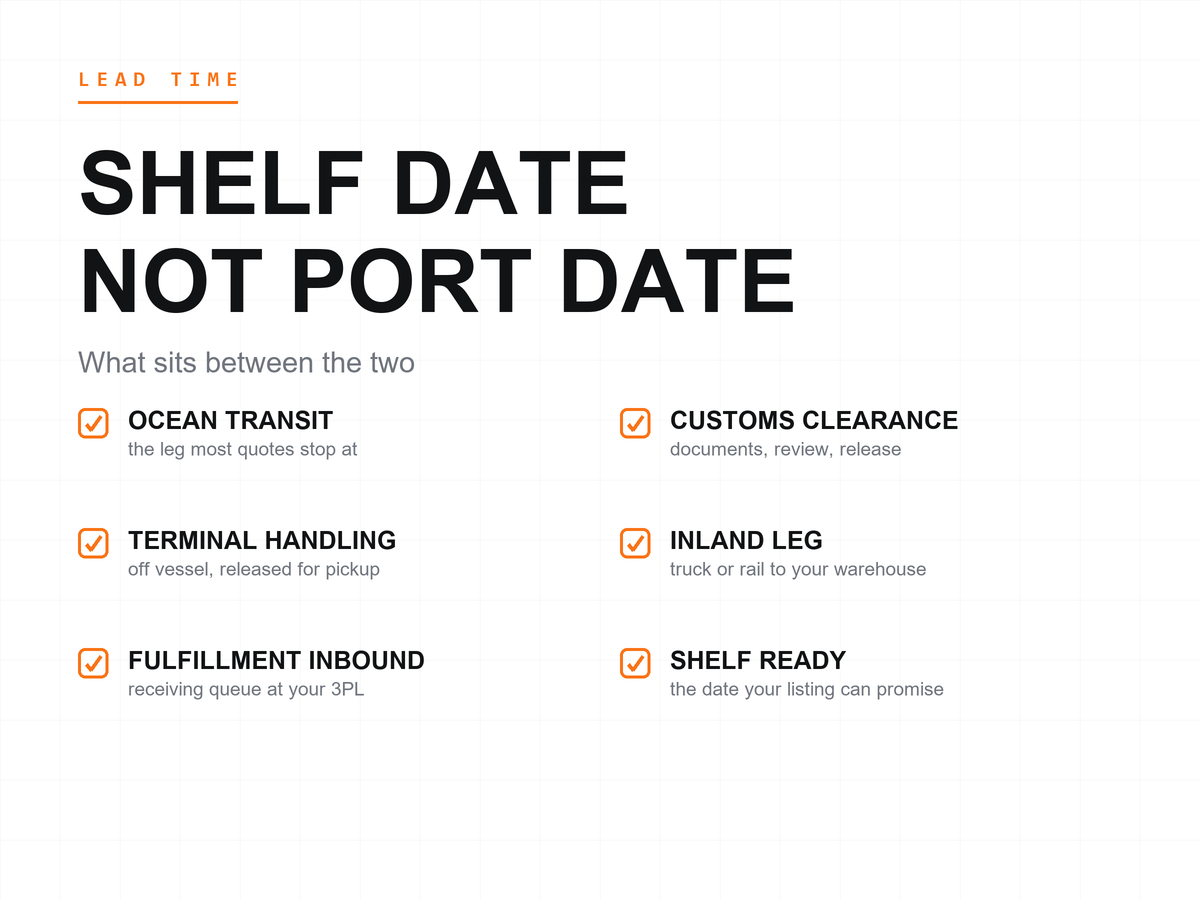
Ports are where a shipment changes mode, not where it finishes. After the vessel docks, your goods still have to clear customs, be released by the terminal, and travel the inland leg to your warehouse or your marketplace's fulfillment center. Each of those stages has its own clock, and only one of them is visible on a tracking page.
This is why two buyers ordering the same product on the same vessel can list for sale weeks apart. The product and the transit are identical; what differs is the distance between the port and the shelf.
Why the Port Looks Like the Finish Line
The port feels like the end of the journey because it is the last stage the seller controls directly, and it is the last stage with a clean tracking event.
Once a container clears the vessel, the remaining work moves to parties you may not have chosen: a customs broker, a terminal, and an inland carrier. A buyer watching a tracking number sees the port arrival and reads it as completion, while the part of the journey that decides their shelf date has not started.
This is also where a quotation quietly misleads. A supplier quoting a ship date is answering a question about the factory and the vessel. The buyer is asking a question about their shelf, and the two answers differ by exactly the post-port stages.
What Sits Between the Port and Your Shelf
Three stages sit between a docked container and sellable stock, and each one can add days you did not budget.
The first is customs clearance, which begins with document submission and ends with release. Its length depends on the destination country, the completeness of the paperwork, and whether the shipment is selected for inspection. Cleared goods move on; goods held for a query wait, and the wait is not something a factory can forecast on your behalf.
The second is terminal and port handling, the process of getting your container off the vessel, through the terminal, and available for pickup. This stage depends on port congestion and on how quickly the container is scheduled for release.
The third is the inland leg, the truck or rail move to your warehouse. For a buyer selling through a marketplace, this often means an additional hop into a fulfillment center with its own receiving queue, which is another wait that never appears in a shipping quote.
Where Incoterms Change the Clock
The trade term you agree decides who carries each post-port stage, and therefore whose calendar absorbs the delay.
Under DDP, delivered duty paid, the seller handles the whole journey including duty and clearance, and you receive the goods at the agreed destination. This is the term that makes the post-port stages someone else's problem, and it is why buyers ask for it by name.
Under DAP, the seller delivers to a named place but the buyer handles import clearance and duty. Under FOB, your responsibility starts once the goods are on board at the origin port, and every stage after that is yours to arrange. A shipment like our clear MagSafe case range travels the same post-port stages as any other, whatever the term. Under EXW, you arrange everything from the factory gate onward.
None of these terms is inherently safer. DDP gives you a single delivered number and less administration; FOB and EXW give you control and usually a lower quoted figure. What matters is that both sides are counting the same stages, because a lead time discussed in one set of terms and measured in another is how expectations drift.
How to Build a Realistic Timeline
The practical method is to work backward from the date stock must be on your shelf and assign every stage an owner.
Start with the shelf date you actually need, then subtract the inland leg, then clearance, then terminal handling, then the ocean transit, and finally production. The rugged armor line and the slim RFID card-holder build pack differently, so their carton plans and post-port stages are planned separately. What remains is your order deadline, and it is usually earlier than a buyer's first estimate, because most estimates drop the post-port stages entirely.
Two habits keep this honest. Ask each stage's owner to give their own figure rather than accepting one blended transit estimate, and put the assumptions in the order confirmation so the ship date and the arrival expectation are recorded together.
A caveat worth stating plainly: we cannot guarantee a clearance duration, because that stage is decided by your destination's authorities and the completeness of your documents. What we can do is quote the stages we control, name the ones we do not, and build a plan that reflects both. For buyers who want the post-port stages handled rather than estimated, DDP is the term that assigns them to us.
Common Questions From Buyers
How much time does customs clearance add?
It depends on your destination, your documentation, and whether your shipment is selected for inspection, which is why no honest supplier quotes a single clearance figure. The useful approach is to ask your broker for a range for your lane and product, then hold that range in the timeline rather than assuming the fast case.
Should I ask for DDP or FOB?
It depends on whether you would rather have one delivered number and less administration, or a lower quoted figure and full control of the post-port stages. Buyers with their own broker and freight rates often prefer FOB or EXW, and buyers without that infrastructure usually want DDP. Both are legitimate; mixing the terms across two suppliers is what breaks a comparison.
What date should I give my own customers?
Give yourself a buffer for the stages you do not own. A delivery estimate built from production plus ocean transit alone ignores clearance, terminal handling, and the inland leg, and those are exactly the stages most likely to move. The buyers who quote reliable dates are the ones who budgeted for the post-port work.
What to Do Next
We quote the stages we control and name the stages we do not, and on DDP orders we carry the clearance and inland work so the post-port clock is ours rather than yours.
Send us your destination, product, and the date stock must be on your shelf, and we will lay out the full timeline stage by stage and confirm a delivery window rather than only a ship date.
Send us your shelf date and destination and we will confirm a delivery window, not just a ship date.
Apple, iPhone, Samsung, and Galaxy are trademarks of their respective owners, used solely to indicate compatibility. iFunSmart is an independent manufacturer of phone cases and accessories.