Oct 3, 2026Business Solutions
Post-CNY Restock: Why Q1 Stock Starts in November
Chinese New Year ends in February, but the restart queue forms in November. What to shape for Q1 2027 now: volumes, colors, models, and sample approvals.
Chinese New Year 2027 ends in February, but the decision that shapes your Q1 restock gets made in November. January production slots fill from December's confirmations, so buyers who wait for the holiday to pass queue behind buyers who decided months earlier. Here is what iPhone case buyers should settle in November, and where iFunSmart fits.
Last updated: October 3, 2026.
The Queue Forms Before the Holiday Ends
Chinese New Year 2027 falls on Saturday, February 6, 2027. The date is the anchor for everything that follows, but the Q1 problem is not the festival itself. It is the capacity that exists when the region starts up again after it, because that capacity is smaller than the demand waiting for it.
Restart capacity after the holiday is contested. Every buyer who under-ordered before the shutdown wants the same early slots, and a factory coming back does so in stages rather than all at once. The queue for those slots is not formed in February when lines restart. It is formed earlier, by whichever orders are already confirmed.
The restart queue is the line of confirmed orders that claim the capacity a factory resumes with after the holiday, and your place in it is set by your confirmation date rather than by the day the festival ends.
Our published cutoff calendar holds that January production slots fill from December's confirmations, which leaves November as the month where a Q1 restock is either decided or deferred. A restock deferred past November competes for whatever capacity is left. We do not publish restart dates, because shutdown and restart schedules are set factory by factory and confirmed per order in writing; until an order is confirmed, there is no date to hold.
The Month Sequence That Decides Q1
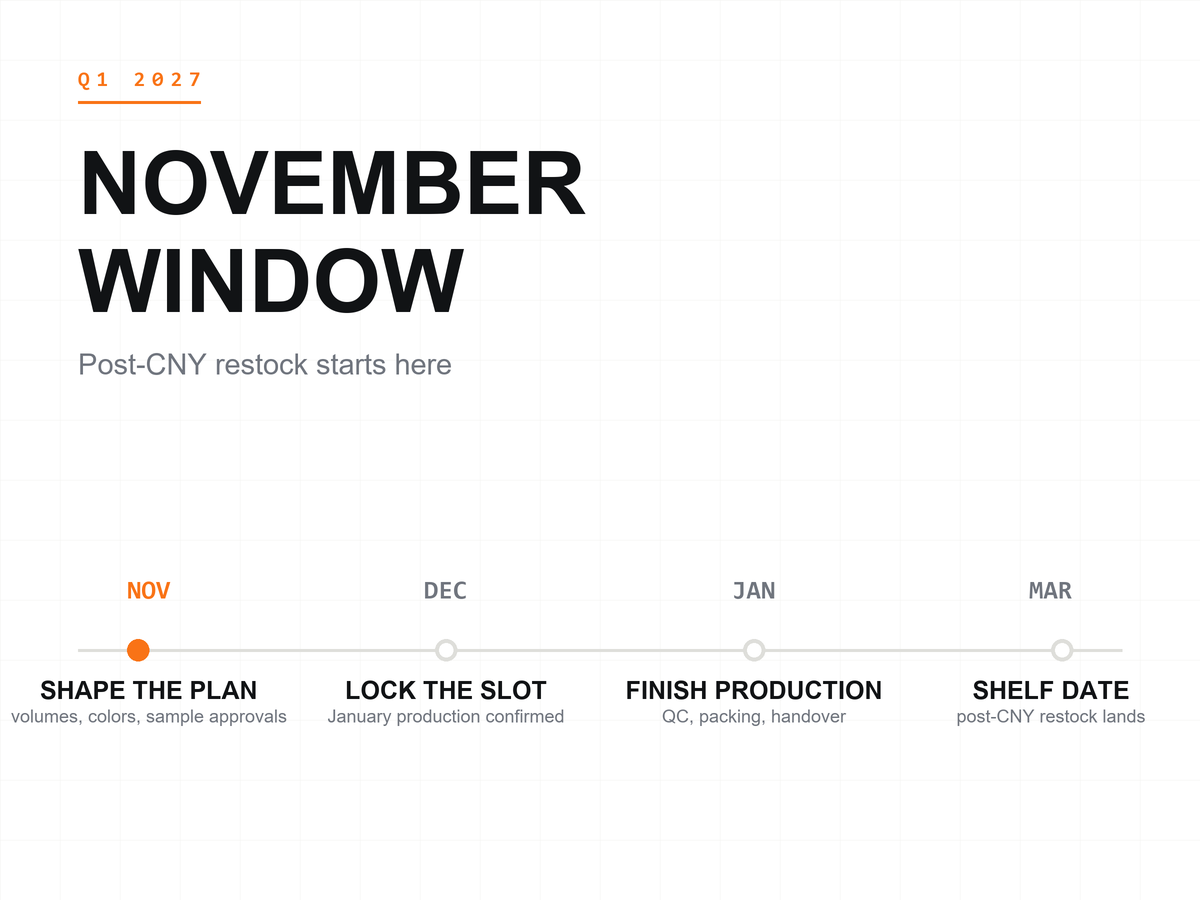
Five months, each with one job. November shapes the restock: which models, which colors, how deep, and whether the samples behind the bulk are approved. December locks the slot, because confirmed orders take the January capacity and unconfirmed plans take none. January produces. February shuts down around the festival, and March shelves the stock.
Read in reverse, the sequence explains itself. A March shelf date needs a January completion, which needs a December slot, and a December slot needs a November decision. Break a link and the chain delivers stock after the season it was meant to serve.
The sequence also shows why February is a poor month to start planning. Nothing is being produced, the restart sits weeks away, and the moves still open are the expensive ones: leftover slots, later shelf dates, or freight chosen in a panic. Buyers who put stock on shelves in March were working in November.
Four Decisions to Make in November
Recalculate the trigger lines first. A trigger line is the stock level that starts the next purchase while the shelf still has cover, and it moves when the replenishment cycle lengthens, which is exactly what the holiday does to a cycle. Run the line per model and per color against a cycle that includes the shutdown, and the SKUs that surface are the start of your restock list.
Confirm colors and models next. A post-holiday restock is mostly a reorder of what sold, so the real question is depth: which shades earned more space, and which barely moved. Settle that structure now. Depth decided in December becomes depth produced in January; depth decided in February becomes a conversation about leftover capacity.
Approve the samples and the packaging third. For designs that have run before, this is a fast check that nothing changed. For anything new inside the restock — a fresh color on a proven build, or a first run of a new design — the sample has to exist in November, because January bulk cannot wait on a sample still being approved. Packaging belongs in the same pass: we print and apply labels in-house, and the label content has to be settled before packing starts.
Count back from the target shelf date last. Start from the day the stock must be on the shelf, subtract the freight leg and the pre-departure stages, and check that the production finish still lands inside January. We cover that countback in detail in a separate piece on the last production day. What matters here is the timing: run it in November, while the answer can still change the plan.
What Existing Tooling Changes About Timing
A restock of designs already in our library starts from a different position than a first run. We hold 1,000+ molds in Guangzhou, so a mainline reorder skips the tooling stage that stretches a new design by weeks, and the sample step is a confirmation rather than a development.
The two positions in a typical restock behave differently. A mainline magnetic build such as the 2700GS magnetic case for the iPhone 18 Pro Max is the pick a well-set trigger line names first, because it sits on demand your sales records already show and its replenishment rides the same January slots that launch stock did. A spring hinge crystal clear magnetic case for the iPhone Duo sits on the other side of the list — a crystal clear magnetic build with a spring hinge, and a restock depth that only your own sell-through data can settle. Both need the slot decided in November. Neither gains anything from a decision made in February.
If you want to see which finishes and builds we run for the models you stock, ask us and we will name them.
Common Questions From Buyers
Why decide in November if slots fill from December?
Because a December slot exists only for an order ready to be confirmed. Confirmation needs a settled SKU list, agreed color depth, and approved samples, and those take weeks to prepare. That preparation is November's work. A buyer who starts it in December is asking a December question with the homework unfinished.
Which models belong in a Q1 restock?
The ones your trigger lines name once the shutdown sits inside the replenishment cycle, which usually means the models that sold through the autumn peak. Our mold list covers the iPhone 18 Pro and Pro Max, the iPhone Duo, and the iPhone 17 series, so a restock on existing tooling starts without a tooling wait. Which of those earn depth in your market is a read of your own sell-through, not a forecast we issue.
Does a restock order need new samples?
Not for a design that has already run to your specification; the bulk is produced against the build you approved, and a repeat sample would spend days the calendar does not have. A new color or a changed design does need one, which is why sample approval sits in November. We cannot start January bulk on a sample still moving between desks in December.
What to Do Next
November's work is preparation, and all of it happens on your side of the table: rerun the trigger lines, settle the color depth, clear the sample approvals, and count back from the shelf date. Done in November, this turns December into a one-step month — confirm the slot — instead of a scramble for leftovers. We mold in Guangzhou, tooling for the current iPhone generation already exists, and a restock on an existing mold runs a shorter cycle than a new build. The list and the dates decide what January holds.
Send us your Q1 restock list — models, colors, and target shelf date — and we will shape it into a production slot confirmed in writing before December fills the calendar.
Apple and iPhone are trademarks of Apple Inc. iFunSmart is an independent manufacturer of phone cases and accessories and is not affiliated with, authorized, sponsored, or endorsed by Apple.