Sep 29, 2026Business Solutions
How Private Mold Costs Actually Spread Across an Order
The tooling charge is paid once and spreads across every unit. How the break-even works, when a private mold pays, and the four terms to confirm first.
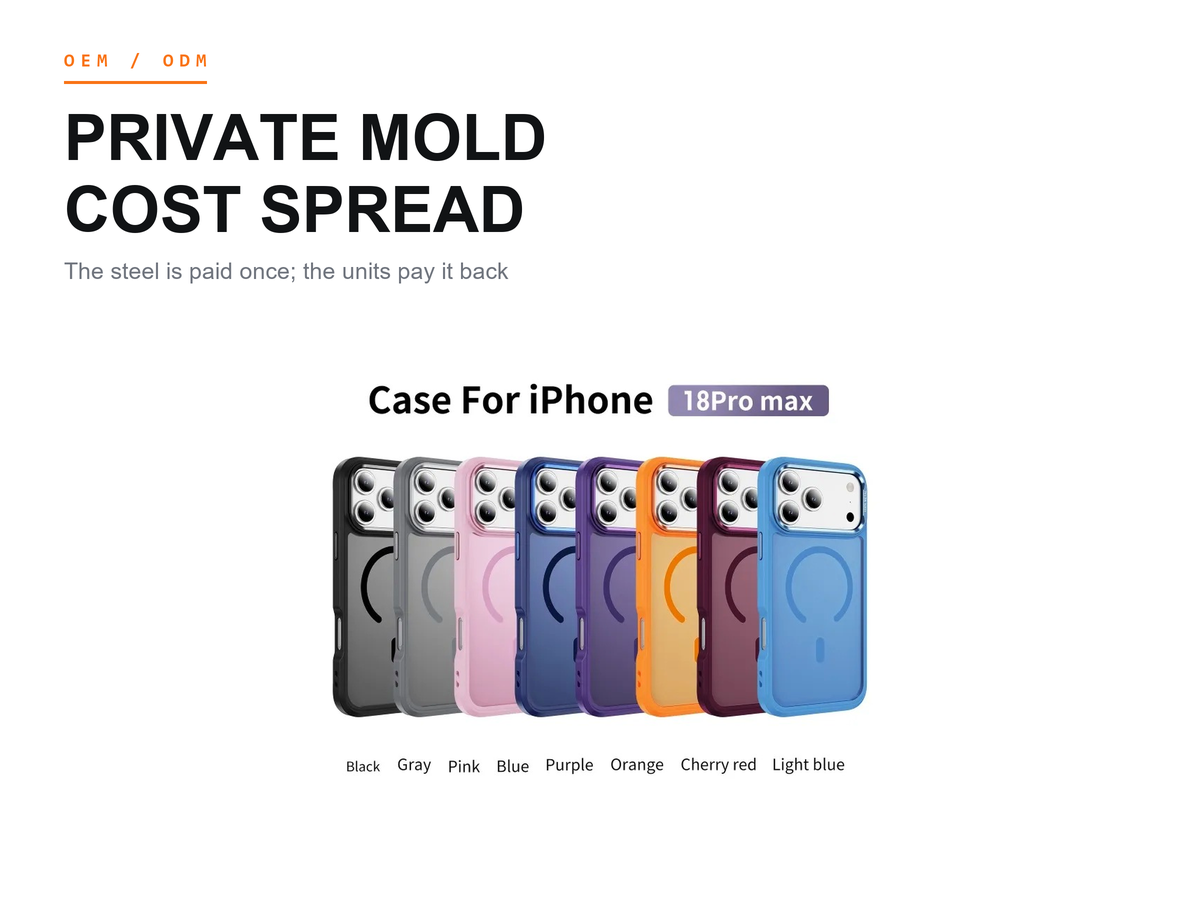
The tooling charge for a private iPhone or Samsung case mold is not a fee that disappears into a factory's pocket. It is the cost of steel, machining, and engineering spread across the units you order, and how fast it spreads depends on one variable a buyer controls: volume. Understanding that spread is the difference between a private mold that pays for itself and one that sits as dead money on your balance sheet.
Last updated: September 29, 2026.
What the Tooling Charge Actually Buys
A private mold charge is not a fee that disappears into a factory's pocket. It is the cost of the steel, the machining, and the engineering time that turn your design into a production tool.
That matters because the charge behaves differently from every other cost in your quote. Case materials, printing, and packaging are consumed per unit and repeat with every batch. The tool is paid once, and after it exists, every future unit runs on it without paying for it again.
This is why the tooling charge and the unit price should never be judged in the same glance. The tool is an investment with a break-even point; the unit price is a running cost. A buyer who compares two suppliers on unit price alone while ignoring who owns the tool is comparing the wrong numbers.
How the Cost Spreads Across Volume
The spread works like this: the tooling charge divided by the number of units you produce is the tooling cost each unit carries.
The arithmetic is simple and unforgiving in both directions. Produce one thousand units and each one carries the full tooling charge divided by a thousand. Produce ten thousand and each unit carries a tenth of it. The case itself does not change between those two orders — what changes is how much of the tool each unit has paid off.
This is why volume commitments in the private-mold conversation are really a question about time, not just quantity. A buyer who cannot reach the break-even volume in one order can reach it across several, and the tool keeps working across all of them. The mold does not care whether the units that pay it off were ordered in one batch or four.
When a Private Mold Becomes Worth It
The break-even question is not only about volume. It is about whether the design earns enough margin to pay off its tool before your market moves.
Three conditions point toward yes. The design is proven, because a mold cut for an untested idea carries design risk on top of tooling cost. The brand intends to hold the shape, because exclusivity is the return the tool pays. And the volume trajectory is visible, because a mold ordered for a growth curve pays itself on a schedule a buyer can plan around.
Two conditions point toward waiting. The design is untested, or the volume is uncertain. In both cases the honest answer is a stocked design under your brand first, and a private mold once the demand data exists.
We wrote about the difference between logo printing and exclusive tooling in a separate article, and the short version is that they are different purchases with different break-even points, not two prices for the same thing.
What to Confirm Before You Commit
The spread is only as honest as the terms around it, and four of them belong in writing.
Confirm who owns the tool once it is paid, and what happens to it if you pause ordering. Confirm whether the quoted tooling charge is the full charge or the first installment of one. Confirm that the mold is tagged and archived for your brand alone, because a mold that serves another buyer is not yours regardless of what you paid. The same standard applies across our metal-button range: the tool, the finish, and the mark are specified per buyer. And confirm the amortization is quoted per model, because a multi-model project spreads differently than a single-SKU one.
A supplier who answers all four in writing is describing a process. A supplier who answers vaguely is asking you to fund a tool whose rules they will explain later.
Common Questions From Buyers
Can the tooling charge be split across orders?
Often yes, and the useful form is a schedule agreed in advance rather than an invoice that arrives mid-project. The tool is paid once, and splitting that payment across your first orders is a normal structure for buyers who prove volume over time. The terms belong in the order confirmation, not in a verbal promise.
What happens to my mold if I stop ordering?
That depends on the ownership and storage terms you agreed, which is exactly why they should be in writing. A mold that is yours can be archived, moved, or produced elsewhere under the terms you signed. A mold that belongs to the factory cannot be claimed by the buyer regardless of what was paid toward it.
Is a private mold worth it for a new brand?
Usually not on the first order, because the demand data that justifies a tool does not exist yet. The normal path is a stocked design under your brand first, and a private mold once a design has proven itself. The exception is a brand whose shape is the brand, and for those buyers the tool is the moat rather than the cost.
What to Do Next
Our mold library runs to more than a thousand original designs, which is why stocked designs start without a tooling charge and private molds are quoted per model once the specification is fixed.
Send us the design you have in mind and the volume you are planning, and we will quote the tooling, the unit price, and the volume at which the tool pays for itself, so the break-even is a number rather than a hope. The [[process from design file to T1 sample -> /posts/private-mold-phone-case-process]] runs in the same four stages whatever the volume.
Send us your design and target volume and we will quote the break-even for your private mold.
Apple, iPhone, Samsung, and Galaxy are trademarks of their respective owners, used solely to indicate compatibility. iFunSmart is an independent manufacturer of phone cases and accessories.