Oct 7, 2026Business Solutions
Retail-Ready Cases: Labels Printed and Applied
Stock that lands labeled can be shelved the day it arrives. What in-house label printing and application cover, and what to confirm per order.
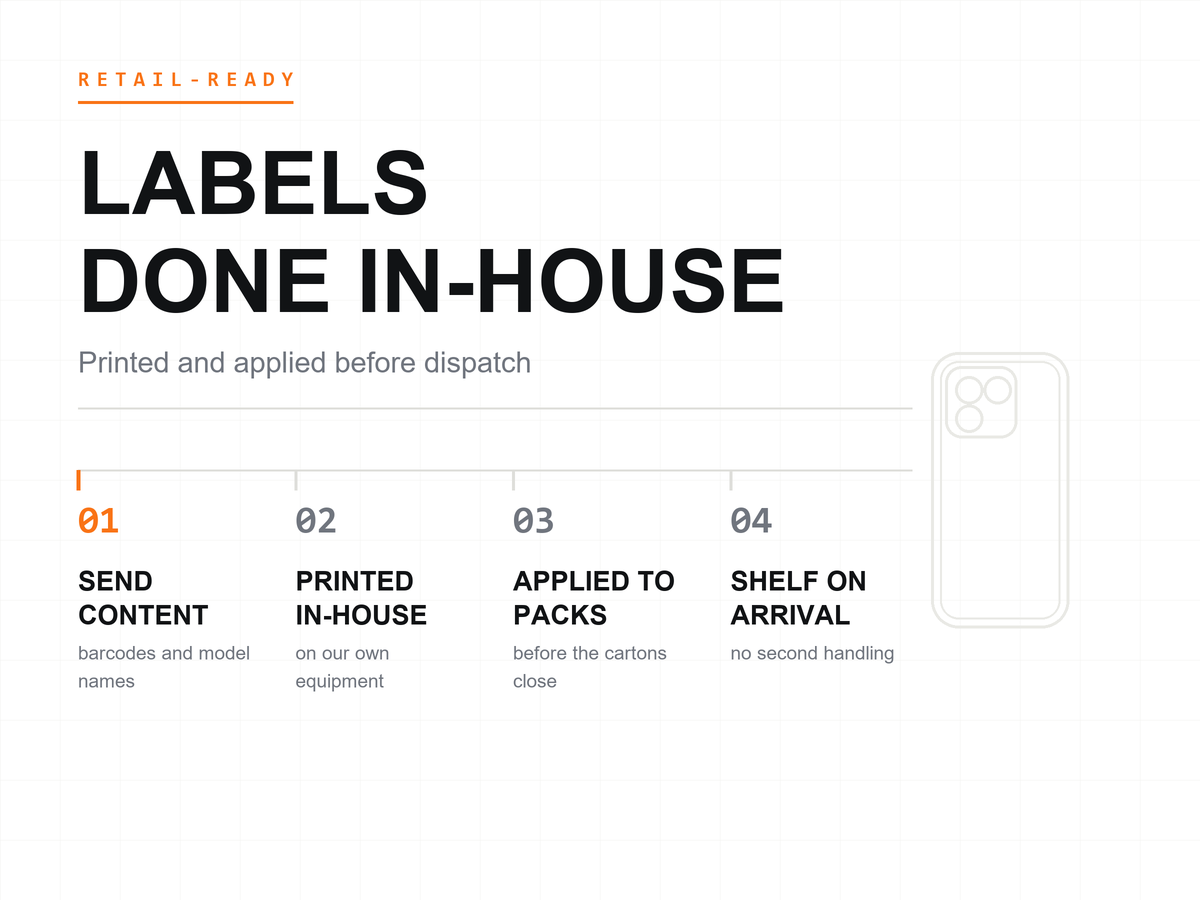
Labeled stock shelves the day it lands, and unlabeled stock does not. iFunSmart prints barcode and model labels in-house at our Guangzhou workshop and applies them to the packaging before your cartons close, so a case leaves the factory already dressed for the shelf. Here is what the service covers and what to confirm before labels print.
Last updated: October 7, 2026.
What Retail-Ready Means on Receiving Day
Retail-ready is stock a store can put on the shelf the day it arrives, with the barcode and the model marking already fixed to the packaging. Nothing needs peeling, printing, or sticking between the dock and the display. The shelf does not wait.
The opposite shows up more often than buyers expect. A carton lands at a phone store with the cases fine and the packaging bare. Somebody hunts for a local print shop, waits for a short label run, then peels and sticks during evening hours by whatever light the back room offers. A label that goes on crooked can cost more than no label at all, because a retail chain can turn away a delivery that looks unfinished at receiving. Every step in that sequence sits between your purchase and your first sale, and none of it adds anything a shopper can see.
Wholesalers run the same sequence at a harder scale. More cartons, more hands, more chances for a model to wear another model's label, and mixed shipments make the guessing worse because two dark finishes can look alike through carton film. Sorting by sight fails quietly. A printed label does not.
What the In-House Label Service Covers
Here is our side of the arrangement, stated the way we practice it: we print and apply labels in-house. The equipment sits in our own workshop, it prints barcode labels and model labels, and our packing line applies them to the packaging before a carton is sealed. The printing and the application are done for you at no charge. The cases and their packaging remain the goods you ordered; the label work is what we add so the same carton can travel straight to a shelf.
Two label types do most of the work. A barcode label gives the scanner at a store's receiving door and checkout counter something to read, so neither stop waits on a reprint. A model label tells staff and shoppers which case is which, and it earns its place the moment a shipment mixes iPhone models or finishes. Mixed cartons read themselves when a flagship magnetic model lands in the bin its label names and a hinge-protection Duo case sits beside it, each wearing the marking that says so.
Labels applied before shipment change the receiving day itself. Cartons move from the dock to the display wall or to a reseller with no repack stop in between, staff hours stay with the store instead of the sticker gun, and the label a shopkeeper finds is flat, straight, and placed on purpose. Tell us which models your shelves carry, and we can point to cases that arrive ready for them.
What You Provide and What We Confirm in Writing
A label is only as good as its content, and the content comes out of an agreement rather than out of thin air. What appears on the label, in what layout, and through what file form are points you and we settle together, order by order. We do not lock a single format into this article, because the right answer depends on your retail channel and on what your own systems expect to read.
Three details deserve their own lines in that written confirmation. The first is the label content itself: which text and which codes appear. The second is the position on the packaging. The third is which face carries the label, because a mark on the wrong panel can cover a feature photo or fight with a hanging tab. Settle those three and the labels have nowhere left to surprise you.
Label terms are confirmed per order in writing. That sentence is deliberately plain, and it is the boundary that keeps a chat thread from rewriting itself later. Whatever the messages suggested along the way, the written confirmation is the version that governs the run, and reading it once before production beats discovering its absence after the cartons land.
Where the Labels End and Other Services Begin
A label service has edges, and knowing them keeps an order honest. Labels are not packaging design. The structure of a box, the number of printed faces, and the insert inside it form a separate project with separate decisions, and we treat them that way instead of folding them silently into label work.
Labels are not compliance paperwork either. A marketplace program can demand its own barcode and placement rules on top of ordinary retail labels, and those rules belong to the channel you sell through, so plan for them as their own layer rather than assuming a retail label settles them. One more edge deserves naming: we do not promise new photography or artwork services beyond the labels themselves. Designing artwork from nothing is a different conversation, and we would rather mark that edge now than imply it later.
Common Questions From Buyers
Does the label work cost extra?
As we practice it, no: we print the barcode and model labels and apply them to the packaging at no charge. What varies from order to order is everything around that fact, such as how many label versions a mixed shipment needs and how the content reaches us, and the written confirmation records those specifics for your order. If any condition ever applies, you will read it there rather than discover it at receiving.
What label content does the buyer supply?
The honest answer is whatever the two of us agree on, which is why the agreement comes first. Some buyers send finished content ready to print; some send codes and ask the factory to lay the label out; some refine the layout over a proof until it reads right. We do not hardcode one arrangement into every order. What matters for your planning is that the source of the content and the file format are both settled in writing before the run, so nobody rebuilds a label in the week the cartons should ship.
Can labels sit on any face of the packaging?
Any face can carry a label, and the useful question is which face should. Some stores want the barcode on the back panel where a scanner reaches it without turning the box, and some want the model marking where a shopper standing at a wall of cases can read it at a glance. Position and face sound trivial in a chat message and decide whether a delivery shelves cleanly, which is why both go into the confirmation next to the content itself.
What to Do Next
Pick the models you want landing shelf-ready and tell us two things: what each label should say, and where it should sit. We confirm the content, the position, and the packaging face in writing before anything prints, and your cartons close with the labels already on. That is the whole arrangement, and it is short enough to read twice.
iFunSmart is a Guangzhou factory running one-stop OEM/ODM for phone case brands and wholesalers, and in-house label printing and application are part of how an order arrives retail-ready.
Send us your label content and placement, and we will confirm both in writing before your cases ship.
Apple and iPhone are trademarks of Apple Inc. iFunSmart is an independent manufacturer of phone cases and accessories and is not affiliated, authorized, sponsored, or endorsed by Apple.