Business Solutions
A Sample Check Skeleton: Look, Feel, Function
Every sample check falls into three groups: how it looks, how it is built, and how it works. A reusable order for checking any case sample before bulk.
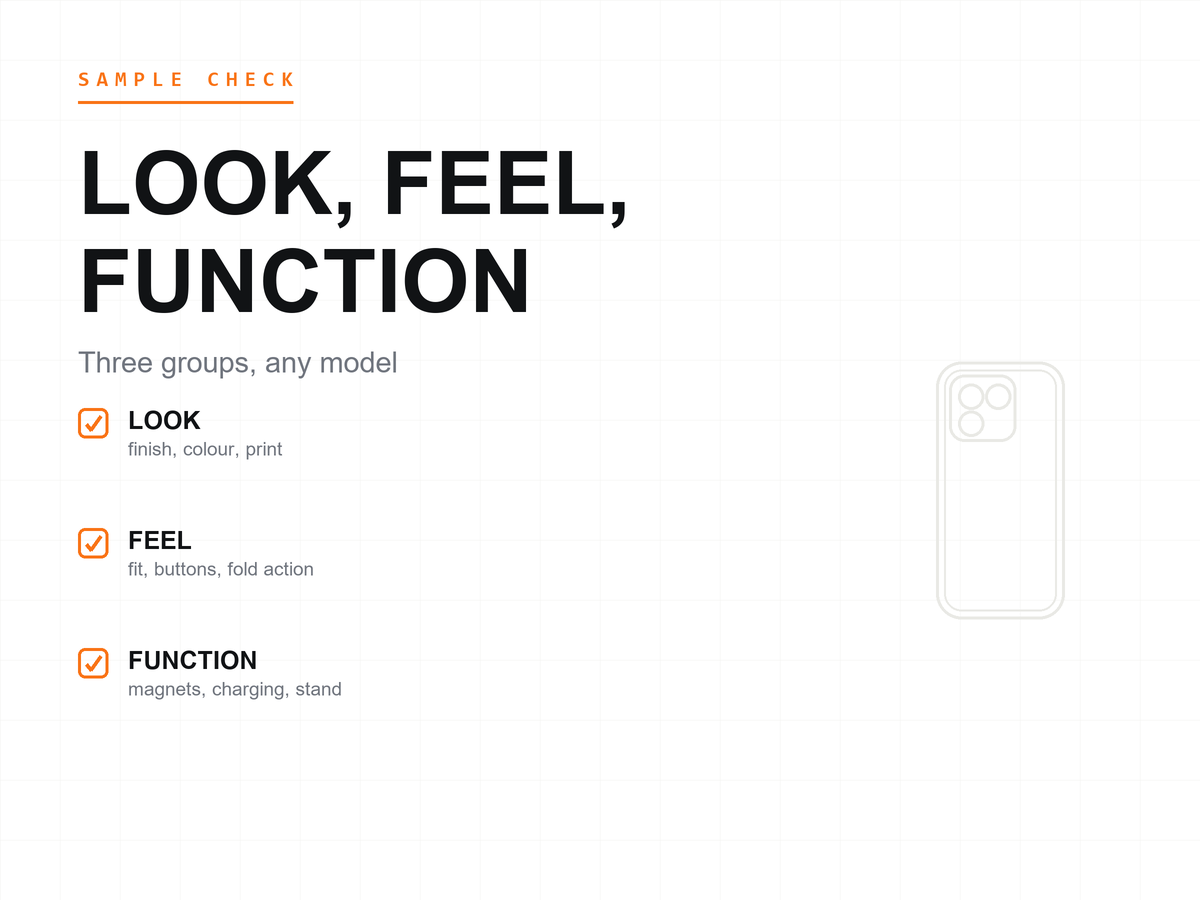
A case sample answers three questions at once, and buyers who separate them check faster and argue less. iFunSmart orders every sample review in Guangzhou around three groups — how the piece looks, how it is built, and how it works — so the same run fits an iPhone, a foldable, or anything between them.
Last updated: November 19, 2026.
Why a Skeleton Beats a Scattered List
The checks exist. They just live in different places. Our fit work on the iPhone 18 Pro runs five opening checks on the live device. The magnet ring gets read against the camera opening, lifted corner by corner under an accessory, then turned for a wobble. The yellowing test pairs a windowsill piece with a twin that stays in a drawer. Each habit earns its own article, yet a buyer who has read them all still faces one first question with the sample on the desk: what comes first?
A sample check skeleton is the fixed three-group order — look, feel, function — that sorts every checkpoint a case sample can face, so one sheet runs on any model.
The definition earns its keep because grouping decides sequence. Surface findings mean little until the build explains them, and the build means little until function says whether the piece can ship. The groups also travel: a slim clear case and a heavy-duty foldable cover share the same three headings though little else matches. What goes on the list before the pieces exist is the sample list's own subject, and how findings travel back belongs to the feedback format; the skeleton is the stretch between them, run with the piece in hand.
The Look Group: What the Surface Says
The look group is read, not operated. Surface finish leads: even across the back panel, no shiny patches breaking a matte field, no cloudiness sitting inside a clear one. Color follows, judged against the approved sample, not against memory. Print and pattern come next — edges crisp, registration clean, no ghosting where a second pass drifted. It ends with damage: scratches, stains, and handling marks, gathered at the corners, the rim of the button cutouts, the lip above the charging port.
Two habits keep the reading honest: raking light across the panel, white paper behind a clear shell. A finding without a position is only a rumor, so every mark gets named — near the volume cutout, on the lower back, at the camera lip. Positions turn a complaint into a fix.
The Feel Group: What the Hands Find
Hands find what eyes excuse. Fit runs first: the case goes on and comes off without fighting the phone or scoring the rim — the test that separates a build from a squeeze. Cutout alignment follows, every opening sitting over its counterpart with room for a cable's shoulder and a finger's reach. Button feedback is the third read — each press travels and returns with a clean click through the case instead of a dull thud. Frame wrap closes the group: the rail covers the edge all the way round, with no seam or sharp spot to catch a palm.
Some checks depend on the model. A foldable carries an item no other phone has: the cover must run the hinge through its full travel without catching, which is the whole question behind a hinge build under check. The heading stays; the row appears only when the phone folds.
The Function Group: What the Piece Must Do
Function is the group the customer pays for, so it runs with the accessories your shelf actually plans to pair. A wallet or a stand seats on the magnets and holds under a lift — the hold a mainline design must keep on a store wall and in a pocket. Wireless charging is judged by outcome: charging starts and stays on instead of cutting in and out. The connector takes a plug all the way in, because a plug that seats only part way works loose on display and comes back as a return. A built-in stand or clasp gets cycled: open, hold, close, with the same action each time, since a lid that needs a trick becomes a support conversation.
The group stands or falls on the pairing: test with the accessories and cables your customers will use, not whatever is nearest the bench. A case can pass every bare-shell item and still fail the one pairing your catalog promises.
The Order: Build Before Surface, Function Last
The sequence outranks the list. Structure comes first because structure leaves the marks the surface shows: a shell that fights the phone during install creates its own scuffs, and a proud frame gathers marks the moment the phone rides in a pocket. Run the feel group first and the look group reads honestly. Run it in reverse and the finish gets blamed for what the fit did — a misjudgment that costs a round and sometimes hides the real cause for good.
Function runs last for a plain reason: it needs the case mounted and loaded, and mounting belongs to the feel group. By the time the piece reaches that pass, everything that would spoil the test has already been cleared.
The Sheet: How a Round Gets Recorded
A check that leaves no record gets run twice, so the round ends on paper. One sheet per batch, three headings already printed, a line per item, and a verdict per line — a word, a tick, or a photograph, whichever carries that finding better. Position travels with every anomaly: which cutout, which corner, which pass of the hinge. The sheet photocopies cleanly — the next model inherits the headings and trades rows in or out, while a fresh copy per batch keeps one order's findings from bleeding into the next.
Pin a copy beside the desk where samples land, so checks start before opinions do.
Two boundaries keep the sheet honest. The skeleton does not replace a written acceptance criterion; the skeleton organizes what gets checked, while the criterion, settled into the order confirmation, decides what happens when a line fails. And the sheet grows rows for whatever the product claims: a water-resistant build adds its own items, and a case that promises the MagSafe animation adds the response check that claim deserves. Common rows serve common cases; claims write their own.
Common Questions From Buyers
Does the Same Skeleton Run on a Foldable?
The headings hold; the rows change. The feel group gains the full hinge travel and the grip in the folded posture, the look group gains the inner panel, and the function group checks wireless charging wherever the fold puts the coil. That is what makes it a skeleton: the model changes the rows, not the shape.
Why Does the Build Come Before the Surface?
Because the build writes on the surface. A scratch found during the look pass may have been put there by the fit, and only a build-first order tells the two apart. Reversed, the supplier polishes a mark the fit will recreate on the next piece, and the conversation moves backward.
Can the Sheet Replace a Written Standard?
It cannot, and the distinction matters more as orders grow. The sheet organizes the checks and carries the findings; the written criterion says what a failed line triggers, who re-checks, and what the buyer accepts. A sheet without a criterion produces well-documented disagreement. The two travel together — the skeleton for the bench, the acceptance criterion for the order confirmation.
What to Do Next
Print the three headings on one sheet and leave the rows loose. Run it on the sample on your desk — build first, then surface, function last with the accessories you actually sell — and put a position beside every anomaly. Add rows for any claim the product makes, keep a fresh copy for each batch, and send the findings back point by point, the way a feedback note is built. If you would rather watch the run on your own piece first, that is the conversation to start.
Tell us the model and the accessories you plan to sell, and we will run your sample through the three groups and return the sheet with every result noted.
Apple and iPhone are trademarks of Apple Inc. iFunSmart is an independent manufacturer of phone cases and accessories and is not affiliated with, authorized, sponsored, or endorsed by Apple.