Business Solutions
Series Shelving: Group Styles, Not Singles
A wall of mixed singles looks like stock; a wall of series looks like a collection. How to group existing styles into themes that sell together.
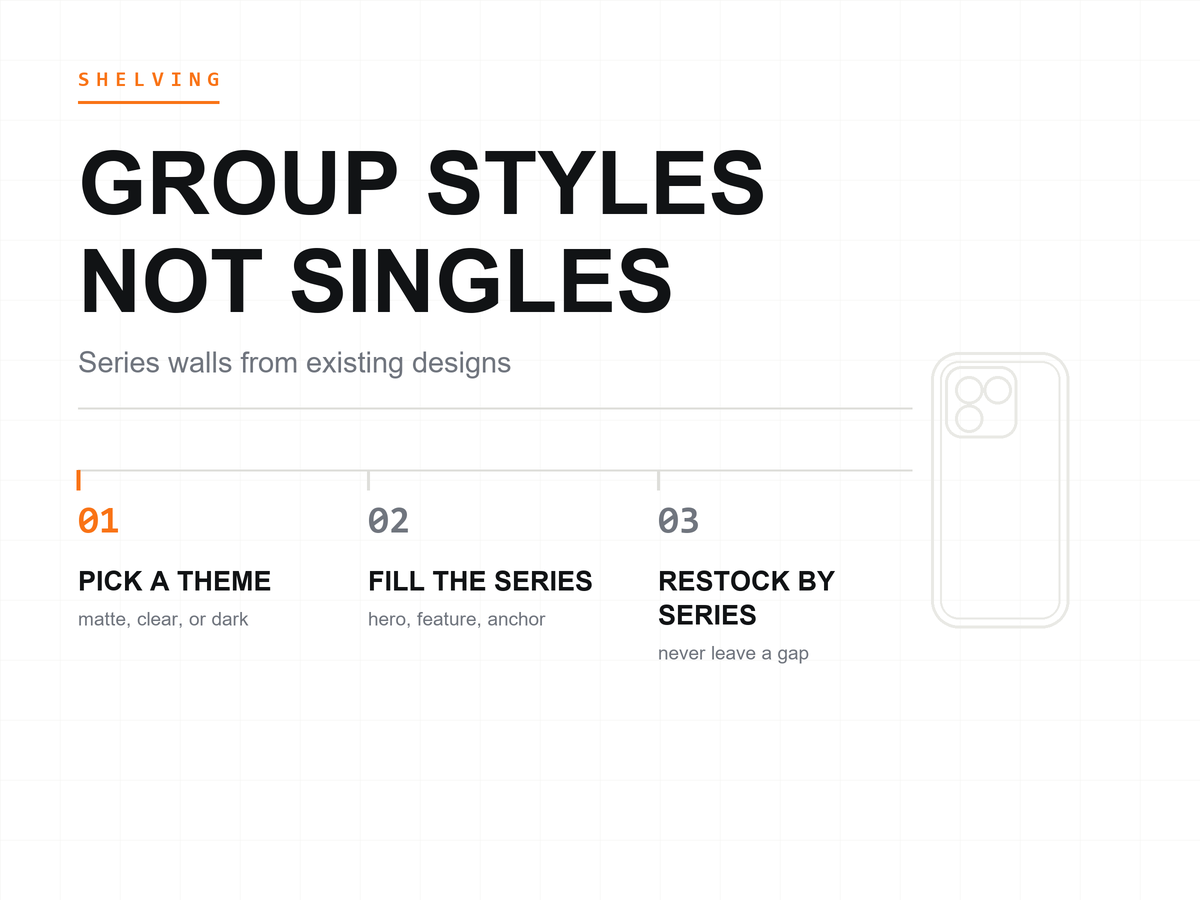
A wall of unrelated cases is hard to shop and harder to restock. iFunSmart builds its range in Guangzhou around finishes that already coordinate, so a wholesale buyer can take the styles we already make and arrange them as series on a shelf. This article walks through how those series take shape and how they stay complete.
Last updated: November 12, 2026.
The Problem With a Wall of Singles
Most shop walls grow by accident. Style by style, shipment by shipment, each piece earns its slot on its own merit, and the wall ends up as a long row of decisions nobody made together. Nothing on it is wrong, exactly. The pieces simply do not talk to each other, and a customer standing in front of them reads inventory rather than intent.
Mixed stock reads as leftover stock. That is the quiet cost of a singles wall: the customer cannot see a pairing logic, and the person behind the counter explains every piece from scratch, which slows the sale down. A series wall is a display that groups cases by a shared finish, so the shelf reads as a handful of collections rather than a pile of unrelated singles. Same goods, different reading.
One honesty note belongs here: we do not claim any particular layout increases sales at your location, because how a wall performs depends on your foot traffic, your street, and your regulars. What a series changes is legibility. A legible wall is easier to shop and easier to refill, and those are the things a shop actually controls.
Group by Finish, Not by Whim
The simplest way to build a series from styles that already exist is to group them by surface finish. Finish is visible from a step away, it photographs consistently, and pieces that share one tend to agree with each other on a shelf without any styling effort.
Start with a matte zone. Skin-feel and frosted surfaces share a low-glint, settled look, they shrug off fingerprints, and they suit the customer who wants the phone to feel quiet in the hand. The zone earns its signature from a skin-feel piece for the matte series, a semi-transparent matte shell with a magnetic ring made for the iPhone Duo, so the section leads with a piece that carries both the finish and the function story.
Beside it sits a clear zone, and a clear piece for the transparency series makes its argument on its own: a hard crystal back that leaves the phone's own lines in view. This section answers the opposite customer, the one who chose the phone for its color and wants the case to say so. The dark zone rounds the wall out for buyers who want the device quieter still, holding deep, subdued shells that read serious from across the room.
Zones like these work because the styles inside each were finished with the same intent. Two matte pieces sit together without trying. A matte piece next to a high-gloss one argues with itself, which is what the grouping removes. And because the grouping happens at the display level, it asks nothing new of the supplier: the styles are already in the catalog, and the series is a decision about where each one stands.
The Roles Inside a Series
A series earns its keep when its pieces hold different jobs. One style acts as the mainline, the build that suits the widest slice of customers and moves steadily without anyone pushing it. Another acts as the difference piece, carrying a stand, a ring, or another function that gives the counter a talking point. The last role belongs to a piece a step above in finish or construction, and its job is framing: it makes the pieces beside it look like sensible purchases rather than competing with them.
Customers tend to enter through the mainline, the least demanding choice on the wall. The difference piece holds them a moment longer, since a stand or a ring sells through the hand. The higher piece then frames the value of everything beside it, which is why it does not need to be the style that walks out the door.
None of these roles asks for an exotic build. A normal range of finishes fills them; what matters is that the pieces stay distinct, so the zone reads as a deliberate cast rather than one style repeated.
Replenish by Series, Not by Single
Grouping only pays off if it survives the reordering cycle. The pattern that breaks a series is familiar: a piece sells steadily, the next order deepens that piece, and soon the wall holds thick stock where the seller sits and an empty slot where its neighbors used to be. Inventory went up and the series went away.
Refill the zone instead. When a piece sells, let the reorder question stop being about that single style and become a question about the set: what is missing, and which pieces bring the group back to whole. A series kept whole keeps its argument, and the moment a zone looks raided, customers read it as leftovers again.
This is also where existing styles earn their place in a smaller buyer's plan: every style in these series is a build whose mold already sits on our rack in Guangzhou, so a gap in the set is a stock question rather than a tooling project, and a fresh series can be assembled by recombining builds that already exist. Mixing is routine for us. A series order can combine finishes and models in one shipment, and replenishment can call for only the pieces a zone is missing.
Common Questions From Buyers
Which piece should lead a series?
Let the mainline lead. It has the widest appeal, so it takes the position a walking customer meets first. Put the difference piece where hands can reach it, because a stand or a ring converts through touch rather than through sight. Give the higher piece a visible spot without letting it crowd the zone, since its job is framing value, not outselling its own shelf. Series names are yours to invent: the label on a zone can use whatever words fit your shop's voice, as long as the grouping underneath stays honest.
What happens when a series runs incomplete?
Treat the gap itself as the reorder signal. An incomplete zone quietly downgrades the pieces still standing, because customers read the space around a case as a judgment on the case. Reorder to restore the set rather than to deepen the winner. Until the missing pieces land, pull the survivors toward each other so the zone reads as a tight group instead of a raided one, and since every style is an established build, the replacements can simply ride along with your next mixed order.
How does a buyer assemble a series with iFunSmart?
Name the finish you want to lead with and the models you stock. We group from the styles we already build, mark which piece fits the mainline role, which carries the difference, and which frames the zone, then ship the set as a single mixed order. If the look you want sits close to something we already make, the series comes together from existing builds. As pieces sell, the zone refills from stock.
What to Do Next
Stand back from your own wall and read it the way a customer does at the door. If the eye lands on isolated boxes, pick the finish you hold the widest range of and group those pieces first, then cast the roles inside the group. Write down what each zone is missing before you reorder, so the next order closes gaps instead of deepening them. Then send us the finishes and the models. We build in Guangzhou, we keep every series style in production, and we can turn your zones into a mixed order that arrives ready to shelve.
Send us the finish you want to lead your wall with, and we will group the styles we already build into a series list made for your models.
Apple and iPhone are trademarks of Apple Inc. iFunSmart is an independent manufacturer of phone cases and accessories and is not affiliated with, authorized, sponsored, or endorsed by Apple.