Sep 19, 2026Business Solutions
Six Promises a Case Factory Should Let You Verify
Premium quality cannot be checked; a tolerance number, a named test, and a sample in your hand can. Six verifiable claims to put in front of any case factory.
Most supplier pages for iPhone and Samsung cases are lists of adjectives. Ours lists numbers, test names, and processes we can demonstrate — because the useful version of any promise is the one a buyer can check. Whether you are vetting us or any other factory, six verifiable claims are where a phone case relationship should start.
Last updated: September 19, 2026.
Why "Trust Us" Is Not a Specification
A verifiable claim is a promise that comes with a number, a named test, or a document — something a buyer can check rather than believe.
That definition is the fastest filter in supplier vetting, because most claims fail it immediately. Phrases such as premium quality, strict inspection, or military grade carry no number, name a no test, and reference no document. They cannot be checked, which means they cannot be compared, which means two suppliers making the same claim are indistinguishable.
The fix costs nothing. Ask every supplier on your shortlist the same six questions below, and ask each one for the evidence behind the answer. The suppliers who respond with documents are different in kind from the ones who respond with confidence. Each of the six claims below is one we publish on our own sourcing site, supply.ifunsmart.com, with the numbers attached, so you can hold our answers to the same standard.
Claim One: Tolerance, With the Number
Case fit is decided by tooling tolerance, and a factory that measures it can tell you the number.
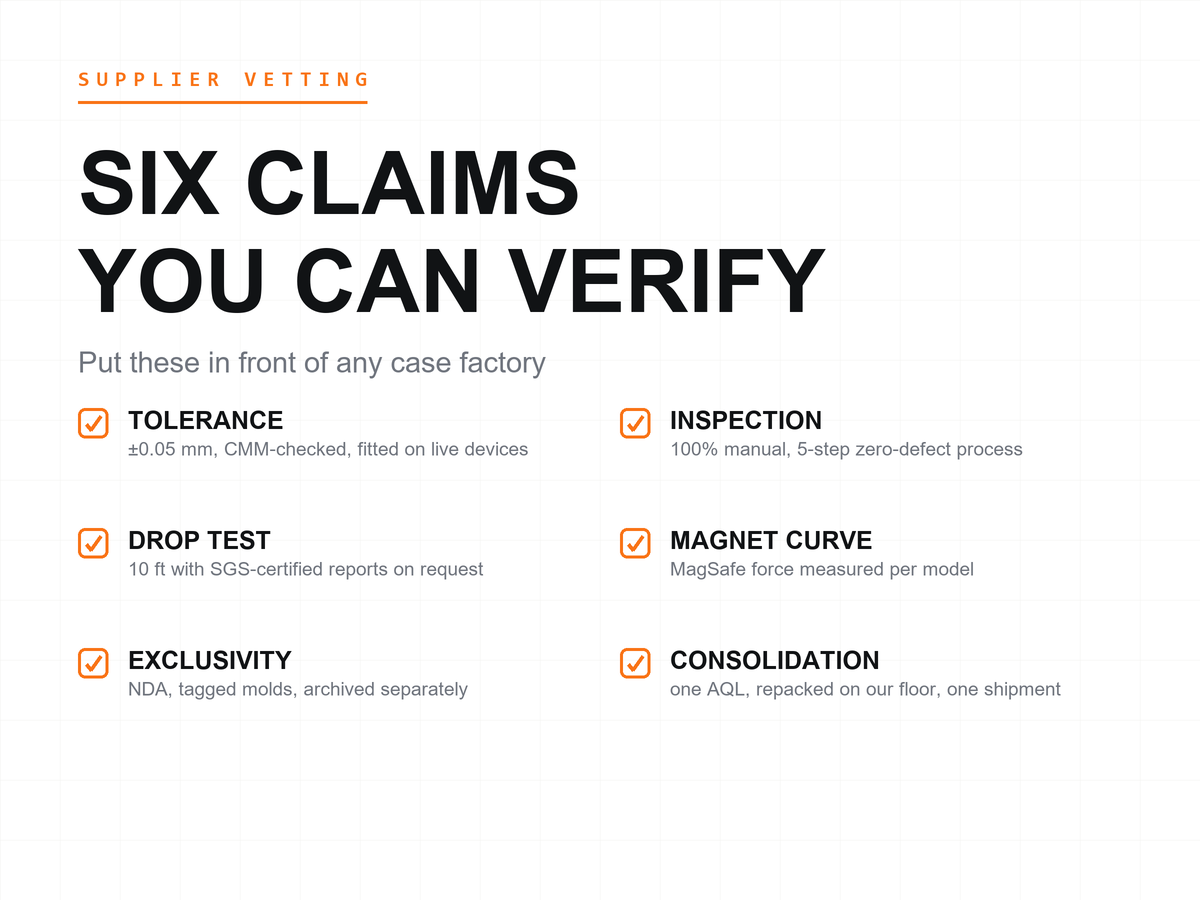
Ours is ±0.05 mm on tooling, machined by CNC and checked on a CMM, with every case fitted to the live device rather than only to the drawing. The phrase that matters is "fitted to the live device": a mold that matches its drawing can still miss the phone.
Whatever number a supplier quotes, the follow-up question is the same. Who measures it, on what machine, and against what — the drawing or the phone? A tolerance without a checking method is a decoration.
Claim Two: Inspection, With the Process
Every case factory claims quality control. The checkable version names the steps and the coverage.
Our standard is 100% manual inspection through a five-step zero-defect process, with first articles test-fitted on live handsets. Two parts of that claim can be probed. What are the five steps, and is inspection sampling or full coverage? A factory running 100% inspection on every unit can walk you through each step in order; one running spot checks should say so, because the risk profile of your order is different.
Claim Three: Drop Testing, With the Report
Drop protection claims are the most abused numbers in this industry, which is why the test name and the report matter more than the height.
Our rugged lines are drop-tested to 10 feet, with material aging tests on top, and our patented Shock Pocket armor is one of the lines covered by that protocol. Three details make a drop claim checkable: the height, who ran the test, and whether you can see it. Ask a supplier how they validate the height they quote, and ask for a sample you can drop yourself — material aging matters because a case that passes a drop new can fail one after six months of heat and pocket wear.
Ask to see the test, or a sample that has been through it. A supplier who hesitates on that is telling you where their claim ends.
Claim Four: Magnet Validation, With the Curve
For a MagSafe case, magnet strength is the spec buyers feel first, and it is measurable.
We measure MagSafe force curves on our N52 arrays and test wireless charging interference down to zero, because a strong magnet that slows charging is a return, not a feature. The curve is the honest form of this claim: it shows hold force across positions rather than a single flattering number.
The buyer question is direct. How do you measure magnet hold, and can I feel it on a sample? A supplier who measures has a method to describe; a supplier buying magnets by grade name does not. Our clear MagSafe build goes through that validation before it ships.
Claim Five: Exclusivity, With the Protections
Exclusive tooling is only real if the protections around it are concrete.
Ours run in three layers: an NDA covering your design, an exclusive tooling agreement, and physical controls — the mold is tagged to your brand and archived separately, never shared with another customer. That is what "exclusive" has to mean for the word to survive contact with a sourcing platform where your mold can resurface months later.
Ask any supplier the three-part question. Who signs, how is the mold marked and stored, and what stops it from serving another buyer? Vague answers here are how a shape you paid for ends up on a competitor's listing.
Claim Six: Consolidation, With the Process
One-stop sourcing saves coordination only when the supplier controls the process. Ours runs in four steps: you send one purchase order covering cases plus any accessory mix; we source from audited partner factories; every carton is inspected to a single AQL standard and repacked on our floor, free of charge; and the whole order ships as one consolidated shipment with one tracking number and one customs file.
The checkable details are the AQL standard and the repack location. A supplier inspecting mixed-category goods on their own floor under one standard is carrying the risk with you. One forwarding it is not.
Common Questions From Buyers
What documents should I request before a first order?
Three things cover a first order: the tolerance number and checking method, the inspection process in writing, and a sample you can test yourself. Where a document exists, ask for it; where it does not, ask to see the process — a factory that measures will show you how, and one that does not will change the subject.
A supplier refused my document request. What does that mean?
It means the claim and the evidence have come apart, and you now know which claims to discount. A factory does not refuse a report request because the report is good; hesitation is information, and it is cheaper to read now than after a deposit.
How do I compare two suppliers on these claims?
Put the six questions in a table and fill one column per supplier with the answer and the evidence attached. The comparison stops being about who writes more confidently and becomes about who can document what they state. We have written before about how to vet a factory, and this table is the concrete version.
What to Do Next
Every claim on our site is one we can walk you through — the numbers, the process, and a sample to judge with your hands.
The fastest way to evaluate us is to ask for exactly that: tolerance and inspection details, how drop testing works, how magnets are measured, exclusivity terms, and the consolidation process in writing.
The numbers behind these claims, and the ways to start an order, live on our sourcing page at supply.ifunsmart.com.
Tell us the models you are sourcing and we will walk you through how each claim is checked, and arrange samples where you want them.
Ask us how each claim is checked, and judge us on the sample in your hand.
Apple, iPhone, Samsung, and Galaxy are trademarks of their respective owners, used solely to indicate compatibility. iFunSmart is an independent manufacturer of phone cases and accessories.