Sep 30, 2026Business Solutions
Split Shipments: Air for the Launch, Sea for the Rest
A full air shipment buys speed for units that did not need it. How to size the air tranche, what to confirm on both legs, and when to skip the split.
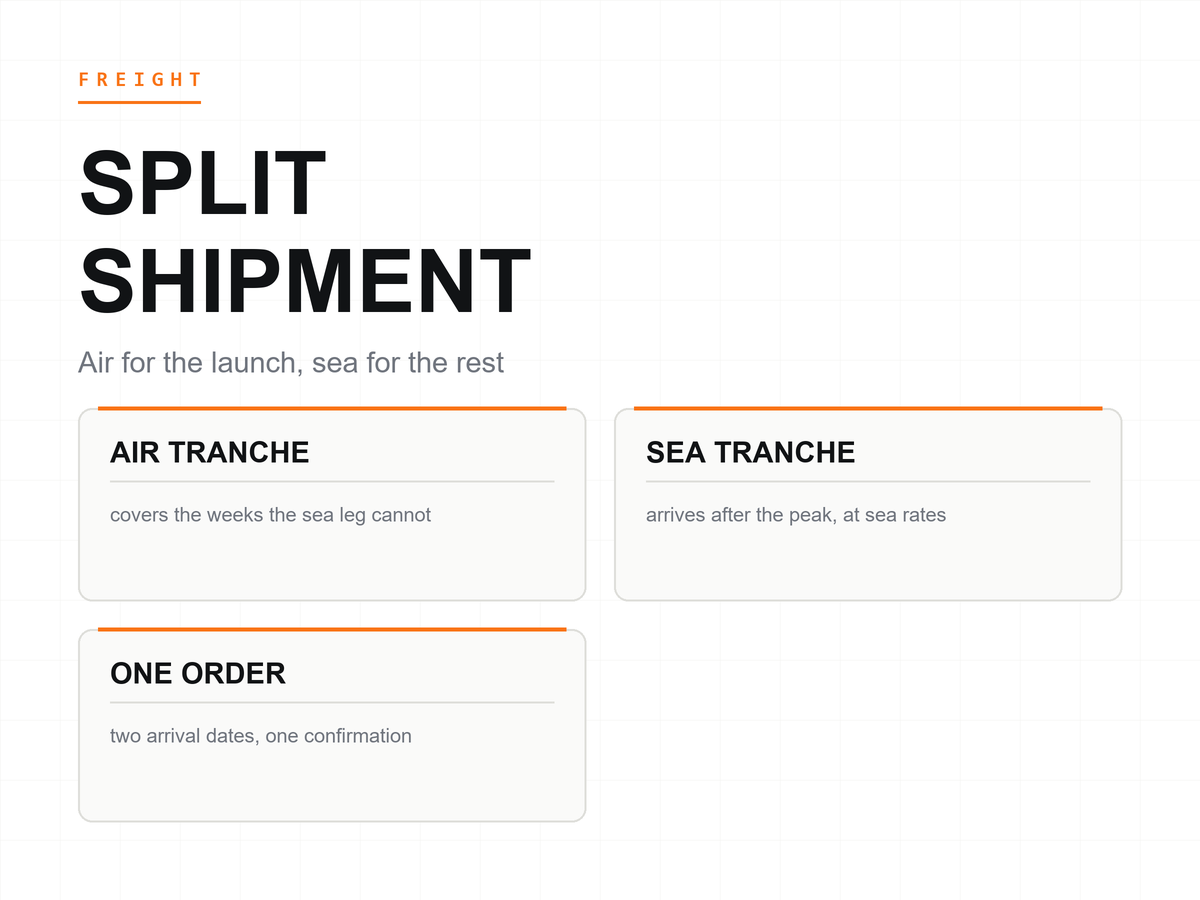
When an iPhone launch order cannot reach the market in time by sea, the fix buyers use is not a full air shipment. It is a split: enough units by air to cover the launch weeks, and the rest by sea to arrive after the peak, when deadline pressure has passed. The split is where margin is saved or lost, and the arithmetic is simpler than most buyers expect.
Last updated: September 30, 2026.
Why a Split Beats Both Full Air and Full Sea
A full air shipment buys speed for units that did not need it. A full sea shipment saves money on units that missed the window that made speed worth paying for. Both mistakes come from treating the whole order as one block with one deadline.
A split recognizes that an order serves two different periods. The first weeks after a launch carry the highest sell-through, and a stockout there costs sales that never come back. The weeks after the peak sell more slowly, and slow weeks do not need air freight to serve them. Matching the shipping mode to the selling period is what the split does.
This is why the split is the standard answer to a late order, not a compromise between two bad options. It is the option that matches cost to urgency per unit rather than per order.
How to Size the Air Tranche
The air tranche should cover the weeks between your earliest possible arrival and the moment the sea tranche lands — and nothing more.
The arithmetic runs in three steps. Estimate the weekly sell rate for the models in the tranche, from your own history or from the launch context. Count the weeks between the air arrival and the sea arrival. Multiply the rate by those weeks, and that product — not a round number, not a guess — is the air quantity.
Two adjustments refine it. Add a buffer for the upside case, because a stockout during the peak costs more than the air premium on a few extra cartons. And subtract anything you can source locally or fulfill from a marketplace's own stock, because those units do not need the air lane at all.
The result is usually a minority of the order. If your air tranche is most of the order, the sea tranche was calculated too late or too thin, and the whole timeline should be re-examined before booking.
What to Confirm Before You Book Either Leg
Three details decide whether the split works, and all three belong in writing before either leg books.
The first is the production schedule for both tranches, because they may not finish on the same day and the air leg cannot wait for the sea leg's units. The second is the carton plan for each leg, because air charges by volume as well as weight and the packing density differs between legs. The third is the documentation for each destination leg, because the customs file for the air shipment is separate from the sea file and both must be correct independently.
We have written about the post-port stages separately, because those stages are where the two legs converge on your shelf date. The legs are separate in the air and on the water; they need to arrive as one plan.
When to Skip the Split Entirely
A split does not fit every order, and two situations argue against it.
The first is a thin margin product, where even a small air tranche erases the profit on the whole order and the honest move is to accept a later arrival or reduce the order. The second is a product that sells steadily year-round, where a missed launch week costs less than the air premium and the sea tranche alone is the rational choice.
The split earns its complexity only when launch demand is concentrated and the margin on the early units is real. Both conditions are checkable before booking, and a supplier who helps you check them rather than pushing a full air upgrade is doing part of their job.
Common Questions From Buyers
How do I calculate the air quantity?
Multiply the expected weekly sell rate by the number of weeks between the air arrival and the sea arrival, and add your upside buffer. That product is the tranche. Anything larger is paying air rates on units that the sea tranche will cover in time anyway.
Do both legs need separate customs files?
Yes. An air shipment and a sea shipment arrive at different times under different documents, and each is cleared independently. The paperwork is doubled, which is one of the administrative costs of the split, and it is why the two legs should be planned as one order with two arrival dates rather than as two orders.
Can the factory schedule both tranches from one order?
Yes, and that is the normal arrangement: one order confirmation covering two production and shipping windows. Tell us the launch date and the market, and both tranches are planned from the same confirmation rather than as two separate negotiations.
What to Do Next
We plan split shipments for launch weeks regularly, and the quantities, cartons, and documents for both legs come from one order confirmation rather than two.
Send us the models, the launch date, and your market, and we will lay out both tranches with their production windows, carton plans, and arrival estimates for your review. For a foldable launch, the air tranche usually starts with the hinge-protection Duo case and the clear MagSafe Duo build, because those are the SKUs a customer names when they arrive.
Send us your launch date and we will plan the air and sea tranches as one order.
Apple, iPhone, and Samsung are trademarks of their respective owners, used solely to indicate compatibility. iFunSmart is an independent manufacturer of phone cases and accessories.