Oct 3, 2026Business Solutions
How to Test Case Samples for Yellowing
Yellowing shows up weeks after launch, when the order is already sold. A comparative sample test you can run before bulk: two cases, a window sill, a control.
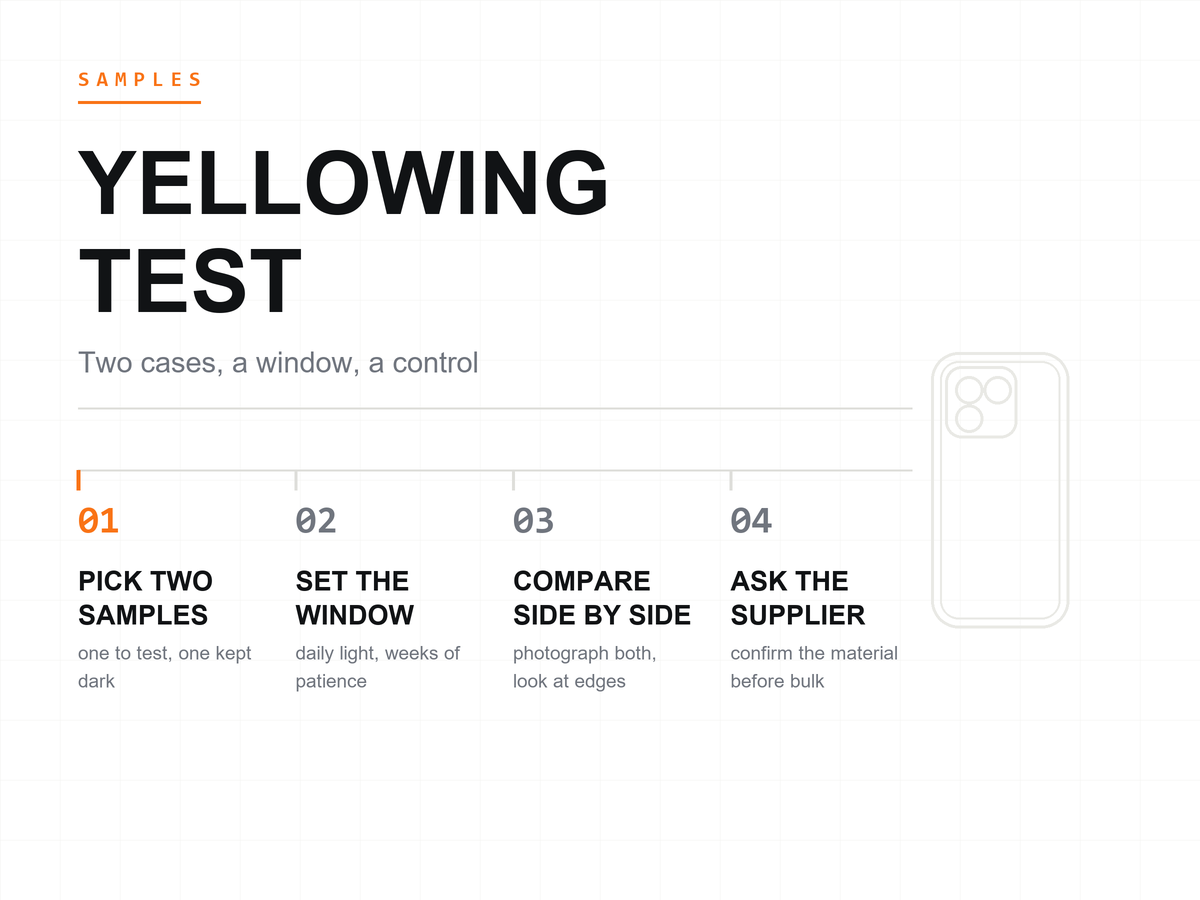
Yellowing is the failure that appears after the order ships, which is why a clear iPhone case needs a comparative test before bulk. Set one sample on a window sill, keep its twin in a drawer as the control, and let the gap speak. The routine costs weeks, not money.
Last updated: October 3, 2026.
Why Yellowing Escapes a Normal Sample Check
A sample approval is built to catch the failures that exist on the first day. Fit, finish, button feel, the way the shell sits on the phone — all of it shows the moment you hold the piece. Yellowing does not live on that timetable. It is the drift a clear material takes toward yellow as daylight, heat, and skin oils work on it across weeks and months, and it happens after approval rather than before it.
A sample sealed in a box cannot age.
The piece you inspect before bulk looks the same as the piece you would inspect after a season on a shelf, until light does its work. So the check that clears bulk on day one stays blind to the failure that arrives after launch, and the drift usually surfaces first as a customer review instead of as a test result. By then the order is sold and the stock sits in your warehouse, so the fix costs a restock rather than a revision. That gap between a cheap decision and a visible failure is what a pre-bulk test exists to close.
The Comparative Test, Step by Step
The test compares two samples from the same batch: one lives in the light, one lives in the dark. A control sample is a second piece from the same production lot that stays out of the exposure, so at the end of the test the only difference between the pair is the light they lived in. Without the control, a slight change is unreadable, because every material shifts a little with time and you need to know how much of the shift belongs to the exposure rather than to the clock.
Put the test piece where your customer's phone actually lives. A window sill with ordinary daylight is the honest version, and a desk beside a window is the same idea in a dimmer climate. Leave the pair for weeks rather than days, because the drift you are hunting is slow and a short test flatters a weak material. Photograph the two side by side at regular intervals, from the same distance and in the same light each time, and keep every shot in one folder. Photos beat memory. Mark the pieces or their spots so the comparison does not trade on a guess about which one sat where.
One habit earns its minute: note the batch each sample came from when the test starts. A verdict about a material only travels if it is tied to the production it came from, and a labeled pair beside a folder of dated photographs is the version of this test that survives a handover to a colleague who did not watch it run.
What to Look At, and How to Judge It
Judge the pair, not the piece. Hold both samples against a sheet of white paper and read the overall tone first: a test piece that has gone faintly cream next to a control that is still neutral says more than any single photograph. Move on to the places where light and handling concentrate — the corners, the edges around the button cutouts, the frame of the camera opening — because drift tends to show there before it crosses the flat back. Then put the interval photographs side by side and read the direction of travel, not one frame in isolation.
What counts as a fail depends on the tolerance of your market, which is a line you should decide before the test starts rather than after. The plain version is this: when the test piece changes clearly beyond its twin, the material behind it is in doubt. Both pieces can shift a little; the gap is the evidence. Write the outcome into your purchase communication — the batch, the dates, the photographs, the conclusion — so the standard travels with the order and the next conversation starts from a record instead of from recollection.
Which Builds Deserve the Test
Clear builds come first, because a crystal shell shows the drift early while a smoke or dark tint hides it for longer. Soft clear TPU carries the known weakness, and a hard PC back holds its clarity for longer before it moves, but the test does not care which construction you hand it. It asks the material rather than the category.
If the iPhone Duo sits on your list, the crystal clear MagSafe case for the iPhone Duo with a hard PC back is the kind of build this comparison was made for. The clear MagSafe case for the iPhone 18 Pro Max belongs to the same family, and the routine applies to it like any other clear build. A build sold to you as anti-yellowing goes into the test too: the label is a supplier's claim, the window is your evidence, and the two are not the same kind of thing.
If you want to see which clear builds we run for the models you stock, ask us and we will name them.
Common Questions From Buyers
Does the windowsill test replace a lab aging report?
It cannot. A windowsill comparison is a screening you run yourself, and a laboratory aging report is a measurement a lab certifies, so we cannot replace lab aging reports with a windowsill test and no supplier should ask you to trade one for the other. What the comparison gives you is a visible difference between two samples from one batch, which is a buying signal rather than a certificate. We do not publish laboratory aging numbers either. When a contract or a platform needs certified data, put that requirement into the purchase terms and let a lab settle it.
How long should the samples sit in the light?
Weeks, not days. The drift is slow, and a test that ends early tends to flatter the weaker material. Let the pair sit through several weeks of ordinary daylight, photograph on a schedule, and let the gap decide when the test is over: when the difference shows, you have your answer, and when nothing shows after a fair stretch, close the test and file the photographs with the order record. A window tests light, and light is only one of the forces that age a case, so a dashboard in summer heat is a different test of a different failure rather than a faster version of this one.
What should I do when the test piece drifts?
Do not approve bulk on that material. Ask the supplier to state in writing what the material is and what stands behind the anti-yellowing claim, then request a sample on the changed material and re-run the same pair. If the second test stays matched, your record now shows why the material changed, and that record belongs in the purchase communication beside the first one. A supplier who resists the retest has answered a different question from the one you asked.
What to Do Next
The whole routine is four moves: two samples from one batch, one window, one drawer, and a camera. Photograph on a schedule, judge the gap instead of either piece alone, and write the verdict into the order communication while the decision is still yours to change. We have molded iPhone cases in Guangzhou since 2010, and we would rather a material question surface on a window sill than after a launch.
Send us the clear builds you are considering, and we will prepare a sample pair with the material of each piece named, so the verdict comes from your window sill rather than from the reviews.
Apple and iPhone are trademarks of Apple Inc. iFunSmart is an independent manufacturer of phone cases and accessories and is not affiliated with, authorized, sponsored, or endorsed by Apple.