Sep 19, 2026Business Solutions
Listing Phone Cases Without a Trademark Problem
Most accessory takedowns come from the same few wording habits. Four rules that keep a case listing alive: name the phone as a fact, say compatible.
Accessories get pulled from marketplaces for trademark reasons far more often than for quality reasons, and most listings break the same few rules. The mark is Apple's or Samsung's, not yours, and the way a listing borrows it decides whether your product stays up. Four rules cover almost every case.
Last updated: September 18, 2026.
What a Trademark Actually Protects
A trademark is a word or symbol that identifies the source of a product, and Apple lists MagSafe, iPhone, and iPhone Duo on its own trademark list, alongside thousands of others. Samsung holds the equivalent rights in Galaxy.
What that ownership means in practice: the brand names belong to their owners, and a seller may use them to state a fact about compatibility but may not use them to suggest endorsement, certification, or origin. A listing that says which phone a case fits is stating a fact. A listing that reads as if the phone maker made, approved, or licensed the case is claiming something else, and that is the claim marketplaces act on.
The distinction sits in the wording, and it is checkable line by line before anything goes live.
Rule One: Name the Phone as a Fact, Never as a Source
State compatibility the way a manual would: the case is designed for a specific phone model, full stop.
The safe pattern names the model as a noun in a compatibility sentence. The unsafe patterns are the ones that borrow the brand as an adjective or a story: words that imply official status, logos placed next to the brand name, or copy that suggests a partnership. If a listing says the case is designed for the iPhone 18 Pro, that is a compatibility statement. If it says anything that could be read as Apple's involvement, that is the takedown risk.
The same applies on the packaging. A case box that carries the Apple logo anywhere has borrowed a mark that does not belong to the seller, and marketplace reviews of packaging happen after goods have shipped, which is the expensive moment to find out.
Rule Two: Say Compatible, Not Certified
Compatibility wording is the habit that keeps listings alive, and certification wording is the habit that kills them.
Certified, official, genuine, and licensed imply a relationship with the brand owner that an independent case maker does not have. Designed for and compatible with state the factual claim a buyer needs. The difference is a few words in a title, and those few words are exactly what takedown systems are tuned to catch.
There is a real certification world on the wireless-charging side, and it is separate from what a case maker does. If a product carries a wireless certification, that fact belongs to that product and that standard, and it should be stated with its own documentation rather than borrowed as general branding.
Rule Three: Keep the Factory Branding Off the Product
Your listing is not the only place branding appears. The product and its packaging carry marks too, and they are checked after delivery rather than before.
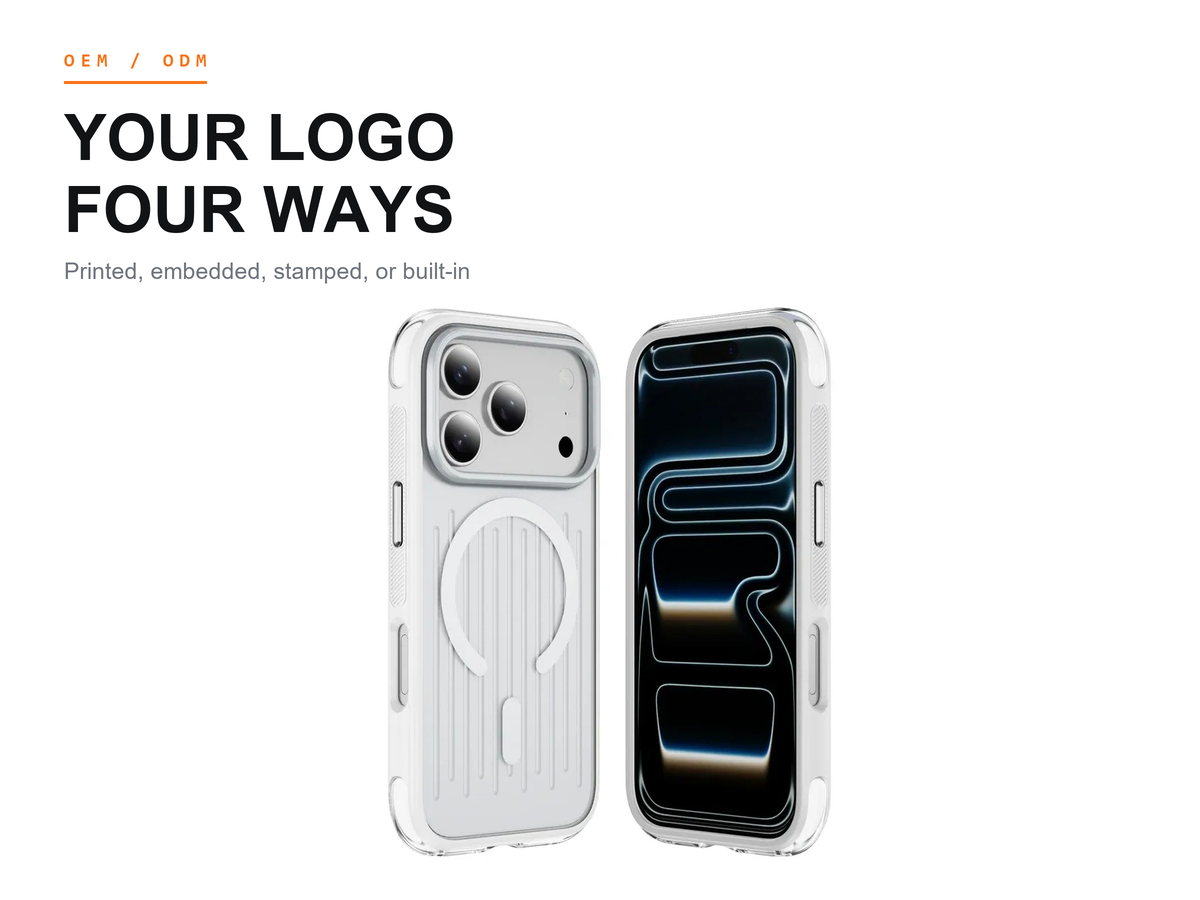
Buyers have told us directly that they want their own logo and retail packaging with minimal or no factory branding on the product, which is the same requirement behind our [[OEM logo and packaging work -> /posts/oem-odm-phone-case-branding-solutions]]. That request is about brand clarity in front of the end customer, and it has a compliance layer: packaging that carries marks the seller has no rights to, including factory logos the seller did not agree to carry, becomes part of the seller's listing risk once it reaches the market.
The fix is agreed before production: the packaging carries the buyer's brand, factory identification sits inside or on the carton rather than on the retail surface, and a printed proof is approved before the run. A product designed that way reads clean in a listing, the way our RFID card-holder case and our metal-button magnetic case carry only the buyer's marks. We have written about how packaging sign-off gates production, because that proof is what turns this from a promise into a check, and about [[what a case order timeline looks like -> /posts/sample-to-shelf-order-timeline]] so the proof lands before production rather than after.
Rule Four: Put the Attribution Line to Work
The disclaimer that appears at the bottom of our own articles exists because it is the standard way an independent manufacturer states its position: brand names belong to their owners, compatibility is the only claim being made, and there is no affiliation.
That line belongs on your listing too, or in your product description, because it states the intent of the whole document in one sentence. It does not make a bad listing safe, but it removes the ambiguity that vague listings carry, and ambiguity is what compliance teams act on when they cannot tell what a seller is claiming.
A related habit is to keep your own product name in front. A case called "Armor Grip Clear Case, designed for the iPhone 18 Pro" leads with your brand and uses the phone name only as a compatibility fact. A listing that leads with the phone name is borrowing attention it does not own.
Common Questions From Buyers
Can I use the words iPhone or Galaxy in my listing?
Yes, to state compatibility as a fact: which models the case is designed for. That is how accessories identify what they fit. What to avoid is wording that implies the brand owner made, approved, certified, or endorses your case, and any use of the brand owner's logos on your product, images, or packaging.
What gets a listing taken down most often?
Wording that implies certification or affiliation, and packaging that carries marks the seller has no rights to. Both are checkable before anything goes live: read the title and bullets for certification words, and look at the packaging proof for logos that are not yours.
Do I need a license to sell a compatible case?
Selling a compatible case is a manufacturing and design question, and licensing is a separate relationship with a brand owner that applies to specific programs and marks. The two should not be confused in a listing: state compatibility factually, do not claim certification you do not hold, and ask a supplier directly about any mark you intend to print on the product or its packaging.
What to Do Next
We manufacture cases with the buyer's brand on the product and no factory marking on the retail surface, and every project ships with the packaging proof approved before production.
Send us your current listing, or the models and finishes you plan to cover, and we will flag the wording and packaging points to fix before a takedown finds them for you.
Send us your listing and we will flag the trademark and packaging points to fix before you publish.
Apple, iPhone, MagSafe, Samsung, and Galaxy are trademarks of their respective owners. Any use on this site is solely to indicate compatibility; iFunSmart is an independent manufacturer and is not affiliated with, authorized, sponsored, or endorsed by Apple or Samsung.