Oct 3, 2026Business Solutions
Volumetric Weight: Why Bulky Cartons Bill High
A carton of light cases can bill at several times its scale weight. How chargeable weight works, where the divisor comes from, and what to confirm.
A carton of iPhone cases can sit feather-light on the scale and still land on your invoice as a heavy shipment. The reason is volumetric weight: when a carton occupies more space than its weight justifies, carriers bill the space. Here is how the math works and what to confirm before you ship.
Last updated: October 3, 2026.
What Chargeable Weight Means
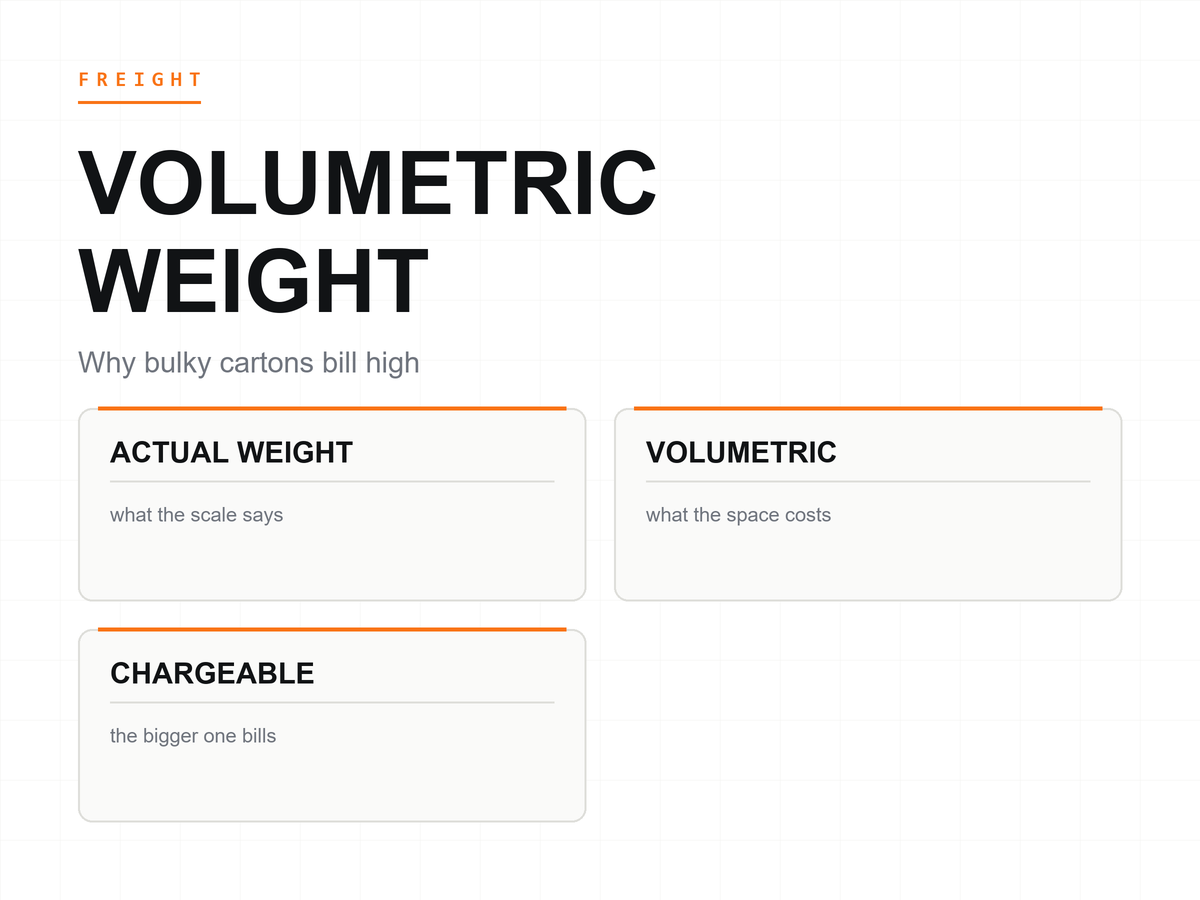
Volumetric weight, which many carriers call dimensional weight, refers to a billable figure calculated from the space a carton occupies rather than from what the carton physically weighs. Chargeable weight is the number the invoice actually follows: whichever is higher, the reading on the scale or the volumetric figure computed from the carton's length, width, and height. The bigger figure wins.
That rule exists because freight capacity is finite. An aircraft runs out of floor space long before it runs out of lifting capacity, and a delivery van fills up the same way. Space is what you are really buying. Phone cases sit on the bulky side of that trade: a single case weighs almost nothing, but packed into retail boxes with trays, hooks, and air cushions, cases consume pallet volume while the scale barely moves. A shipment can therefore be light on the scale and heavy on the invoice at the same time, and nothing about that outcome is a clerical error. It is the pricing system doing what it was built to do.
The Arithmetic, Worked Once
Run the calculation once on a hypothetical carton, for illustration only. Say a master carton measures 60 by 40 by 40 centimeters. Multiplied out, that is 96,000 cubic centimeters of volume. The divisor most often quoted for air freight sits near 6,000 (commonly used, varies by carrier — confirm with your forwarder). Divide 96,000 by 6,000 and the volumetric weight comes out at 16 kilograms.
Now apply the take-the-larger rule. If that carton weighs less than 16 kilograms on the scale, you are billed for 16 kilograms. If the scale reads higher, the scale wins and the volume is ignored. One figure survives, the other is discarded, and the invoice follows the survivor. That is the whole mechanic behind a light carton billing heavy: the space it takes, converted through the divisor, outgrew what it weighs.
Two habits sit around the formula and both push the figure upward. Carriers measure the carton at its extreme points, so bulge, handles, and stretched strapping all count. Many networks also round dimensions before computing, and rounding directions differ between them, which is one more reason to confirm the measuring rules instead of assuming them.
Where the Divisor Comes From
A divisor is not physics; it is commercial policy. Each carrier network decides how much volume it treats as one billable kilogram, and the figure it picks reflects its aircraft, its routes, and how it prices space on those routes. Two forwarders can measure the same carton and hand you two different chargeable weights. Both can be right, because each is applying its own published rule. A divisor quoted for one lane also tells you little about another, since the same network can treat dense lanes and thin lanes differently.
The mode changes the machinery too. Air networks work from a volume-to-weight divisor of the kind used above. Sea consolidation is a different beast: less-than-containerload cargo usually bills by the cubic meter, with a weight-to-volume ratio layered on for dense shipments, and the ratio is the consolidator's to state. Courier networks publish their own conversions, which can differ from a freight forwarder's on the same lane. None of these figures are hidden, but none of them transfer between carriers either.
So send a short confirmation list before you budget anything: which divisor applies to your lane and mode, whether the carton is measured alone or together with the pallet, how dimensions get rounded, and whether a minimum chargeable weight applies to small shipments. Every answer changes the invoice. We do not publish freight rates, because each lane prices differently and every shipment is calculated on its own carton plan; the arithmetic worth trusting is the one run against your forwarder's confirmed divisor.
What This Means for a Phone Case Order
Bulk hides in the packaging, and case construction decides how much of it there is. A slim shell nests into a low-profile retail box and keeps the volumetric figure close to the scale figure. A slide-cover armor build carries a sliding camera guard and deeper walls, so its master carton grows in every direction. A heavy-duty armor build goes further again, adding metal buttons and more structure per unit. None of that is a flaw; protection occupies volume, and the point is to count it before the pallet is built rather than after the invoice lands.
The comparison that matters is per pallet, not per piece. A build that looks economical unit by unit can turn expensive once its cartons are stacked and measured, while a denser build that costs more per piece can bill closer to its scale weight and come out ahead on the freight line. Which way it breaks depends on your forwarder's divisor and on your market's demand, and neither of those is ours to settle. What we can do is tell you how each build in our range packs, so the carton dimensions you take to your forwarder are real ones.
Before you lock a packaging choice, ask your forwarder to confirm the divisor and the measuring rules on your lane, then compare candidate builds against that confirmed figure.
Common Questions From Buyers
Why does a light carton sometimes bill heavier than a dense one?
Because the invoice follows the larger of the two figures, and space is the scarcer resource on most routes. A dense carton rides under its volumetric figure, so its scale weight governs. A tall, airy carton of slim shells sails past its scale weight, so its volume governs. The scale alone does not settle the invoice; the tape measure finishes the job.
Does the divisor change between air and sea?
It does, and it also changes between carriers on the same mode. Air works from a volume-to-weight divisor; sea consolidation usually works from cubic meters with a weight ratio attached; couriers set their own conversions. Which rules govern your shipment depends on who carries it, so confirming with your forwarder is not a formality. It is the answer.
Can iFunSmart give me the chargeable weight of my order?
We can share the master carton dimensions and carton weights for the builds you are considering, so the arithmetic is ready to run on your side. We cannot hand you the chargeable weight itself, because the divisor is your forwarder's policy and we do not publish freight rates; every shipment is worked lane by lane. Take our carton figures, apply the divisor your forwarder confirms, and the invoice figure is known before booking.
What to Do Next
Start from the measurement, not the assumption. Measure one master carton of the build you plan to ship, confirm the divisor and the measuring rules with your forwarder, and run the arithmetic once the way this piece did. The result tells you whether the next order bills on the scale or on the tape, and that outcome belongs next to your per-unit comparison when you pick builds. If you want the packing side mapped first, we can lay out how each build in our range boxes up before you commit to a carton plan.
Tell iFunSmart which models you are stocking, and we will help you match case builds to carton plans that keep the bulky side of the math in view.
Apple and iPhone are trademarks of Apple Inc. iFunSmart is an independent manufacturer of phone cases and accessories and is not affiliated with, authorized, sponsored, or endorsed by Apple.