Oct 7, 2026Business Solutions
Clear Case Yellowing: Write It Into the Order
Yellowing is a review risk you buy in advance. How to state anti-yellowing expectations in a purchase order so the claim is checkable, not hopeful.
A clear iPhone case turns yellow on the shelf, not in the mold. The reviews that follow are bought in advance, which is why the anti-yellowing promise belongs in the purchase order instead of the chat log. Spoken claims fade; a written clause stays on file and turns a hope into a term.
Last updated: October 7, 2026.
Why a Spoken Promise Is Not a Term
A buyer asks whether the case is anti-yellowing, and the supplier says yes. Both sides leave the call satisfied, and neither has said what the word covers. The same yes can mean an anti-yellowing TPU grade, a treated surface, or an optimistic reading of a material sheet. When the case drifts later, each side remembers a different promise, and the buyer discovers that a chat log is not a record either party has to honor. By the time the disagreement surfaces, the stock is on your shelf and the review is on your listing, which is the exact position the clause exists to prevent.
An anti-yellowing claim is a supplier's statement about how a clear material will hold up under light, heat, and handling, and it is only as strong as the wording that defines it. Written into the order confirmation, the claim becomes a term: something to point at when the first shelf reports come back. That difference is the whole reason to write the clause before paying, not after the reviews arrive.
Name the Material, Not the Chemistry
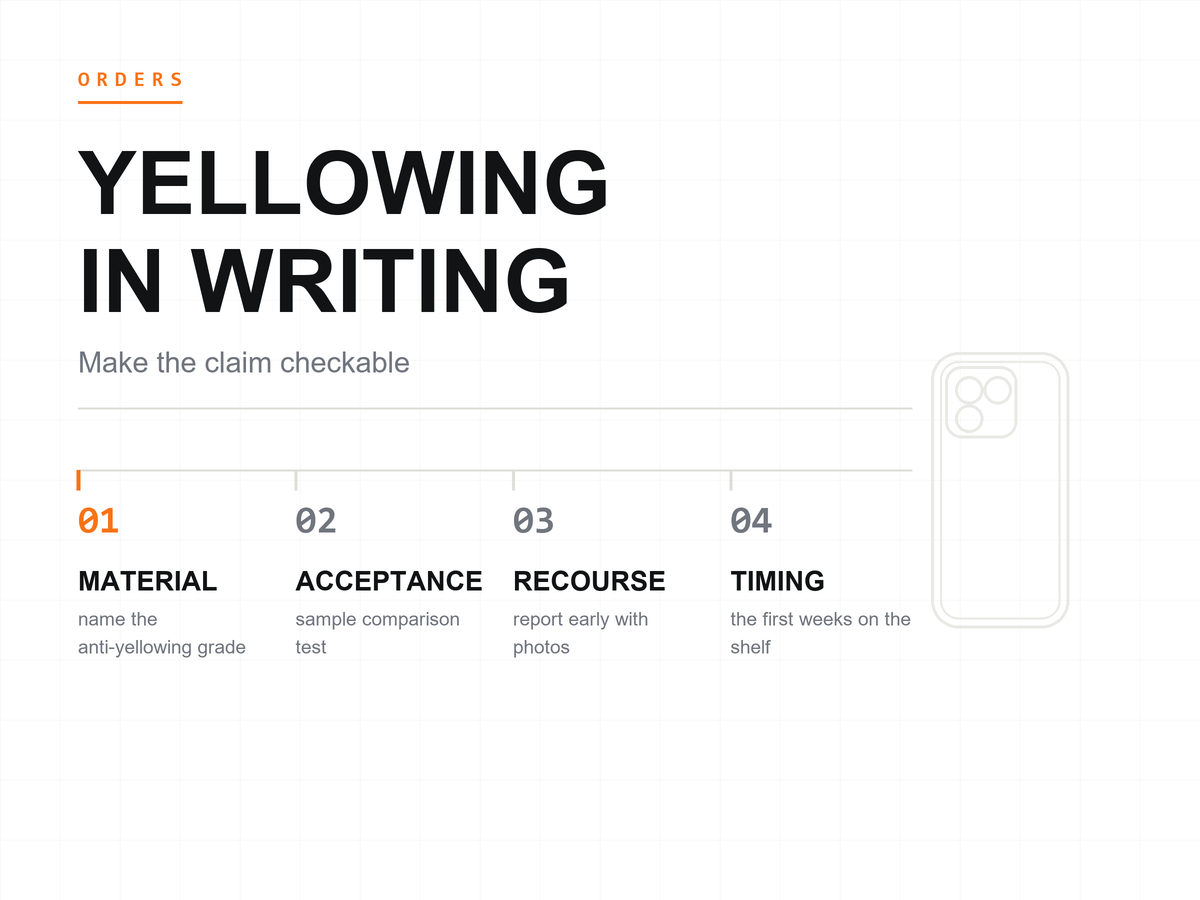
A purchase clause does not need formulas. What it needs is the material category both sides can verify: clear anti-yellowing TPU, a hybrid of PC and TPU, or whatever grade the supplier actually runs. The buyer writes the category, the supplier confirms it against the build, and the confirmed line becomes part of the deal.
If the supplier quotes a named grade or a trade name, ask what the grade is and what document stands behind it, and keep that document with the order file, where it survives a change of staff or a gap between seasons. The wording does not change across the range: the same clause fits a clear MagSafe build and a clear card-holder build, because the clause names the material rather than the SKU.
Send the clause to your supplier and ask them to return it with the material name filled in, before samples move.
State the Check
A clause that claims without a check is still a hope. Say how the expectation will be verified: a pair of samples from the production batch, one kept out of the light and its twin left in ordinary daylight beside a window, photographed side by side on a schedule. That is the paired-sample windowsill comparison we wrote about in the sampling guide, and the clause turns it from a suggestion into a condition.
The condition reads simply: bulk proceeds after the buyer reads the pair and the gap stays acceptable. Verification then belongs to the order itself, and a supplier who accepts the clause has accepted the test that comes with it. A supplier who pushes back has told you something about the claim before any money changes hands.
Agree What Early Yellowing Triggers
Define the trigger before it happens. If a clear case drifts visibly in the first weeks on the shelf, the buyer photographs the piece against its control and returns to the supplier with the pictures before discounting or replacing stock. That line makes the clause a communication channel with an agreed trigger, not a punishment waiting to be invented mid-season. It also protects the supplier, who gets a clear picture of the shelf problem early, while the fix is still a conversation rather than a refund wave.
Without a defined trigger, the buyer discovers the drift mid-season and negotiates from a weak position. With one, the conversation starts from a sentence both sides signed. How fast a case drifts depends on the life it leads — sunlight, dashboard heat, skin oils, pocket wear — so the trigger is written around evidence, not around a calendar.
Keep Timeframes Qualitative
Resist the urge to write a month count into the clause. A number looks precise and means nothing, because the same case ages differently on a sunny shelf in a hot city than it does in a drawer. The honest clause uses qualitative windows — the first weeks on the shelf, early in the selling season — and names the check, so a disagreement settles by photograph rather than by calendar.
We do not publish yellowing timeframes, and we would rather say so than hand you a number that pretends to control the sunlight. The clause is where that honesty pays: a buyer who asks for qualitative wording gets a supplier's real answer, while a buyer who insists on a month count gets a number nobody can stand behind.
Common Questions From Buyers
Should I ask the supplier to commit to a specific number of months?
No. A month count promises precision the material cannot deliver, and the same case ages differently under different skies. Write the material category, the verification check, the early-yellowing trigger, and a qualitative timeframe instead. Those lines are checkable; a month count is not. The qualitative version asks for honesty; the numeric version asks for salesmanship.
What if the supplier will not put the claim in writing?
Then the claim does not exist. A supplier who sells anti-yellowing material can name the grade and confirm it on the order confirmation, and a refusal at this stage answers the question a sample test would answer later, without costing you a shipment.
Does a written clause protect me if a batch still yellows?
It gives you a defined path instead of an argument. The trigger is agreed, the evidence is a dated photograph against the control, and the response starts as a conversation with the supplier rather than a pile of customer reviews. The clause does not make the material stronger; it makes the failure discussable. Whether a remedy follows depends on the terms and the relationship, but you no longer argue from a chat log. The clause changes what you hold when things go wrong: a record instead of a recollection.
What to Do Next
Draft the clause in plain lines before the next order: the material category, the verification check, the early-yellowing trigger, the qualitative timeframe. Send it with the sample request, keep the confirmed copy filed with the order, and write the same wording into every reorder so the standard survives busy seasons and staff changes. We have molded clear cases in Guangzhou since 2010, and we would rather confirm a clause in writing than watch it drift in a chat log.
Send us your clause draft and we will confirm it against the material of the build, line by line, before samples leave Guangzhou.
Apple and iPhone are trademarks of Apple Inc. iFunSmart is an independent manufacturer of phone cases and accessories and is not affiliated with, authorized, sponsored, or endorsed by Apple.