Freight and DDP Explained: Air vs Sea for Phone Case Orders
EXW, FOB, DDP — three letters that decide what your order really costs. Air vs sea, volumetric weight, and what to ask before you pay freight.
The short answer: The freight term decides what your order really costs — not the case price. A factory-gate price and a delivered-to-your-door price are two different totals for two different things, and comparing them as if they were the same is the most common freight mistake a first-time buyer makes. If you want one all-in number, ask for DDP: the supplier handles the freight, the customs clearance and the duties, and the price you are quoted is the price at your door. If you have your own forwarder, ask for EXW or FOB instead and let your forwarder handle the journey. Either way, get the term in writing before you pay anything, and ask for the freight quote per order — freight rates change with the season, the route and the size of the cartons, so no article can quote them for you. Send the destination country and quantity on WhatsApp https://wa.me/8613632248734 — we reply within 24 hours with MOQ, sample cost and lead time for that model, and the freight term available for your country.
1. The four terms you will actually see
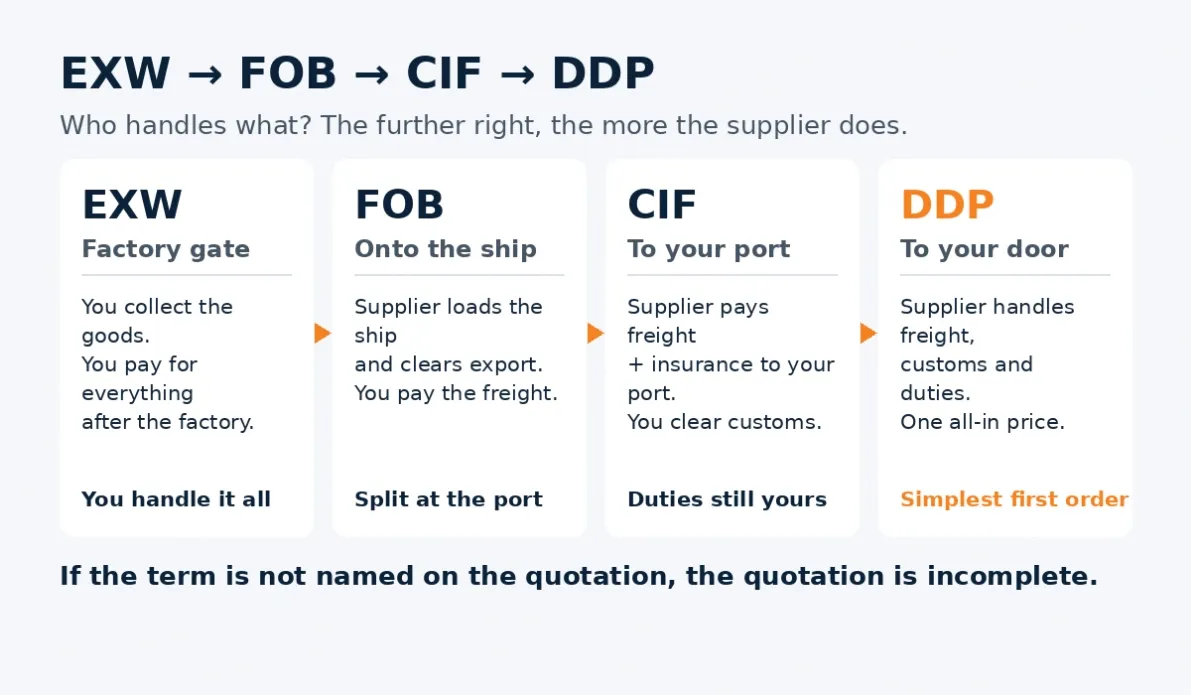
Every international order is sold under a freight term, and the term is a division of work: who pays for each leg of the journey, and who handles customs. Four terms cover almost every phone case order.
EXW — Ex Works, factory gate. You collect the goods at the factory door, or your forwarder does. The supplier's job ends when the cartons are ready. You pay for everything after that: the truck to the port, the freight, the customs clearance at your end, the duties. EXW is the cheapest-looking price on a quotation and the most expensive one to manage, because every step after the factory is yours to arrange. It only makes sense if you already have a forwarder you trust in China.
FOB — Free On Board. The supplier delivers the goods onto the ship or plane and clears export customs; you pay for the international freight and everything after it arrives. FOB is the middle ground: the supplier handles the China side, you handle the rest. If you have a forwarder but no agent in China, FOB is usually the practical choice.
CIF — Cost, Insurance and Freight. The supplier pays for the freight and the insurance to your port, and you handle customs clearance and duties when the goods arrive. CIF looks convenient, and it is — but check whose insurance it is and what it covers, and remember that the duties at your end are still yours.
DDP — Delivered Duty Paid. The supplier handles the whole journey: freight, customs clearance at your end, and the duties. The price you are quoted is the price at your door. DDP is the simplest term for a first-time buyer, because there is one number and no customs paperwork to arrange yourself. It is also the term you should ask for by name if a supplier quotes you "shipping included" without saying what that includes — "shipping included" is not a term, and it does not tell you who pays the duties.
One rule covers all four: if the term is not named on the quotation, the quotation is incomplete. A total with no freight term is not a price you can compare. Read more: https://www.ifunsmart.com/posts/phone-case-quotation-guide
2. Air vs sea: speed against cost, not good against bad
Buyers often ask which is "better," air or sea. The wrong question. They are different tools for different orders, and the right one depends on what you are shipping and when you need it.
Air freight is for speed and for small quantities. Samples, a first test order, a restock before a launch — these travel by air, because the order is small and the date matters more than the freight cost per piece. A carton of samples is light, and the freight is a small part of the order's value.
Sea freight is for bulk. A full order of hundreds or thousands of cases travels by sea, because the freight cost per piece is far lower than by air and the order is large enough that the saving matters. The trade-off is time: sea is slower, and the goods spend longer in transit and in customs. That is why lead-time planning matters — a sea shipment has to be ordered earlier, and the date you need the goods decides the freight, not the other way round. Read more: https://www.ifunsmart.com/posts/phone-case-order-lead-time-planning-guide
The mistake is choosing by habit. A buyer who always ships by air pays too much on bulk orders; a buyer who always ships by sea misses launch dates on small ones. Ask for both quotes on your first order — air and sea, for the same quantity, under the same term — and the difference will tell you which one fits. Neither quote is a fixed rate: freight changes with the season, the route and the space available, so ask for the quote per order, in writing, and do not treat a rate from one order as the rate for the next.
3. Volumetric weight: why a light carton can cost more than a heavy one
Here is the freight surprise that catches first-time buyers. Freight is not charged on weight alone. It is charged on whichever is greater: the actual weight of the carton, or its volumetric weight — the space it takes up.
A carton of phone cases is light. A carton of phone cases in retail boxes, with inserts and padding, is light and bulky. The carrier charges for the space, because space on a plane or in a container is what they are selling. So two cartons can weigh the same and cost different amounts to ship, because one is bigger. That is volumetric weight, and it is the reason packaging choices change freight costs: a retail box with an insert costs more to ship than a polybag, not only because the box costs more to make, but because it takes more space.
Three practical consequences. First, ask how the goods are packed before you compare freight quotes — a quote for polybag packing and a quote for retail-box packing are quotes for different cartons. Second, if you are comparing two suppliers' freight, make the packaging match first, the same way you make the quantities match on a quotation. Third, ask for the carton count, the carton size and the carton weight on the packing list — those three numbers are what the freight is calculated from, and they should be on the documents you receive before you pay the balance. Read more: https://www.ifunsmart.com/posts/phone-case-payment-terms-first-order
If a supplier cannot tell you the carton size and weight, they cannot give you a real freight quote. They are guessing, and the real number will appear later — usually after the deposit is paid.
4. DDP in practice: what to ask before you agree
DDP is the simplest term, but "simplest" does not mean "ask nothing." Four questions decide whether a DDP quote is a real all-in price or a headline with extras behind it.
First, which countries is DDP available for? DDP depends on the supplier's freight partners and customs agents in your country, and it is not available everywhere. Do not assume it is available for your country because it was available for someone else's. Ask for your country, by name, in writing.
Second, are the duties included or estimated? A DDP quote should include the duties. If the duties are "estimated" or "to be confirmed," the total is not final, and you should ask what happens if the actual duties are higher. A fixed DDP price and an estimated DDP price are different offers.
Third, who clears customs, and what do they need from you? Under DDP the supplier's agent clears customs, but they may still need your tax number, your company details, or a power of attorney. Ask what documents you need to provide, and when. A DDP shipment held at customs because a document was missing is still a delayed shipment, even if the freight was paid.
Fourth, what happens if customs holds or inspects the goods? Ask who pays for storage during a hold, and who handles the inspection. The answer should be in the same written confirmation as the price — agreed before production starts, not argued about while the goods sit in a warehouse.
If a supplier answers all four clearly, DDP is the easiest way to buy your first order. If they cannot answer them, ask for FOB and use your own forwarder — a term you control is better than a term nobody can explain.
5. What to send so you get a usable freight quote back
Suppliers quote freight for the order you describe. Send six things in one message, and the quote that comes back will have the same lines as every other supplier's.
First, the destination — the country and the city, not just the country. Freight to a port city and freight to an inland city are different journeys. Second, the quantity — the number of pieces and the number of colours, because the carton count follows from them. Our MOQ is 50 pcs per colour per model, so every colour you add is a new production run and a new set of cartons. Third, the packaging — retail box, plain box, or polybag — because the carton size follows from it. Fourth, the freight term you want quoted — DDP if you want one all-in number, FOB if you have your own forwarder. Fifth, the date you need the goods — your launch date, not "as soon as possible," because the date decides air against sea. Sixth, the model list — the exact phone models, one line each, because the case size follows from the model.
Send that message to two or three suppliers, and ask each for air and sea under the same term. Then the comparison takes ten minutes, and the total you choose is a landed cost, not a guess. Send your destination, quantity and date on WhatsApp https://wa.me/8613632248734 — we reply within 24 hours with MOQ, sample cost and lead time for that model, and the freight term available for your country.
FAQ
Q: What does DDP mean for a phone case order?
A: Delivered Duty Paid: the supplier handles the freight, the customs clearance at your end, and the duties, and the price quoted is the price at your door. Ask whether DDP is available for your country, and whether the duties are included or estimated.
Q: Should I ship by air or by sea?
A: Air for samples, test orders and urgent restocks — small quantities where the date matters. Sea for bulk orders, where the freight cost per piece matters more. Ask for both quotes on your first order, under the same term, and compare.
Q: What is volumetric weight?
A: Freight is charged on whichever is greater: the carton's actual weight or the space it takes up. A light, bulky carton — for example cases in retail boxes — can cost more to ship than a heavy, small one. Ask for the carton count, size and weight on the packing list.
Q: Why do three suppliers quote different freight for the same order?
A: Because they quote different things: different terms (EXW vs DDP), different packaging (polybag vs retail box), or air vs sea. Make the term, the packaging and the mode match first, then compare the totals.
Q: What should I send to get a usable freight quote?
A: The destination city and country, the quantity and colours, the packaging, the freight term you want, the date you need the goods, and the exact phone models — in one message, to every supplier you ask.
About iFunSmart
Ifun Electronics Technology Co., Ltd, Guangzhou, since 2010. 1,000+ designs, 500+ models, 500K+ pcs/month, exported to 30+ countries. MOQ 50 pcs per colour per model. We quote model, style, colour, quantity per colour, sample cost, packaging, freight term, payment terms and lead time in writing — ask us for the freight term available for your country. WhatsApp https://wa.me/8613632248734 — Email contact@ifunsmart.com