How to Plan Your Phone Case Order Timeline (Without Missing Your Launch Date)
A phone case order is five stages with approval gates between them. Plan backwards from your launch date, send the supplier the full order details first, and the timeline stops being a guess.
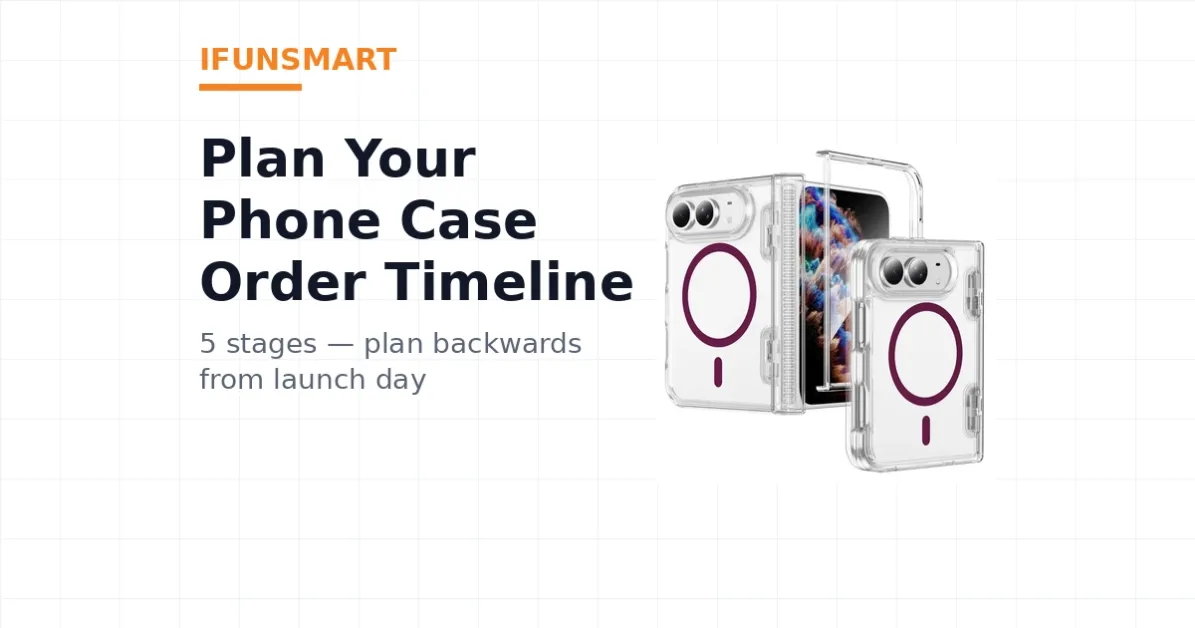
The short answer: A phone case order moves through five stages — artwork and colour approval, sample approval, production, quality checks, and packing and shipping — and each stage waits for your approval before the next one starts. The most common reason a launch date is missed is not slow production; it is a late artwork change, a colour approved and then changed, or a model added after production has started. Plan backwards from your launch date, leave room for shipping and one round of sample changes, and send the full order details in your first message so the timeline can be quoted, not guessed. Send model, style, quantity, colours and country on WhatsApp https://wa.me/8613632248734 — we reply within 24 hours with MOQ, sample cost and lead time for that model.
1. The five stages every order goes through
Every wholesale order, stock or custom, passes through the same five stages.
| Stage | What happens | What the buyer must do |
|---|---|---|
| 1. Artwork and colour approval | Logo files, colour references and packaging artwork are checked against what the factory can actually print and produce | Send the final files and the colour reference; approve the proof in writing |
| 2. Sample approval | A sample is made to the approved artwork and colour, and sent to the buyer | Test it on a real handset — fit, buttons, magnet, charging — and approve or request changes in writing |
| 3. Production | The approved sample becomes the bulk run, colour by colour | Confirm the final model, style and colour list in writing; do not change it after this point |
| 4. Quality checks | Fit, magnet, finish, print and packaging are checked before the goods leave | Agree the inspection points and evidence (photos, video) before production starts |
| 5. Packing and shipping | Goods are packed, labelled and dispatched to the buyer | Confirm labels, carton marks and the delivery address in writing |
Stages do not overlap by default: production does not start while the sample is still being argued about, and packing does not start while quality checks are still open. A delay in any stage is visible early — but no stage is left at the end to absorb it. Read more: https://www.ifunsmart.com/posts/phone-case-wholesale-china-buying-direct-manufacturer
2. What actually delays an order
When an order runs late, the cause is almost always one of six things — and five of them sit with the buyer, not the factory.
First, artwork arrives in the wrong form: a small screenshot instead of a usable logo file, or a logo placed differently on every colour. Second, a colour is approved and then changed after the sample is made — every colour is a separate production run, so a late colour change is a new run, not a small edit. Third, a model is added after production has started. Fourth, packaging is decided last — a custom retail box is its own print run, and it cannot be printed from a description. Fifth, labels are confirmed after packing has started, which means cartons are opened again. Sixth, the shipping method is chosen at the last minute.
None of these are anyone's fault — they are planning failures, and planning is the part the buyer controls completely. If your launch date is fixed — a retail listing, a trade show, a seasonal drop — say so in your first message, with the date. A supplier who knows the date can tell you honestly whether it is achievable; one who does not can only quote a standard timeline, and a standard timeline has no launch date in it.
3. Plan backwards from the launch date
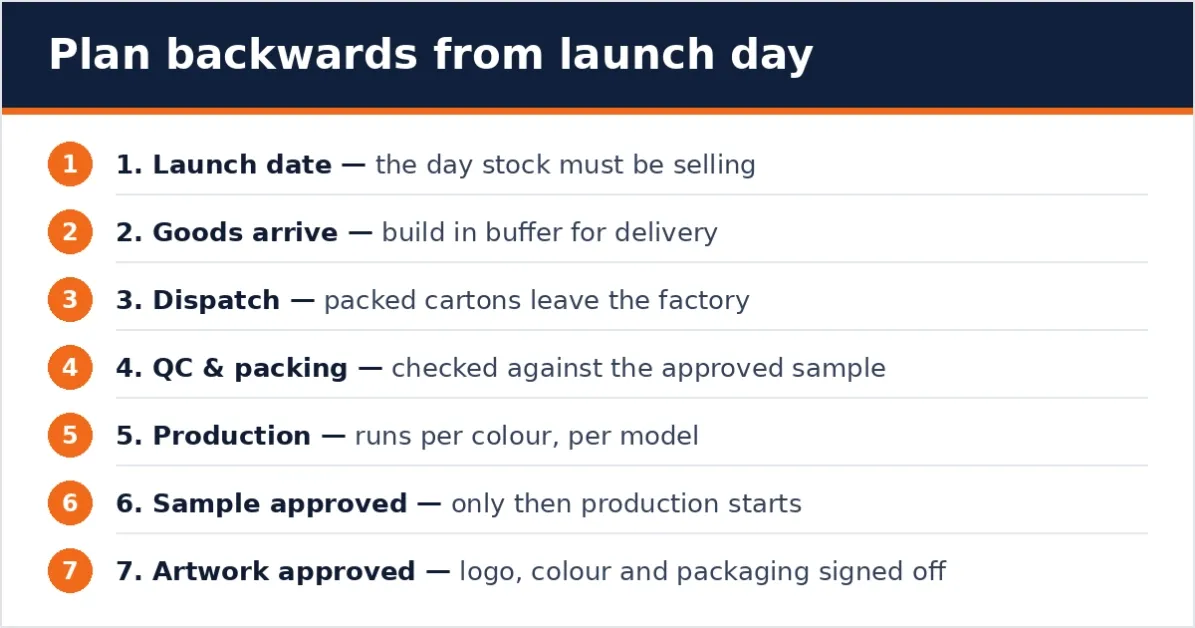
Start with the day the cases must be on sale, or in your customers' hands. Work back to the day the goods must arrive at your warehouse — allowing time for receiving, labelling and listing. Work back to the dispatch date, allowing for the shipping method you have chosen. Work back through quality checks and packing, which need their own time after production ends. Work back through production, which starts only after the sample is approved. Work back through the sample stage, which starts only after the artwork and colour are approved. And work back to today, which is when the artwork and colour should be sent.
Write the dates down, one line per stage, and send the list with your first enquiry. Then ask the supplier to fill in the time each stage takes for your order — it depends on your models, colours and packaging, and no article can give you the number. Ask us for lead time for this model, with the launch date included, and we confirm in writing. And leave a buffer: room between the goods arriving and the launch, because a shipment that arrives on the launch date is already late.
4. What to send first so a timeline can be quoted
A supplier cannot quote a real timeline from "I need 500 cases." Send all of these in your first message:
- The exact phone models, one by one — a model added later is a delay.
- The style for each model: clear, liquid silicone, MagSafe, rugged, or the exact style name from the catalogue.
- The colours per style and the quantity per colour. MOQ is 50 pcs per colour per model, so the colour count decides the number of production runs. Read more: https://www.ifunsmart.com/posts/phone-case-moq-50-per-colour-first-order
- Whether the order is stock or custom. A logo, a custom colour or custom packaging each adds an approval step. If it is custom, send the logo file and the packaging requirements with the first message, not after the quote. Read more: https://www.ifunsmart.com/posts/custom-phone-case-oem-odm-logo-colour-packaging
- The destination country and the delivery address type — warehouse, Amazon FBA, or fulfilment centre — because labelling and shipping depend on it. If the goods go to Amazon, say so now: FBA labels must be applied before dispatch. Read more: https://www.ifunsmart.com/posts/selling-iphone-18-cases-amazon-2026-landed-cost-fba
- The launch date, or the date the goods must arrive. A date turns a quote into a plan. If you sell in the EU, the labelling and the responsible-person details belong in the first message too. Read more: https://www.ifunsmart.com/posts/selling-phone-cases-eu-2026-gpsr-reach-rohs-documents
Send it as one written message and keep a copy — it saves the rounds of questions that otherwise eat the first week.
5. Sample approval is the gate that controls everything
Of all five stages, the sample stage is the one that decides whether the timeline holds. Production cannot start before the sample is approved, so every day spent deciding on a sample is a day taken from the end of the order. Two habits keep this gate moving.
First, test the sample the day it arrives. Check the fit on a real handset, the button cutouts, the magnet hold on your own charger and car mount, and wireless charging. For MagSafe styles, run the three magnet tests on your own accessories before you approve anything. Read more: https://www.ifunsmart.com/posts/magsafe-cases-2026-n52-2700-gauss-test-magnet. For clear cases, start the sunlight comparison the day the sample arrives. Read more: https://www.ifunsmart.com/posts/clear-phone-case-anti-yellowing-test
Second, approve or request changes in writing, in one message, listing every change at once. "The logo is 2 mm too high, the pink is too dark, and the box needs the barcode on the back" is one round of changes. Three separate messages over three days are three rounds, and three rounds push a launch date. When you approve, write the words "sample approved" with the date, and name the sample you approved. That sentence is what starts production.
6. Shipping and receiving: the last stage is not free time
Buyers often treat shipping as the time after the order is "done." It is a stage with its own choices, and the wrong choice at the end can undo a perfect production schedule. Decide the shipping method when you place the order, not when the goods are packed. Air freight suits a launch or a first order; sea freight suits a full season's stock once you know what sells — the trade-off is covered in the US Amazon guide linked above. Whichever you choose, confirm the carton labels and the delivery address before packing starts, and ask for a photo of a labelled carton before dispatch. Remember your own side of the arrival, too: goods that land at your warehouse still need receiving, checking and listing before they are on sale.
FAQ
How long does a phone case order take?
It depends on your models, colours, customisation and shipping method — there is no single number. Ask us for lead time for this model, with the model list, colour count and launch date, and we confirm in writing.
What is the first thing I should send the supplier?
The model list, the style, the colours and quantities per colour, whether the order is stock or custom, the destination, and your launch date — in one written message.
Why did my last order run late?
Artwork in the wrong form, a colour changed after sample approval, a model added after production started, packaging decided last, or labels confirmed after packing. All five are fixed by deciding earlier, not by producing faster.
When does production actually start?
After the sample is approved in writing. Nothing before that date counts as production time, so test the sample the day it arrives and send all change requests in one message.
Should I leave buffer time before my launch date?
Yes — leave room between arrival and launch for receiving, checking and listing. A shipment that arrives on the launch date is already late.
About iFunSmart
Ifun Electronics Technology Co., Ltd, Guangzhou, since 2010. 1,000+ designs, 500+ models, 500K+ pcs/month, exported to 30+ countries. MOQ 50 pcs per colour per model. Our 2700GS Magnetic Case for iPhone 18 Pro Max uses up to 2700 Gauss, N52 magnets. Send your model list, colours and launch date and we confirm MOQ, sample cost and lead time. WhatsApp https://wa.me/8613632248734 — Email contact@ifunsmart.com