Business Solutions
Phone Cases for Telecom Carriers & Operators
Carriers order cases in bulk for activation bundles and fleet phones. Which styles take a logo, which models to cover first, the 50-pc MOQ, the 100-pc laser logo trial and what to send for a quote.
BLUF
A carrier's first phone-case order is three styles across the launch models: one clear magnetic case, one rugged armor case and one folio wallet, each carrying the carrier's logo. The most common MOQ is 50 pcs per colour per model; bulk terms start at 500 pcs per order.
Short answer
A telecom carrier does not buy phone cases the way a retail shop does. A retail shop buys what is selling this week; a carrier buys for a launch window, an activation bundle and a fleet of phones that all have to look the same. That changes three things about the order. First, the case has to carry the carrier's brand — a logo on the back, a uniform colour across the fleet, packaging that matches the carrier's retail standard. Second, the order has to cover the models the carrier actually activates — the current iPhone Pro Max and the current Samsung Ultra first, the mid-range Samsung A-series second, and carrier-branded Android handsets only where a mould exists. Third, the order has to be agreed in writing before the deposit, because a carrier order is a bulk order from the first carton: the most common MOQ is 50 pcs per colour per model, and it varies by product line, bulk and distributor terms start at 500 pcs per order in total, and a 100-pc trial order can already carry a logo by laser engraving. Samples carry a fee, refundable on orders of 500+ pcs — ask us to confirm the amount per style in writing. Payment is T/T and Western Union only, with a 30% deposit for new customers, photos and video and the packing list after the goods are ready, then the balance, then the goods ship. This guide works through the styles that take a logo, the models to cover first, how a bulk carrier order is built line by line, how the sample is approved, what goes in an activation bundle, and what to send for a first quotation.
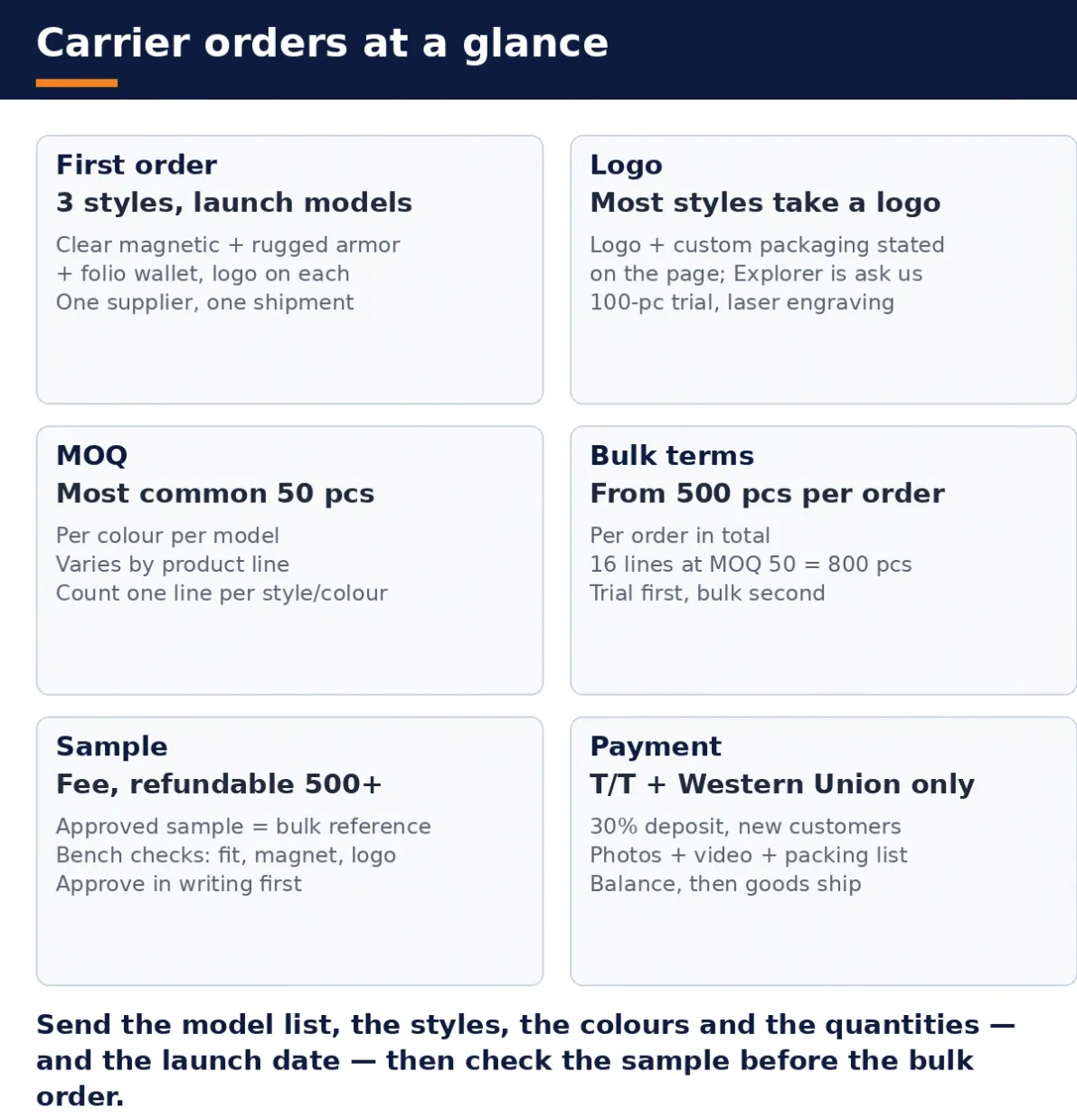
Carrier orders at a glance
Check | What applies to a carrier order |
|---|---|
First order | One clear magnetic case, one rugged armor case, one folio wallet — across the launch models |
Logo | Most styles support logo customisation and custom packaging — check the style table in §2; the Explorer is "ask us" |
MOQ | Most common 50 pcs per colour per model, varies by product line — count one line per model, style and colour |
Bulk terms | Distributor and bulk orders start at 500 pcs per order in total |
Logo trial | A 100-pc trial order can carry a logo by laser engraving — per-piece charge confirmed in writing per order |
Sample | Fee charged, refundable on orders of 500+ pcs — ask us to confirm the amount per style in writing |
Payment | T/T and Western Union only; 30% deposit for new customers; photos + video + packing list, then balance, then ship |
Models first | iPhone 18 Pro Max, iPhone 17 Pro Max, Samsung S26 Ultra, Samsung A27/A37/A57 — carrier-handset moulds are "ask us" |
1. Which phone case styles do carriers order first?
A carrier's first order is three styles, not one, because the three styles do three different jobs. The clear magnetic case is the activation-bundle case: it shows the phone, it holds a magnet for a charger or a wallet, and it is the case a customer sees first when the phone comes out of the box. The rugged armor case is the fleet case: it goes on phones that are handed out, carried on site and replaced on a schedule, where the case has to survive the working day. The folio wallet is the premium case: it carries cards, it closes over the screen, and it is the case a carrier sells with a contract renewal or a business plan. A carrier that orders all three in the same first order has a case for the bundle, a case for the fleet and a case for the premium sale — and one supplier, one shipment and one set of documents for all three.
The clear magnetic case — the activation-bundle case. Four confirmed styles carry the clear magnetic job, all with the logo line on the page and all at the most common MOQ of 50 pcs per colour per model. The Clear Magnetic Case for iPhone 17 & Samsung, Moto and Google covers the widest brand range of any clear case in the range — iPhone 17 and Samsung series, plus Google and Moto — with a 12N magnetic lock stated on the page. The Clear MagSafe Case for iPhone 18 Pro Max is the current flagship clear case, with a 99% high-transmittance anti-yellow PC back and a shockproof soft TPU bumper, and N52H stated in the page title. The Bayer MagSafe Case for iPhone & Samsung (Crystal Clear, N52) covers iPhone 17, 16 and 15 series plus Samsung, with 2600 Gauss at N52 grade stated in the page's own body text and a 4.5-level anti-yellowing figure stated on the page. The 2700GS Magnetic Case for iPhone 18 Pro and Pro Max states up to 2700 Gauss in the page's own body text, with a translucent frosted PC back, a TPU bumper and a raised metal camera frame. The magnet figure is stated per style, never as a blanket figure for the range: the Clear Magnetic states 12N, the Bayer states 2600 Gauss N52, the 2700GS states up to 2700 Gauss, and the Clear MagSafe states N52H in its title. A carrier that wants a magnet figure on the quote should ask for the figure for the style it is ordering, in writing — never assume one style's figure applies to another.
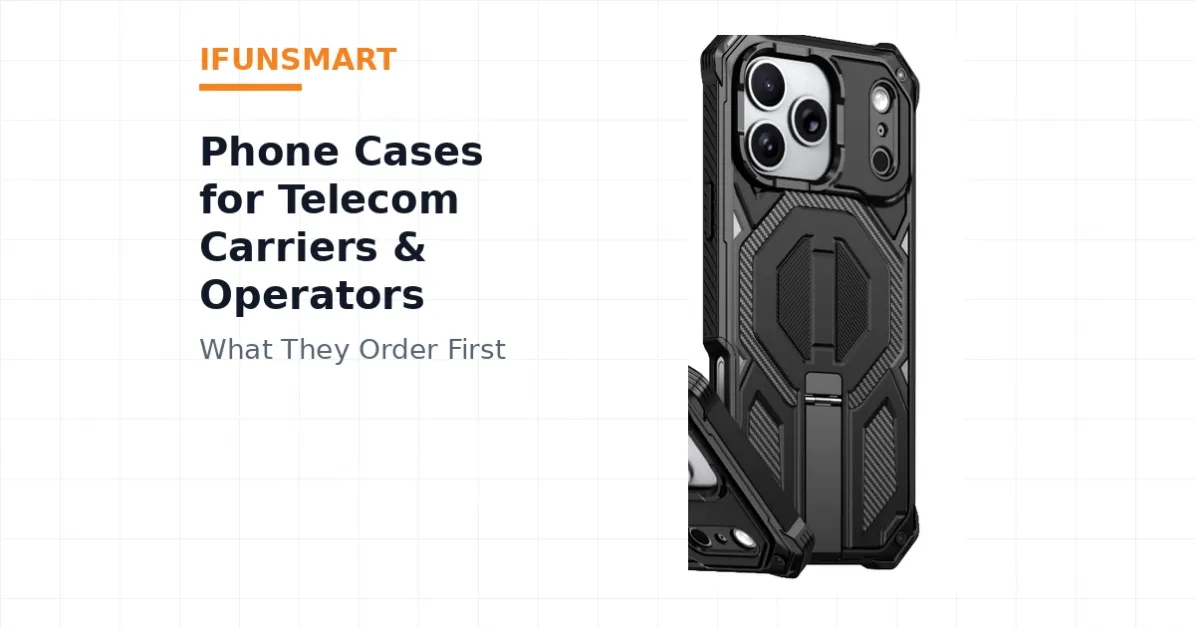
The rugged armor case — the fleet case. Three confirmed armor builds carry the fleet job, all with the logo line on the page and all at the most common MOQ of 50 pcs per colour per model. The Premium MagSafe Armor Case for iPhone 18 Pro Max is the flagship armor build, with metal buttons and an 18N N52 magnetic core stated in the page's own body text. The Heavy Duty Armor MagSafe Case, IB25-015, covers iPhone and Samsung series with a 360° rotatable ring stand, built-in N52 magnets stated on the page with no Gauss figure, and seven colours stated on the page — Purple, Pink, Orange, Red, Grayish Green, Navy Blue and Black. The Shockproof Armor MagSafe Case covers Samsung S26, S26+ and S25 plus iPhone 17 and 16 series, with a 1.5 mm hard PC back, a soft TPU frame and patented "Shock Pocket" airbags stated on the page. A fourth rugged build, "The Explorer" Heavy Duty Rugged MagSafe Case with a Metal Hinge Stand for iPhone 17 Pro Max, is the most visibly rugged case in the range — built-in N52 magnets at 2500–2800Gs stated in the page's own specification — but its page does NOT state logo customisation, so a carrier that wants the Explorer co-branded should ask us first; do not assume the logo line applies to it. Note also that the Explorer's 2500–2800Gs figure appears in the shared related-product blocks on several other product pages — it belongs to the Explorer only and must never be quoted as another style's figure.
The folio wallet — the premium case. Five confirmed folio and wallet styles carry the premium job, all with the logo line on the page and all at the most common MOQ of 50 pcs per colour per model. The Dreamy Magnetic Folio Wallet Case for iPhone Duo covers iPhone 18 Pro and Pro Max, with three card slots, a PU leather folio and a magnetic clasp. The Luxury Leather Wallet Case for iPhone 18 Pro Max is the lychee-leather folio, also with three card slots and a magnetic clasp. The Microfiber Leather Wallet Case for iPhone 18 Pro is the microfiber-leather folio with a magnetic flip cover. The Leather Wallet Magnetic Case for Samsung Galaxy A27, A37 and A57 is the mid-range folio — textured PU leather, a flexible TPU inner shell, a magnetic closure and a fold-out kickstand, in seven colours. The Magnetic Closure Folio Leather Wallet covers iPhone, Samsung, Xiaomi and Google — the broadest brand coverage of any folio in the range, which is the folio for a carrier whose fleet is not one brand. Two more folio styles complete the range: the Mirror Spliced Leather Folio Wallet Case for iPhone Duo and the Litchi Two-Tone Magnetic Wristlet Folio Case for iPhone Duo, the second with a wristlet strap. The R20 Leather Wallet Case for iPhone 18 Pro Max is also a confirmed folio with the logo line on the page. Its MOQ is not stated in this guide — ask us to confirm it per line in writing before the deposit.
The card and slide styles — the bundle add-ons. Four more confirmed styles round out a carrier order. The Slide-Window MagSafe Case for iPhone 18 Pro Max is the sliding card-slot cover. The Magnetic Ring Stand Armor Case for iPhone 18 Pro is the sliding camera-cover armor with a magnetic ring stand — its page confirms the MOQ in its own FAQ as well as its specification. The RFID Blocking Clear Card Holder Case for iPhone 17 & Samsung is the crystal-clear card holder with a metal shaft. The Pop-Up MagSafe Card Wallet is a universal accessory for all magnetic phones, holding four to six cards, at 50 pcs per colour — not per colour per model, because it is universal and not model-specific. The P7 Replaceable Panel Case for iPhone 18 Pro Max, with five stand options and a replaceable magnetic back panel, is the style for a carrier that wants to refresh the look — or the logo panel — without re-tooling the whole case; the panel-swap mechanism is stated on the page, and the logo line is confirmed on the page. The Star Origin R2 Magnetic Stand Case for iPhone 18 Pro Max is the frosted translucent stand case. The Qiying Gen 1 Magnetic Case for iPhone Duo is the matte kickstand case with 38 N52 magnetic rings inside the back panel, stated in the page's own body text. The Translucent MagSafe Case and the Micro-Matte MagSafe Holder Case for iPhone 18 Pro and Pro Max both state 18N magnetic in their page titles. The Velvet MagSafe Case with a Metal Camera Frame covers iPhone 17 and Samsung with a soft velvet interior. What is NOT in this list is liquid silicone for iPhone Duo: it is not a confirmed live style in this guide, so Duo liquid silicone is "ask us" — the iPhone 18 Pro Max liquid silicone page is live and confirmed. No style in this section is claimed for a carrier-branded Android handset: there is no live product page for carrier-specific models such as the T-Mobile REVVL or Metro, Cricket and Boost handsets, and mould coverage for those models is "ask us".
2. What makes a case co-brandable for a carrier?
A case is co-brandable when three things are true: the page states logo customisation, the material takes the logo method the carrier wants, and the logo position is agreed on the approved sample before the bulk order. That is the test for any custom logo phone case carrier order — the page must state logo customisation, the material must take the method, and the position must be agreed on the sample. Most styles in §1 meet the first test — the page's specification carries "Support Logo Customization & Custom Packaging". The Explorer is the exception: its page carries no logo line at all, so its logo availability is "ask us". The R20 carries the logo line, but its MOQ is not stated in this guide, so a carrier ordering the R20 should confirm both the logo and the MOQ in writing before the deposit. Every other style named in §1 is co-brandable on the page's own terms.
The logo methods — and which material takes which. Four print methods are confirmed for phone cases in this series: UV printing, which cures the graphic with UV light; IMD, which seals the graphic inside the moulded wall; silk screening, which uses a mesh stencil and spot colours with no gradients; and heat transfer, which moves a graphic layer with heat and pressure. A fifth method, laser engraving, is the method for a trial order: a 100-pc trial order can carry a logo by laser engraving, and laser is permanent — silk-screen fades and needs a higher MOQ. The per-piece charge for the laser engraving is confirmed in writing per order; this guide states no figure, because the figure is confirmed per order. Which method fits which case depends on the material. A flat PC back is the cleanest surface for a logo — the graphic sits flat, the colour reads true, and the position is easy to hold across a batch. A soft TPU frame flexes, so a logo on the frame needs its position checked on the sample. Silicone needs its surface checked before the logo method is chosen — the surface treatment decides whether the graphic adheres. A PU leather or microfiber folio has a texture that changes the effect of the logo, so the logo on a folio is agreed on the sample, never from a photograph. A clear case needs the logo colour checked against the transparency and against the phone behind it — a dark logo on a clear back reads differently on a dark phone than on a light one. A magnetic case needs space around the ring and the camera opening and any texture, so the logo position on a magnetic case is kept clear of the ring. None of this is decided from a catalogue photograph. It is decided on the sample, and the approved sample becomes the bulk reference — see §5.
The artwork — what the carrier sends. The carrier sends the logo artwork at the start, not after the order is placed: an AI or PDF file, or a high-resolution image, plus the brand colours at the start so the colour match is agreed before the sample is made. The carrier also states the logo size and the logo position — on the back, centred or offset, above or below the magnetic ring, on the folio cover or inside it — and whether the logo is the carrier's own mark or a co-brand that needs authorisation. A protected brand element needs authorisation before it is printed; a factory that prints a carrier's mark without it is a factory that has not checked. The carrier should also state the packaging requirement at the same time: neutral packaging is usually in stock and a logo sticker can be added to it, and custom packaging is available — ask us to confirm the packaging options and the packaging MOQ per style in writing. The 2700GS page adds a colour note worth borrowing for the whole order: standard colours are ready for sampling, and custom colours can be matched for OEM orders — confirm the minimum quantity for custom colours when you enquire. A carrier that wants a uniform fleet colour across three styles should send the colour reference with the artwork and ask for the match in writing per style, because a colour that matches on a frosted PC back does not automatically match on a leather folio.
The colour uniformity question. A carrier fleet has to look the same — the same colour on every phone, in every store, on every activation. That is a colour-matching question, not a colour-naming question. Seven colours are stated on the Heavy Duty Armor page and seven on the A27/A37/A57 leather wallet page, and the 2700GS lineup shows eight colours on one page — Black, Gray, Pink, Blue, Purple, Orange, Cherry Red and Light Blue. For every other style, the colour list is on the page gallery, and the carrier should confirm the colour per style in writing before the deposit. A carrier that orders three styles in one fleet colour should ask for one colour reference across all three, and check the match on the sample — a frosted translucent back, a matte TPU bumper and a leather folio will not take the same colour the same way, and the sample is where that difference is caught.
3. Which models should a carrier cover first?
A carrier covers the models it activates, in the order it activates them — and the order is the launch models first, the mid-range second, and everything else only when the first two are moving. One model deep before two models wide: a first order that goes deep on the iPhone 18 Pro Max and the Samsung S26 Ultra, in three or four styles each and three or four colours each, is a bulk order from the first carton, because the line count is the order size — four styles in four colours on one model is already sixteen lines at the most common MOQ.
iPhone 18 Pro Max — the first model. The iPhone 18 Pro Max is the current flagship: 163.4 × 78.0 × 8.75 mm, 249 g, announced 9 September 2026 and on sale 18 September 2026. It is also the model with the deepest confirmed case coverage in the range — the Clear MagSafe, the Liquid Silicone Magnetic, the Premium MagSafe Armor, the Luxury Leather Wallet, the R20 Leather Wallet, the Slide-Window, the P7 Replaceable Panel, the Star Origin R2, the 2700GS, the Translucent MagSafe and the Micro-Matte MagSafe Holder are all confirmed iPhone 18 Pro Max pages, all at the most common MOQ of 50 pcs per colour per model, all with the logo line on the page. A carrier that activates the 18 Pro Max should start here, in three styles — one clear magnetic, one armor, one folio — in three or four colours each. The standard iPhone 18 is a different question: it was not announced with the Pro range, reports point to a spring 2027 launch, and no live product page lists the standard iPhone 18 — every 18-series page is Pro or Pro Max only. The confirmed offer for the standard iPhone 18 is the five-style pre-order series, and pre-orders hold allocation while fit is confirmed on a sample. A carrier that wants standard-18 cases should ask us about the pre-order position, not assume a live page exists.
iPhone 17 Pro Max — the second model. The iPhone 17 Pro Max is the previous flagship: 163.4 × 78.0 × 8.75 mm, 233 g, announced 9 September 2025 and released 19 September 2025, discontinued 9 September 2026. It is a year past launch, price-reduced, with a large installed base — the volume segment, and the model a carrier's existing customers already hold. Confirmed 17 Pro Max coverage includes the Explorer rugged case, the Clear Magnetic Case for iPhone 17 & Samsung, Moto and Google, the Shockproof Armor MagSafe Case and the Bayer Crystal Clear case. A carrier adds the 17 Pro Max when the 18 Pro Max lines are moving, not before — the installed base is the reason to stock it, and the installed base is also the reason it does not need to lead the order.
Samsung S26 Ultra — the Android flagship. The Samsung S26 Ultra is the current Samsung flagship: 6.9-inch display, 163.6 × 78.1 × 7.9 mm, 214 g, announced 25 February 2026 and on sale 11 March 2026, with 25W Qi2.2 wireless charging and no built-in magnets — it is "Qi2 Ready", which means the magnet has to be in the case, not the phone. Confirmed S26 Ultra coverage includes the Shockproof Armor MagSafe Case, which also covers the S26+ and S25, and the Clear Magnetic Case for iPhone 17 & Samsung, the Bayer Crystal Clear case and the Velvet MagSafe case, which all cover Samsung series. The magnet figure is the case's figure, per style — the 2700GS states up to 2700 Gauss for the iPhone 18 Pro and Pro Max, and no S26 Ultra style in this guide carries a blanket Gauss figure. A carrier that sells the S26 Ultra with a magnetic charger or a magnetic wallet should ask for the magnet figure for the S26 Ultra style it is ordering, in writing.
Samsung A27, A37 and A57 — the mid-range. The mid-range is where a carrier's volume sits, and the confirmed mid-range coverage is the Leather Wallet Magnetic Case for Samsung Galaxy A27, A37 and A57 — textured PU leather, a flexible TPU inner shell, a magnetic closure and a fold-out kickstand, in seven colours, at the most common MOQ of 50 pcs per colour per model, with the logo line on the page. The Magnetic Closure Folio Leather Wallet covers iPhone, Samsung, Xiaomi and Google, which is the folio for a mixed-brand fleet. A carrier that activates mid-range Samsung phones should lead with the A-series folio and add the clear magnetic styles that cover Samsung series, rather than ordering a flagship-only range and leaving the mid-range uncovered.
Carrier-branded Android handsets — ask us. There is no live product page for carrier-specific models such as the T-Mobile REVVL or Metro, Cricket and Boost handsets, and no dedicated supplier guide for the carrier channel ranks anywhere — this guide is the first of its kind in the carrier search results. Mould coverage for carrier-branded handsets is "ask us": send the model list with the enquiry and ask which models the factory holds a mould for, before assuming a style exists. The confirmed Android coverage in this guide is Samsung S26, S26+ and S25, Samsung A27, A37 and A57, and the iPhone 17 & Samsung, Moto and Google range on the Clear Magnetic page. A carrier that orders for a handset with no confirmed mould should ask for the mould position in writing — a re-tool that shares an existing mould is a different question from a new mould, and the answer decides whether the order is a pre-order or a live order.
4. How does a carrier order in bulk?
A carrier order is built line by line, and the line is the unit that decides the size of the order, the size of the deposit and the size of the shipment. One line is one model, one style and one colour. An operator phone case bulk order is built the same way: four styles in four colours on one model is sixteen lines, and three models in three styles in three colours is twenty-seven lines. Bulk phone cases for mobile operators are ordered from 500 pcs per order in total — not per model, not per colour, per order — and at the most common MOQ of 50 pcs per colour per model, sixteen lines is 800 pcs and twenty-seven lines is 1,350 pcs, both bulk orders from the first carton. Count the lines before the deposit, because a line that was not counted is a line that was not ordered, and a line that was not ordered is a model, a style or a colour that does not arrive.
The MOQ — per line, not per order. The most common MOQ is 50 pcs per colour per model, and it varies by product line — it is not uniform, and it is never stated as a universal figure in this guide. The catalogue lines behind the range show the variation: the IPDK Duo line is MOQ 100, the ISF Samsung line is MOQ 50, the IP leather line is MOQ 30 to 50, the IQ line is mostly MOQ 30, and the IPD line is MOQ 20, 30 or 50 by line. Every style named in §1 states 50 pcs per colour per model on its own page, except the Pop-Up Card Wallet, which is universal and states 50 pcs per colour, and the R20, whose MOQ is not stated in this guide — ask us to confirm it per line in writing. The MOQ a carrier should ask for is the MOQ per line, in writing, on the quote — model, style, colour, quantity, MOQ per line — because a quote that states one MOQ for the whole order is a quote that cannot be checked. A custom-logo MOQ is not confirmed anywhere in this guide: no page states a MOQ for logo customisation specifically, so do not invent one. The one confirmed logo-quantity fact is the trial: a 100-pc trial order can carry a logo by laser engraving, and the per-piece charge for the laser engraving is confirmed in writing per order.
The trial order — 100 pcs with a logo. A carrier that has not ordered from a factory before should not start with the full fleet order. The trial is 100 pcs with a logo by laser engraving — laser is permanent, silk-screen fades and needs a higher MOQ — and the trial is the order that proves the logo, the colour and the fit before the bulk run. The trial is also the order that proves the factory: does the logo sit where it was agreed, does the colour match the reference, does the case fit the phone, does the magnetic ring hold, does the packaging match the approved order. A trial that fails on any of those is a trial that saved the bulk order. A carrier that skips the trial and goes straight to bulk is a carrier that finds the problem in 500 pcs instead of 100.
The payment — agreed in writing before the deposit. Payment is T/T and Western Union only. New customers may pay a 30% deposit first. After the goods are ready, the factory sends photos and video and the packing list. The customer pays the balance, then the goods ship. No other payment methods are offered, and no other sequence is used. The payment terms are agreed in writing before the deposit — not after it — and the quotation is the document that carries them, along with the specification, the MOQ per line, the sample fee, the logo method and the packaging. A carrier that pays a deposit on a quotation that does not state the MOQ per line, the logo method and the packaging has paid for an order that cannot be checked. Ask for the current production window in writing on the quote — no day figure in this guide, because no day figure was verified. A launch-window order should send its launch or activation date with the enquiry, so the production window is agreed against a real date, not a hope.
5. How does sample approval work for a carrier order?
A sample is not a free case. A sample fee is charged, refundable on orders of 500+ pcs — ask us to confirm the amount per style in writing. The fee is the price of the check, and the check is the point: a carrier order is approved on the sample, and the approved sample becomes the bulk reference. Everything the bulk order is checked against — the logo, the colour, the fit, the magnet, the packaging — is checked against the sample, not against a photograph and not against a description.
The bench checks — factory QC language, not consumer anecdotes. The sample is checked on the bench, the way a factory checks it. The parting lines are checked for flash and for a clean edge. The coating adhesion is checked for lifting or peeling at the edge. The batch tolerance is checked — the sample is one case, and the bulk order is hundreds, so the tolerance is the question that decides whether the hundredth case fits the way the first one does. The magnet pull-force is checked where the page states a figure — the 2700GS at up to 2700 Gauss, the Bayer at 2600 Gauss N52, the Premium Armor at 18N N52, the Clear Magnetic at 12N, the Qiying Gen 1 at 38 N52 rings — and asked for in writing where the page states no figure. The hinge friction is checked on a stand case by cycling the stand on the bench sample and checking it sits flush. The card-slot cover is checked by cycling the slide cover on the bench sample and checking it sits flush. The camera cutout is checked against the phone, the buttons are checked for response, and the packaging is checked against the approved order — the packaging information must match the approved order, which matters most on a mixed-model order where one wrong label sends the wrong case to the wrong store.
The logo check — the carrier's own check. The logo is checked on the sample for position, size, colour, clarity and adhesion, and for consistency across the batch — the logo on the hundredth case must sit where the logo on the first case sits. The colour is checked against the brand-colour reference the carrier sent with the artwork, not against a screen. The position is checked against the agreed position — clear of the magnetic ring, clear of the camera opening, clear of any texture — and the size is checked against the agreed size. A logo that is right on the sample and wrong on the bulk order is a logo that was not checked against the sample. The sample approval is the carrier's signature on the specification: once the sample is approved, the bulk order is made to the sample, and a bulk case that does not match the sample is a case that does not pass.
The approval — in writing, before the bulk order. The sample approval is given in writing, with the approved sample kept as the reference, and the bulk order does not start until the approval is given. A carrier that approves a sample by message and then disputes the bulk order has no reference to point to; a carrier that approves it in writing, with the sample kept, has one. The approval should state the model, the style, the colour, the logo position and size, the magnet figure where the page states one, and the packaging — the same lines that are on the quotation. A carrier order that is agreed in writing before the deposit, approved on a sample in writing, and checked against the sample on arrival is a carrier order that can be defended at every step.
6. What goes in a carrier activation bundle?
A carrier activation bundle is the case plus what the customer needs on the day the phone is activated: a screen protector, and a charger or a cable, and sometimes a card wallet or an earphone. The case is the product iFunSmart makes; the rest is the product iFunSmart sources. The factory's main product is phone cases, and it can also one-stop source all other phone accessories and electronics for the same order — chargers, cables, earphones and other accessories — but it has no ready-made price list for non-case products. For anything that is not a case, the customer sends the specifics first — what product, pictures, quantity — and only then does the factory confirm the final price. A carrier activation bundle is therefore a "send the list, we quote" item, never a priced bundle, and a quote that prices the bundle without the list is a quote that was not checked.
The case in the bundle. The case in the bundle is the clear magnetic case, because it is the case the customer sees first and the case that holds the magnetic charger or wallet. Branded phone cases for carriers are the point of the bundle: the case carries the logo, the packaging carries the brand, and the customer sees the carrier's name when the phone comes out of the box. The Clear Magnetic Case for iPhone 17 & Samsung, the Clear MagSafe Case for iPhone 18 Pro Max, the Bayer Crystal Clear case and the 2700GS are the four confirmed clear magnetic styles, all with the logo line on the page, and the bundle case should carry the carrier's logo — the bundle is branded, not blank. The Pop-Up MagSafe Card Wallet is the bundle add-on for a magnetic phone: it holds four to six cards, it is universal, and it is the accessory that turns the case into a wallet without a second case. The Armor AirPods Pro 2 case is the add-on line for a carrier that sells earphones with the phone — a rugged case with a metal carabiner for the earphone case, in the same order as the phone cases.
The screen protector and the charger. The screen protector and the charger are sourced on the same order, but they are quoted separately, after the carrier sends the specifications: which phone, which protector, which charger, how many. The carrier should send the list with the case enquiry, so the bundle is quoted as one order with one shipment and one set of documents, rather than as three separate orders that arrive on three different days. The packaging for the bundle should be agreed at the same time: neutral packaging is usually in stock and a logo sticker can be added to it, and custom packaging is available — ask us to confirm the packaging options and the packaging MOQ per style in writing. A bundle that is packed in three different boxes with three different labels is not a bundle; it is three orders that happen to arrive together.
7. What should a carrier send for a first quotation?
A phone cases for telecom carriers wholesale quotation is only as good as the enquiry behind it. A carrier that sends a one-line enquiry — "send me your price list" — gets a one-line answer, and a one-line answer cannot be checked. A carrier that sends a complete enquiry gets a quotation that can be checked line by line, and a quotation that can be checked is a quotation that can be agreed. This checklist is the same for a phone case wholesale mobile operator buyer and for a phone case distributor telecom buyer — the factory needs the same ten items either way, because the factory needs the same lines to make the same order. The enquiry should carry ten items, and the eleventh is the date that decides whether the order is possible at all.
The ten items to send, plus the date:
1. The target model list. Which phones the carrier activates, in the order it activates them — iPhone 18 Pro Max first, iPhone 17 Pro Max second, Samsung S26 Ultra third, Samsung A27, A37 and A57 fourth — and which carrier-branded handsets, if any, with the mould position asked for in writing.
2. The case style per model. Which of the three styles per model — clear magnetic, rugged armor, folio wallet — and which confirmed style by name, from §1. A style named by its page title is a style that can be checked; a style described as "a clear case" is a style that cannot be.
3. The quantity per model and colour. How many pcs per model, per style, per colour — the line count, not a single total. A total without lines is a total that cannot be made.
4. The logo artwork. An AI or PDF file, or a high-resolution image, plus the brand colours, the logo size and the logo position — and whether the logo needs authorisation.
5. The logo method. Laser engraving for a 100-pc trial, or UV printing, IMD, silk screening or heat transfer for the bulk order — agreed on the sample, never from a photograph.
6. The packaging requirement. Neutral packaging with a logo sticker, or custom packaging — and the packaging MOQ per style, confirmed in writing.
7. The destination country. Where the goods ship to, so the trade term and the documents are agreed for that destination.
8. The preferred trade term. Which term the carrier wants the quote on, so the quote is comparable with the carrier's other suppliers.
9. The fleet colour uniformity requirement. Whether the fleet has to match one colour across three styles, and the colour reference — so the match is checked on the sample, not discovered in the bulk order.
10. The QA and sample-approval checklist. Any carrier QA checklist, any sample-approval process, any brand-standard requirement for the bundle — sent with the enquiry, so the factory can confirm whether it can meet it before the deposit.
11. The launch or activation date. The date the cases are needed for, so the production window is agreed against a real date. Ask for the current production window in writing on the quote — no day figure in this guide, because no day figure was verified.
What cannot be answered yet — the ask-us list. Some questions have no confirmed answer in this guide, and a carrier that asks them should expect "ask us", not a figure. Mould coverage for carrier-branded Android handsets is "ask us". A custom-logo MOQ beyond the 100-pc laser trial is "ask us". A custom-colour MOQ is "ask us". The production window is "ask us". Logo availability on the Explorer is "ask us". The R20 MOQ is "ask us" — confirm it per line in writing before the deposit. Duo liquid silicone is "ask us". A magnet figure for a style whose page states none is "ask us". A carrier that gets a figure for any of these from a quote should ask where the figure came from — and a carrier that gets "ask us" should treat it as the honest answer, not as a refusal, because a figure that was invented to close the enquiry is a figure that fails on the bulk order.
Frequently asked questions
Who supplies phone cases to telecom carriers wholesale?
A carrier phone case supplier is a factory that makes cases at volume, takes a carrier's logo on the case, and ships a bulk order against a written specification. iFunSmart is a phone-case OEM and ODM manufacturer in Guangzhou since 2010, with 1000+ designs, 500+ models and 500K+ pcs a month capacity, exported to 30+ countries. A carrier that is choosing a supplier should ask for the same things this guide asks for: which styles take a logo, what the MOQ is per line, what the sample costs, what the logo trial is, and what the payment terms are — and should check the answers against live product pages, not against a sales message. The most common MOQ is 50 pcs per colour per model and it varies by product line; bulk and distributor terms start at 500 pcs per order in total; a 100-pc trial order can carry a logo by laser engraving; samples carry a fee, refundable on orders of 500+ pcs.
How do I order branded phone cases for a mobile operator in bulk?
Send a complete enquiry — the ten items in §7 plus the launch or activation date — and agree the quotation in writing before the deposit. The order is built line by line: one line per model, style and colour, at the most common MOQ of 50 pcs per colour per model, with bulk terms from 500 pcs per order in total. Start with a 100-pc trial order carrying the logo by laser engraving, approve the sample in writing, and only then place the bulk order against the approved sample. Payment is T/T and Western Union only, with a 30% deposit for new customers, photos and video and the packing list after the goods are ready, then the balance, then the goods ship. No carrier name is claimed as a customer in this guide, and no carrier should expect one to be named — a factory that names its carrier customers in a public guide is a factory that has not been asked to keep them confidential.
Can a carrier put its logo on a phone case?
Yes — most styles in this guide support logo customisation and custom packaging, stated on the product page itself. The clear magnetic styles, the armor styles and the folio wallet styles all carry the logo line, except the Explorer, whose page states no logo customisation and whose logo availability is "ask us". The logo methods are laser engraving for a 100-pc trial, and UV printing, IMD, silk screening or heat transfer for the bulk order — the method is agreed on the sample, per material, because a flat PC back, a soft TPU frame, a silicone surface and a leather folio do not take a logo the same way. Send the artwork as an AI or PDF file or a high-resolution image, with the brand colours, the logo size and the logo position, and check the position, size, colour, clarity and adhesion on the sample before the bulk order.
What is the minimum order for carrier phone cases?
The most common MOQ is 50 pcs per colour per model, and it varies by product line — it is not uniform. The catalogue lines show the variation: the IPDK Duo line is MOQ 100, the ISF Samsung line is MOQ 50, the IP leather line is MOQ 30 to 50, the IQ line is mostly MOQ 30, and the IPD line is MOQ 20, 30 or 50 by line. Every style named in §1 states 50 pcs per colour per model on its own page, except the Pop-Up Card Wallet at 50 pcs per colour and the R20, whose MOQ is not stated in this guide — ask us to confirm it per line in writing. Bulk and distributor terms start at 500 pcs per order in total — not per model, not per colour, per order. A 100-pc trial order can carry a logo by laser engraving, which is the smallest order that proves the logo, the colour and the fit before the bulk run. No custom-logo MOQ is stated in this guide, because no page states one — ask us.
What should a carrier send for a phone case quotation?
The model list, the case style per model, the quantity per model and colour, the logo artwork with brand colours, size and position, the logo method, the packaging requirement, the destination country, the preferred trade term, the fleet colour uniformity requirement, any QA or sample-approval checklist, and the launch or activation date — the ten items plus the date in §7. A quote should show, line by line: the model, the style, the colour, the quantity, the MOQ per line, the magnet grade and figure where the page states them, the sample fee, the logo method and its per-piece charge, the packaging, and the payment terms. The price for an order is confirmed per style, per model, per colour and per quantity, in writing, on the quote — and this guide states no price anywhere, because no price was confirmed for these styles. A quote that shows a single lump-sum price with no line items is a quote that cannot be checked. Ask for the current production window in writing on the quote — no day figure in this guide, because no day figure was verified.
About iFunSmart
iFunSmart — Ifun Electronics Technology Co., Ltd, Guangzhou, China — has made phone cases as an OEM and ODM manufacturer since 2010, with 1000+ designs, 500+ models and 500K+ pcs a month capacity, exported to 30+ countries. The factory is at Yongning Street, Zengcheng District, Guangzhou, Guangdong 511340. The most common MOQ is 50 pcs per colour per model and it varies by product line. Bulk and distributor orders start at 500 pcs per order in total. Samples carry a fee, refundable on orders of 500+ pcs — ask us to confirm the amount per style in writing. A 100-pc trial order can carry a logo by laser engraving. Payment is T/T and Western Union only, with a 30% deposit for new customers, photos and video and the packing list after the goods are ready, then the balance, then the goods ship. We reply within 24 hours.
To start a carrier phone case order, send the models, the styles, the colours and the quantities, and the destination: contact@ifunsmart.com or WhatsApp +86 13632248734.