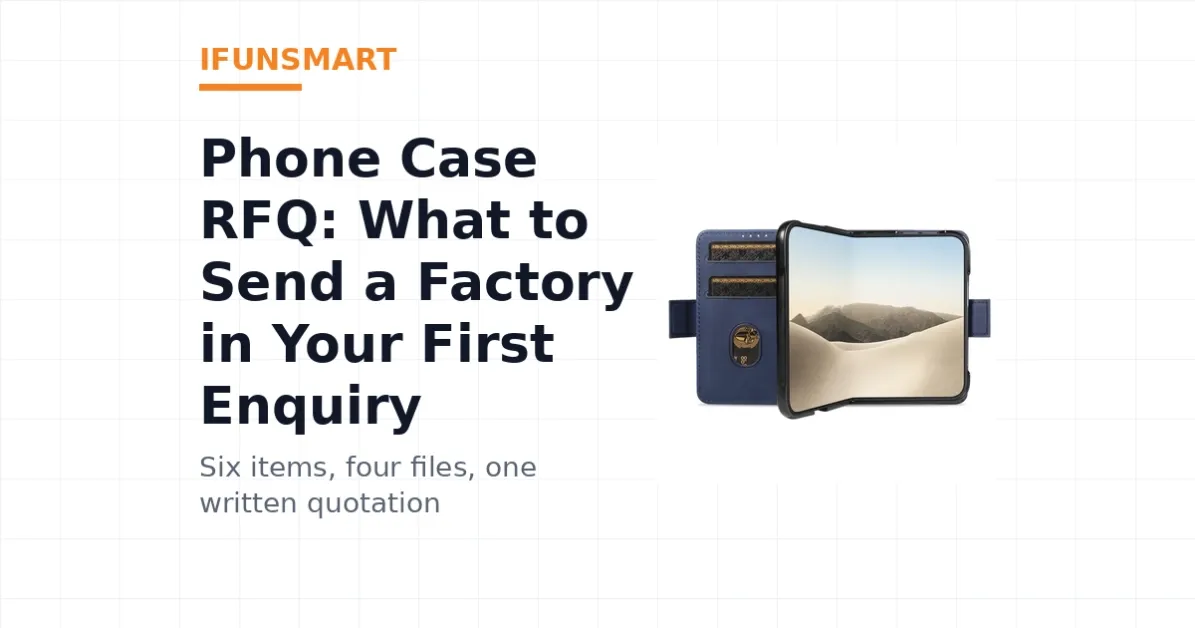
Phone Case RFQ: What to Send a Factory in Your First Enquiry
Six items in your first message — models, design, logo, packaging, sample checks and delivery terms — turn a catalogue request into a written quotation. The RFQ checklist, with copy-paste spec block.
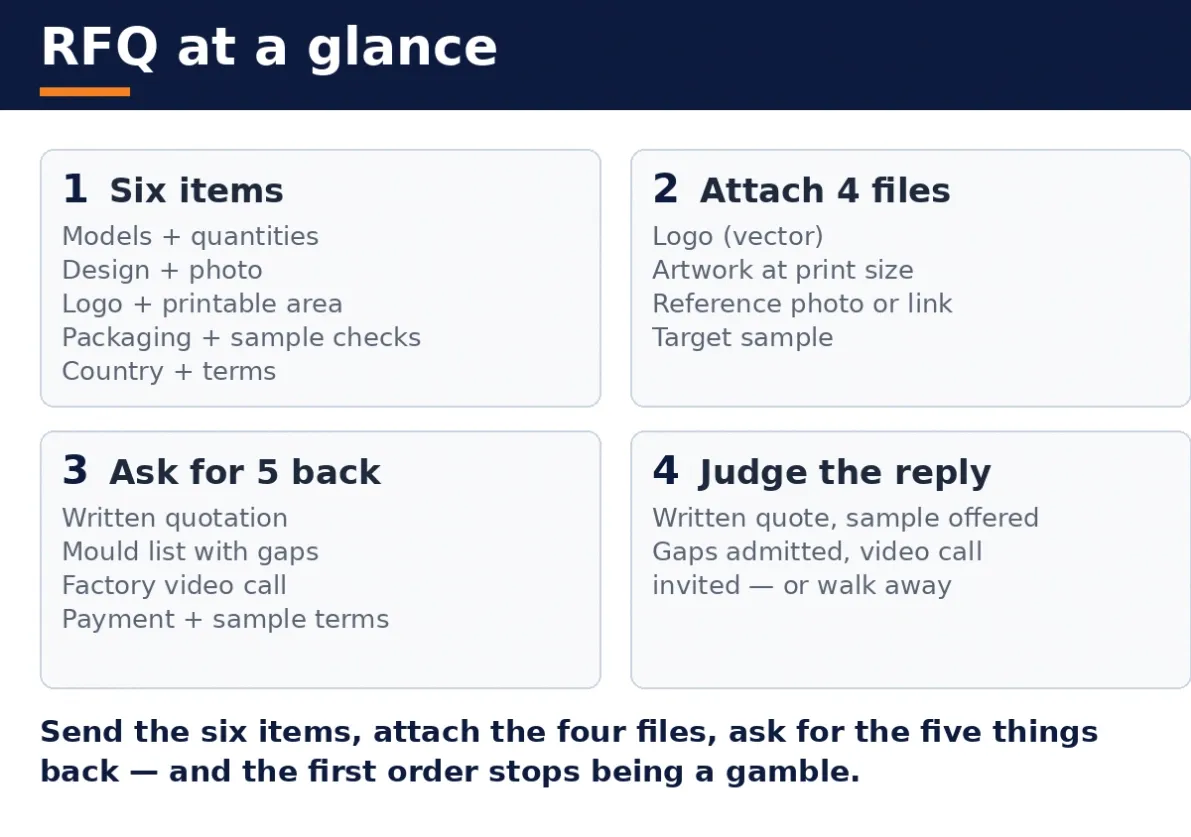
The short answer: Send the factory six things in your first message — exact models and quantities, the design you want, your logo and printable area, your packaging, what you will check on the sample, and your country and delivery terms. That is what turns a catalogue request into a written quotation.
Send model, style, quantity and country on WhatsApp https://wa.me/8613632248734 — we reply within 24 hours with MOQ, sample cost and lead time for that model.
1. The enquiry that got a real answer
In October 2026, a brand in Seoul wrote to us with the most complete first enquiry we had seen that year. They wanted cases for their own brand, and their message asked for everything a factory needs to answer properly: a review of our original designs and OEM capability for iPhone and Samsung Galaxy, a catalogue including MagSafe options, supported models, MOQ per design and per model, sample costs, production lead times, custom printing, branding and packaging — and two questions most first-time buyers forget to ask. Are you a factory or a trading company? And are your original designs available for licensed use under our brand?
That message got a real answer, because it gave the factory something to answer with. Compare it with the enquiries that fill most inboxes: a one-word "yes", a "send catalogue please", a "price list?" with no model, no quantity and no country. Those messages cannot be answered with a quotation, because there is nothing to quote. The factory has to reply with questions, the buyer has to reply with answers, and by the third round of questions most buyers have moved on to the next supplier. The first enquiry is not a formality. It is the document that decides whether you get a written quotation in one day or a week of back-and-forth that ends in silence.
This article is the checklist for that first message: the six items every usable enquiry contains, a spec block you can copy and fill in, what to attach, what to ask the factory to send back, and how to judge the reply when it comes. It is written for wholesalers, importers and distributors placing their first order with a new factory — and it is the companion to our guide on reading the quotation that comes back. Read more: https://www.ifunsmart.com/posts/phone-case-quotation-guide
2. The six items that get a usable quote back
A factory cannot quote a case order from "I want custom cases". The quotations that come back fast and usable all contain the same six items. Send them in your first message and the factory can answer with a written quotation instead of asking you the same six questions back.
First, device and volume: which phone models, which designs, and how many pieces per model and per colour. A model list that says "iPhone and Samsung" is not a list — the factory needs the exact models, because every model is a different mould. Write it as a table, even in a chat message: model, design, colour, quantity. If you do not know the exact quantities yet, say so and give a range — but give the models exactly. A factory that knows you want 500 pieces of one design across three models can quote; a factory that knows you want "some cases" cannot. Read more: https://www.ifunsmart.com/posts/phone-case-model-mould-coverage
Second, product reference: the design you want, by name or by photo, and whether it is an existing design, an adapted platform or a new structure. Send a photo or a link to the product page — a design described as "the magnetic clear one" could be five different cases. If you are adapting an existing case, say what changes: a different material, a different finish, a new colour, a magnetic ring added. If you want a new design, say so plainly and send the brief. The three routes differ in cost, time and control, and the factory cannot price your order until it knows which route you are on. Read more: https://www.ifunsmart.com/posts/custom-phone-case-oem-odm-logo-colour-packaging and https://www.ifunsmart.com/posts/phone-cases-for-private-label-e-commerce-brands
Third, branding: your logo file, where it goes on the case, how big it is, and how it is applied — printed, debossed or another method — and the printable area you need. This is the item buyers most often leave out, and the one that causes the most trouble later. A buyer who wanted full custom artwork printed around a magnetic ring learned — before ordering — that the artwork had to leave the ring area clear so charging and the stand still worked. Send the artwork file early, ask for the printable-area drawing for that design, and confirm the logo size and position on the sample before the bulk order. The artwork that looks best on screen is not always the artwork that works on the case.
Fourth, packaging: the box or the bag, the insert card, the barcode, the language on the pack, and whether the pack is retail-ready for your channel. A shelf box for a shop is not the same as a mailer for an online order. Ask for the packaging in the same written quote as the case, not as an afterthought — a pack added late costs more than a pack planned from the start. And keep the pack consistent across your range: the same box, the same insert, the same barcode format, for every model and every colour. Read more: https://www.ifunsmart.com/posts/phone-case-accessories-bundles
Fifth, sample and quality: whether you want a sample first, what you will check on it, and what the acceptance standard is. Say it in the first message, not after the quotation arrives: "Please send a sample first. We will check the fit on a retail phone, the magnet, the print and the pack." A factory that knows you will check the sample treats the sample differently from a factory that thinks the sample is a formality. If the design carries your brand, add the licence question from the Seoul enquiry: are the factory's original designs available for licensed use under your brand, and for which models and markets? Get that answer in writing, with the quotation.
Sixth, commercial terms and continuity: your country, your delivery address, who owns the artwork and the mould if a new one is cut, and whether the design will be re-ordered. A factory that knows a second order is coming treats the first order differently — it holds the mould, it keeps the colour formula, it answers the quality question from its own line. And the country matters for the quotation itself: the documents, the delivery terms and the import checks differ by destination, so the factory needs to know where the cases are going before it can quote the landed cost. Read more: https://www.ifunsmart.com/posts/phone-case-supplier-for-distributors
3. The spec block: copy this into your first message
The six items above are easier to send as one block than as six paragraphs. Copy the block below, fill in your answers, and paste it into your first message to the factory. Every line has a job: it removes one round of questions.
Model and quantity: [phone model, design name, colour, pieces per colour — one line per model]
Design reference: [existing design / adapted platform / new structure — attach a photo or product link]
Material and finish: [for example liquid silicone, clear PC + TPU, leather-look folio — or ask the factory to recommend for your price point]
Logo and artwork: [logo file attached — position, size, print method; printable area confirmed for this design]
Packaging: [box or bag, insert card, barcode, language on the pack, retail-ready or mailer]
Sample: [sample first — checks: fit on a retail phone, magnet, print, pack]
Country and delivery: [destination country and city, delivery address type — warehouse, shop, fulfilment centre]
Re-order: [one-off order or repeat range — and who owns the artwork and any new mould]
Three lines in that block deserve a note. First, the material line: if you do not know which material suits your price point, say so and ask the factory to recommend — but name your retail price band and your market, so the recommendation has something to work from. A material chosen without a price point is a guess. Read more: https://www.ifunsmart.com/posts/phone-case-materials-tpu-pc-silicone-leather
Second, the quantity line: every colour is a separate production run, so write the quantity per colour, not per design. MOQ is 50 pcs per colour per model, and our catalogue lines vary — the iPhone 18 line is mostly 30 pcs, the Samsung foldable line 50, the iPhone Duo line 100 — so ask for the per-line MOQ in writing for the models you are ordering, and do not assume one number covers everything. For distributors, bulk orders start at 500 pcs per order in total, and samples are free. Read more: https://www.ifunsmart.com/posts/phone-case-moq-50-per-colour-first-order and https://www.ifunsmart.com/posts/bulk-phone-case-orders-volume-guide
Third, the re-order line: if this is a test order before a bigger range, say so. A factory that knows the test is the start of a range will hold the mould and the colour formula for the second order. A factory that thinks it is a one-off will not — and the second order will start from scratch.
4. What to attach to the first message
An enquiry with attachments gets answered faster than an enquiry with descriptions, because the factory can see what you mean instead of guessing. Attach four things.
The logo file, in vector format if you have it — the file the factory will actually print from, not a screenshot of your website header. If the logo exists only as a small image, say so; the factory will tell you whether it can be used or needs to be redrawn, and it is better to learn that before the sample than after it.
The artwork file, if the design carries full custom artwork rather than a logo alone. Send the artwork at the size it will print, and ask for the printable-area drawing for that design — especially around a magnetic ring or a stand, where artwork can interfere with charging or with the mechanism. The printable area is the single most useful drawing a factory can send you, and most buyers never ask for it.
A reference photo of the case you want, or a link to the product page. A photo removes ambiguity: the factory can see the material, the finish, the camera cutout and the ring. If you are adapting an existing design, mark the photo — circle what changes, write what stays. A marked photo is worth a paragraph of description.
A target sample, if you have one. If you already sell a case you like — a competitor's case, a previous supplier's case, a retail sample — send it, or send a photo of it with the measurements that matter. The factory can match the material and the feel from a physical sample in a way no description can. And if you are ordering before a new phone launches, say so and send the launch timing you are working to, so the factory can confirm the mould and the fit guarantee in writing. Read more: https://www.ifunsmart.com/posts/ordering-before-a-new-iphone-or-samsung-launch
5. What to ask the factory to send back
A good first enquiry also tells the factory what you expect in return. Ask for five things, in writing, and judge the reply against them.
A written quotation that states the model, the design, the material, the quantity per colour, the MOQ per model, the sample terms and the payment terms — one line each, so you can compare it with the next supplier's quote line by line. A quotation that hides the MOQ or the sample terms in a chat message is not a quotation. Read more: https://www.ifunsmart.com/posts/phone-case-quotation-guide
Confirmation of the mould list: which of your models the factory holds moulds for, and which it does not. A factory that lists its gaps honestly — "we hold moulds for these models, not for those" — is a factory you can plan with. A factory that claims every model is a factory that has not checked. Read more: https://www.ifunsmart.com/posts/phone-case-model-mould-coverage
Confirmation that you are dealing with the factory, not a trading company — and a live video call from the production line if you want it. A factory can show you the moulds, the line and the packing bench on a video call. A trading company relays the question. For an order that carries your brand or your distributor's name, that difference is the difference between a fix and an apology. Read more: https://www.ifunsmart.com/posts/phone-case-factory-vs-trading-company
The payment terms in writing: for new customers, 30% deposit by T/T or Western Union; after the goods are ready the factory sends photos, a video and the packing list, and you pay the balance before the goods ship. Ask for those terms on the quotation, not in a chat message — and if a supplier asks for full payment upfront before any sample, treat that as a red flag, not a term. Read more: https://www.ifunsmart.com/posts/phone-case-payment-terms-first-order
And the sample terms: whether the sample is free or charged, what it includes, and what happens to the sample cost if you place the bulk order. For distributors, samples are free — ask for that in writing on the quotation, so the sample is part of the order and not a favour that disappears later.
6. How to judge the reply
The reply tells you as much about the factory as the quotation does. A good reply answers the six items, line by line, with a written quotation and a sample offer. A bad reply answers with a catalogue link and a "what is your quantity?" — the same questions you already answered in the first message.
Five things should end the conversation. First, no written quotation — only a price in a chat message, with no MOQ, no sample terms and no payment terms. Second, no mould list — the factory cannot say which of your models it holds moulds for. Third, no sample — the factory wants the bulk order approved before you have seen the product. Fourth, full payment upfront before any sample, with no photos, no video and no packing list before the balance. Fifth, no factory to show you — no video call from the line, no mould list, no production photos, only a catalogue. Any one of these is a reason to stop. Two together is a reason to stop and not look back.
A good reply looks like this: a written quotation with the model, the design, the material, the quantity per colour, the MOQ per model and the payment terms; a sample offer with the checks named; a mould list that states its gaps; and an invitation to a video call from the production line. That reply took the factory ten minutes to write — and it tells you the factory wants a second order, not just a first one. Check the sample the way you would check a shipment: fit on a retail phone, magnet, print, pack — before the bulk order is approved. Read more: https://www.ifunsmart.com/posts/phone-case-quality-check-before-shipment-checklist
Send the six items, attach the four files, ask for the five things back — and the first order stops being a gamble. The factory that answers properly is the factory to build with.
FAQ
What should I send a phone case factory in my first enquiry? Six items: device and volume (exact models, designs, pieces per model and colour), product reference (existing design, adapted platform or new structure, with a photo or link), branding (logo file, position, size, print method and printable area), packaging (box or bag, insert, barcode, language), sample and quality (what you will check and the acceptance standard), and commercial terms and continuity (country, delivery, who owns the artwork and any new mould, and whether you will re-order).
Can I just ask for a catalogue and price list first? You can, but you will get a catalogue, not a quotation. A catalogue tells you what exists; a quotation tells you what your order costs. Send the six items in the same first message and the factory can answer with a written quotation — model, design, material, quantity per colour, MOQ per model and payment terms — instead of asking you the same six questions back.
What files should I attach to my first enquiry? Four: the logo file in vector format if you have it, the artwork file at print size, a reference photo of the case you want (or a link to the product page, marked up if you are adapting it), and a target sample or its photo if you have one. Ask for the printable-area drawing for the design — especially around a magnetic ring or a stand, where artwork can interfere with charging or the mechanism.
What should a good reply from the factory include? A written quotation with the model, design, material, quantity per colour, MOQ per model and payment terms; a sample offer with the checks named; a mould list that states its gaps honestly; and an invitation to a live video call from the production line. If the reply is only a catalogue link and "what is your quantity?", the factory has not read your enquiry.
What are the red flags in a factory's first reply? Five: no written quotation, only a price in a chat message; no mould list for your models; no sample before the bulk order; full payment upfront before any sample, with no photos, video or packing list before the balance; and no factory to show you — no video call, no mould list, no production photos. Any one is a reason to stop; two together is a reason to stop and not look back.
About iFunSmart
Ifun Electronics Technology Co., Ltd, Guangzhou, since 2010. A phone case factory — 1,000+ designs, 500+ models, 500K+ pcs/month, exported to 30+ countries — supplying wholesalers, importers and distributors worldwide. Our 2700GS Magnetic Case for iPhone 18 Pro Max uses N52 magnets at up to 2700 Gauss. MOQ is 50 pcs per colour per model; bulk orders from 500 pcs per order in total; free samples for distributors. Ask us for a live video call from our production line, our mould and model list, or a sample — we reply within 24 hours. WhatsApp https://wa.me/8613632248734 — Email contact@ifunsmart.com