Business Solutions
Phone Cases for Supermarkets: What They Order First
A supermarket or hypermarket buyer orders few styles deep, in uniform colours, in shelf-ready packaging, for every store at once. The 12-style first order and what to confirm in writing.
BLUF
A supermarket or hypermarket buyer orders few styles deep, in uniform colours, in shelf-ready packaging, for every store at once. Start with the 12-style first order below, agree the packaging against the chain's own manual, and confirm the fit and the MOQ per line in writing before the deposit.
Short answer
A supermarket or hypermarket does not buy phone cases the way a distributor does. A distributor buys breadth — many styles, many models, many colours — because its customers are many different shops. A supermarket buys depth: a small number of styles, in the same colours, in the same packaging, for every store in the chain at once. The shelf in one store must look like the shelf in every other store, the barcode must scan at every till, and the case that arrives in the tray must be the case the shopper picks up. That is the whole difference, and it decides the order.
The first order is twelve styles. The clear cases lead — the Bayer Crystal Clear and the 3D Color Bar — because the clear buyer is the largest buyer in a self-service aisle. Then the colour ranges — the Liquid Silicone in ten colours, the Tech Fabric in nine, the Silky Touch in seven — because a chain needs one range that looks like one range across every store. Then the stand, the gift and the wallet styles — the Airbag Ring Stand, the Bling, the Starry card holder, the RFID card holder, the Samsung leather wallet — and the full-protection style, the 360° Full Protective, which is the one line in the order with a different MOQ: 100 pcs per colour per model, not 50. Every other style in the first order states the most common MOQ of 50 pcs per colour per model, and the MOQ varies by product line. Bulk and distributor orders start at 500 pcs per order in total. Samples carry a fee, refundable on orders of 500+ pcs — ask us to confirm the amount per style in writing. A 100-pc trial order can carry a logo by laser engraving. Payment is T/T and Western Union only, with a 30% deposit for new customers, photos and video and the packing list after the goods are ready, then the balance, then the goods ship.
The packaging is agreed against the chain's own manual, not against a general standard — there is no single national standard for shelf-ready packaging, and every chain publishes its own. Custom packaging is available on every style in this guide — each product page states "Support Logo Customization & Custom Packaging" — but the packaging MOQ per style was not confirmed, so ask us to confirm it in writing. A quote shows, line by line, the model, the style, the colour, the quantity, the MOQ per line, the sample fee, the logo method and its per-piece charge, the packaging, and the payment terms — and this guide states no price anywhere, because no price was confirmed for these styles.
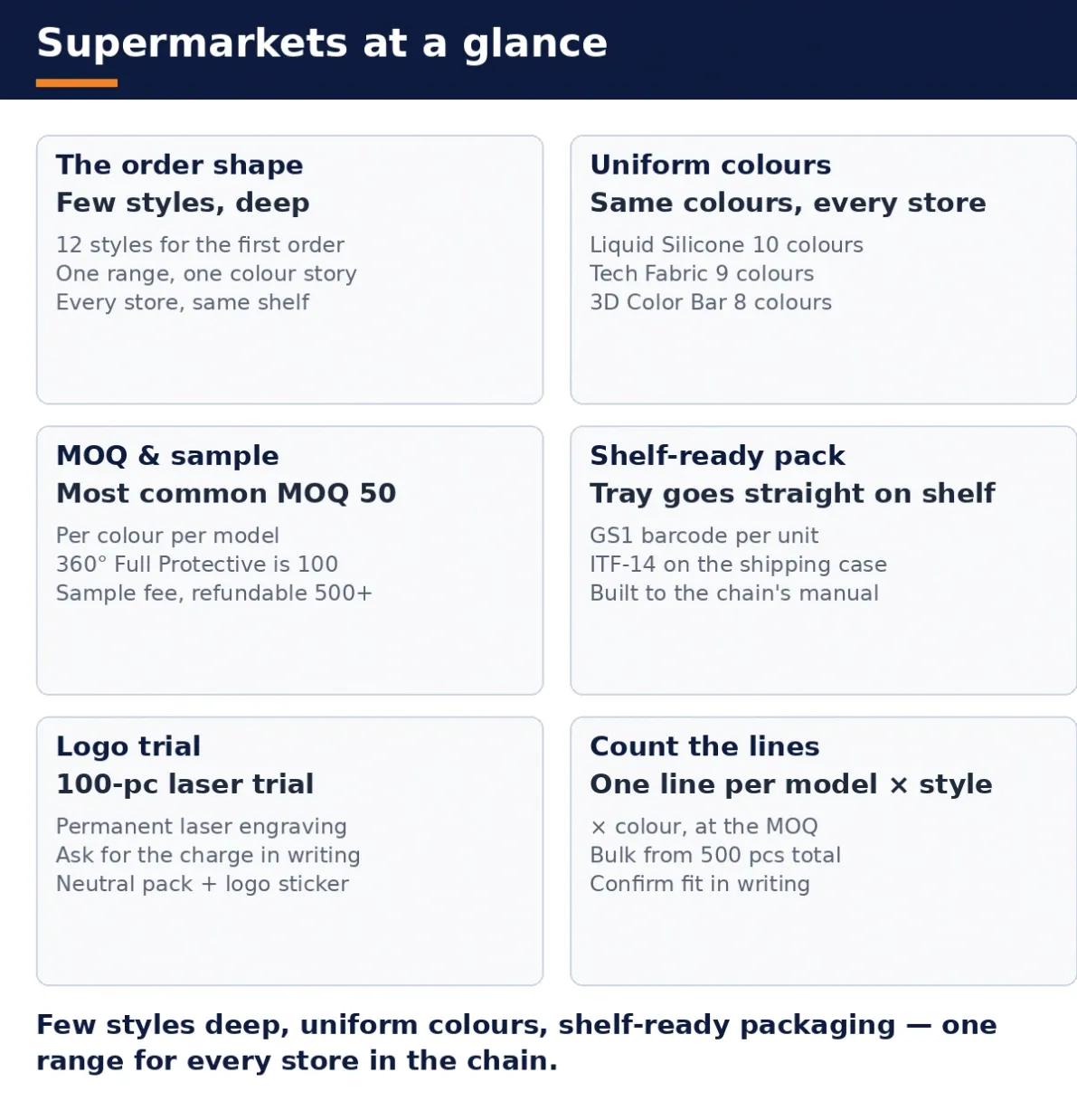
Supermarkets at a glance
Check | What applies to a supermarket or hypermarket order |
|---|---|
The order shape | Few styles, deep — 12 styles for the first order, not 40 |
Uniform colours | Same colours across every store; one range, not a mixed lot |
First order | 12 styles: clear, colour, feel, stand, gift, wallet, full protection |
MOQ | Most common 50 pcs per colour per model, varies by product line; 360° Full Protective is 100 |
Sample | Fee charged, refundable on orders of 500+ pcs — ask us to confirm the amount per style in writing |
Logo trial | 100-pc trial order can carry a logo by laser engraving — ask for the per-piece charge in writing |
Packaging | Shelf-ready / retail-ready per the chain's own manual; custom packaging available — packaging MOQ ask us |
Not on the order | R20 leather wallet (MOQ conflict unresolved); any style whose fit is not confirmed in writing |
1. What does a supermarket order that a distributor does not?
The difference is not the case. It is the shelf. A distributor's customer is a shop, and a shop can take a mixed order — a few of this style, a few of that colour — because the shop assistant explains the case to the buyer. A supermarket's customer is a shopper walking past a shelf with no assistant, and the shelf has to sell the case on its own. That changes four things about the order, and each one is a decision the buyer makes before the first line is written.
First, the range is narrow. A supermarket stocks a small number of styles, each in depth. The reason is the planogram — the plan of what sits where on the shelf — and the planogram has a fixed number of facings. A style that takes one facing in 200 stores is 200 facings; a style that takes one facing in 20 stores is a rounding error. So the buyer picks the styles that earn a facing in every store, and leaves the rest for the second order. The twelve styles in section 2 are the ones that earn a facing: clear, colour, feel, stand, gift, wallet and full protection — one style per job, not three styles per job.
Second, the colours are uniform. The same colour must be available for every model in the range, in the same finish, so the shelf looks like one range. A black case on the iPhone model and a different black on the Samsung model is not a range — it is a mixed lot, and a mixed lot is what a shopper walks past. The colour counts in section 2 are the reason the range works: the Liquid Silicone comes in ten colours, the Tech Fabric in nine, the 3D Color Bar in eight, the 2700GS in eight, the Silky Touch in seven. Those are the styles that can carry the same colour story across the whole chain. A style with one colour cannot carry a range — it can only be a depth line inside one.
Third, the packaging is shelf-ready. The case arrives in a tray or a box that goes straight onto the shelf — the shipping case opens into a display tray, a perforated front tears away, and the units sit faced with the brand visible. Section 4 sets out what that means and what the chain's manual asks for. A distributor's order ships in a plain carton and the shop repacks it; a supermarket order ships in the packaging the shelf needs, because there is no one in the store to repack it.
Fourth, the order is one order for the whole chain. A distributor orders per customer; a supermarket orders per chain, and the chain's stores all take the same range. That is why the MOQ is counted per line, not per total: the most common MOQ is 50 pcs per colour per model, and it varies by product line — and a chain order that runs three styles in six colours on two models is already a large order at 50 pcs a line, before the store count is even applied. Section 6 counts it out.
The order rule, borrowed from the ranking bulk guides and applied here: go deep on few styles, not wide on many. A chain order in four styles will beat a chain order in twenty on landed cost per unit, on warehouse space and on the shelf — every time. The twenty-style order is a distributor's order. The four-style order, repeated across the chain, is a supermarket's order. The twelve styles in section 2 are the first order, not the whole range — the range grows by reorder, not by a wider first order.
2. Which 12 styles make the first supermarket order?
Twelve styles, each verified live on its product page on 2026-11-28 — every one states the most common MOQ of 50 pcs per colour per model except the 360° Full Protective, which states 100, and every one states "Support Logo Customization & Custom Packaging". Order them in the order of this section: clear first, then colour, then feel and texture, then stand, gift and wallet, then full protection. Each style is one job on the shelf.
Bayer Crystal Clear MagSafe Case — the clear case, order it first. The page lists it for iPhone and Samsung, in premium Bayer PC with a flexible TPU frame — a 1.5 mm PC back and a 1.8 mm TPU frame — and the magnet is N52 at 2300–2600 Gauss, the per-style figure as the page states it. Order this first for the supermarket, because it is the clear case with the most stated on its page: the material named by brand, the thickness stated, the magnet figure stated. The clear buyer is the largest buyer in a self-service aisle — the shopper who wants the phone they already own, visible and protected — and this is the clear case that answers the questions the box cannot.
3D Color Bar Clear MagSafe Case — the clear case with colour edges. The page lists it for iPhone 17 and Samsung, in a 2.5 mm composite plate with a 2.0 mm high-permeability TPU frame, and the magnet is built-in N52 at 2600 Gauss with a 12N hold — the per-style figure, stated here and nowhere else in this guide. Eight colours are listed: Black, White, Blue, Pink, Orange, Purple, Yellow and Green. Order this beside the Bayer, because it is the same clear job with a colour edge — and eight colours is eight lines per model at the most common MOQ, so order the colours the chain moves and let the rest wait for the reorder.
Liquid Silicone Magnetic Case — the widest colour range in the order. The page lists it for the iPhone 18 Pro Max, in liquid silicone with a soft touch, and ten colours — from light blue and pink through purple, orange, black and cherry red, all in the same matte silicone finish. Order this for the colour buyer: ten colours in one style is the range that lets a chain carry one style in every store and still look like a range. It is also the style that needs a sample more than any other in this section, because a silicone feel cannot be checked from a photo — approve the sample on the bench, with the feel checked against the colour reference, before the deposit.
Silky Touch MagSafe Case — the feel-first case. The page lists it for iPhone 17 and Samsung, in PC with TPU, with a baby-skin silicone feel — a feel, not liquid silicone; the case is PC and TPU, and this guide does not describe it as silicone. The magnet is built-in N52 with no figure stated. Seven colours are listed: Black, Blue, Grey, Purple, Green, White and Orange. Order this for the buyer who sells on touch: the case a shopper picks up and holds. Seven colours is a manageable line count, and the black and grey colourways are the ones that move first in a grocery aisle — ask the buyer which colours sell in which region before the order is placed, and let that answer set the colour split.
Tech Fabric Magnetic Phone Case — the texture case. The page describes a woven tech-fabric back in nine colours, in matte TPU and PC, shockproof and wireless-charging compatible. Order this for the shopper who wants a case that does not look like every other case on the shelf — the texture is the selling point, and nine colours is the widest texture range in this guide. One warning: the product page's main image is the nine-colour lineup itself, which was the cover of the reordering guide earlier in this series — it is not used as the cover here, because a cover product is never reused.
2700GS Magnetic Case — the magnet-figure case. The page lists it for the iPhone 18 Pro and Pro Max, with a metal camera frame, and the name states the figure: 2700 Gauss, N52. Eight colours are listed. Order this where the buyer wants a magnet figure on the box — the one style in this guide whose figure is in its name. The per-style figure rule still applies: 2700 Gauss belongs to this style, and it is not repeated here as a range-wide claim. The product page's own main image carries a large "Case For iPhone 18Pro max" text overlay — do not use its photos as a cover, and do not show a customer a marketing image when selling the case.
Airbag Ring Stand Case — the stand case. The page lists it for the iPhone 18 Pro Max, with a MagSafe kickstand, in a matte back with smooth curved edges. Six colours are listed: dark gray, sapphire blue, orange, white, cherry red and light blue. Order this where the buyer wants a stand and a ring in one case — the desk user, the video-watcher, the shopper who props the phone up in the kitchen. Check on the bench that the stand holds its angle when open and sits flush when closed.
Bling MagSafe Case — the gift and decorative case. The page lists it for iPhone 17 and Samsung, in PC with TPU and glitter, with a diamond lens protector. The magnet is built-in high-grade magnets, with no figure and no grade stated on the page, so none is stated here. Five colours are listed: Silver, Red, Blue, Gold and Pink. Order this for the gift buyer and the seasonal endcap, not for the general range: glitter is a look, and the buyer who wants it knows it when they see it. Five colours is a manageable line count.
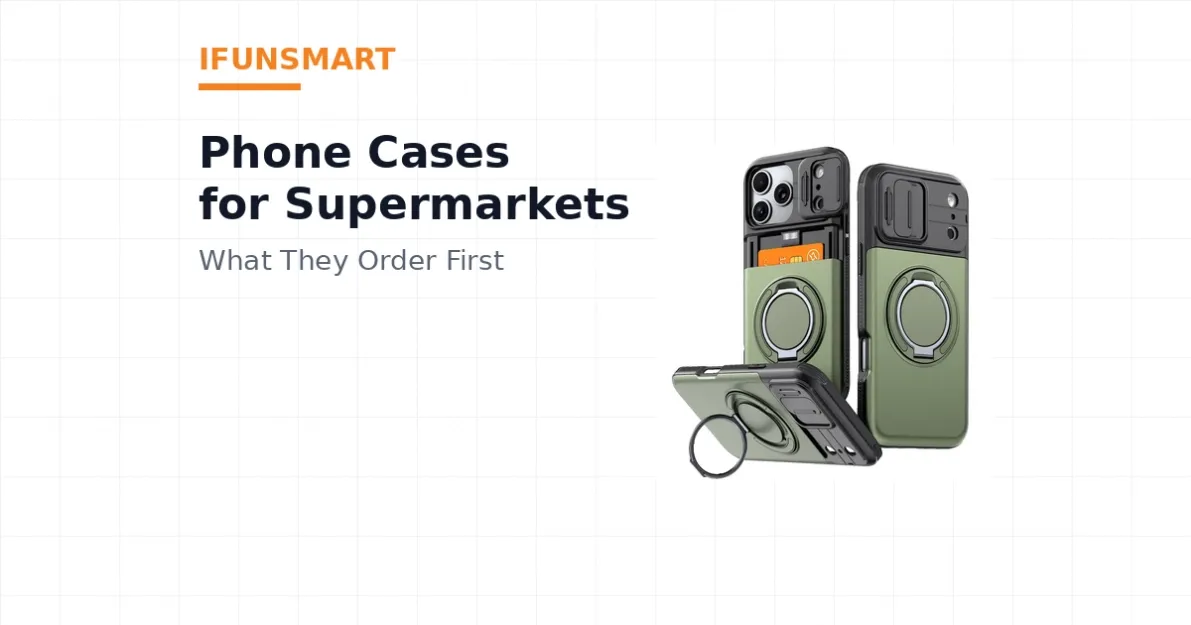
Starry Magnetic Case — the card-holder case. The page lists it for the iPhone 18 Pro Max, with a card holder and a slide camera cover, and a magnetic ring stand. Order this for the wallet buyer who carries a card and wants the camera covered — and check on the sample that the slide cover moves cleanly and the card holder closes with a card inside, because a card holder that does not close is a card holder that gets returned. This is the style on the cover of this guide: the green three-view shot shows the card, the ring and the slide cover in one image, which is what a self-service shelf needs — the selling points visible at a glance.
RFID Blocking Clear Card Holder Case — the clear wallet case. The page lists it for iPhone 17 and Samsung, in crystal-clear hard PC with a soft TPU bumper and a metal shaft, with a two-card slot, a safety snap and an RFID-blocking layer. This is not a magnetic style, so no magnet figure is stated. Order this for the wallet buyer who wants the phone visible and two cards carried — and note that this product was the cover of the online-marketplaces guide earlier in this series, so it is not used as the cover here.
Leather Wallet Magnetic Case — the Samsung wallet case. The page lists it for the Samsung Galaxy A27, A37 and A57, in leather with a magnetic flip cover. Order this for the Samsung buyer in the chain: the A-series is the volume Samsung range in a grocery aisle, and a wallet case is the style that sells with it. The light-blue colourway of this product was the cover of the corporate-gifts guide earlier in this series — it is not used as the cover here.
360° Full Protective MagSafe Case — the full-protection case, and the one line with a different MOQ. The page lists it for the iPhone 17, with a built-in screen protector, in translucent matte, and the MOQ is 100 pcs per colour per model — not 50. Six colours are listed: Black, Blue, Green, Purple, Orange and White. Order this for the protection buyer — the parent, the field worker, the shopper who wants the screen covered as well as the back — and flag the 100-pc MOQ on the order line, because it is the one line in this order where the line count doubles. The blue colourway of this product was a cover earlier in this series — it is not used as the cover here.
The rule for this section, in one line: one style per job, twelve jobs, no duplicates — and every style's MOQ, colours and packaging are stated on its own product page, so the order is checked against the pages, not against a catalogue.
3. How do uniform colours work across a chain?
Uniform colour is the hardest part of a chain order to get right, and the easiest to get wrong — because it is not about the colours on the page, it is about the colours that are still available, in the same finish, on the reorder six months later.
One range, one colour story. A chain's shelf is planned as a range, not as a pile of cases. The range has a colour story — usually black, white and two or three accent colours — and every style in the range carries the same story. The colour counts in section 2 are what make that possible: a style with ten colours can carry the story on its own; a style with four colours can carry part of it; a style with one colour cannot carry it at all. When the buyer picks the range, the question is not "which colours does this style come in" — it is "which colours does every style in the range come in". The styles that share a colour are the range. The styles that do not are the second order.
Count the lines before the deposit. The MOQ applies per line — per model, per style, per colour — not per order. That is the rule from the mixed-model guide, and it bites hardest on a chain order, because a chain order multiplies fast: three styles in six colours on two models is already a large order at the most common MOQ of 50 pcs a line, and the 360° Full Protective lines count double at 100. Count the lines in section 6 before the deposit, because the line count is the order size — and a chain buyer who counts the lines before the deposit does not discover the order size after it.
Colour continuity is a reorder promise. The reorder guide's rule applies here with more force: a colour that is in the range in January must still be in the range in July, or the shelf has a gap where the range used to be. Before the first order, ask us in writing which colours are current production and which are being phased out, and put the answer on the order. A colour that is being phased out is a colour to skip in the first order, however well it sells today — because a chain cannot re-planogram for a colour that disappears.
Black is the anchor, not the range. Every style in this guide comes in black, and black is the colour that sells in every store — but a range of only black is not a range, it is a single colour. The accent colours are what make the shelf look like a range: the Liquid Silicone's light blue and cherry red, the Tech Fabric's nine-colour spread, the 3D Color Bar's orange and purple. Order black deepest, the accents next, and the rest on the reorder — and never order a colour because it looks good in a photo. Order it because the buyer said it sells in their stores.
The sample proves the colour, not the photo. Colour varies between batches, and a chain that orders the same colour across twelve styles needs the twelve to match. Approve the sample against the colour reference for the colour ordered, in writing, with the sample reference stated — and check the reorder sample against the same reference, not against the first batch. A colour that drifts between batches is a colour that breaks the range.
4. What is shelf-ready packaging, and what does the chain's manual ask for?
Shelf-ready packaging — also called retail-ready packaging, or SRP and RRP — is secondary packaging designed so products can move from the shipping case to the store shelf with minimal handling. GS1 describes retail-ready packaging as ready-to-sell secondary packaging: the outer package can be placed directly onto the shelf without unpacking every inner unit. That is the definition, and it is the whole test: if the store staff have to unpack every unit by hand, it is not shelf-ready.
The formats. A shelf-ready pack takes one of a few shapes. A tear-away case or shelf tray: the shipping case converts into a shelf tray when a perforated front tears away, leaving the units neatly faced with the brand visible. A PDQ display: the pack arrives ready for display, or needs very little setup, and acts as a branded display or promotional fixture — the counter display by the till is the commonest form. A stackable retail tray: the tray stacks for bulk and high-volume retail, and the units are taken from the top. A divider tray: inserts separate the units inside the pack. Which format the chain uses is the chain's decision, not the supplier's — and it is stated in the chain's vendor manual, which is the document that governs the order.
The Five Easies. The packaging framework most retailers use is the FEFCO "Five Easies": easy to identify, easy to open, easy to get on shelf, easy to shop, and easy to flatten and recycle. Each one is a check on the sample pack: can the store staff identify the contents without opening the case? Can they open it without a knife? Can they get it onto the shelf in one move? Can the shopper see and take the case? Can the empty tray be flattened for recycling? A pack that fails any one of the five is a pack the chain will reject — and the rejection happens at the distribution centre, not at the shelf, so it is caught before the goods ship, not after.
The barcodes. Most retailers expect a GS1-issued barcode on each sellable unit and a case-level barcode on the shipping case. The barcode is issued under the brand owner's GS1 Company Prefix — the same rule the packaging guide verified for FBA — and the shipping case carries an ITF-14. One barcode per SKU: each model plus style plus colour is its own SKU, and each SKU needs its own code. A barcode bought from a reseller may not be accepted, because it is not registered to the brand owner — confirm with the buyer and license the prefix directly from GS1 if required. The barcode must scan at the till: a smudged or wrongly sized barcode causes scan failures, and scan failures slow receiving and trigger compliance penalties.
There is no single standard — the manual governs. Every retailer and distributor publishes its own vendor manual or supplier guide, and the details vary between chains, between categories and sometimes between regions of the same chain. That is the verified position from the packaging sources, and it is why this guide states no chain-specific packaging spec: a spec from one chain is wrong for the next. Send the chain's manual with the order, and the packaging is built to that manual — the artwork, the barcode, the tray size, the carton marking, all of it. A general guide can tell you what shelf-ready packaging is. Only the manual can tell you what this chain wants.
Pegboard is the other format. Not every chain shelves phone cases in trays. Some hang them on hooks, and a hung case needs a Euro slot — 30 by 10 millimetres — punched in the header of the retail box, so it hangs straight and does not tear. The buyer states which format the chain uses — tray or hook — before the order, because a tray pack and a hook pack are different boxes, and a box built for the wrong format is a box that does not fit the shelf.
Custom packaging is available — the packaging MOQ is not confirmed. Every style in this guide states "Support Logo Customization & Custom Packaging" on its product page, so the box, the insert, the tray and the carton marking can all be built to the chain's manual. The packaging MOQ per style was not confirmed — ask us to confirm it in writing before the deposit, because a packaging MOQ is counted separately from the case MOQ, and a chain order that assumes one MOQ for both will be short on one of them.
5. Private label or branded — how does the logo decision work?
A supermarket or hypermarket sells phone cases under one of three names: its own brand, the supplier's brand, or both — its own brand on the everyday styles, a supplier brand on the premium ones. The decision is the buyer's, and it is made before the first order, because the logo method, the artwork and the packaging all follow from it.
The logo trial is the cheapest way to test a chain-branded line. A 100-pc trial order can already carry a logo by laser engraving, which is permanent — silk-screen fades and needs a higher MOQ. The per-piece charge for the laser engraving is confirmed in writing per order; this guide states no figure, because the figure is confirmed per order. Neutral packaging is usually in stock, and a logo sticker can be added to it. For a chain buyer, the trial works the same way as for any buyer: the 100-pc trial is approved on the sample, the logo position and artwork are agreed in writing, and the trial runs with the first production run. A chain that wants to test its own brand on a phone case does not need a full chain order to do it — the trial is the test.
Private label means the artwork is the buyer's. A chain-branded case carries the chain's logo, the chain's colours and the chain's barcode — and the artwork for all three comes from the buyer, in the format the factory asks for. The printable area, the print method and the mockup are agreed before the deposit: UV printing, IMD, silk screening and heat transfer are the four confirmed print methods, and the printable area per model is confirmed from the factory drawing, not from a photo. Send the artwork with the order, and the sample proves it — the logo position, the colour match, the print adhesion — before the bulk run.
Branded means the supplier's name stays on the box. A supplier-branded case carries the iFunSmart range as it stands, and the chain sells it as a brand it stocks, not a brand it owns. The advantage is speed: no artwork to agree, no print to approve, no barcode to register — the range is ordered as listed, and the shelf is filled from the first carton. The disadvantage is the same as the advantage: the chain does not own the brand, so it cannot change the artwork, the colours or the price architecture. A chain that wants control orders private label. A chain that wants speed orders branded. A chain that wants both orders private label on the everyday styles and branded on the premium ones — and the mix is stated on the order, style by style, not decided after the goods ship.
The mix is the decision, and it is written down. Before the deposit, the order states for each style: private label or branded, the logo method, the artwork status, and the packaging. A style with no logo decision is a style that will be delayed — because the factory cannot print a logo it has not received, and cannot pack a box whose artwork is not agreed. The logo trial exists so the decision can be tested on 100 pieces before it is made on the whole chain.
6. How do you count the first chain order — and what do you check before the deposit?
A first chain order is counted the same way as a first order for any buyer: one line per model, per style, per colour, at the most common MOQ of 50 pcs per colour per model — and the MOQ varies by product line, so ask us to confirm the MOQ per style in writing before the deposit. Bulk and distributor orders start at 500 pcs per order in total. The difference is the multiplication: a chain order runs the same lines across every store, so the line count is counted once and the store count is applied to it — and a range that runs four models deep multiplies fast.
A first-order shape that works. Start with the two clear cases on the iPhone 17 — the Bayer Crystal Clear in four or five colours and the 3D Color Bar in three or four — then add the Samsung range in the same two styles. Add the Liquid Silicone in three colours on the iPhone 18 Pro Max, because the colour buyer is a different buyer from the clear buyer and the shelf needs both. Add the Silky Touch in three colours and the Tech Fabric in three colours, because the feel buyer and the texture buyer are different buyers again. Add the Bling in two colours for the gift endcap, the Starry and the RFID card holder in two colours each for the wallet buyer, the Samsung leather wallet in two colours, and the 360° Full Protective in two colours — flagged at 100 pcs a line. That shape is twelve styles in two to five colours each, and at the most common MOQ it is a bulk order from the first carton — which is the point: a supermarket order is a volume order, and it should look like one.
The order-line table — one model, one style, one colour per line:
Order line | Model | Style | Status |
|---|---|---|---|
1 | iPhone 17 | Bayer Crystal Clear, one colour | Page states MOQ 50 — confirm in writing |
2 | iPhone 17 | 3D Color Bar, one colour | Page states MOQ 50 — confirm in writing |
3 | iPhone 18 Pro Max | Liquid Silicone, one colour | Page states MOQ 50 — confirm in writing |
4 | iPhone 17 | Silky Touch, one colour | Page states MOQ 50 — confirm in writing |
5 | iPhone 17 | Tech Fabric, one colour | Page states MOQ 50 — confirm in writing |
6 | iPhone 18 Pro Max | Airbag Ring Stand, one colour | Page states MOQ 50 — confirm in writing |
7 | iPhone 18 Pro Max | 2700GS Magnetic, one colour | Page states MOQ 50 — confirm in writing |
8 | iPhone 17 | Bling, one colour | Page states MOQ 50 — confirm in writing |
9 | iPhone 18 Pro Max | Starry, one colour | Page states MOQ 50 — confirm in writing |
10 | iPhone 17 | RFID Blocking Clear Card Holder, one colour | Page states MOQ 50 — confirm in writing |
11 | iPhone 17 | 360° Full Protective, one colour | Page states MOQ 100 — flag on the order line |
12 | Samsung A27/A37/A57 | Leather Wallet, one colour | Page states MOQ 50 — confirm in writing |
What a quote shows — and what it does not. A quote should show, line by line: the model, the style, the colour, the quantity, the MOQ per line, the sample fee, the logo method and its per-piece charge, the packaging, and the payment terms. It should not show a unit price as a promise: the price for an order is confirmed per style, per model, per colour and per quantity, in writing, on the quote — and this guide states no price anywhere, because no price was confirmed for these styles. A quote that shows a single lump-sum price with no line items is a quote that cannot be checked. Insist on the line items, and ask for the current production window in writing on the quote — no day figure in this guide, because no day figure was verified.
The sample check, on the bench. No first order becomes a chain order without a sample, and no sample is approved without a bench check. Check it in factory QC language, not as a consumer using the phone. The bench checks, in order: the case seats fully, with no gap at any corner, on the exact model ordered — check the model name on the sample against the order line. The camera cutout clears every lens. The switch or the button works through the case. The magnetic ring holds a charger firmly, with the pull force the product page states for that style — 2300–2600 Gauss for the Bayer, 2600 Gauss and 12N for the 3D Color Bar, 2700 Gauss N52 for the 2700GS — and against no figure at all where the page states none. The stand opens and closes cleanly, fifty times on the bench, and sits flush when closed. The parting lines are clean, the coating adheres, and the batch tolerance is even — compare the sample against the colour reference for the colour ordered. The carton and the marking are right: check the carton integrity, the quantity per carton, and the carton marking — model, style, colour, quantity — against the packing list. And the packaging sample: open the shelf tray along its perforation, put it on a shelf, and check the Five Easies — easy to identify, easy to open, easy to get on shelf, easy to shop, easy to flatten. Samples carry a fee, refundable on orders of 500+ pcs — ask us to confirm the amount per style in writing. Approve the sample in writing, with the sample reference, the model, the style, the colours and the logo method stated.
Payment and shipment, agreed in writing. The payment terms are agreed in writing before the deposit — not after it. Payment is T/T and Western Union only. New customers may pay a 30% deposit first. After the goods are ready, the factory sends photos and video and the packing list. The customer pays the balance, then the goods ship. No other payment methods are offered, and no other sequence is used. Ask which documents travel with the goods and which your broker must arrange, before the goods ship. The commercial invoice, the packing list and the certificate of origin travel with the goods, and the packing list should match the invoice line by line — model, style, colour, quantity, weight — because a mismatch between the packing list and the declaration is the most common reason a shipment is held for inspection. A document that is missing at the port is a shipment that waits at the port.
Frequently asked questions
What is the MOQ for supermarket phone case orders?
The most common MOQ is 50 pcs per colour per model, and it varies by product line — ask us to confirm the MOQ per style in writing before the deposit. One line in the first order is different: the 360° Full Protective states 100 pcs per colour per model, so flag it on the order line. Bulk and distributor orders start at 500 pcs per order in total. Count the lines before the deposit: the MOQ applies per line, not per total, so three styles in six colours on two models is already a large order at 50 pcs a line.
Can a supermarket put its own logo on phone cases?
Yes. A 100-pc trial order can already carry a logo by laser engraving, which is permanent — silk-screen fades and needs a higher MOQ. Ask for the per-piece charge and the artwork position in writing on the order; this guide states no figure, because the figure is confirmed per order. Custom packaging is available on every style in this guide — each product page states "Support Logo Customization & Custom Packaging" — but the packaging MOQ per style was not confirmed, so ask us to confirm it in writing. Approve the sample in writing first, with the logo method stated, and the trial runs with the first production run.
What is shelf-ready packaging for phone cases?
Shelf-ready packaging — also called retail-ready packaging — is secondary packaging designed so products can move from the shipping case to the store shelf with minimal handling. GS1 describes it as ready-to-sell secondary packaging: the outer package goes directly onto the shelf without unpacking every inner unit. The common formats are a tear-away case that opens into a shelf tray, a PDQ display that arrives ready for display, and a stackable retail tray. The framework is the FEFCO Five Easies: easy to identify, easy to open, easy to get on shelf, easy to shop, easy to flatten and recycle. There is no single national standard — every chain publishes its own vendor manual, so send the chain's manual with the order and the packaging is built to it.
Which phone cases should a grocery store stock first?
The Bayer Crystal Clear MagSafe Case first, on the iPhone 17, in four or five colours — it is the clear case with the most stated on its page, and the clear buyer is the largest buyer in a self-service aisle. After it, stock the 3D Color Bar for the buyer who wants colour edges, then the Liquid Silicone for the colour buyer and the Silky Touch for the buyer who buys on feel. Confirm the fit for the exact model in writing before the deposit, and agree the packaging against the chain's own manual — a tray pack and a hook pack are different boxes, and the buyer states which format the chain uses.
How many phone case styles should a retail chain order?
Twelve for the first order — one style per job: clear, colour, feel, texture, stand, gift, wallet and full protection — each in two to five colours, each at the most common MOQ of 50 pcs per colour per model, except the 360° Full Protective at 100. Go deep on few styles, not wide on many: a chain order in four styles will beat a chain order in twenty on landed cost per unit, on warehouse space and on the shelf. The range grows by reorder, not by a wider first order — and a colour that is in the range in January must still be in the range in July, or the shelf has a gap where the range used to be.
About iFunSmart
iFunSmart — Ifun Electronics Technology Co., Ltd, Guangzhou, China — has made phone cases as an OEM and ODM manufacturer since 2010, with 1000+ designs, 500+ models and 500K+ pcs a month capacity, exported to 30+ countries. The factory is at Yongning Street, Zengcheng District, Guangzhou, Guangdong 511340. The most common MOQ is 50 pcs per colour per model and it varies by product line. Bulk and distributor orders start at 500 pcs per order in total. Samples carry a fee, refundable on orders of 500+ pcs — ask us to confirm the amount per style in writing. A 100-pc trial order can carry a logo by laser engraving. Payment is T/T and Western Union only, with a 30% deposit for new customers, photos and video and the packing list after the goods are ready, then the balance, then the goods ship. We reply within 24 hours.
To start a supermarket or hypermarket order, send the models, the styles, the colours and the quantities, the chain's packaging manual, and the destination: contact@ifunsmart.com or WhatsApp +86 13632248734.
Read more
- Bulk Phone Case Orders: How Volume Changes the Order — https://www.ifunsmart.com/posts/bulk-phone-case-orders-volume-guide
- Reordering Phone Cases: Keep Best Sellers in Stock — https://www.ifunsmart.com/posts/reordering-phone-cases-keep-best-sellers-in-stock
- Mixed-Model Phone Case Orders: How to Combine Models — https://www.ifunsmart.com/posts/mixed-model-phone-case-orders-how-to-combine-models
- Phone Case Packaging: Boxes, Barcodes and the Dieline — https://www.ifunsmart.com/posts/phone-case-packaging-boxes-barcodes-dieline
- Phone Cases for Online Marketplaces: Amazon, eBay & Etsy — https://www.ifunsmart.com/posts/phone-cases-for-online-marketplaces
- Phone Case Colours: What Distributors Stock First — https://www.ifunsmart.com/posts/phone-case-colours-what-distributors-stock-first
- Phone Cases as Corporate Gifts: Logo & First Order — https://www.ifunsmart.com/posts/phone-cases-as-corporate-gifts-logo-first-order
- Phone Cases for Travel Retail & Duty-Free Buyers — https://www.ifunsmart.com/posts/phone-cases-travel-retail-duty-free-buyers