Business Solutions
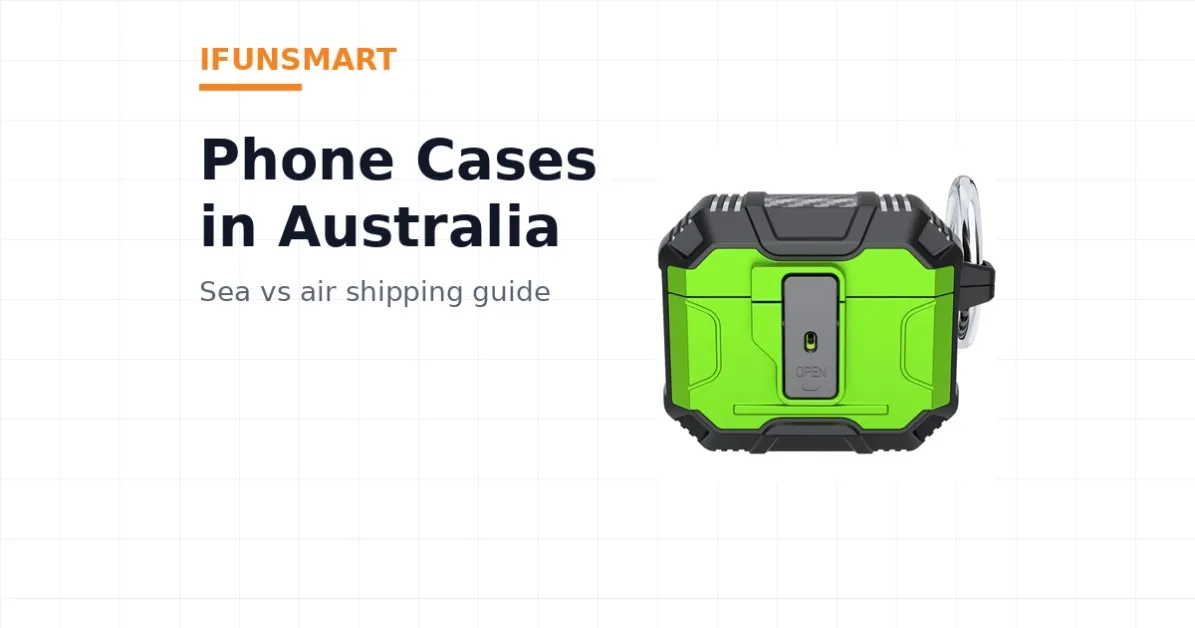
Phone Cases in Australia: Sea vs Air Shipping Guide
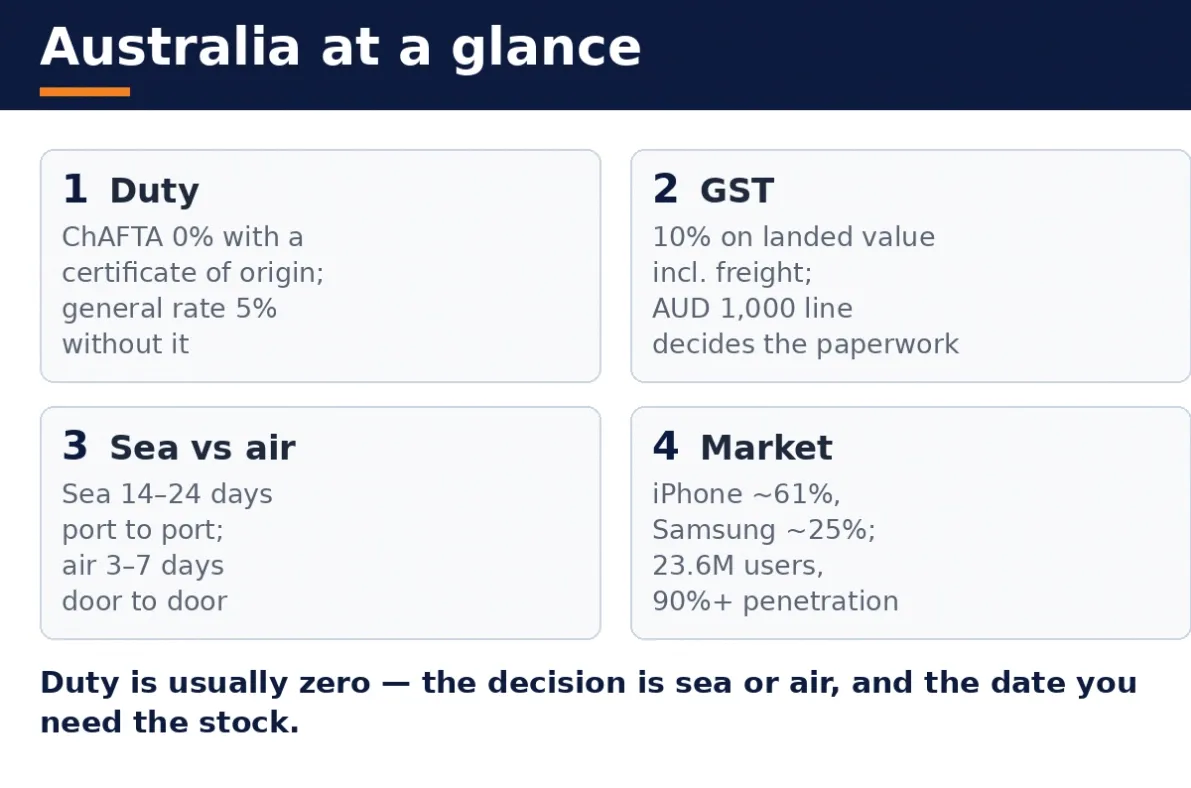
Australia clears easily — ChAFTA cuts duty to 0%. The real choice is sea or air: sea takes weeks and wins on bulk, air takes days and wins on speed.
The short answer: Australia is the easiest large market in Asia-Pacific to import phone cases into. The China–Australia Free Trade Agreement cuts duty to 0% on most Chinese goods with a valid certificate of origin, so duty is rarely the problem. The real decision is sea or air: sea freight takes roughly two to four weeks port to port and wins on cost once the order has real bulk; air freight takes roughly three to seven days door to door and wins when the stock is needed fast. The AUD 1,000 line decides the paperwork — under it, a self-assessed clearance; over it, a full import declaration with GST at 10%. Order backwards from the date you need the stock, not forwards from the date you pay.
Send model, style, quantity and country on WhatsApp https://wa.me/8613632248734 — we reply within 24 hours with MOQ, sample cost and lead time for that model.
- What Australia charges at the border — and what it does not
Australia charges 0% or 5% customs duty on most goods, one of the lowest headline rates in Asia-Pacific. Under the China–Australia Free Trade Agreement (ChAFTA), tariffs on Chinese goods were eliminated in stages — 82% when the agreement entered into force on 20 December 2015, the rest by 1 January 2019. For goods that qualify as Chinese originating goods, the duty rate is free. Without proof of origin, the same goods fall back to the general rate, commonly 5% — small, but real money on a distributor-sized order, and avoidable, which is why §4 matters.
GST is the charge that always applies. Import GST is 10% of the value of the taxable importation. That value is not the factory invoice price: it is the customs value plus duty plus international transport and insurance — the landed value. Two details catch first-time importers. First, Australia uses the FOB value as the customs value base, not CIF — freight and insurance are excluded from the duty calculation, which lowers the dutiable value. Second, the 10% GST is then calculated on the full landed value including freight and insurance, so freight still feeds the GST even thoug it escapes the duty. A GST-registered business reclaims the import GST as an input tax credit, and regular importers can join the Deferred GST scheme and pay the GST at their next BAS lodgement instead of at the border. Duty, by contrast, never comes back. Read more: https://www.ifunsmart.com/posts/importing-phone-cases-documents-checklist
On top of duty and GST, a full import declaration carries government charges: an import processing charge of AUD 50 for a consignment over AUD 1,000 and under AUD 10,000, or AUD 152 at AUD 10,000 and over, plus a biosecurity charge of AUD 48 for air freight or AUD 71 for sea freight. These are small next to the order value, but they are fixed — one more reason small, frequent air shipments cost more per unit than one consolidated sea shipment. Read more: https://www.ifunsmart.com/posts/phone-case-freight-ddp-air-vs-sea
- Sea vs air — the real comparison
Sea and air are not two versions of the same service. They are different tools, and the order size decides which one fits.
Sea freight is the default for anything over roughly 100–150 kg or a full pallet. It is priced by volume — cubic metres — or by container, which makes it dramatically cheaper per kilogram than air once a shipment has any real bulk. The carrier-quoted planning bands, consistent across several freight sources, are 14–20 days port to port from southern Chinese ports such as Shenzhen and Guangzhou to Fremantle, and 16–24 days to Sydney, Melbourne and Brisbane; sailings from Shanghai and Ningbo typically add two to four days to east-coast ports. A shared container, known as LCL, adds roughly three to seven days on top for consolidation and deconsolidation. Door to door, sea commonly sits in a 20–45 day band once pickup, export formalities, Border Force clearance, biosecurity checks and final delivery are included. Treat every one of these figures as a planning band, not a guarantee: port congestion, vessel rollovers and customs holds all add time, and the weeks before and after Chinese New Year — when factories typically shut for one to three weeks — see a surge in bookings that pushes production and sailing schedules out.
Air freight is priced per kilogram, so it costs several times more per unit than sea — but it compresses the delivery window from weeks to days. The planning band is three to seven days door to door from most Chinese hubs, including customs clearance and last-mile delivery, with direct flights to Sydney, Melbourne and Brisbane from Shanghai, Guangzhou and Shenzhen keeping transit tight. Freight routed through a transhipment hub can add a day or two.
The rule of thumb: a full container load wins when the volume reaches roughly 15 cubic metres or more, or when faster door-to-door handling matters; LCL bills per cubic metre with a minimum charge and suits first orders and market stock; air wins when the total deadline cannot fit sea freight's calendar — a new iPhone launch, a retailer's shelf date, a stock-out. A distributor's normal rhythm is sea for the planned range and air for the gap: the bulk order sails, and a small air top-up covers the models that sell out first. Read more: https://www.ifunsmart.com/posts/bulk-phone-case-orders-volume-guide
- The AUD 1,000 line — and what it does not do
The value of the consignment decides which declaration it needs, and the line sits at AUD 1,000. Air and sea cargo worth AUD 1,000 or less uses a Self-Assessed Clearance declaration: no import processing charge, and no duty or GST collected at the border for ordinary goods. Anything over AUD 1,000 needs a full import declaration, lodged through the Integrated Cargo System by a licensed customs broker or by the importer, with all relevant duties, taxes and charges paid before the goods are released. A commercial consignment over AUD 1,000 also needs an ABN and an Import Client Account in the Integrated Cargo System.
Two things the AUD 1,000 line does not do. First, it does not remove GST from a commercial order. GST of 10% applies either way — on low-value goods sold to Australian consumers it is collected by the seller once the seller is registered, under the rules in force since July 2018 for overseas sellers with Australian turnover above AUD 75,000. Second, it does not remove the need for origin paperwork on a large order: the ChAFTA zero rate needs a certificate of origin, and no document is required only where the total customs value is under AUD 1,000. A distributor ordering at 500 pieces per order and above is always over the line, so plan for a full declaration, a broker and the origin certificate from the start — and do not split one order into small parcels to stay under it. Read more: https://www.ifunsmart.com/posts/phone-case-payment-terms-first-order
- ChAFTA — how the 0% duty actually works
The zero rate is claimed, not given. Three things have to be true. The goods must qualify as Chinese originating goods under ChAFTA's rules of origin. The claim must be supported by an origin document travelling with the shipment — a certificate of origin issued by an authorised body in China, such as China Customs or the China Council for the Promotion of International Trade, or in some cases a declaration of origin from an approved exporter. And the tariff code must be right: the rate for a product's code can be checked on the Department of Foreign Affairs and Trade FTA Portal, and the general rate in Schedule 3 of the Customs Tariff Act applies where origin is not established.
Ask the factory three questions before the goods ship: will a ChAFTA certificate of origin travel with the shipment, who issues it, and does the HS code on the certificate match the code on the commercial invoice and packing list? A mismatch between documents is the most common reason a zero-rate claim fails at the border, and it is fixed before shipping, not after. Keep the certificate with the shipment records: if the Border Force queries the claim later, the document is the answer. Read more: https://www.ifunsmart.com/posts/phone-case-factory-vs-trading-company
Biosecurity is the other Australian gate, and it is about packaging more than product. Phone cases are low biosecurity risk, but timber packaging, pallets and dunnage are checked by the Department of Agriculture, Fisheries and Forestry, and untreated wood can be held, treated or destroyed at the importer's cost. Ask the factory whether any timber is treated and marked to the ISPM 15 standard — a one-line question that prevents a hold at the port. Read more: https://www.ifunsmart.com/posts/phone-case-supplier-for-distributors
- What to order for Australia — an iPhone-led market
Australia is not like Southeast Asia or Latin America. It is a duopoly: Apple holds about 61% of the market and Samsung about 25%, together nearly 90%, with Google the main third brand at a single-digit share. About 23.6 million Australians use smartphones — penetration above 90% of the population — and the market is mature, premium-led and brand-loyal. The channels are concentrated too: JB Hi-Fi and Harvey Norman on retail, and Telstra, Optus and Vodafone on carrier. A distributor's first order should lead with iPhone 18 Pro and Pro Max, then Samsung's S-series and A-series, then Google Pixel — not the other way round.
Two trends shape the range. First, magnetic cases matter more here than in most markets: with iPhone dominant and Samsung's newer flagships sold as Qi2 Ready — magnetic charging through a magnetic case rather than built-in magnets — a MagSafe-compatible magnetic case is the default premium choice, and our 2700GS Magnetic Case for iPhone 18 Pro Max uses N52 magnets at up to 2700 Gauss. Second, foldables are growing — Australian foldable demand grew about 25% in the latest IDC tracking — so a foldable range for Samsung's Z Fold and Z Flip lines earns its place in the second order. Read more: https://www.ifunsmart.com/posts/qi2-android-magnetic-cases-guide and https://www.ifunsmart.com/posts/foldable-phone-cases-wholesale-buyers-guide
Order at distributor depth. MOQ is 50 pcs per colour per model, so a first order can test a model and colour. For distributors, bulk orders start at 500 pcs per order in total, and samples are free. Bundle the case with the accessories that sell alongside it — screen protectors, chargers, cables, power banks and stands — and ask for one combined shipment, one certificate of origin and one packing list. Read more: https://www.ifunsmart.com/posts/phone-case-accessories-bundles and https://www.ifunsmart.com/posts/phone-case-moq-50-per-colour-first-order
- Timing the order — work backwards from the shelf date
The most expensive mistake in Australia is not the freight choice. It is ordering forwards from the payment date instead of backwards from the date the stock is needed. Sea freight takes weeks on the water plus days at each end for pickup, clearance, biosecurity and delivery; a customs hold or a biosecurity check adds more; and the weeks around Chinese New Year compress factory capacity on both sides of the holiday. A distributor who needs stock on a retailer's shelf date should set that date, subtract the sea transit band, subtract clearance and delivery time, subtract production, and pay on the date that is left — not the date that feels comfortable.
Air freight exists for the orders that cannot wait: a launch-week gap, a model that sold through, a retailer's urgent top-up. It costs several times more per kilogram, so it should be the exception, not the plan. The plan is a sea order placed early, a sample approved before production, and the documents — certificate of origin, commercial invoice, packing list — checked while the goods are still in the factory. Read more: https://www.ifunsmart.com/posts/phone-case-order-lead-time-planning-guide
New customers pay 30% deposit by T/T or Western Union; after the goods are ready we send photos, a video and the packing list, and you pay the balance before the goods ship. Send us your model list and your port — Sydney, Melbourne, Brisbane or Fremantle — we confirm what is covered, within 24 hours. Read more: https://www.ifunsmart.com/posts/phone-case-factory-vs-trading-company
FAQ
Is there duty on phone cases imported from China to Australia? Usually none, if the paperwork is right. Under the China–Australia Free Trade Agreement, tariffs on Chinese-origin goods were fully eliminated by 1 January 2019, so the duty rate is 0% with a valid certificate of origin. Without proof of origin the goods fall back to the general rate, commonly 5%. GST of 10% applies either way, on the landed value including freight and insurance.
How is GST calculated on imports into Australia? At 10% of the value of the taxable importation — the customs value (FOB) plus duty plus international transport and insurance. Freight and insurance are excluded from the duty calculation but included in the GST base. A GST-registered business reclaims the import GST as an input tax credit, and regular importers can defer it to their next BAS lodgement under the Deferred GST scheme.
What is the AUD 1,000 threshold for importing into Australia? Consignments worth AUD 1,000 or less clear on a Self-Assessed Clearance declaration, with no import processing charge and no duty or border GST for ordinary goods. Anything over AUD 1,000 needs a full import declaration through the Integrated Cargo System, with duty and GST paid before release, plus an import processing charge of AUD 50 or AUD 152 and a biosecurity charge of AUD 48 by air or AUD 71 by sea.
Should I ship phone cases to Australia by sea or by air? Sea for planned bulk, air for urgency. Sea freight runs roughly 14–24 days port to port from China to Australian ports, plus clearance and delivery, and wins on cost once the shipment has real bulk — over roughly 100–150 kg or a full pallet, a full container at about 15 cubic metres. Air freight runs roughly three to seven days door to door and wins when the deadline cannot fit sea freight, such as a launch or a stock-out. Both figures are carrier-quoted planning bands, not guarantees.
Which phone models should I stock first for Australia? iPhone first. Apple holds about 61% of the Australian market and Samsung about 25%, together nearly 90%, with Google the main third brand. Lead with iPhone 18 Pro and Pro Max, then Samsung S-series and A-series, then Google Pixel, and add Samsung Z Fold and Z Flip foldables once the core range is covered. Send the factory your model list and get written confirmation of which designs cover each model and generation.
About iFunSmart
Ifun Electronics Technology Co., Ltd, Guangzhou, since 2010. A phone case factory — 1,000+ designs, 500+ models, 500K+ pcs/month, exported to 30+ countries — supplying wholesalers, importers and distributors in Australia and worldwide. Our 2700GS Magnetic Case for iPhone 18 Pro Max uses N52 magnets at up to 2700 Gauss. MOQ is 50 pcs per colour per model; bulk orders from 500 pcs per order in total; free samples for distributors. Ask us for a live video call from our production line, our mould and model list, or a sample — we reply within 24 hours. WhatsApp https://wa.me/8613632248734 — Email contact@ifunsmart.com