Business Solutions
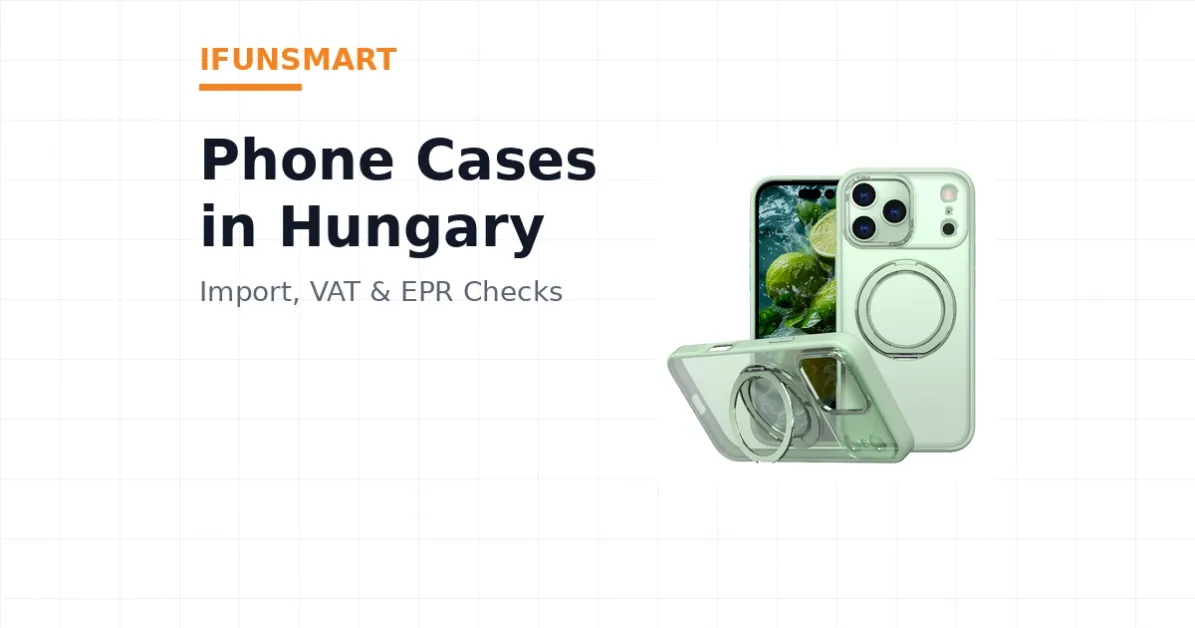
Phone Cases in Hungary: Import, VAT & EPR Checks
Hungary charges 27% import VAT at the border — the EU's highest rate — duty around 6.5%, and packaging EPR through MOHU with no threshold. What to check first, and which styles to stock.
BLUF
Hungary charges 27% import VAT at the border — the EU's highest rate — duty of around 6.5%, and packaging EPR through MOHU with no threshold. An order needs an EORI, the right tariff code, and a sample checked on the phone. The range follows Samsung first, then iPhone.
Short answer
Hungary is an EU member state, so a phone-case shipment from China clears under EU customs and VAT rules, administered in Hungary by NAV, the National Tax and Customs Administration — tax and customs are one authority in Hungary. There is no customs border between Hungary and other EU member states — but there is a real one between China and Hungary, and it is where a first order is won or lost. The three charges a distributor plans for are import VAT at the standard rate of 27%, the EU's highest, charged from the first euro and paid at customs clearance; customs duty of around 6.5% on plastic cases under HS 3926 90 97 90 — a TARIC-mirror figure, so confirm it with your broker before you quote on it; and the packaging EPR obligation, which in Hungary runs through MOHU, the state concession company, under Government Decree 80/2023 — with no de-minimis threshold at all, so the first shipment already triggers the duty. The old EUR 150 duty relief is gone — abolished EU-wide on 1 July 2026 — and the EUR 3 flat duty and EUR 2 handling fee that replaced it apply to B2C distance sales only. A distributor importing in bulk was never covered by that relief and pays duty at the normal tariff rate. The paperwork is short but exact: an EORI number, the import declaration filed electronically with NAV, and an entry summary declaration in ICS2 before the goods arrive — plus one Hungary-specific check, EKÁER, that no other country guide in this series has needed. A plain phone case needs no CE marking and falls outside WEEE, while a battery or LED case is in scope for both; the GPSR has applied since 13 December 2024, and for a Chinese factory with no EU establishment the Hungarian importer is the EU responsible person. Labelling is in Hungarian — and Hungarian consumer-protection law requires it, not just good practice. The market is Samsung first, then iPhone, with Android running at 73% of mobile internet traffic — the highest Android figure in Central-Eastern Europe. This guide works through the border cost, the VAT payment, the paperwork, the EPR, the product rules, and what to stock first.
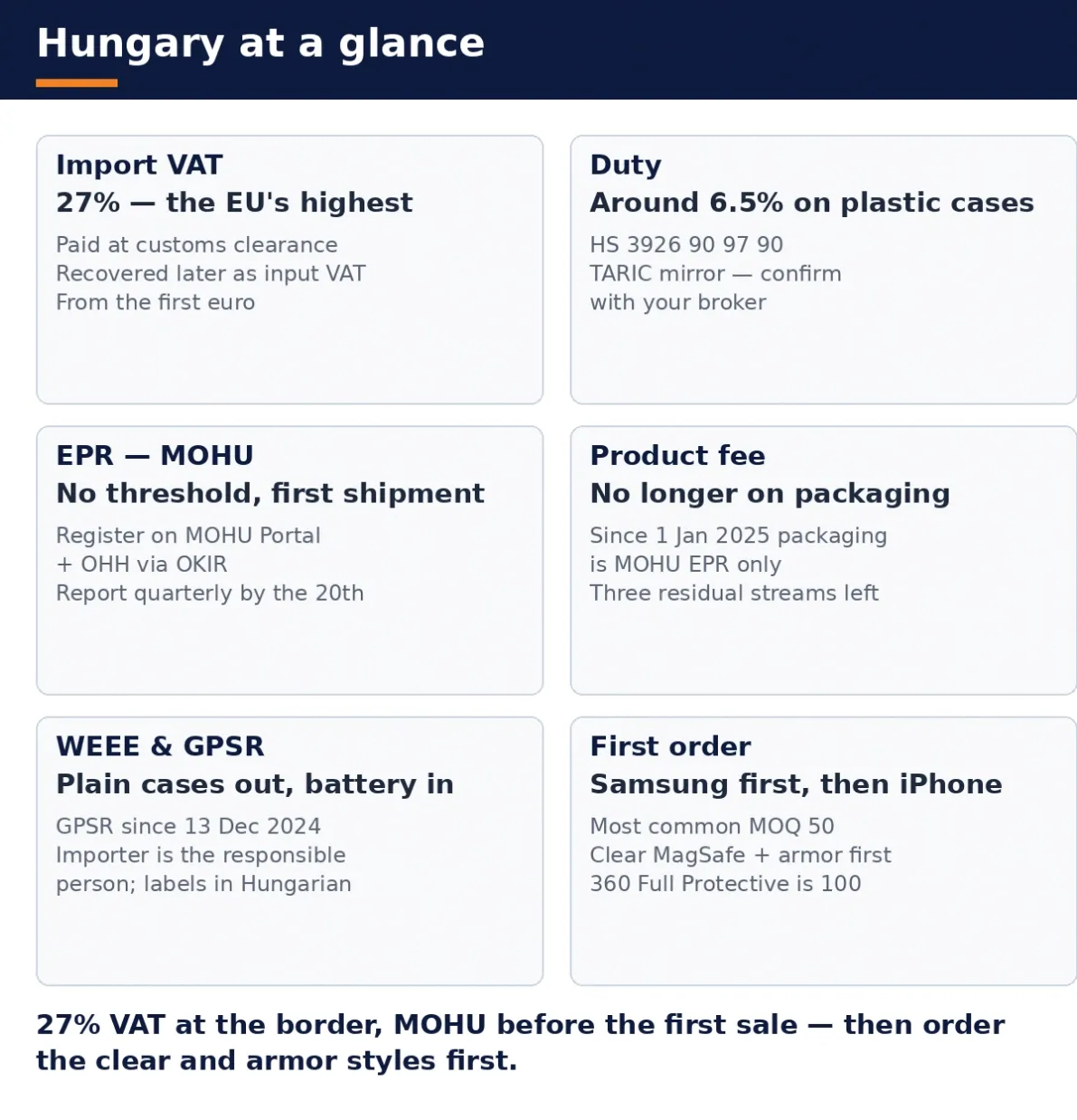
Hungary at a glance
Check | What applies to a Hungary order |
|---|---|
Market | EU member since 2004; population about 9.5 million; Samsung top brand (37.63%, 2023 ranking); Android 73% of mobile internet traffic (Jan–Jun 2026) |
Import VAT | 27% from the first euro — the EU's highest standard rate; paid AT customs clearance, not reverse-charged; recovered later as input VAT |
Duty | Around 6.5% on plastic cases (HS 3926 90 97 90, TARIC mirror — confirm with your broker); leather wallet cases around 3% (CN 4202 31 00) |
Low-value rules | EUR 150 duty relief abolished 1 Jul 2026; EUR 3 flat duty + EUR 2 handling fee are B2C distance sales only — B2B bulk pays normal duty |
EORI | Required; via NAV, then electronic declarations; ENS in ICS2 before arrival; EKÁER road-transport check — ask your broker |
EPR | Government Decree 80/2023; MOHU is the sole operator, no competing schemes, no individual compliance for packaging; NO threshold — first shipment triggers the duty |
Product fee | Environmental product fee NO LONGER applies to packaging since 1 Jan 2025 — packaging is MOHU EPR now; the fee covers only three residual streams |
PPWR | Regulation (EU) 2025/40, generally applicable 12 Aug 2026 — Declaration of Conformity + technical documentation |
WEEE | Plain cases out of scope; battery/LED cases in — Decree 197/2014, register via MOHU then OHH before first sale |
GPSR | Regulation (EU) 2023/988, applied 13 Dec 2024; market surveillance by the National Authority for Trade and Consumer Protection; the Hungarian importer is the EU responsible person |
CE / labelling | No CE marking on plain cases; labels and instructions in Hungarian (Act CLV of 1997); prices in HUF |
Channels | eMAG.hu (largest online retailer), Alza.hu, MediaMarkt, Euronics, Árukereső.hu price comparison; no local Amazon site |
MOQ | Most common 50 pcs per colour per model; 360° Full Protective is 100 pcs per colour per model |
Sample | Fee charged, refundable on orders of 500+ pcs — ask us to confirm the amount per style in writing |
Payment | T/T and Western Union only; 30% deposit for new customers; photos + video + packing list, then balance, then ship |
1. What does a Hungary order cost at the border?
Three charges, and only three — import VAT, customs duty, and the packaging EPR cost behind the order. Everything else a distributor pays — the goods, the freight, the inspection — is a commercial cost, not a border charge. This section takes the three border charges in the order they hit the shipment. The first one is the reason Hungary is the most expensive EU entry point in this series on cash flow alone.
Import VAT — 27%, from the first euro, paid at the border. Hungary's standard VAT rate (ÁFA) is 27%, the highest standard rate in the EU, and phone cases fall under the standard rate. The reduced rates — 18% for certain food and accommodation, 5% for medicines, books and similar goods — do not cover phone cases. Import VAT has applied from the first euro since 1 July 2021, when the old EUR 22 VAT exemption was abolished EU-wide. There is no low-value VAT relief left to plan around: a sample parcel and a container both pay import VAT. The import VAT base is the customs (CIF) value plus customs duty plus transport and insurance up to the place the goods enter the EU customs territory. A phone case import Hungary VAT question is really two questions — the VAT rate and the duty code — and both belong on the quotation, with the code stated, not assumed. How the VAT is actually paid is a separate question, and in Hungary it is the most important one — that is §2.
Customs duty — around 6.5% on plastic cases, with a broker caveat. Plain TPU, silicone and PC phone cases classify under HS 3926 90 97 90 — "other articles of plastics, other" — the same EU-wide code used across this series' country guides, because Hungary applies the EU common external tariff and has no separate Hungarian duty schedule. The third-country (MFN) duty rate is around 6.5% on the CIF value, according to two independent TARIC mirrors — Tarific (TARIC version 261126, synchronised 26 November 2026) and HTSBase (EU Combined Nomenclature 2026). That "around" matters: the authoritative source is the EU TARIC database itself, where a Binding Tariff Information decision gives legal certainty binding across the EU for three years. A distributor should confirm the 10-digit tariff item with its broker before the first order, and should ask the broker to confirm it in writing — the code decides the duty, and the wrong code is the most expensive mistake in the shipment. Leather wallet and folio cases classify separately, under CN 4202 31 00, at around 3% per the same mirrors — same broker-confirmation caveat, and with one more caution: whether a leather wallet case is even classified under that code is itself a question for the broker, because a folio case with a phone function may classify elsewhere. Do not apply the 3% to plastic cases, and do not apply 6.5% to leather wallets. One more Hungary fact: Hungary is landlocked. Sea freight arrives at a coastal EU port — Hamburg, Bremerhaven, Rotterdam, Koper or Trieste — and moves under transit to a Hungarian customs point. Duty and VAT are assessed on entry into the EU customs territory, not on arrival in Budapest, so the transit leg does not change the border charges.
A worked illustration — not a quote. On EUR 1,000 of customs value, the arithmetic runs: 6.5% duty is EUR 65, then 27% Hungarian import VAT on EUR 1,065 is EUR 287.55, for a border total of EUR 352.55. That is an illustration built from the two verified rates, not a quotation: it includes no freight, no brokerage, no EPR fee and no sample cost, and the duty figure itself carries the broker-confirmation caveat above. The point of the illustration is the VAT, not the duty — at 27%, the VAT is more than four times the duty on the same shipment, and it is paid at the border. A distributor that plans a Hungary order on the duty alone has planned around the smaller number.
The EUR 150 relief is gone — and the replacement charges are B2C only. Until 30 June 2026, consignments with an intrinsic value of EUR 150 or less were exempt from customs duty. From 1 July 2026 that relief is abolished EU-wide under Council Regulation (EU) 2026/382. The replacement is a temporary flat customs duty of EUR 3 per item — per six-digit tariff line, per distinct product type, with identical items counting once — on qualifying low-value consignments, running until 1 July 2028, when normal tariff rates under the EU Customs Data Hub are expected to apply. From 1 November 2026 a separate Union handling fee of EUR 2 per item applies as well — permanent, non-refundable, per declaration line, on B2C distance sales of imported goods whatever the value, so it also applies above EUR 150, on top of normal duty. Both charges are part of the taxable amount for VAT, under the Commission's revised VAT guidance of 6 October 2026. Product identifiers became mandatory from 1 November 2026 for low-value distance-sale import declarations — SKU, manufacturer product ID, GTIN/EAN/UPC where one exists. And IOSS does not remove the EUR 3 duty: duty and VAT are separate charges. None of this touches a distributor's bulk order. Business-to-business consignments of EUR 150 or less pay duty at the normal tariff rate instead. A distributor importing in bulk was never covered by the EUR 150 relief and pays normal duty — the EUR 3 and EUR 2 charges are a B2C e-commerce story, and a buyer that plans a bulk order around them has planned around the wrong rules.
2. How is import VAT actually paid?
This is the section that makes Hungary different from every other market in this series — and the reason a distributor that plans to serve several EU countries from one warehouse should look at Czechia before Hungary, not the other way round. In Czechia, a VAT-registered importer does not pay import VAT at the border at all: it declares the VAT and deducts it in the same return. In Hungary, the importer pays.
Paid at customs clearance — the cash leaves at the border. Hungary does not operate a general postponed import VAT accounting system comparable to some other EU member states. Import VAT is due at customs clearance: the importer pays 27% when the goods clear, and recovers it later as input VAT when filing VAT returns — if the goods are used for taxable activities. The cash leaves the business at import and comes back afterwards; it is not netted in the same return. VAT returns are filed electronically with NAV, generally due by the 20th day of the month following the reporting period, with real-time invoice reporting through NAV's Online Számla system. Worked through with the illustration from §1: on EUR 1,000 of customs value, the Hungarian importer pays EUR 287.55 of VAT at the border and reclaims it later; the Czech importer on the same shipment declares EUR 210 of VAT at 21% and deducts it in the same return, with no cash outlay at all. The Hungarian rate is higher and the payment is earlier — both facts belong on the first order's cash-flow plan, not discovered at the border. A Hungary phone case distributor that prices a first order without the 27% at the border has priced a different country.
Deferment — do not present it as a general postponed-accounting scheme. Two sources point in different directions, and this guide does not overstate either. One Avalara developer page lists Hungary among the countries that allow an import-VAT deferment scheme, but only for businesses that have applied for it. A PwC summary describes a narrow simplified scheme only: since 1 July 2021 the Hungarian VAT Act has simplified rules for paying import VAT on low-value consignments under EUR 150 where the seller does not use IOSS — the person initiating release for free circulation collects the import VAT from the consignee and pays it to the tax authority, and only taxable persons registered in Hungary holding an authorisation for deferred payment of customs duties may use it. Neither source describes a Czech-style reverse charge open to a bulk B2B importer. The default position for a distributor is VAT paid at import; a deferment or authorisation route exists but is not a general postponed-accounting system — a B2B bulk importer must ask its broker or NAV whether it qualifies, before the first order, not after the first invoice.
Fiscal representative — a VAT-registration point, not a customs point. Non-EU businesses must generally appoint a fiscal representative in Hungary for VAT registration purposes. Keep this separate from the Importer of Record question in §3: the fiscal representative is about VAT registration for a non-EU seller, and a DDP shipment still needs someone in the EU to act as Importer of Record. For a normal B2B import cleared by the Hungarian buyer, the buyer is the importer of record and the fiscal-representative question does not arise in the same way — confirm the position with a tax adviser before structuring the first shipment.
Onward supply inside the EU — and the Intrastat line. Goods imported into Hungary and then supplied onward to another EU member state follow the normal intra-EU supply rules, with the VAT treatment depending on the supply chain — confirm it with a tax adviser before quoting an onward price. One reporting duty to set up before the volumes grow: businesses above the Intrastat threshold file Intrastat declarations on physical movements between Hungary and other EU countries — a reporting duty, not a tax. The 2026 thresholds published by the Hungarian Central Statistical Office are HUF 500,000,000 a year for arrivals and HUF 200,000,000 for dispatches, with filing by the 15th of the month after the reporting period. Older figures still circulate — HUF 400 million and HUF 160 million were the 2025 thresholds — do not use those.
IOSS — for the retail side only. The Import One-Stop Shop is an optional EU VAT scheme for B2C distance sales of goods imported from outside the EU in consignments with an intrinsic value of EUR 150 or less, live since 1 July 2021. The seller charges VAT at the destination country's rate at checkout and declares it in a single monthly IOSS return filed in one member state; one IOSS registration covers all 27 member states. It matters to a Hungary phone case distributor only if the buyer also sells direct to Hungarian consumers in sub-EUR 150 parcels. A B2B bulk import does not use IOSS — the Hungarian importer clears customs with its EORI and pays import VAT at customs clearance. One related point for a distributor that also trades inside the EU: the EU-wide EUR 10,000 distance-selling threshold for B2C sales applies, and OSS is available — but that is a retail-side mechanism, not an import mechanism.
3. What paperwork does the first shipment need?
The paperwork for a first Hungary shipment is short: one number, one declaration system, and one pre-arrival filing — plus one Hungary-specific road-transport check that no other country guide in this series has needed. Short does not mean skippable — the shipment does not clear without the first three, and the first two have to be arranged before the goods leave China.
EORI — register through NAV first. An EORI number is required for any economic operator that lodges customs declarations in the EU. One EORI per legal entity, valid across the whole EU. The Hungarian route runs through NAV, the National Tax and Customs Administration, which holds both tax and customs for Hungary. Operators established outside the EU must obtain an EORI to lodge customs declarations. No EORI processing time was confirmed from an official source in the research for this guide — ask NAV or your broker for the current timing, and do not promise a ship date that depends on it.
Electronic declarations — lodged with NAV. Import declarations are lodged electronically with NAV under the Union Customs Code. The paper Single Administrative Document is now only used in limited fallback cases. The broker submits the import declaration with the commercial invoice, the packing list and the transport document — the bill of lading or the air waybill — and an incomplete declaration is flagged by the system and delays release. No Hungarian customs-system name was verified in the research for this guide — unlike Czechia, which has CELS — so this guide does not name one; confirm the current system name with your broker. Before the goods arrive, the carrier files safety and security data in ICS2 — the EU Import Control System 2, now deployed for all modes of transport — as an Entry Summary Declaration (ENS). The order is fixed: ENS first, then the import declaration, then customs review, then release. One more boundary to know: true DDP delivery requires someone in the EU to act as Importer of Record, overseeing the customs declarations and paying duties and VAT before the shipment clears — without a registered IOR, DDP delivery is not possible. A distributor that is quoted DDP should ask who the IOR is, in writing, before the goods ship. Keep the declaration documents on file for audit — no Hungarian retention period was verified in the research for this guide, so confirm the period with your broker. (VAT records, separately, are retained for at least eight years.)
EKÁER — the Hungary-specific check. EKÁER, the Electronic Public Road Trade Control System, is Hungary's road-transport registration system, run by NAV to combat VAT fraud. Since 1 January 2021 the registration obligation applies only to goods deemed risky — food products, clothes and other products listed in the governing decree — and only above thresholds: no EKÁER number is required for a single delivery from the same dispatcher to the same recipient in the same vehicle not exceeding HUF 1 million in value and 500 kg in gross weight. For non-risky goods there is no registration obligation at all under the 2021 decree. Whether EKÁER applies to phone cases was NOT verified in this research: phone cases are not on any published risky-goods list seen, and the sources describe risky goods as typically food and clothing — but no source names phone cases, or their HS/CN code, as risky or non-risky. Do not state that phone cases are exempt, and do not state that they are covered. Ask the broker or forwarder whether the shipment needs an EKÁER number before the goods move by road in Hungary. One warning: older pages still describe the pre-2021 regime — all road shipments, HUF 5 million and 2,500 kg for non-risky goods — those figures are superseded by the 2021 decree and must not be used.
4. Packaging EPR: MOHU, and the product fee that no longer applies to packaging
Packaging is the obligation most first-time importers miss, because it is not a border charge — no one stops the container for it — and it is the obligation that follows the importer home, because the packaging stays in Hungary after the cases sell. In Hungary it runs through one law, one register and one state concession company, with no threshold at all — and it sits next to a second, older obligation that no longer applies to packaging, which is exactly where older guides go wrong.
The four steps, in order. 1. Register on the MOHU Partner Portal and sign the concession/service contract. 2. Apply for registration with the National Waste Management Authority (OHH) via the OKIR system before the activity starts — the authority registers a compliant application within 15 days. 3. Report the packaging placed on the market quarterly — data reports to OHH by the 20th of the month after each quarter — and keep records for at least five years. 4. Pay the MOHU invoice within 15 days of issue, and put the prescribed EPR clause on B2B invoices.
The law and the company. The legal basis is Government Decree 80/2023 on the extended producer responsibility system, in force since 1 July 2023, as amended most recently by Decree 412/2025, which aligned the Hungarian packaging decree with the PPWR. The obligation falls on the producer — the business that first places the packaging or packaged product on the Hungarian market: the first domestic transfer of ownership, use for the company's own purposes, or release from a bonded, excise or fee warehouse. In practice, for China-to-Hungary trade, the Hungarian importer is the obligated party for the shipment's packaging. Producers fulfil the take-back and recovery obligations through MOHU MOL Hulladékgazdálkodási Zrt., which holds the 35-year state waste-management concession from 1 July 2023. MOHU is the sole operator: there are no competing producer-responsibility organisations for packaging, and individual compliance is NOT available for packaging. That is the sharpest Hungary-versus-Czechia EPR difference in the series: Czechia has the single authorised company EKO-KOM but individual compliance exists in law; Hungary's packaging route is MOHU-only. Products must be mapped to the correct 8-digit KF codes — circular product codes — for reporting.
No threshold — the first shipment already triggers the duty. Hungary has no de-minimis threshold for registration. The obligation to register, report and pay fees begins with the first parcel or item sent to a Hungarian customer. A distributor's first shipment already triggers the duty — there is no small first order that escapes it. That is the point a distributor coming from Greece or Czechia must not miss in either direction: Greece has no threshold by settled law, and Czechia's small-producer exemption is in dispute — Hungary has no threshold at all, by design. One narrow note, from a single secondary source: if the producer's total annual EPR fee is below HUF 50,000, it may be permitted to switch from quarterly to annual reporting — confirm that with MOHU rather than planning on it.
The fees — reported rates, confirm with MOHU. The 2026 per-kilogram EPR rates by material, reported from the fee decree (EM Decree 33/2025) and unchanged from 1 October 2025, are: plastic HUF 219, paper HUF 173, metal HUF 186, glass HUF 107, composite HUF 191, wood HUF 22, textile HUF 148, other HUF 129. Phone-case retail packaging is typically plastic and/or paper/card — the plastic rate is the one a distributor would illustrate, and only with the "confirm with MOHU" caveat, because no rate was verified against MOHU or OHH directly. Do not convert a per-kilogram rate into a per-case cost in a quotation. Eco-modulation rules linking fees to recyclability apply from 12 August 2026. Amounts under HUF 1,000 are carried forward.
Authorised representative — for direct sellers. A company outside Hungary that sells directly to Hungarian consumers or businesses, including online, is the producer for that packaging. An authorised representative is mandatory for a foreign-established producer selling in Hungary by e-commerce, and optional for other foreign producers — established in Hungary, with a Hungarian tax number. An authorised representative is also required under PPWR Article 45(3) for producers in other EU countries selling directly to Hungarian end users. For a normal B2B import the Hungarian importer is the producer instead. Confirm the current position with MOHU or a compliance adviser before stating a flat rule for a Chinese factory selling direct.
The product fee — a different obligation, and packaging left it on 1 January 2025. Hungary has two different packaging-related obligations, and they are not the same thing. The EPR fee, since 1 July 2023, is paid to MOHU for financing collection and recycling of packaging. The environmental product fee (környezetvédelmi termékdíj, Act LXXXV of 2011) is a state tax administered by NAV, declared on the NAV KTBEV return. Since 1 January 2025 the product fee only applies to three residual product streams — other petroleum products such as lubricating oils; other plastic products such as artificial flowers and plastic carrier bags; and other chemical products such as soaps, detergents and cosmetics. Packaging, electrical and electronic equipment, batteries, tyres, office paper and advertising paper moved to EPR instead. So for a phone-case distributor, the packaging obligation is the MOHU EPR fee; the product fee only bites if the shipment also includes a residual-stream item — a plastic carrier bag supplied with the goods, for example. Before 1 July 2023 the product fee was the only packaging charge; from 1 July 2023 most businesses were affected by both the product fee and the new EPR fee; from 1 January 2025 packaging left the product fee entirely. Older guides that describe packaging as product-fee-liable are out of date — and a distributor that pays the product fee on its packaging in 2026 is paying the wrong charge. Enforcement runs through the waste authority, which can impose a waste-management fine — no fine figure was verified, so none is stated here.
PPWR — the regulation that sits alongside the Hungarian EPR system. Regulation (EU) 2025/40, the Packaging and Packaging Waste Regulation, came into force on 11 February 2025 and has been generally applicable since 12 August 2026 across the EU, replacing Directive 94/62/EC. It sits alongside the Hungarian EPR system (Decree 80/2023, as amended by Decree 412/2025), not instead of it — registration, scheme membership and fee payment continue as before. What is new since 12 August 2026: packaging needs an EU Declaration of Conformity and technical documentation — the manufacturer's duty, kept for five years for single-use packaging and ten years for reusable packaging — plus substance restrictions under Article 5, and manufacturer identification on the packaging or via a QR code or data carrier. Harmonised EU labelling of material composition follows from 12 August 2028, or 24 months after the implementing act if later. The practical point for a distributor: ask the Chinese factory for the PPWR Declaration of Conformity and technical documentation for the retail packaging, and keep it on file — the Hungarian importer holds it, not the factory.
- WEEE, GPSR and CE: what a plain case does and does not need
This is the section where most first-time importers either over-comply or under-comply, and both cost money. A plain phone case is a simple product under EU law: it needs no CE marking, it falls outside WEEE, and it is covered by the GPSR. A case with electronics in it is a different product, with different obligations. The line between the two is the electronics, not the price or the brand.
WEEE — plain cases out, battery and LED cases in. The legal basis is the EU WEEE Directive 2012/19/EU, implemented in Hungary principally through Government Decree 197/2014 on WEEE obligations, folded into the national EPR system (Government Decree 80/2023) on 1 July 2023. Packaging is not covered by this decree — it stays under Decree 80/2023 and MOHU, so a distributor that sells cases deals with two laws and two registers, not one. A plain phone case — TPU, silicone, PC or leather, with no electronics — is not electrical equipment and falls outside WEEE scope. A case only enters WEEE scope when it contains electrical or electronic functions — a battery case, a case with LEDs, charging electronics or wireless features. The same split applies to the EU Batteries Regulation (EU) 2023/1542 for built-in batteries. If a case is in scope, the producer — the first business to place the equipment on the Hungarian market, including importers and distance sellers — must register before placing the first unit on the market. Registration runs through MOHU first and then the waste authority (OKIR), in a fixed order. Unlike Czechia, where several collective systems compete for electrical equipment, Hungary has no competing WEEE collective systems — MOHU is the single state concession operator for collective fulfilment. WEEE is one of only three product groups where a producer may choose individual fulfilment instead of collective fulfilment through MOHU — the other two are motor vehicles and industrial or automotive batteries. There is no small-producer exemption from registration: the duty starts with the first unit. Reporting runs quarterly to the waste authority through OKIRkapu, due by the 20th of the month after each quarter. The 2026 WEEE EPR contribution is a per-kilogram charge to MOHU, set per KF code by ministerial decree — reported 2026 rates range from HUF 63 to HUF 419 per kilogram excluding VAT, depending on the equipment category. No per-unit rate for a phone case was verified — do not convert the per-
kilogram range into a per-case cost. A distributor that stocks only plain cases has no WEEE registration to do. A distributor that adds one battery case to the range has a registration to do before the first unit sells — the scope follows the product, not the order.
Batteries add a second registration. A device with a built-in battery makes the seller a battery producer as well, under separate rules, at the same time — one product, two registrations. A producer established outside Hungary that sells online directly to Hungarian households or other users must appoint a Hungarian authorised representative, who registers and reports on its behalf. Enforcement runs through the waste authority, and placing unregistered equipment on the market is itself the breach — register before you sell.
GPSR — the safety net, applied since 13 December 2024. Regulation (EU) 2023/988, the General Product Safety Regulation, was adopted on 10 May 2023 and has applied since 13 December 2024, replacing the General Product Safety Directive 2001/95/EC. It is the safety net for consumer products with no sector-specific EU legislation — plain phone cases are covered by it. The importer duties, under Article 11, are the ones that matter to a distributor: before placing a product on the market, verify the manufacturer carried out its duties — internal risk analysis plus technical documentation, and product identification; put the importer's own name, trade name or trademark and postal and electronic address on the product, or on the packaging or an accompanying document if that is not possible; ensure instructions and safety information accompany the product in a language easily understood by consumers in the member state of sale; keep technical documentation available to market surveillance authorities; keep a register of complaints, recalls and non-compliant products; take corrective action — withdrawal or recall — and notify through the Safety Business Gateway when a product presents a risk; and cooperate with the authorities. The EU responsible person, under Article 16, is the economic operator established in the EU who is responsible for the tasks in Article 4(3) of Regulation (EU) 2019/1020 — in order: the EU manufacturer, the authorised representative, the importer, or the EU fulfilment service provider. For a Chinese factory with no EU establishment, the Hungarian importer is the responsible person. The manufacturer duties, under Article 9, are the factory's side: internal risk analysis and technical documentation kept for ten years; a type, batch or serial number on the product; the manufacturer's name and postal and electronic address on the product where possible; instructions and safety information in a language set by the member state; publicly accessible communication channels for consumers; and an internal register of complaints, recalls and corrective measures. Market surveillance in Hungary sits with the National Authority for Trade and Consumer Protection — Hungary's market surveillance authority for consumer products, listed in the EU's CASP 2025 coordinated market-surveillance programme. Hungary was among the six most active notifying countries in the European Commission's Safety Gate 2024 annual report, with 365 alerts. Two things this guide does not do: it does not certify the factory — GPSR is a regulation, not a certificate, and iFunSmart holds no GPSR certification — and it does not give legal advice. A distributor that wants certainty should ask its compliance adviser, not its supplier.
CE marking — not for plain cases. A plain plastic, silicone or TPU phone case with no electronics needs no CE marking. CE marking follows from matching the product against directives one at a time, and a plain case has no drive, no electronics and no live parts, so the Machinery Directive, the EMC Directive, the Low Voltage Directive and the RoHS Directive do not reach it. CE marking is required when the case has electronics — LEDs, a battery, speakers, charging features, wireless or NFC functions. Then an EU Declaration of Conformity is needed covering every applicable directive — RoHS, EMC, RED and LVD as applicable — and a battery case must also carry the CE mark, the crossed-out bin symbol and the required battery labelling under the Batteries Regulation. Do not put a CE mark on a plain case just because a buyer asks: a CE declaration for a product outside every directive has no legal hook and becomes a liability. The REACH position, for completeness: GPSR-adjacent chemical rules apply to plain cases — REACH SVHC limits at the 0.1% threshold, with SCIP notification where applicable, and the POPs Regulation. iFunSmart does not claim REACH, RoHS or GPSR certification for itself. A buyer that wants material or test documentation should ask the factory for it in writing.