Business Solutions
Phone Cases in Greece: Import, VAT & EPR Checks
Greece charges 24% import VAT from the first euro and duty around 6.5%, with packaging EPR through EOAN and HERRCO — what a distributor checks before the first order, and which styles to stock first.
BLUF
Greece charges 24% import VAT from the first euro, duty of around 6.5%, and packaging EPR from the first unit through EOAN and HERRCO. A first order needs an EORI, the right tariff code, and a sample checked on the real phone. The range follows Apple, Samsung and Xiaomi.
Short answer
Greece is an EU member state, so a phone-case shipment from China clears under EU customs and VAT rules, administered in Greece by the Independent Authority for Public Revenue (AADE). There is no customs border between Greece and other EU member states — but there is a real one between China and Greece, and it is where a first order is won or lost. The three charges a distributor plans for are import VAT at the standard rate of 24%, charged from the first euro and normally paid at import; customs duty of around 6.5% on plastic cases under HS 3926 90 97 90 — a TARIC-mirror figure, so confirm it with your broker before you quote on it; and the packaging EPR obligation, which in Greece runs through EOAN, the Hellenic Recycling Agency, with registration in the EM-PA national register and a contract with HERRCO, the dominant collective system — and unlike Ireland, there is no threshold: the obligation starts with the first packaging unit. The old EUR 150 duty relief is gone — abolished EU-wide on 1 July 2026 — and the EUR 3 flat duty and EUR 2 handling fee that replaced it apply to B2C distance sales only. A distributor importing in bulk was never covered by that relief and pays duty at the normal tariff rate. The paperwork is short but exact: an EORI number, registered through AADE, with the import declaration filed in ICISnet and an entry summary declaration in ICS2 before the goods arrive. On the product side, a plain phone case needs no CE marking and falls outside WEEE, while a battery or LED case is in scope for both; the GPSR has applied since 13 December 2024, and for a Chinese factory with no EU establishment the Greek importer is the EU responsible person. Labelling is in Greek. The market is Apple first, Samsung second and Xiaomi a close third — together around 74% of mobile internet traffic — with Android at about two-thirds of the market. This guide works through the border cost, the VAT payment, the paperwork, the EPR, the product rules, and what to stock first.
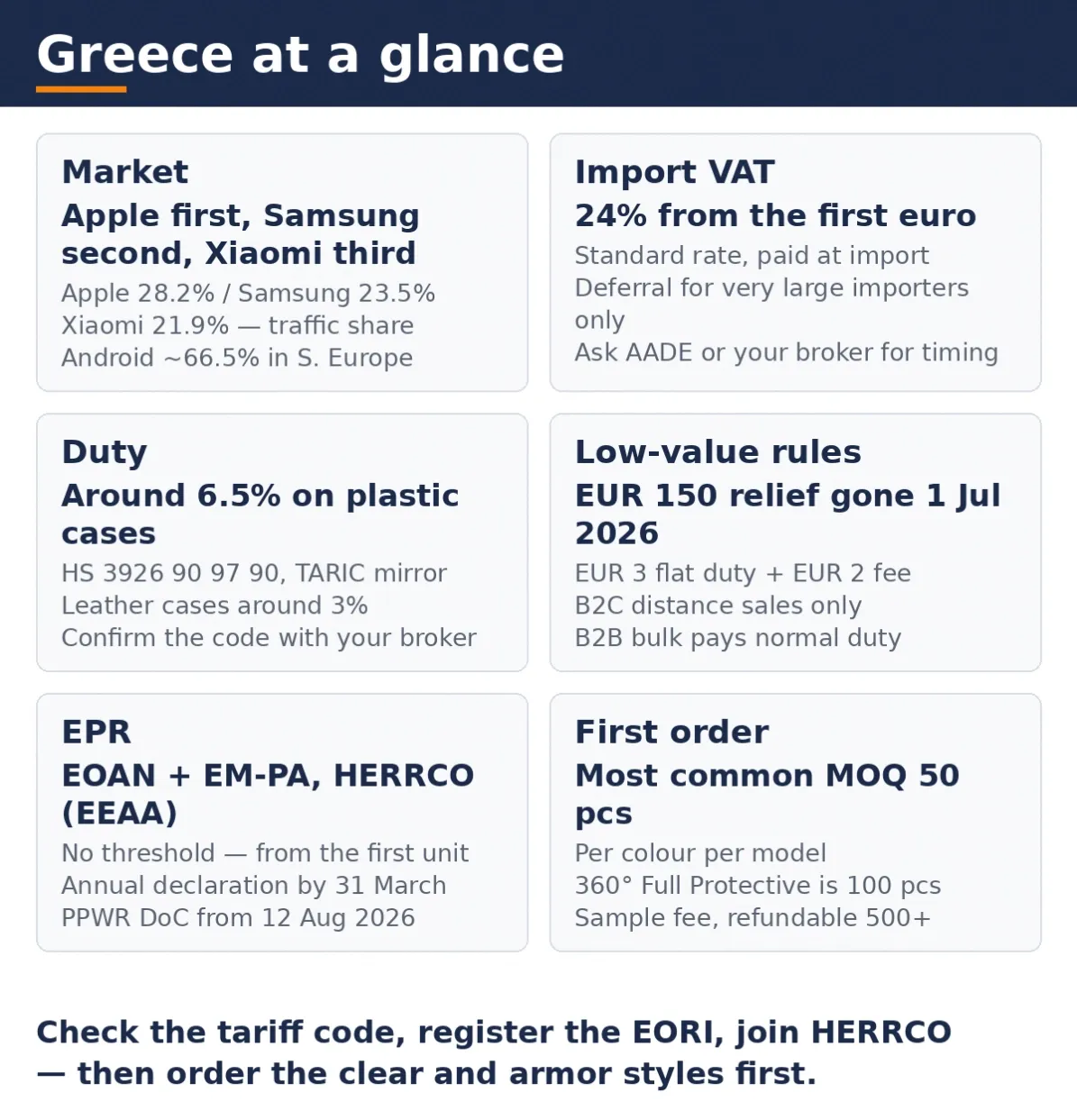
Greece at a glance
Check | What applies to a Greece order |
|---|---|
Market | EU member since 1981; Apple 28.2%, Samsung 23.5%, Xiaomi 21.9% (traffic share, not sales) |
Import VAT | 24% from the first euro; normally paid at import — the deferral regime is for very large importers only |
Duty | Around 6.5% on plastic cases (HS 3926 90 97 90, TARIC mirror — confirm with your broker); leather wallet cases around 3% (CN 4202 31 00) |
Low-value rules | EUR 150 duty relief abolished 1 Jul 2026; EUR 3 flat duty + EUR 2 handling fee are B2C distance sales only — B2B bulk pays normal duty |
EORI | Required; register via AADE/myAADE, then ICISnet; ENS in ICS2 before arrival |
EPR | EOAN + EM-PA register; HERRCO (EEAA) is the dominant PRO; no threshold — from the first packaging unit; annual declaration by 31 March |
PPWR | Regulation (EU) 2025/40, generally applicable 12 Aug 2026 — Declaration of Conformity + technical documentation |
WEEE | Plain cases out of scope; battery/LED cases in — register in EMPA + join Electrocycle |
GPSR | Regulation (EU) 2023/988, applied 13 Dec 2024 — the Greek importer is the EU responsible person |
CE / labelling | No CE marking on plain cases; instructions and safety information in Greek |
MOQ | Most common 50 pcs per colour per model; 360° Full Protective is 100 pcs per colour per model |
Sample | Fee charged, refundable on orders of 500+ pcs — ask us to confirm the amount per style in writing |
Payment | T/T and Western Union only; 30% deposit for new customers; photos + video + packing list, then balance, then ship |
1. What does a Greece order cost at the border?
Three charges, and only three — import VAT, customs duty, and the packaging EPR cost behind the order. Everything else a distributor pays — the goods, the freight, the inspection — is a commercial cost, not a border charge. This section takes the three border charges in the order they hit the shipment.
Import VAT — 24%, from the first euro. Greece's standard VAT rate (ΦΠΑ) is 24%, and phone cases fall under the standard rate. The reduced rates — 13% and 6% — cover food, hotels, books, medicines and similar goods, not phone cases. Import VAT has applied from the first euro since 1 July 2021, when the old EUR 22 VAT exemption was abolished EU-wide. There is no low-value VAT relief left to plan around: a sample parcel and a container both pay import VAT. The import VAT base is the customs (CIF) value plus customs duty plus transport and insurance up to the place the goods enter the EU customs territory. A phone case import Greece VAT question is really two questions — the VAT rate and the duty code — and both belong on the quotation, with the code stated, not assumed.
Customs duty — around 6.5% on plastic cases, with a broker caveat. Plain TPU, silicone and PC phone cases classify under HS 3926 90 97 90 — "other articles of plastics, other" — the same EU-wide code used across this series' country guides, because Greece applies the EU common external tariff and has no separate Greek duty schedule. The third-country (MFN) duty rate is around 6.5% on the CIF value, according to two independent TARIC mirrors — Tarific (TARIC version 261126, synchronised 26 November 2026) and HTSBase (EU Combined Nomenclature 2026). That "around" matters: the authoritative source is the EU TARIC database itself, where a Binding Tariff Information decision gives legal certainty binding across the EU for three years. A distributor should confirm the 10-digit tariff item with its broker before the first order, and should ask the broker to confirm it in writing — the code decides the duty, and the wrong code is the most expensive mistake in the shipment. Leather wallet and folio cases classify separately, under CN 4202 31 00, at around 3% per the same mirrors — same broker-confirmation caveat.
The EUR 150 relief is gone — and the replacement charges are B2C only. Until 30 June 2026, consignments with an intrinsic value of EUR 150 or less were exempt from customs duty. From 1 July 2026 that relief is abolished EU-wide under Council Regulation (EU) 2026/382. The replacement is a temporary flat customs duty of EUR 3 per item — per declaration line, per distinct product type, with identical items counting once — on qualifying low-value consignments, running until 1 July 2028, when normal tariff rates under the EU Customs Data Hub are expected to apply. From 1 November 2026 a separate Union handling fee of EUR 2 per item applies as well — permanent, non-refundable, per declaration line, on B2C distance sales of imported goods whatever the value, so it also applies above EUR 150, on top of normal duty. Both charges are part of the taxable amount for VAT, under the Commission's revised VAT guidance of 6 October 2026. Product identifiers became mandatory from 1 November 2026 for low-value distance-sale import declarations — SKU, manufacturer product ID, GTIN/EAN/UPC where one exists. And IOSS does not remove the EUR 3 duty: duty and VAT are separate charges. None of this touches a distributor's bulk order. Business-to-business consignments of EUR 150 or less pay duty at the normal tariff rate instead. A distributor importing in bulk was never covered by the EUR 150 relief and pays normal duty — the EUR 3 and EUR 2 charges are a B2C e-commerce story, and a buyer that plans a bulk order around them has planned around the wrong rules.
2. How is import VAT actually paid?
Import VAT is paid at import — that is the default in Greece, and it is the first cash-flow fact a distributor should plan around. The deferral route that exists on paper is not a route a normal distributor can use, and the retail VAT scheme does not apply to a bulk import at all.
Paid at import — the normal route. In principle, import duties and VAT at import must be paid at the moment the import declaration is submitted. That is the position for a Greek distributor buying stock from China: the VAT is assessed on the customs documents and paid when the goods are released for free circulation. A buyer that prices a first order should price the 24% as cash out at the border, not as a return entry. One related point for a distributor that also trades inside the EU: businesses above the Intrastat arrivals threshold of EUR 150,000 a year file Intrastat declarations on physical movements between Greece and other EU countries — a reporting duty, not a tax, but one to set up before the volumes grow.
The deferral regime — real, but not for a normal distributor. Greece introduced a postponed import VAT accounting mechanism under Law 4132/2013, but it is available only to foreign taxable persons with a Greek VAT number that obtain a state licence from the Ministry of Finance — and only if all of the conditions are met: the goods are not subject to excise duties; the taxpayer has no fixed establishment in Greece; the value of the goods imported exceeds EUR 100 million for the first five years and EUR 250 million after the fifth year; and more than 90% of the imported goods are used for subsequent intra-Community supplies or exports. A phone-case distributor does not meet those thresholds, and should not plan a first order around them. This is the sharpest difference from the Ireland guide in this series: an Irish VAT-registered trader can account for import VAT on its VAT3 return under postponed accounting, while a Greek distributor pays at import. Do not copy the Irish cash-flow plan into a Greece order.
IOSS — for the retail side only. The Import One-Stop Shop is an optional EU VAT scheme for B2C distance sales of goods imported from outside the EU in consignments with an intrinsic value of EUR 150 or less, live since 1 July 2021. The seller charges VAT at the destination country's rate at checkout and declares it in a single monthly IOSS return filed in one member state; one IOSS registration covers all 27 member states. AADE's own e-commerce page describes the two collection routes for Greece: IOSS, where the seller charges the VAT, and the special arrangements, where the VAT is paid on the recipient's behalf by whoever presents the goods to customs — usually the express carrier or the postal operator ELTA SA. It matters to a Greece phone case distributor only if the buyer also sells direct to Greek consumers in sub-EUR 150 parcels. A B2B bulk import does not use IOSS — the Greek importer clears customs with its EORI and pays import VAT at import. A distributor that buys stock wholesale and sells it retail should keep the two flows separate in its own books, because the border treats them as two different things.
3. What paperwork does the first shipment need?
The paperwork for a first Greece shipment is short: one number, one declaration system, and one pre-arrival filing. Short does not mean skippable — the shipment does not clear without all three, and the first two have to be arranged before the goods leave China.
EORI — register through AADE first. An EORI number is required for any economic operator that lodges customs declarations in the EU. One EORI per legal entity, valid across the whole EU. The Greece route runs through AADE, the Independent Authority for Public Revenue, which holds both tax and customs in one body. To use ICISnet, a trader without a Greek VAT number must first update its EORI data with its email account in the country where the EORI was registered, then submit an application to myAADE to be registered as a user — the application is bilingual, Greek–English — and AADE cross-checks the declared data online against the EORI data in the common domain. A trader with a Greek VAT number uses its myAADE credentials. No EORI processing time was confirmed from an official source in the research for this guide — ask AADE or your broker for the current timing, and do not promise a ship date that depends on it.
ICISnet — the import declaration system. Import declarations are lodged electronically with AADE Customs through ICISnet, Greece's customs system, under the Union Customs Code. The paper Single Administrative Document is now only used in limited fallback cases. The broker submits the import declaration via ICISnet with the commercial invoice, the packing list and the transport document — the bill of lading or the air waybill — and an incomplete declaration is flagged by the system and delays release. Before the goods arrive, the carrier files safety and security data in ICS2 — the EU Import Control System 2, now deployed for all modes of transport — as an Entry Summary Declaration (ENS). The order is fixed: ENS first, then the import declaration, then customs review, then release. One more boundary to know: true DDP delivery requires someone in Greece to act as Importer of Record, overseeing the customs declarations and paying duties and VAT before the shipment clears — without a registered IOR, DDP delivery is impossible under Greek law. A distributor that is quoted DDP should ask who the IOR is, in writing, before the goods ship. Keep the declaration documents on file for audit — no Greek retention period was verified in the research for this guide, so confirm the period with your broker rather than assuming another country's figure.
4. Packaging EPR: EOAN, EM-PA and HERRCO
Packaging is the obligation most first-time importers miss, because it is not a border charge — no one stops the container for it — and it is the obligation that follows the importer home, because the packaging stays in Greece after the cases sell. In Greece it runs through one regulator, one register and one dominant scheme, and the threshold question has a different answer from Ireland: there is no threshold at all.
The four steps, in order. 1. Register in EM-PA, the National Producers Register, before the first sale — the business registry GEMI cross-checks EMPA registration automatically. 2. Contract with an approved collective system — in practice HERRCO (EEAA). 3. Hold your producer registration number (ΑΜΠ) and the registration certificate per product group. 4. File the annual quantity report in EMPA by 31 March, and keep the PPWR Declaration of Conformity and technical documentation for the retail packaging on file — 5 years for single-use packaging, 10 years for reusable packaging.
EOAN and EM-PA — the regulator and the register. The legal basis is Law 4819/2021, the integrated waste-management framework that transposes the EU waste directives and builds on Laws 2939/2001 and 4496/2017, most recently tweaked by Law 5151/2024. Oversight sits with EOAN, the Hellenic Recycling Agency. Every producer must register with EM-PA, the National Register of Producers managed by EOAN — registration is a mandatory prerequisite for legally placing packaged goods on the market, and since Law 5151/2024 the business registry GEMI checks EMPA registration automatically. Registration is complete only when the scheme has confirmed the contract and EOAN has confirmed the entry; the producer then holds one producer registration number (ΑΜΠ) and a registration certificate per product group, which it shows to buyers, marketplaces and tender officers.
HERRCO — the dominant collective system. A producer is the business that packs or has products packed in Greece, imports packaged products, or manufactures or imports empty packaging to be filled at the point of sale. In practice, for China-to-Greece trade, the Greek importer is the obligated party for the shipment's packaging. Producers must contract with an EOAN-approved collective alternative management system before placing packaging on the market — and in practice that usually means HERRCO, the Hellenic Recovery Recycling Corporation (EEAA), the dominant collective system; other approved systems exist for specific packaging types. The system manages the collection and recycling infrastructure and reports to EOAN on its members' behalf.
No threshold — from the first packaging unit. A business becomes obliged when it places its first packaging unit on the Greek market. There is no de minimis exemption: a single item of packaging triggers the duties. That is the point a distributor coming from Ireland must not miss — Ireland's major-producer test (more than 10 tonnes of packaging and more than EUR 1 million turnover, both tests) does not exist in Greece. A small first order still needs the EM-PA registration and the HERRCO contract before the first sale. The annual quantity report goes into EMPA by 31 March, covering the previous calendar year, with the declaration and fees settled with the system, and weight updates to HERRCO monthly or quarterly under the contract. Data is retained for five years, and EOAN may audit at any time. EOAN fines non-compliance and publishes a public registry of non-compliant producers — no fine figure is stated in this guide, because none was verified against EOAN. The Green Dot is widely recognised through HERRCO's licensing, but it is not a legal requirement. No HERRCO fee amount is stated in this guide, because none was verified — ask HERRCO for the current fee schedule in writing before the first order, not after the first audit.
Authorised representative — for direct sellers. A company outside Greece that sells directly to Greek consumers or businesses, including online, is the producer for that packaging and must contract with an approved system and register in EMPA before the first sale. EOAN completes the registration of a producer without a Greek establishment through an authorised representative established in Greece, appointed by written mandate — EOAN publishes a model mandate. For a normal B2B import the Greek importer is the producer instead, and no representative is needed. Confirm the current position with EOAN or HERRCO or a compliance adviser before stating a flat rule for a Chinese factory selling direct.
PPWR — the regulation that sits alongside EOAN. Regulation (EU) 2025/40, the Packaging and Packaging Waste Regulation, came into force on 11 February 2025 and has been generally applicable since 12 August 2026 across the EU, replacing Directive 94/62/EC. It sits alongside the Greek Law 4819/2021 and the EOAN/HERRCO system, not instead of them — EM-PA registration, scheme membership and fee payment continue as before. What is new since 12 August 2026: packaging needs an EU Declaration of Conformity and technical documentation — the manufacturer's duty, kept for five years for single-use packaging and ten years for reusable packaging — plus substance restrictions under Article 5, and manufacturer identification on the packaging or via a QR code or data carrier. Harmonised EU labelling of material composition follows from 12 August 2028, or 24 months after the implementing act if later. The practical point for a distributor: ask the Chinese factory for the PPWR Declaration of Conformity and technical documentation for the retail packaging, and keep it on file — the Greek importer holds it, not the factory.
5. WEEE, GPSR and CE: what a plain case does and does not need
This is the section where most first-time importers either over-comply or under-comply, and both cost money. A plain phone case is a simple product under EU law: it needs no CE marking, it falls outside WEEE, and it is covered by the GPSR. A case with electronics in it is a different product, with different obligations. The line between the two is the electronics, not the price or the brand.
WEEE — plain cases out, battery and LED cases in. The legal basis is the EU WEEE Directive 2012/19/EU, transposed in Greece under Law 4496/2017, which strengthens the EPR framework for packaging, WEEE, batteries and other products, and Joint Ministerial Decision 23615/651/E.103. Scope has been open since 15 August 2018, covering six WEEE Directive categories. A plain phone case — TPU, silicone, PC or leather, with no electronics — is not electrical equipment and falls outside WEEE scope. A case only enters WEEE scope when it contains electrical or electronic functions — a battery case, a case with LEDs, charging electronics or wireless features. The same split applies to the EU Batteries Regulation (EU) 2023/1542 for built-in batteries. If a case is in scope, the producer or importer must register in EMPA — the same National Producers Register as packaging — and contract with an approved electronics scheme, Electrocycle (Appliances Recycling SA) for appliances and electrical equipment or Fotokiklosi for lamps, before placing the first unit on the Greek market. There is no small-producer exemption from registration: the duty starts with the first unit, and registration yields a Producer Registration Number and a certificate. Distributors must trade only electrical equipment that is included in an approved system and sourced from registered producers. Selling electrical equipment without an EMPA producer number and scheme membership is not lawful, and enforcement runs under Law 4819/2021, supervised by EOAN. Batteries add a second registration: a device with a built-in battery makes the seller a battery producer as well, under separate rules — the approved battery schemes are AFIS for portable batteries, Re-Battery and COMBATT, with registration also running through EMPA. The Batteries Regulation applies from 18 February 2024, and its conformity-assessment rules — behind the CE mark on a battery — have applied since 18 August 2024. A distributor that stocks only plain cases has no WEEE registration to do. A distributor that adds one battery case to the range has a registration to do before the first unit sells — the scope follows the product, not the order.
GPSR — the safety net, applied since 13 December 2024. Regulation (EU) 2023/988, the General Product Safety Regulation, was adopted on 10 May 2023 and has applied since 13 December 2024, replacing the General Product Safety Directive 2001/95/EC. It is the safety net for consumer products with no sector-specific EU legislation — plain phone cases are covered by it. The importer duties, under Article 11, are the ones that matter to a distributor: before placing a product on the market, verify the manufacturer carried out its duties — internal risk analysis plus technical documentation, and product identification; put the importer's own name, trade name or trademark and postal and electronic address on the product, or on the packaging or an accompanying document if that is not possible; ensure instructions and safety information accompany the product in a language easily understood by consumers in the member state of sale; keep technical documentation available to market surveillance authorities; keep a register of complaints, recalls and non-compliant products; take corrective action — withdrawal or recall — and notify through the Safety Business Gateway when a product presents a risk; and cooperate with the authorities. The EU responsible person, under Article 16, is the economic operator established in the EU who is responsible for the tasks in Article 4(3) of Regulation (EU) 2019/1020 — in order: the EU manufacturer, the authorised representative, the importer, or the EU fulfilment service provider. For a Chinese factory with no EU establishment, the Greek importer is the responsible person. The manufacturer duties, under Article 9, are the factory's side: internal risk analysis and technical documentation kept for ten years; a type, batch or serial number on the product; the manufacturer's name and postal and electronic address on the product where possible; instructions and safety information in a language set by the member state; publicly accessible communication channels for consumers; and an internal register of complaints, recalls and corrective measures. Market surveillance in Greece sits with the General Secretariat for Trade and Consumer Protection. Two things this guide does not do: it does not certify the factory — GPSR is a regulation, not a certificate, and iFunSmart holds no GPSR certification — and it does not give legal advice. The Commission's GPSR Guidelines, published in November 2025, are guidance, not legally binding. A distributor that wants certainty should ask its compliance adviser, not its supplier.
CE marking — not for plain cases. A plain plastic, silicone or TPU phone case with no electronics needs no CE marking. CE marking follows from matching the product against directives one at a time, and a plain case has no drive, no electronics and no live parts, so the Machinery Directive, the EMC Directive, the Low Voltage Directive and the RoHS Directive do not reach it. CE marking is required when the case has electronics — LEDs, a battery, speakers, charging features, wireless or NFC functions. Then an EU Declaration of Conformity is needed covering every applicable directive — RoHS, EMC, RED and LVD as applicable — and a battery case must also carry the CE mark, the crossed-out bin symbol and the required battery labelling under the Batteries Regulation. Do not put a CE mark on a plain case just because a buyer asks: a CE declaration for a product outside every directive has no legal hook and becomes a liability. The REACH position, for completeness: GPSR-adjacent chemical rules apply to plain cases — REACH SVHC limits at the 0.1% threshold, with SCIP notification where applicable, and the POPs Regulation. iFunSmart does not claim REACH, RoHS or GPSR certification for itself. A buyer that wants material or test documentation should ask the factory for it in writing.
Labelling — Greek, and both names on it. The GPSR requires instructions and safety information in a language easily understood by consumers in the member state of sale — for Greece that means Greek. English is widely used in Greek trade, but the safe position for consumer-facing instructions and safety information is Greek, and an English-only pack should be confirmed with a compliance adviser before a run is printed. The manufacturer name and postal and electronic addresses must appear on the product, its packaging, or an accompanying document — on the product where possible. Importer details are added alongside the manufacturer's, never instead of them. Both a postal and an electronic address are required. No Greek national packaging sorting label was found in the research for this guide — unlike France's Triman — and none is claimed here; confirm the labelling position with a compliance adviser before printing a run. Custom packaging is available from the factory — ask us to confirm the packaging options and the packaging MOQ per style in writing — and a custom box is the place where the agreed Greek text, the manufacturer details and the importer details all sit together.
6. What to stock first for Greece
The range follows the market, and the market in Greece is different from every other market in this series: it is a three-brand market, not a two-brand one. Apple leads at 28.2% of mobile internet traffic, Samsung is second at 23.5%, and Xiaomi is a close third at 21.9% — nearly tied with Samsung. The Unknown category, mostly budget devices, takes 15.4%, Huawei 2.1% and everything else 8.9%. Apple and Samsung together account for only about 52% of traffic — in Ireland the same two brands account for around 80%. Android as a whole runs at about 66.5% across Southern Europe, against roughly 50/50 in Ireland. The mobile subscriber base in Greece fell 0.8% against 2024, so this is a replacement market, not a growing one: the buyer wins by matching the phones people already hold, not by betting on a new wave. That is the whole stocking argument for wholesale phone cases in Greece: an iPhone-first range, a Samsung range almost as deep, and a Xiaomi answer — and the Xiaomi answer is where the live range has a gap.
The Xiaomi gap — say it plainly. The live iFunSmart range has no dedicated Xiaomi moulds. The only Xiaomi-covering product is a universal magnetic-closure folio wallet cover listed for iPhone, Samsung, Xiaomi and Google — a folio, not a fitted case, and its MOQ was not verified in the research for this guide, so it is not in the first-order list below. A Greece phone case distributor that wants fitted Xiaomi cases should ask us which Xiaomi models are covered and which are not, before promising a customer a model. Do not order a fitted Xiaomi case on an assumed mould. The same applies to Google: no dedicated Google moulds were found on the live pages. The first order below therefore leads with iPhone and Samsung, where the moulds and the MOQs are confirmed on live pages, and treats Xiaomi and Google as an ask-us line.
The first-order list — eleven styles, all live pages. Every style below is on a live ifunsmart.com product page, fetched and checked on 28 November 2026 — 72 pages, no errors, no missing pages. Every page states "Support Logo Customization & Custom Packaging" and "Custom logo, colour and packaging available (OEM/ODM)". Ten of the eleven are at the most common MOQ of 50 pcs per colour per model; the 360° Full Protective is 100. One leather wallet line is deliberately left out of the list below: its catalogue MOQ and its page MOQ disagree, and the factory has not confirmed which is correct — ask us, and do not order it on a guessed MOQ.
- Clear MagSafe, iPhone 17 and Samsung — 12FT Drop Clear MagSafe Case. 2.5 mm composite plate plus 2.5 mm TPU bumper, metal buttons, lens guard. The clear case is the first style for Greece because it shows the phone — and the phones Greek buyers hold are overwhelmingly iPhone, Samsung and Xiaomi.
- Armor, iPhone 18 Pro Max — Premium MagSafe Armor Case. Thickened anti-scratch PC backplane plus thickened TPU bumper, metal buttons, heavy-duty protection. The rugged end of the range, for the buyer that wants one tough case in the line.
- Leather wallet, iPhone 18 Pro — Microfiber Leather Wallet Case. PU leather with a soft TPU inner shell and microfiber lining, magnetic flip cover. The wallet style for the iPhone buyer that wants card storage with the case.
- Silky Touch MagSafe, iPhone 17 and Samsung — hybrid PC plus TPU, with the page itself stating a flexible 50-pc MOQ. The soft-touch style for the buyer that wants a skin-feel case across both brands.
- 360° Full Protective MagSafe with built-in screen protector, iPhone 17, Translucent Matte — PC plus TPU plus PET screen protector. MOQ 100 pcs per colour per model — the only style in this list above 50, stated here so no one orders it at 50.
- Ring stand, iPhone 18 Pro Max — Airbag Ring Stand MagSafe Case. Airbag frame, 360-degree rotating ring stand, built-in magnet ring. The stand style for the buyer that wants hands-free viewing in the line.
- Card holder, iPhone 17 and Samsung — RFID Blocking Clear Card Holder Case. Crystal-clear hard PC plus soft TPU bumper plus metal shaft, with a metal stand. The card-carrying clear case, for the buyer that wants storage without a wallet cover.
- Velvet MagSafe with metal camera frame — textured PC plus velvet interior, raised metal camera frame, five textures and six colours per texture. The premium-feel style for the buyer that wants a texture story on the shelf.
- 2700GS Magnetic Case, iPhone 18 Pro and Pro Max — frosted PC back, flexible TPU bumper, raised metal camera frame, 2700 Gauss N52 magnet — the confirmed factory figure, stated per style and never as a blanket figure for the range.
- Leather wallet, Samsung Galaxy A27 / A37 / A57 — textured PU leather cover with a flexible TPU inner shell. The Samsung wallet, for the buyer that wants the second brand covered in the same style family.
- Star Grid R2 Heat-Dissipating Case, iPhone 18 Pro Max — magnetic 360-degree ring stand, detachable camera lens cover. The heat-dissipating style, for the buyer that wants a technical story in the range.
The first order — how it is built. A buyer that wants to buy phone cases in bulk in Greece starts with a trial-sized first order: three or four styles in two or three colours each, at the most common MOQ of 50 pcs per colour per model — not a bulk order. An order is built line by line: one line is one model, one style and one colour. Bulk and distributor terms start at 500 pcs per order in total, and that is the second order, not the first: it is the order a buyer places when the first order has sold, the colours are proven, and the next styles have been confirmed. An iPhone case wholesale Greece order should lead with the clear MagSafe and the armor, because those are the two styles that sell to the most buyers. A Samsung phone case distributor order in Greece should lead with the Silky Touch and the A-series leather wallet, because those cover the second brand in two different styles. A custom logo phone case Greece order starts with the logo trial: a 100-pc trial order can carry a logo by laser engraving — laser is permanent, silk-screen fades and needs a higher MOQ — and the per-piece charge is confirmed in writing per order; this guide states no figure, because the figure is confirmed per order. Four print methods are confirmed for phone cases in this series: UV printing, IMD, silk screening and heat transfer. The buyer sends the logo artwork at the start — an AI or PDF file, or a high-resolution image — plus the brand colours, the logo size and the logo position, and whether the logo needs authorisation. A sample fee is charged, refundable on orders of 500+ pcs — ask us to confirm the amount per style in writing. Payment is T/T and Western Union only, with a 30% deposit for new customers, photos and video and the packing list after the goods are ready, then the balance, then the goods ship. Ask for the current production window in writing on the quote — no day figure in this guide, because no day figure was verified.
Frequently asked questions
Who supplies phone cases wholesale in Greece?
A Greece phone case distributor buys from a factory that makes cases at volume, lists the models on live product pages, takes a buyer's logo on the case, and ships a bulk order against a written specification. iFunSmart is a phone-case OEM and ODM manufacturer in Guangzhou since 2010, with 1000+ designs, 500+ models and 500K+ pcs a month capacity, exported to 30+ countries. A buyer choosing a phone case supplier in Greece should ask for the same things this guide asks for: which styles are listed for the models its customers hold, what the MOQ is per line, what the sample costs, what the logo trial is, and what the payment terms are — and should check the answers against live product pages, not against a sales message. No supplier publishes a dedicated Greece phone-case import, VAT and EPR guide today, so a buyer should judge a supplier by its live product pages and its written answers, not by its search ranking.
What is the import VAT on phone cases in Greece?
The import VAT on phone cases in Greece is 24%, charged from the first euro — there is no low-value VAT relief. The VAT base is the customs (CIF) value plus customs duty plus transport and insurance up to the place the goods enter the EU customs territory. Unlike Ireland, a Greek distributor normally pays the import VAT at import, when the import declaration is submitted — the postponed-accounting regime exists only for very large importers under a state licence, with import thresholds in the hundreds of millions of euros and a 90% re-export or intra-EU supply condition, so a normal distributor should not plan on it. Duty is separate: around 6.5% on plastic cases under HS 3926 90 97 90, a TARIC-mirror figure to confirm with your broker, and around 3% on leather wallet cases under CN 4202 31 00. The EUR 3 flat duty and EUR 2 handling fee are B2C distance-sale charges only — a bulk import pays duty at the normal tariff rate.
What is the minimum order for phone cases in Greece?
The most common MOQ is 50 pcs per colour per model, and it varies by product line — it is not uniform. Ten of the eleven styles in §6 are at 50 pcs per colour per model; the 360° Full Protective is 100. The catalogue lines behind the range show the variation: the IPDK Duo line is MOQ 100, the ISF Samsung line is MOQ 50, the IP leather line is MOQ 30 to 50, the IQ line is mostly MOQ 30, and the IPD line is MOQ 20, 30 or 50 by line. Bulk and distributor terms start at 500 pcs per order in total — not per model, not per colour, per order. A 100-pc trial order can carry a logo by laser engraving, which is the smallest order that proves the logo, the colour and the fit before the bulk run. No custom-logo MOQ is stated in this guide, because no page states one — ask us.
Do I need EOAN and HERRCO registration to import phone cases into Greece?
Yes, from the first packaging unit. Greece has no threshold: a business that places packaging on the Greek market must register in EM-PA, the National Producers Register managed by EOAN, the Hellenic Recycling Agency, and contract with an EOAN-approved collective system — in practice HERRCO (EEAA), the dominant system — before the first sale. Registration is complete only when the scheme has confirmed the contract and EOAN has confirmed the entry. The annual quantity report goes into EMPA by 31 March, and data is retained for five years. A company outside Greece that sells directly to Greek consumers or businesses is the producer for that packaging and registers through an authorised representative established in Greece, appointed by written mandate; for a normal B2B import the Greek importer is the producer instead. The packaging itself also falls under the PPWR since 12 Aug 2026, which needs a Declaration of Conformity and technical documentation — ask the factory for it, and keep it on file. No HERRCO fee amount is stated in this guide, because none was verified — ask HERRCO for the current fee schedule in writing.
What is the wholesale price of phone cases in Greece?
This guide states no price, because no price was confirmed for these styles. A wholesale price is confirmed per style, per model, per colour and per quantity, in writing, on the quote — and a quote should show it line by line, with the model, the style, the colour, the quantity, the MOQ per line, the magnet figure where the page states one, the sample fee, the logo method and its per-piece charge, the packaging, and the payment terms. A single lump-sum price with no line items is a price that cannot be checked. Send the model, the style, the colours and the quantities, and the destination, and ask for the current production window in writing on the quote. A supplier that quotes a price for a style that has no live listing, or a price for a magnet figure that no page states, is a supplier that has not checked its own range.
About iFunSmart
iFunSmart — Ifun Electronics Technology Co., Ltd, Guangzhou, China — has made phone cases as an OEM and ODM manufacturer since 2010, with 1000+ designs, 500+ models and 500K+ pcs a month capacity, exported to 30+ countries. The factory is at Yongning Street, Zengcheng District, Guangzhou, Guangdong 511340. The most common MOQ is 50 pcs per colour per model and it varies by product line. Bulk and distributor orders start at 500 pcs per order in total. Samples carry a fee, refundable on orders of 500+ pcs — ask us to confirm the amount per style in writing. A 100-pc trial order can carry a logo by laser engraving. Payment is T/T and Western Union only, with a 30% deposit for new customers, photos and video and the packing list after the goods are ready, then the balance, then the goods ship. We reply within 24 hours.
To start a phone case order for Greece, send the model, the style, the colours and the quantities, and the destination: contact@ifunsmart.com or WhatsApp +86 13632248734.
Read more
- Phone Cases in Ireland: Import, VAT & EPR Checks — https://www.ifunsmart.com/posts/phone-cases-in-ireland-import-vat-epr-checks
- Phone Cases in the UK: UKCA, VAT & Import Checks — https://www.ifunsmart.com/posts/phone-cases-uk-ukca-vat-import-guide
- Phone Cases in New Zealand: Import, GST & Labelling Checks — https://www.ifunsmart.com/posts/phone-cases-in-new-zealand-import-gst-labelling-checks
- Phone Cases in Austria: Import, VAT & EPR Checks — https://www.ifunsmart.com/posts/phone-cases-in-austria-import-vat-epr-checks
- Phone Cases in Portugal: Import, VAT & EPR Checks — https://www.ifunsmart.com/posts/phone-cases-in-portugal-import-vat-epr-checks
- Phone Cases in Switzerland: Import, VAT & EPR Checks — https://www.ifunsmart.com/posts/phone-cases-in-switzerland-import-vat-epr-checks
- Phone Case MOQ Explained: What 50 Pcs per Colour Really Means for Your First Order — https://www.ifunsmart.com/posts/phone-case-moq-50-per-colour-first-order
- Phone Case Sampling: How to Evaluate a Sample Before a Bulk Order — https://www.ifunsmart.com/posts/phone-case-sampling-how-to-evaluate-a-sample-before-bulk