Business Solutions
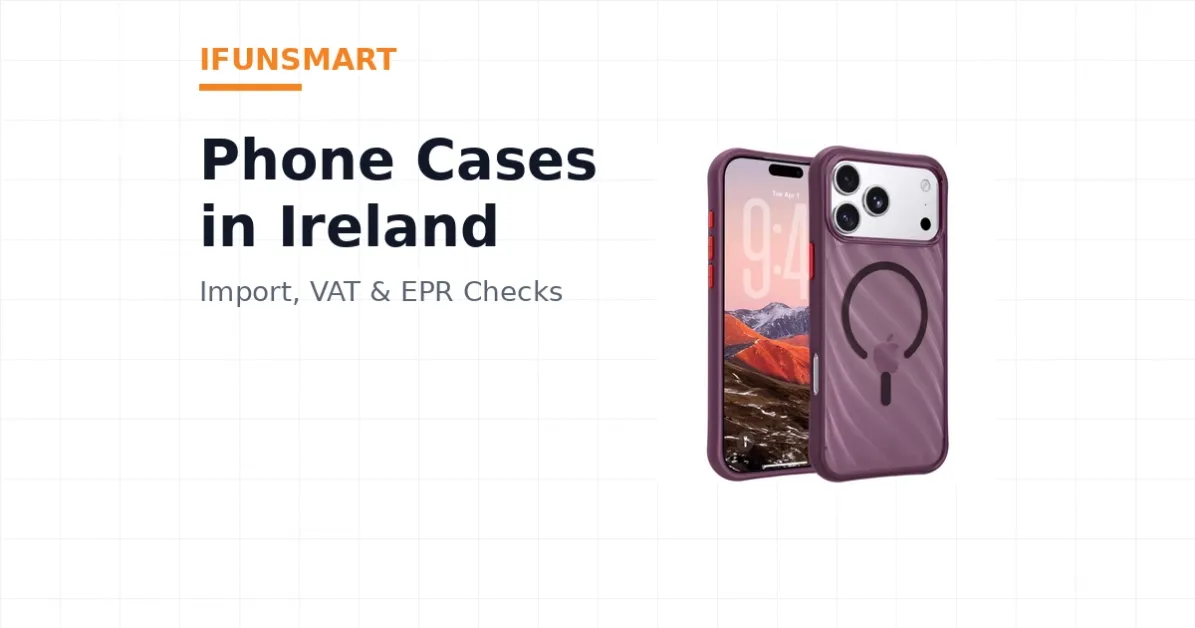
Phone Cases in Ireland: Import, VAT & EPR Checks
Ireland charges 23% import VAT from the first cent and duty of around 6.5%, with Repak packaging EPR — what a distributor checks before the first order, and which styles to stock first.
BLUF
Ireland charges 23% import VAT from the first cent, duty of around 6.5% on plastic phone cases, and packaging EPR through Repak. A distributor's first order needs an EORI, a correct tariff code, and a sample checked on the real phone. The range follows the Apple-first, Samsung-second market.
Short answer
Ireland is an EU member state, so a phone-case shipment from China clears under EU customs and VAT rules, administered in Ireland by the Revenue Commissioners. There is no customs border between Ireland and other EU member states — but there is a real one between China and Ireland, and it is where a first order is won or lost. The three charges a distributor plans for are import VAT at the standard rate of 23%, charged from the first cent; customs duty of around 6.5% on plastic cases under HS 3926 90 97 90 — a TARIC-mirror figure, so confirm it with your broker before you quote on it; and the packaging EPR obligation, which in Ireland runs through Repak, the sole government-approved producer responsibility organisation. The old EUR 150 duty relief is gone — abolished EU-wide on 1 July 2026 — and the EUR 3 flat duty and EUR 2 handling fee that replaced it apply to B2C distance sales only. A distributor importing in bulk was never covered by that relief and pays duty at the normal tariff rate. The paperwork is short but exact: an EORI number, registered through Revenue Online Service first, with the Eircode mandatory; an AIS import declaration; and records kept for three years. On the product side, a plain phone case needs no CE marking and falls outside WEEE, while a battery or LED case is in scope for both; the GPSR has applied since 13 December 2024, and for a Chinese factory with no EU establishment the Irish importer is the EU responsible person. Labelling is in English. The market is Apple first and Samsung second — together around 80% of mobile internet traffic — with iOS and Android splitting roughly 50/50. This guide works through the border cost, how the VAT is actually paid, the paperwork, the EPR, the product rules, and what to stock first for Ireland.
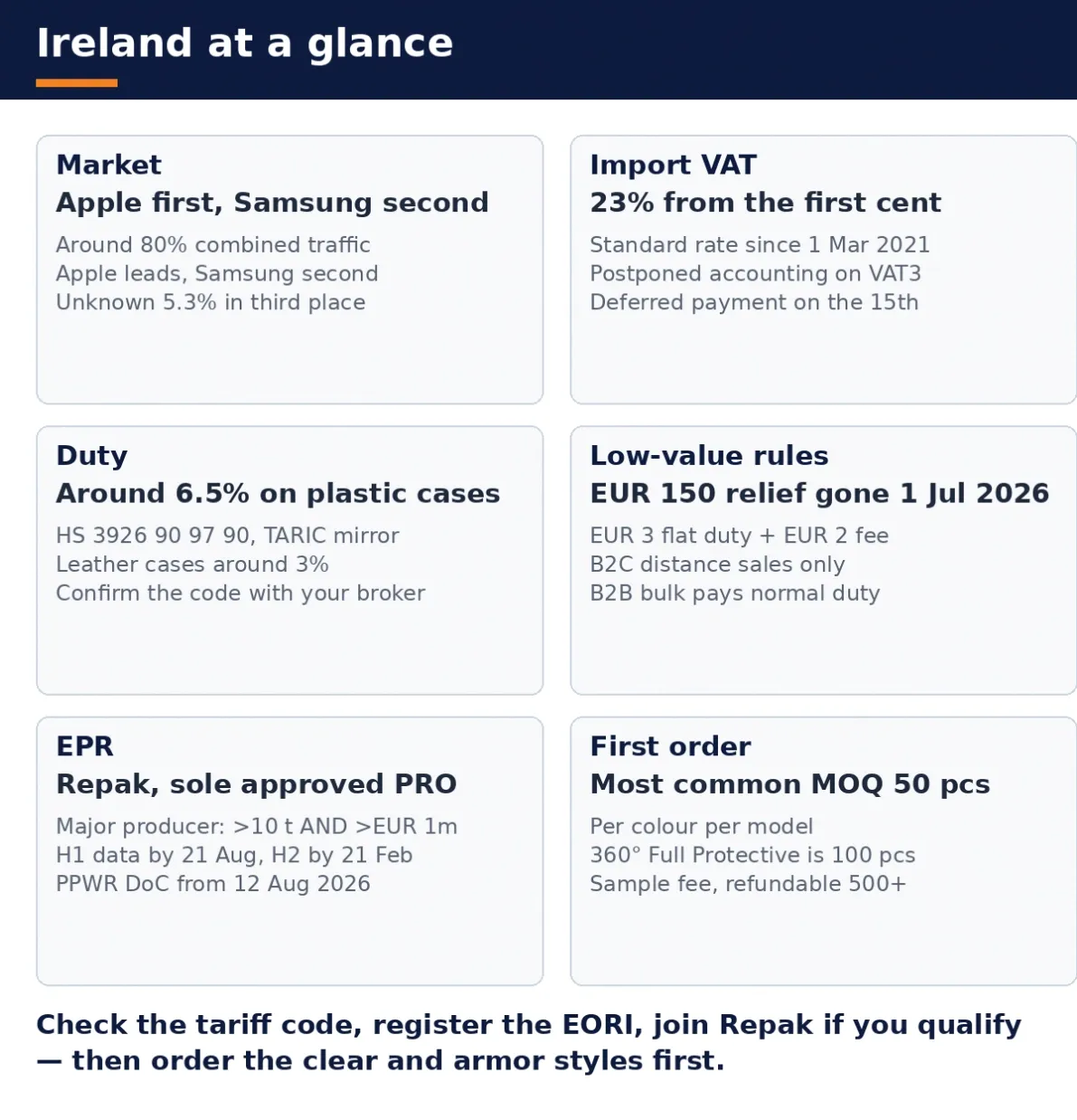
Ireland at a glance
Market: EU member since 1973; Apple leads, Samsung second — around 80% combined (traffic share, not sales)
Import VAT: 23% from the first cent; postponed accounting available for VAT-registered traders
Duty: Around 6.5% on plastic cases (HS 3926 90 97 90, TARIC mirror — confirm with your broker); leather wallet cases around 3% (CN 4202 31 00)
Low-value rules: EUR 150 duty relief abolished 1 Jul 2026; EUR 3 flat duty + EUR 2 handling fee are B2C distance sales only — B2B bulk pays normal duty
EORI: Required; register via Revenue Online Service first, Eircode mandatory; AIS import declaration
EPR: Repak — sole approved PRO; major producer is over 10 t of packaging AND over EUR 1 m turnover
PPWR: Regulation (EU) 2025/40, generally applicable 12 Aug 2026 — Declaration of Conformity + technical documentation
WEEE: Plain cases out of scope; battery/LED cases in — register with Producer Register Limited
GPSR: Regulation (EU) 2023/988, applied 13 Dec 2024 — the Irish importer is the EU responsible person
CE / labelling: No CE marking on plain cases; instructions and safety information in English
MOQ: Most common 50 pcs per colour per model; 360° Full Protective is 100 pcs per colour per model
Sample: Fee charged, refundable on orders of 500+ pcs — ask us to confirm the amount per style in writing
Payment: T/T and Western Union only; 30% deposit for new customers; photos + video + packing list, then balance, then ship
1. What does an Ireland order cost at the border?
Three charges, and only three — import VAT, customs duty, and the packaging EPR cost behind the order. Everything else a distributor pays — the goods, the freight, the inspection — is a commercial cost, not a border charge. This section takes the three border charges in the order they hit the shipment.
Import VAT — 23%, from the first cent. Ireland's standard VAT rate is 23%, in force at that rate since 1 March 2021, and phone cases fall under the standard rate. The reduced rates — 13.50%, 9.00% and 4.80% — cover other goods and services, not phone cases. Import VAT has applied from the first cent since 1 July 2021, when the old EUR 22 VAT exemption was abolished EU-wide. There is no low-value VAT relief left to plan around: a sample parcel and a container both pay import VAT. The import VAT base is the customs (CIF) value plus customs duty plus transport and insurance up to the place the goods enter the EU customs territory. One detail catches buyers out: containers from China often arrive via a continental hub — Rotterdam or Antwerp — then a feeder to Dublin or Cork. The feeder leg sits outside the customs value, so no duty is charged on it, but it is added back into the VAT base. A distributor that prices import VAT on the CIF value alone under-prices it by the feeder leg.
Customs duty — around 6.5% on plastic cases, with a broker caveat. Plain TPU, silicone and PC phone cases classify under HS 3926 90 97 90 — "other articles of plastics, other" — the same EU-wide code used across this series' country guides. The third-country (MFN) duty rate is around 6.5% on the CIF value, according to two independent TARIC mirrors — Tarific (TARIC version 261126, synchronised 26 November 2026) and HTSBase (EU Combined Nomenclature 2026). That "around" matters: the authoritative source is the EU TARIC database itself, where a Binding Tariff Information decision gives legal certainty binding across the EU for three years. A distributor should confirm the 10-digit tariff item with its broker before the first order, and should ask the broker to confirm it in writing — the code decides the duty, and the wrong code is the most expensive mistake in the shipment. Leather wallet and folio cases classify separately, under CN 4202 31 00, at around 3% per the same mirrors — same broker-confirmation caveat. A phone case import Ireland VAT question is really two questions — the VAT rate and the duty code — and both belong on the quotation, with the code stated, not assumed.
The EUR 150 relief is gone — and the replacement charges are B2C only. Until 30 June 2026, consignments with an intrinsic value of EUR 150 or less were exempt from customs duty. From 1 July 2026 that relief is abolished EU-wide under Council Regulation (EU) 2026/382. The replacement is a temporary flat customs duty of EUR 3 per item — per declaration line, per distinct product type, with identical items counting once — on qualifying low-value consignments, running until 1 July 2028, when normal tariff rates under the EU Customs Data Hub are expected to apply. From 1 November 2026 a separate Union handling fee of EUR 2 per item applies as well — permanent, non-refundable, per declaration line, on B2C distance sales of imported goods whatever the value, so it also applies above EUR 150, on top of normal duty. Both charges are part of the taxable amount for VAT, under the Commission's revised VAT guidance of 6 October 2026. Product identifiers became mandatory from 1 November 2026 for low-value distance-sale import declarations — SKU, manufacturer product ID, GTIN/EAN/UPC where one exists. And IOSS does not remove the EUR 3 duty: duty and VAT are separate charges. None of this touches a distributor's bulk order. Business-to-business consignments of EUR 150 or less pay duty at the normal tariff rate instead, under AIS code 1LV. A distributor importing in bulk was never covered by the EUR 150 relief and pays normal duty — the EUR 3 and EUR 2 charges are a B2C e-commerce story, and a buyer that plans a bulk order around them has planned around the wrong rules.
2. How is import VAT actually paid?
Import VAT is not paid at the border by default — for a VAT-registered trader it is accounted for on the return, and the cash only moves if the trader chooses, or fails, to use that route. The choice is the first decision a distributor makes after the EORI, and it is a cash-flow decision, not a compliance one.
Postponed accounting — the usual route. VAT-registered traders can account for import VAT on the VAT3 return instead of paying cash at import, under section 53A of the VAT Consolidation Act 2010, in place since 31 December 2020. It is optional. The import goes into boxes PA1 (customs value plus duty), T1 (VAT due) and T2 (VAT deductible) — and a fully taxable business adds EUR 0.00 net VAT for the import. That is the point: postponed accounting removes the import VAT from the cash-flow calculation entirely, which is why a distributor that imports regularly should set it up before the first shipment, not after the third. Revenue can exclude a trader that fails its compliance tests, with an appeal within 30 days. Postponed accounting covers import VAT only — customs duty, anti-dumping duty and excise are still paid from the Trader Account Number or by deferred payment.
Deferred payment — duty and VAT on the 15th. A deferred payment authorisation lets duty and import VAT be collected on the 15th of the following month — the next working day if the 15th is not one. Revenue requires a bank guarantee for this authorisation, which is a cost to price in and a document to arrange before the shipment, not during it. Cash payment from the Trader Account Number requires credit on the account before the declaration is submitted — a declaration filed against an empty TAN does not clear. A distributor that has neither postponed accounting nor deferred payment pays at the border, in cash, from a funded TAN. All three routes work; the mistake is assuming the border will wait while the paperwork catches up.
IOSS — for the retail side only. The Import One-Stop Shop is an optional EU VAT scheme for B2C distance sales of goods imported from outside the EU in consignments with an intrinsic value of EUR 150 or less, live since 1 July 2021. The seller charges VAT at the destination country's rate at checkout and declares it in a single monthly IOSS return filed in one member state; one IOSS registration covers all 27 member states. Non-EU sellers usually need an EU-established IOSS intermediary to register, and marketplaces often act as deemed supplier with their own IOSS number. It matters to an Ireland phone case distributor only if the buyer also sells direct to Irish consumers in sub-EUR 150 parcels. A B2B bulk import does not use IOSS — the Irish importer clears customs with its EORI and accounts for import VAT, possibly via postponed accounting. A distributor that buys stock wholesale and sells it retail should keep the two flows separate in its own books, because the border treats them as two different things.
3. What paperwork does the first shipment need?
The paperwork for a first Ireland shipment is short: one number, one declaration system, and a representative decision. Short does not mean skippable — the shipment does not clear without all three, and the first two have to be arranged before the goods leave China.
EORI — register through ROS first. An EORI number is required for any economic operator that lodges customs declarations in the EU. Revenue states it is the only number accepted on a customs declaration. One EORI per legal entity, valid across the whole EU. The Ireland route runs through Revenue Online Service first: Revenue requires a ROS registration before applying for an EORI, and the Eircode — the Irish postcode — is mandatory in every EORI registration. The EORI application runs inside ROS; the alternatives are My Enquiries via myAccount, or an agent uploading an agent-link notification letter. A ROS digital certificate is a prerequisite, and the business must be registered for Customs and Excise, or register at the same time. Revenue assigns a Trader Account Number automatically once EORI registration is in place — the TAN is the account that pays duties and VAT on imports. One hygiene point: for a business not established in the EU, Revenue may cancel an EORI unused for six months. A distributor that registers an EORI and then waits a year to order has a number to re-apply for. No EORI processing time was confirmed in the research for this guide — ask Revenue or your agent for the current timing, and do not promise a ship date that depends on it.
AIS — the import declaration system. Revenue's Automated Import System handles import declarations under the Union Customs Code. It launched in November 2020, and Revenue confirmed in October 2021 that all relevant businesses had moved to AIS and new declarations could no longer go through the older system. Before arrival, the carrier files safety and security data in ICS2 — live for sea cargo from 3 June 2024. The importer files the declaration itself, or its agent does. The declarant must be established in the EU customs territory, subject to a waiver Revenue's manual mentions. The representative question should be agreed in writing before the first container: a direct representative acts in the importer's name; an indirect representative acts in its own name and becomes a debtor alongside the importer. An agent must be approved by the AIS eCustoms Helpdesk and hold a ROS digital certificate. All documents from declarations must be retained for three years from the end of the year in which the declaration is accepted.
What the declaration carries — and what it does not. The declaration carries the tariff code, the value, the origin, and the product identifiers where the low-value rules require them. It does not carry the product's safety file — that stays with the importer under the GPSR, in §5. The two systems — customs and product safety — are separate, and a shipment that clears customs is not a shipment that is compliant on the shelf. One more boundary to know: Northern Ireland is a different system. Goods for Belfast clear with HMRC under UK rules, not Revenue. A distributor that serves both Dublin and Belfast from one order needs two clearance plans, not one — the UK guide in this series covers the Belfast side.
4. Packaging EPR: Repak and the PPWR
Packaging is the obligation most first-time importers miss, because it is not a border charge — no one stops the container for it — and it is the obligation that follows the importer home, because the packaging stays in Ireland after the cases sell. In Ireland it runs through one organisation, under one set of rules, and the threshold question is the first one to answer.
Repak — the sole approved PRO. The legal basis is the European Union (Packaging) Regulations 2014 (S.I. No. 282 of 2014) as amended. Policy is overseen by the Department of the Environment, Climate and Communications — now the Minister for Climate, Energy and the Environment — and the EPA and local authorities enforce. A "producer" is any business that places packaging or packaged products on the Irish market — manufacturers, importers, brand owners, distributors, retailers. In practice, for China-to-Ireland trade, the Irish importer is the obligated party for the shipment's packaging. Repak is the sole government-approved Producer Responsibility Organisation in Ireland, re-approved for ten years in early 2026. Most producers fulfil their obligations by joining Repak.
The major-producer threshold — two tests, both must be met. A business becomes a "major producer" when both (a) more than 10 tonnes of packaging is placed on the Irish market per year and (b) turnover is above EUR 1 million. Repak membership has been mandatory for major producers since 1 January 2023. Below either limit, firms still keep records and must register with their local authority, but no Repak fee is due. A phone-case distributor should do the arithmetic early: 10 tonnes of packaging is a lot of cases, but a distributor that also imports chargers, cables and earbuds in retail boxes reaches it faster than a cases-only buyer expects. Repak members file half-year data returns — H1 (January–June) data by 21 August of the same year, H2 (July–December) data by 21 February of the following year — and retain data for six years for EPA and local-authority audits. The local-authority self-compliance route, for producers that do not join Repak, carries its own figures — EUR 15 per tonne, minimum EUR 500, maximum EUR 15,000 — but no Repak fee amount was verified in the research for this guide, and none is stated here. Ask Repak for the current fee schedule in writing before the first order, not after the first audit.
PPWR — the regulation that sits alongside Repak. Regulation (EU) 2025/40, the Packaging and Packaging Waste Regulation, came into force on 11 February 2025 and has been generally applicable since 12 August 2026 across the EU, replacing Directive 94/62/EC. It sits alongside the Irish 2014 Regulations and the Repak system, not instead of them — Repak membership, eco-fee payment and recovery-target funding continue as before. What is new since 12 August 2026: packaging needs an EU Declaration of Conformity and technical documentation — the manufacturer's duty, kept for five years for single-use packaging and ten years for reusable packaging — plus substance restrictions under Article 5, and manufacturer identification on the packaging or via a QR code or data carrier. Harmonised EU labelling of material composition follows from 12 August 2028, or 24 months after the implementing act if later. The practical point for a distributor: ask the Chinese factory for the PPWR Declaration of Conformity and technical documentation for the retail packaging, and keep it on file — the Irish importer holds it, not the factory. One point is genuinely unsettled: whether a non-EU producer selling directly to Irish end users must appoint an Ireland-established authorised representative under PPWR Article 45(3). Two compliance sources disagree on the threshold, and a Commission proposal from December 2025 that would suspend the requirement for EU-established producers until 2035 has not been adopted. Confirm the current position with Repak or a compliance adviser before stating a flat rule. Ireland's Re-turn deposit-return scheme — 15c on PET bottles and cans of 150–500 ml, 25c above 500 ml up to 3 litres, running since 1 February 2024 — does not apply to phone cases or their packaging, and is mentioned here only so no one confuses it with packaging EPR.
5. WEEE, GPSR and CE: what a plain case does and does not need
This is the section where most first-time importers either over-comply or under-comply, and both cost money. A plain phone case is a simple product under EU law: it needs no CE marking, it falls outside WEEE, and it is covered by the GPSR. A case with electronics in it is a different product, with different obligations. The line between the two is the electronics, not the price or the brand.
WEEE — plain cases out, battery and LED cases in. The legal basis is the EU WEEE Directive 2012/19/EU, transposed in Ireland (S.I. No. 149/2014, as amended; earlier S.I. No. 355/2011). Scope has been open since 15 August 2018, covering six WEEE Directive categories, and Ireland's framework covers equipment "dependent on electric currents or electromagnetic fields to operate". A plain phone case — TPU, silicone, PC or leather, with no electronics — is not electrical equipment and falls outside WEEE scope. A case only enters WEEE scope when it contains electrical or electronic functions — a battery case, a case with LEDs, charging electronics or wireless features. The same split applies to the EU Batteries Regulation (EU) 2023/1542 for built-in batteries. If a case is in scope, the producer or importer must register with Producer Register Limited — Ireland's national registration body — before placing the first unit on the Irish market. There is no de minimis threshold. Producers register every year and report the products they place on the market. Selling to households means joining one of the approved compliance schemes, WEEE Ireland or ERP Ireland, with a financial guarantee for household equipment — scheme participation, recycling insurance, or a blocked bank account. Selling only to businesses means a three-year waste management plan through the EPA plus an annual report. Distance sellers into Ireland appoint an Irish-established authorised representative by written mandate, and the representative registers with PRL and joins a compliance scheme on the producer's behalf. Batteries add a second registration: a battery producer — anyone importing batteries for placement on the Irish market — must register with PRL by 31 January every year, then either join a compliance scheme or self-comply. The Batteries Regulation applies from 18 February 2024, and its conformity-assessment rules — behind the CE mark on a battery — have applied since 18 August 2024. A distributor that stocks only plain cases has no WEEE registration to do. A distributor that adds one battery case to the range has a registration to do before the first unit sells — the scope follows the product, not the order.
GPSR — the safety net, applied since 13 December 2024. Regulation (EU) 2023/988, the General Product Safety Regulation, was adopted on 10 May 2023 and has applied since 13 December 2024, replacing the General Product Safety Directive 2001/95/EC. It is the safety net for consumer products with no sector-specific EU legislation — plain phone cases are covered by it. The importer duties, under Article 11, are the ones that matter to a distributor: before placing a product on the market, verify the manufacturer carried out its duties — internal risk analysis plus technical documentation, and product identification; put the importer's own name, trade name or trademark and postal and electronic address on the product, or on the packaging or an accompanying document if that is not possible; ensure instructions and safety information accompany the product in a language easily understood by consumers in the member state of sale; keep technical documentation available to market surveillance authorities; keep a register of complaints, recalls and non-compliant products; take corrective action — withdrawal or recall — and notify through the Safety Business Gateway when a product presents a risk; and cooperate with the authorities. The EU responsible person, under Article 16, is the economic operator established in the EU who is responsible for the tasks in Article 4(3) of Regulation (EU) 2019/1020 — in order: the EU manufacturer, the authorised representative, the importer, or the EU fulfilment service provider. For a Chinese factory with no EU establishment, the Irish importer is the responsible person. The manufacturer duties, under Article 9, are the factory's side: internal risk analysis and technical documentation kept for ten years; a type, batch or serial number on the product; the manufacturer's name and postal and electronic address on the product where possible; instructions and safety information in a language set by the member state; publicly accessible communication channels for consumers; and an internal register of complaints, recalls and corrective measures. Market surveillance in Ireland sits with the CCPC — the Competition and Consumer Protection Commission. Two things this guide does not do: it does not certify the factory — GPSR is a regulation, not a certificate, and iFunSmart holds no GPSR certification — and it does not give legal advice. The Commission's GPSR Guidelines, published in November 2025, are guidance, not legally binding. A distributor that wants certainty should ask its compliance adviser, not its supplier.
CE marking — not for plain cases. A plain plastic, silicone or TPU phone case with no electronics needs no CE marking. CE marking follows from matching the product against directives one at a time, and a plain case has no drive, no electronics and no live parts, so the Machinery Directive, the EMC Directive, the Low Voltage Directive and the RoHS Directive do not reach it. CE marking is required when the case has electronics — LEDs, a battery, speakers, charging features, wireless or NFC functions. Then an EU Declaration of Conformity is needed covering every applicable directive — RoHS, EMC, RED and LVD as applicable — and a battery case must also carry the CE mark, the crossed-out bin symbol and the required battery labelling under the Batteries Regulation. Do not put a CE mark on a plain case just because a buyer asks: a CE declaration for a product outside every directive has no legal hook and becomes a liability. The REACH position, for completeness: GPSR-adjacent chemical rules apply to plain cases — REACH SVHC limits at the 0.1% threshold, with SCIP notification where applicable, and the POPs Regulation. iFunSmart does not claim REACH, RoHS or GPSR certification for itself. A buyer that wants material or test documentation should ask the factory for it in writing.
Labelling — English, and both names on it. The GPSR requires instructions and safety information in a language easily understood by consumers in the member state of sale — for Ireland that means English, the language of commerce and consumer information. The manufacturer name and postal and electronic addresses must appear on the product, its packaging, or an accompanying document — on the product where possible. Importer details are added alongside the manufacturer's, never instead of them. Both a postal and an electronic address are required. No Irish national packaging sorting label was found in the research for this guide — unlike France's Triman — and none is claimed here; confirm the labelling position with a compliance adviser before printing a run. Custom packaging is available from the factory — ask us to confirm the packaging options and the packaging MOQ per style in writing — and a custom box is the place where the agreed English text, the manufacturer details and the importer details all sit together.
6. What to stock first for Ireland
The range follows the market, and the market in Ireland is Apple first and Samsung second. Apple leads and Samsung is second in mobile internet traffic, and together the two account for around 80% of it — a traffic share, not a sales share, measured from January to early August 2026 — with the gap between them narrower in Ireland than in the UK. Third place belongs to the “Unknown” category at 5.3%. iOS and Android split the market roughly 50/50. The mobile subscriber base grew by 73,000, up 1.3%, in 2025. That is the whole stocking argument for wholesale phone cases in Ireland: an Ireland range that is deep on iPhone and Samsung, and thin on everything else, is a range that matches the market. A distributor that buys the same depth across five brands has bought dead stock in three of them.
The channels — and who buys from them. The buyers in Ireland are phone shops, repair shops, petrol-station and convenience stores, gift shops and online sellers, buying phone accessories from China in small mixed quantities and adding their own brand — and Amazon.ie is a named online channel. That mix shapes the first order: small mixed quantities, own-brand packaging, and a range that sells through a shop counter, not a warehouse pallet. No population figure and no online-shopping share are stated in this guide — neither was verified in the research — and no retail chain is named as a channel, because none was verified as selling phone cases in Ireland.
The first-order list — eleven styles, all live pages. Every style below is on a live ifunsmart.com product page, fetched and checked on 27 November 2026 — 72 pages, no errors, no missing pages. Every page states “Support Logo Customization & Custom Packaging” and “Custom logo, colour and packaging available (OEM/ODM)”. Ten of the eleven are at the most common MOQ of 50 pcs per colour per model; the 360° Full Protective is 100. One leather wallet line is deliberately left out of the list below: its catalogue MOQ and its page MOQ disagree, and the factory has not confirmed which is correct — ask us, and do not order it on a guessed MOQ.
- Clear MagSafe, iPhone 17 and Samsung — 12FT Drop Clear MagSafe Case. 2.5 mm composite plate plus 2.5 mm TPU bumper, metal buttons, lens guard. The clear case is the first style for Ireland because it shows the phone — and the phones Irish buyers hold are overwhelmingly iPhone and Samsung.
- Armor, iPhone 18 Pro Max — Premium MagSafe Armor Case. Thickened anti-scratch PC backplane plus thickened TPU bumper, metal buttons, heavy-duty protection. The rugged end of the range, for the buyer that wants one tough case in the line.
- Leather wallet, iPhone 18 Pro — Microfiber Leather Wallet Case. PU leather with a soft TPU inner shell and microfiber lining, magnetic flip cover. The wallet style for the iPhone buyer that wants card storage with the case.
- Silky Touch MagSafe, iPhone 17 and Samsung — hybrid PC plus TPU, with the page itself stating a flexible 50-pc MOQ. The soft-touch style for the buyer that wants a skin-feel case across both brands.
- 360° Full Protective MagSafe with built-in screen protector, iPhone 17, Translucent Matte — PC plus TPU plus PET screen protector. MOQ 100 pcs per colour per model — the only style in this list above 50, stated here so no one orders it at 50.
- Ring stand, iPhone 18 Pro Max — Airbag Ring Stand MagSafe Case. Airbag frame, 360-degree rotating ring stand, built-in magnet ring. The stand style for the buyer that wants hands-free viewing in the line.
- Card holder, iPhone 17 and Samsung — RFID Blocking Clear Card Holder Case. Crystal-clear hard PC plus soft TPU bumper plus metal shaft, with a metal stand. The card-carrying clear case, for the buyer that wants storage without a wallet cover.
- Velvet MagSafe with metal camera frame — textured PC plus velvet interior, raised metal camera frame, five textures and six colours per texture. The premium-feel style for the buyer that wants a texture story on the shelf.
- 2700GS Magnetic Case, iPhone 18 Pro and Pro Max — frosted PC back, flexible TPU bumper, raised metal camera frame, 2700 Gauss N52 magnet — the confirmed factory figure, stated per style and never as a blanket figure for the range.
- Leather wallet, Samsung Galaxy A27 / A37 / A57 — textured PU leather cover with a flexible TPU inner shell. The Samsung wallet, for the buyer that wants the second brand covered in the same style family.
- Star Grid R2 Heat-Dissipating Case, iPhone 18 Pro Max — magnetic 360-degree ring stand, detachable camera lens cover. The heat-dissipating style, for the buyer that wants a technical story in the range.
The first order — how it is built. A buyer that wants to buy phone cases in bulk in Ireland starts with a trial-sized first order: three or four styles in two or three colours each, at the most common MOQ of 50 pcs per colour per model — not a bulk order. An order is built line by line: one line is one model, one style and one colour. Bulk and distributor terms start at 500 pcs per order in total, and that is the second order, not the first: it is the order a buyer places when the first order has sold, the colours are proven, and the next styles have been confirmed. An iPhone case wholesale Ireland order should lead with the clear MagSafe and the armor, because those are the two styles that sell to the most buyers. A Samsung phone case distributor order in Ireland should lead with the Silky Touch and the A-series leather wallet, because those cover the second brand in two different styles. A custom logo phone case Ireland order starts with the logo trial: a 100-pc trial order can carry a logo by laser engraving — laser is permanent, silk-screen fades and needs a higher MOQ — and the per-piece charge is confirmed in writing per order; this guide states no figure, because the figure is confirmed per order. Four print methods are confirmed for phone cases in this series: UV printing, IMD, silk screening and heat transfer. The buyer sends the logo artwork at the start — an AI or PDF file, or a high-resolution image — plus the brand colours, the logo size and the logo position, and whether the logo needs authorisation. A sample fee is charged, refundable on orders of 500+ pcs — ask us to confirm the amount per style in writing. Payment is T/T and Western Union only, with a 30% deposit for new customers, photos and video and the packing list after the goods are ready, then the balance, then the goods ship. Ask for the current production window in writing on the quote — no day figure in this guide, because no day figure was verified.