Business Solutions
AirPods & Earbuds Cases: What Distributors Order First
AirPods Pro 2 cases do not fit Pro 3 — the new case is larger. What distributors should order first, which models to confirm in writing, and how to build an earbuds order around one verified style.
BLUF
AirPods Pro 2 cases do not fit AirPods Pro 3 — Apple's new case is larger. Order the Pro 2 style we hold, confirm every other model in writing before you pay, and build the order on colours, not on a model we have not tooled.
Short answer
An earbuds case is a fit product before it is a fashion product: the charging case it protects changed size between generations, and a case made for the wrong generation does not close, does not charge and does not sell. AirPods Pro 3, announced 9 September 2025 and on sale 19 September 2025, ships in a charging case that measures 47.2 by 62.2 by 21.8 millimetres — about 2 millimetres taller and 1.6 millimetres wider than the AirPods Pro 2 case it replaces. A hard-shell Pro 2 case will not close cleanly on it, and the cutouts for the speaker, the lanyard loop and the charging port will not line up. That single fact decides the first order: buy the Pro 2 style that exists on a live product page, in the colours your shops move, and confirm every other model — Pro 3, AirPods 4, AirPods 5 — in writing before you pay a deposit. The six sections below work through the fit break, the one verified style, the models your customers actually own now, the material choice, the sample checks and the first-order paperwork. Every figure in this guide comes from Apple's own published specifications or from a live iFunSmart product page read on 26 November 2026, and every model we do not hold is marked as one to confirm in writing, not stated as stock.
AirPods cases at a glance
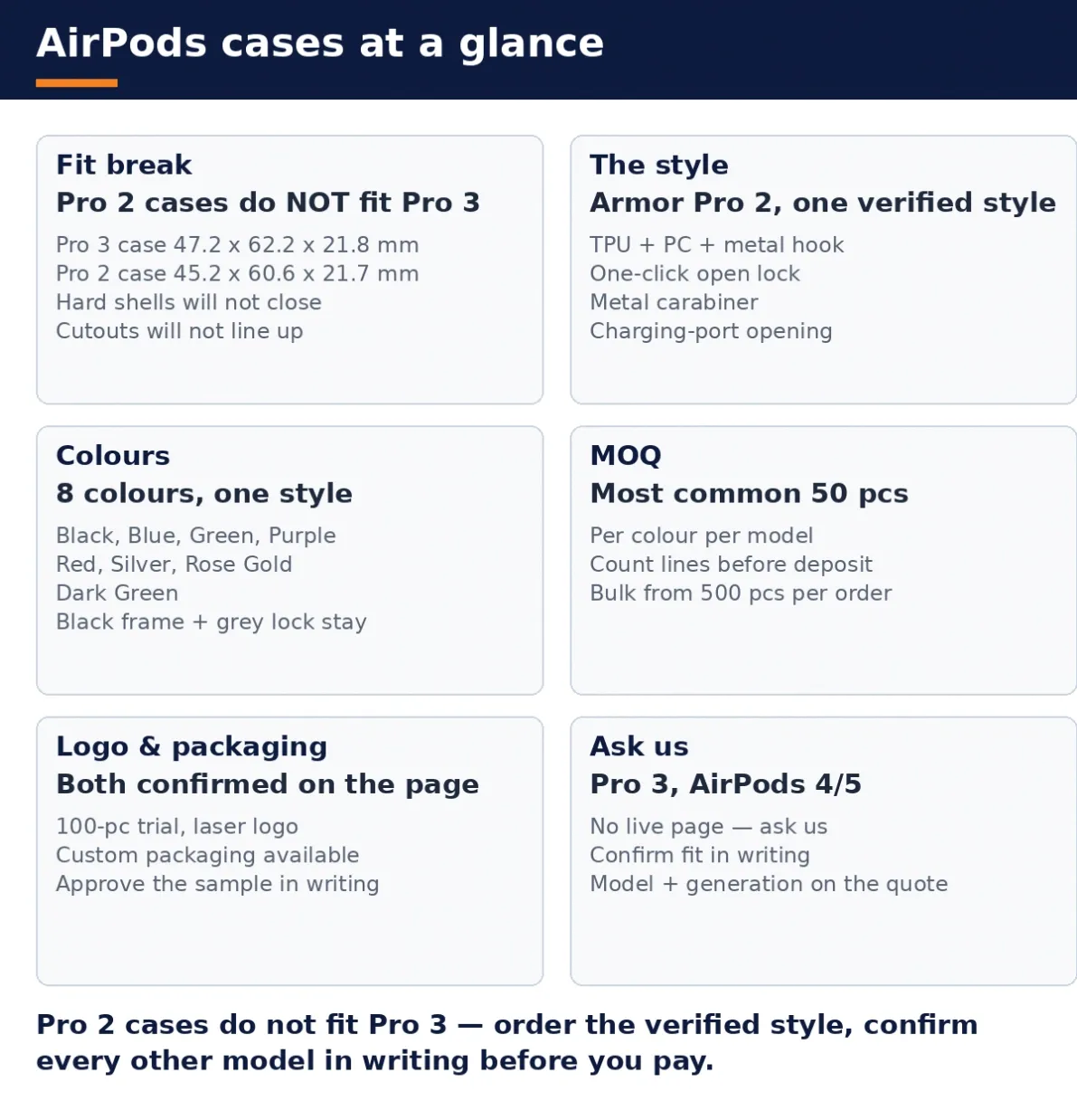
Check | What we hold | What to do |
|---|---|---|
Exact-model fit | AirPods Pro 2 only, on a live page | Pro 3, AirPods 4/5: ask us, confirm in writing |
The style | Armor Shockproof, TPU + PC + metal hook | One-click lock, carabiner, charging-port opening |
Colours | 8: Black, Blue, Green, Purple, Red, Silver, Rose Gold, Dark Green | Order the colours your shops move |
MOQ | Most common 50 pcs per colour per model | Count lines before the deposit |
Bulk threshold | 500 pcs per order in total | One order, one PI, one freight |
Logo & packaging | Logo customisation + custom packaging confirmed | 100-pc trial order can carry a laser-engraved logo |
Sample | Fee charged, refundable on orders of 500+ pcs | Approve the sample in writing before the bulk order |
Payment | T/T and Western Union only, 30% deposit for new customers | Photos + video + packing list, then balance, then ship |
1. Will an AirPods Pro 2 case fit the AirPods Pro 3?
No — and this is the first question to settle, because it is the mistake that costs a distributor a whole order. The AirPods Pro 3 charging case is larger than the AirPods Pro 2 case in every dimension Apple publishes: 47.2 millimetres high, 62.2 millimetres wide and 21.8 millimetres deep, against 45.2 by 60.6 by 21.7 millimetres for the Pro 2 case. Two millimetres of height and 1.6 millimetres of width sound small until they meet a hard shell: a rigid TPU and PC case moulded for the Pro 2 will not close cleanly on the Pro 3 case, the lid will sit proud or gap at the hinge, and the one-click lock — the feature that keeps the lid shut in a bag — will not engage the way it was designed to. A flexible silicone sleeve may stretch over the larger case, but the cutouts will still be wrong: the speaker grille, the lanyard loop and the USB-C charging port sit in different places, so a stretched case covers the wrong holes and leaves the right ones blocked. The Pro 3 earbuds themselves cannot be charged in an older case either, so there is no workaround in which the old case serves the new earbuds. "AirPods Pro" on a listing is not a model — it is a family name that now spans two incompatible case sizes, and a quote that does not name the generation is a quote that cannot be checked.
What this means for the order. The Pro 3 is the current flagship in-ear model and the one your customers are buying now, which is exactly why the fit question matters: a distributor who orders Pro 2 cases for Pro 3 customers has bought dead stock. The honest position is the one this guide takes throughout: we hold one verified AirPods style, for the Pro 2, and every other model is a question to confirm in writing before the deposit — not a line on the quote. Ask for the model name, the generation and the case dimensions on the quote, per style, and ask the factory to confirm the fit against the Apple specification for that generation. A supplier who answers "universal fit" or "fits all AirPods Pro" has not measured anything, and a supplier who cannot name the generation its mould was cut for has not cut a mould for your model at all.
What to ask. Ask, in writing, which AirPods generation each style fits, and ask for the case dimensions the mould was cut to. Ask whether the style is a hard shell or a flexible sleeve, because a hard shell that is 2 millimetres short will not close and a sleeve that stretches will misalign the cutouts. And ask for the fit to be confirmed against the Apple specification for that generation — Pro 3 at 47.2 by 62.2 by 21.8 millimetres, Pro 2 at 45.2 by 60.6 by 21.7 millimetres — before the sample is made, not after the bulk order lands.
2. What should a distributor order first?
The one verified style, in the colours your shops move, at the most common MOQ of 50 pcs per colour per model. That is the whole of the first order — and it is enough, because the range is honest about what it is: a single Armor style for the AirPods Pro 2, in eight colours, with a metal carabiner and a one-click lock, and logo customisation and custom packaging confirmed on the live product page. The ranking below is not a choice between five styles. It is a choice between eight colours of one style, and the distributor's job is to decide how deep to go on each colour, not which style to bet on.
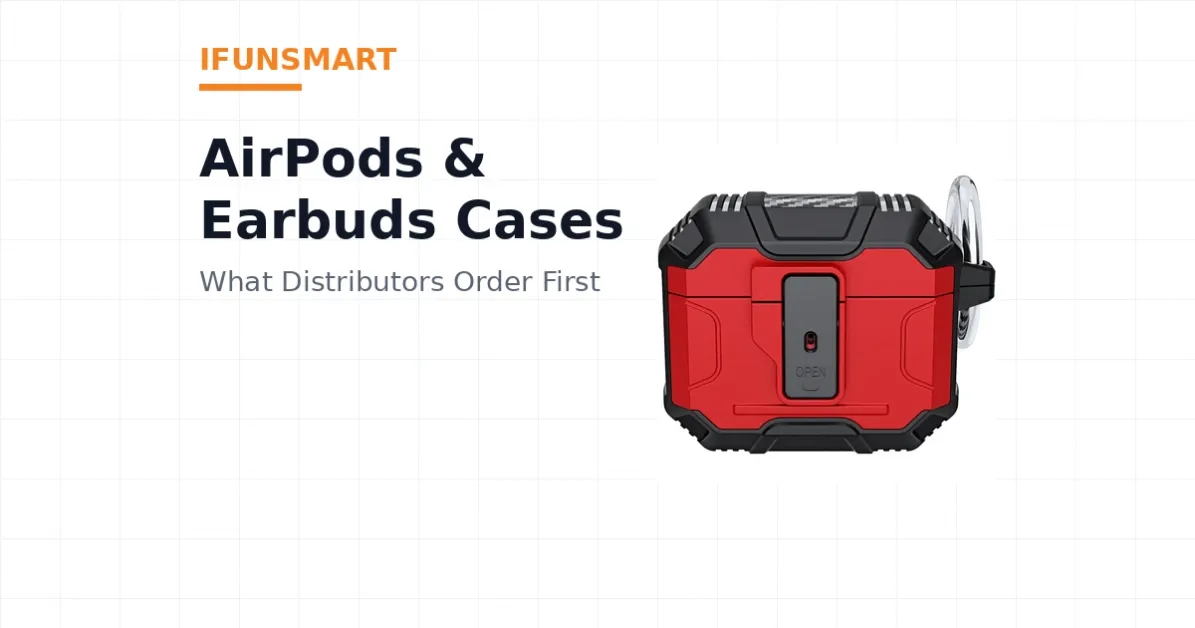
The style itself. The Armor Shockproof AirPods Pro 2 Case is a two-piece lid-and-base shell in TPU and PC with a metal hook — a rugged build, not a slim sleeve. The armor corners are the protection story, stated qualitatively on the page: no drop-test height is claimed, and this guide claims none either. The one-click open lock is a central grey lock, moulded with the word OPEN, that opens the lid with one press and keeps it closed in a bag — the feature that stops the case opening in transit and the earbuds falling out. The large silver metal carabiner clips to a bag, a belt or a keychain, which is the feature that makes the case a carry product rather than a pocket product: it hangs where the customer can see it, and it sells where the customer can see it. The charging-port opening at the bottom is cut for the USB-C case, and the carbon-fibre textured trim is the finish detail that separates it from a plain shell. The black armor frame and the grey lock stay the same on every colour, so the colour is the variable and the build is constant — which is what makes an eight-colour order manageable: one style, one fit check, eight colour lines.
The colours. Eight colours are listed on the page: Black, Blue, Green, Purple, Red, Silver, Rose Gold and Dark Green. The first order does not need all eight. It needs the colours your shops move, and the honest way to decide is to ask your shops — or, if this is a first order with a new channel, to start with the colours that sell in every market and add the rest on the reorder. Black is the safe depth colour in every market: it matches every bag, every phone and every outfit, and it is the colour a shop reaches for when a customer asks for "just a case". Red and Blue are the visible colours — the ones that show up on a pegboard and on a shelf, and the ones a shop sells to a customer who wants the case to be seen. Silver and Rose Gold are the premium colours, the ones that sit next to the phone itself. Purple and Dark Green are the fashion colours: they sell well in a season and slowly out of it, so they deserve breadth — a line on the order — rather than depth. Green is already on the site as the cover product of an earlier guide, which is a reminder that the colour exists and sells; it is also a reminder not to order a colour because it photographs well. The MOQ is 50 pcs per colour per model, so each colour is a line of 50 — and eight colours is 400 pcs before a single style is repeated. Count the lines before the deposit, because the bulk threshold of 500 pcs per order in total is reached by the colours, not by the styles.
What to ask. Ask for the per-line MOQ in writing, counted line by line, before the deposit — because an eight-colour first order is eight lines at 50 pcs, and a distributor who counts it as one order of 400 pcs has not counted it at all. Ask which colours your shops actually move, and build the first order from that list. And ask for the sample in the colours you intend to order, not in one colour only, because a colour that looks right on a screen can look wrong on the shelf — the batch tolerance is even, but the colour is the thing the customer sees first.
3. Which AirPods models are your customers actually buying now?
Three models are current, one is the installed base, and one is not a case product at all — and the first order has to be built on that map, not on the assumption that every AirPods owner needs the same case. Apple sells four AirPods models new as of November 2026: the AirPods 5, the AirPods 5 with Wireless Charging Case, the AirPods Pro 3 and the AirPods Max 2. The Pro 2, announced 7 September 2022 and on sale 23 September 2022, with a USB-C version on sale 22 September 2023, has been replaced by the Pro 3 — but replacement is not disappearance. Millions of Pro 2 earbuds are still in daily use, and their owners still need cases, still lose cases and still buy cases. The Pro 2 is the installed base, and the installed base is the reason a Pro 2 case still sells after the model itself has been replaced.
The current models, in order. The AirPods Pro 3 is the flagship in-ear model: announced 9 September 2025, on sale 19 September 2025, with a heart-rate sensor in the earbuds, live translation through Apple Intelligence, twice the noise cancellation Apple claims over the Pro 2, and an IP57 rating on the earbuds and the case. It is the model your customers are buying now, and it is the model we do not hold a case for on a live page — ask us for the full model list and confirm the fit in writing before you order for it. The AirPods 5, announced 9 September 2026 and on sale 18 September 2026, is the current entry model: active noise cancellation is standard on both variants, the case is 46.2 by 50.1 by 21.2 millimetres, and the two variants — a USB-C case and a wireless-charging case — do not mix: each case works only with its own earbuds. The AirPods 4, announced 9 September 2024 in two variants, was discontinued on 9 September 2026 when the AirPods 5 replaced it — its owners are still buying cases, but it is a replacement market now, not a launch market. The AirPods Max 2, announced 16 March 2026 and shipped in early April 2026, is an over-ear headphone with a Smart Case included — it is not an earbuds case product, and this guide promises no hard case for it. And the AirPods Pro 4 has not been announced as of October 2026: any guide that lists a Pro 4 case is listing a rumour, and this guide does not.
What this means for the order. A distributor's earbuds-case range is really two ranges: the current-model range, which follows the launch calendar, and the installed-base range, which follows the earbuds people already own. The Pro 2 case we hold belongs to the second range, and it is a real range: the Pro 2 sold for three years, across two case generations, and its owners are still replacing cases. The Pro 3 and AirPods 5 ranges belong to the first range, and they are the ranges to ask about — with the model, the generation and the case dimensions on the quote, in writing, before the deposit. Do not order a Pro 3 case from a listing that does not name the generation, and do not order an AirPods 5 case from a supplier who cannot tell you which of the two AirPods 5 variants it fits.
What to ask. Ask your shops which models their customers actually own, not which models Apple sells now — the two lists are different, and the first order should follow the shops. Ask for the full model list in writing, with the generation and the case dimensions for each style. And ask, for every model except the Pro 2, whether the style is tooled, sampled or only planned — because "we can make it" and "we hold the mould" are two different answers, and only the second one belongs on a quote.
4. Silicone or hybrid TPU and PC — which survives a distributor's shelf?
The material question is the second question a distributor asks after fit, and it is a question with a real answer — but only if it is asked about the case in front of you, not about materials in general. A silicone case is a single soft sleeve: it grips the charging case, it stretches over a slightly larger case, and it shows wear first at the edges, where it is handled every day. A hybrid TPU and PC case is two materials doing two jobs: the TPU bumper absorbs the knock, the PC back holds the shape and carries the finish. The style we hold is the hybrid — TPU and PC with a metal hook — and the choice it embodies is the choice between a case that stretches and a case that holds its shape. A hard shell that holds its shape is the right choice for a distributor's shelf, because a case that holds its shape looks the same on the last day of the season as it did on the first, and a case that stretches looks tired before it is sold.
What the hybrid buys you. The armor corners are the protection story, and they are stated qualitatively: the page calls the case shockproof and says nothing about a drop height, and this guide says nothing either — a drop-test figure belongs on a test report, not in a guide, and a distributor who wants one should ask for the report in writing. What the hybrid does buy, on the page and on the bench, is a lid that closes the same way every time, a lock that engages the same way every time, and a carabiner that carries the same weight every time. The carbon-fibre textured trim is the finish: it hides the scuffs that a plain gloss back would show, which matters for a case that is handled in a shop before it is bought. The charging-port opening is cut for the USB-C case, so the case does not have to come off to charge — a small detail that decides whether a customer keeps the case on, and a case that stays on is a case that does not get returned.
What to check on the material. The material choice is only as good as the sample that proves it, and the sample checks are in section 5. Two things to settle in writing before the sample: whether the style is a hard shell or a flexible sleeve, because the two behave differently on a case that is 2 millimetres larger than the mould; and whether the page's material claim — TPU and PC with a metal hook — is the material of the style you are ordering, not of a different style in the same listing. A listing that shows five materials and quotes one is a listing that has not been read.
What to ask. Ask for the material specification per style, in writing, and ask whether the style is a hard shell or a flexible sleeve. Ask what the finish is — the carbon-fibre trim on this style is a texture, not a material — and ask whether the finish is the same across all eight colours, because a colour that changes the finish changes the product. And ask for the test report in writing if you want a drop figure: a guide that invents one is worse than a guide that says "ask us".
5. What should the sample prove before the bulk order?
Everything the listing claims, on the bench, in the colours you intend to order — and nothing the listing does not claim. A sample is not a formality. It is the one chance to find out, before 400 or 500 cases are on the water, whether the case fits the phone's earbuds, closes the way it should, and looks the way your shops will sell it. The checks below are factory checks, not consumer anecdotes: they are done on the bench, on the sample, with the case in hand — not by wearing the case in a pocket or dropping it on a road.
The fit checks. Seat the Pro 2 charging case in the shell and close the lid: it should seat fully, with no gap at any corner, and the lid should close flush, with no lift at the hinge. Press the one-click lock: it should open the lid with one press and hold it shut when closed — the lock is the feature that keeps the earbuds inside the case in a bag, and a lock that does not engage is a case that does not work. Check the charging-port opening against the USB-C port: the opening should line up with the port, not cover it, and the case should charge with the shell on. Check the speaker grille and the lanyard loop on the Pro 2 case: neither should be covered by the shell, because a covered speaker mutes the Find My chirp and a covered loop is a loop that cannot be used. Check the carabiner: clip it to a bag strap and tug it — it should hold, and the metal hook should not flex. These are the checks that decide whether the case works. Do them on the sample, in writing, with the sample reference, the model, the style and the colours stated.
The finish checks. Check the parting lines: they should be clean, with no flash and no sharp edge where the two halves of the mould met. Check the coating adhesion on the trim: the carbon-fibre texture should be even across the back, with no lifting at the edges. Check the batch tolerance across the colours you ordered: the red sample and the black sample should be the same shell, the same lock and the same carabiner, in different colours — not different shells in different colours. Check the colour itself against the page: the eight colours on the page are Black, Blue, Green, Purple, Red, Silver, Rose Gold and Dark Green, and the black armor frame and the grey lock stay the same on every colour — if a sample arrives with a different frame colour, it is a different product, and it should be flagged before the bulk order, not after. Check the moulded OPEN on the lock: it is part of the product, not a defect, and it should read cleanly on every sample.
What to ask. Ask for the sample in the colours you intend to order, not in one colour only, and ask for the sample fee in writing — samples carry a fee that is refundable on orders of 500+ pcs, and the amount is confirmed per style. Approve the sample in writing, with the sample reference, the model, the style, the colours and the logo method stated. And ask what happens if the sample fails: the answer should be a revised sample, not a bulk order with a note.
6. How do logo, packaging and payment work on a first earbuds order?
The same way they work on a phone-case order — and the earbuds case is a good first order precisely because it is a small, simple version of the same process. The product page confirms both customisations for this style: logo customisation and custom packaging are both supported. A 100-pc trial order can already carry a logo by laser engraving — laser is permanent, where silk-screen fades and needs a higher MOQ — and the per-piece charge and the artwork position are confirmed in writing on the quote, not assumed. The trial order is the way a distributor tests a new channel without committing to a bulk run: 100 pieces, one colour, one logo, one packaging, and a sample approved in writing first.
The packaging. An earbuds case is small, light and easy to lose on a shelf — which is why the packaging matters more than it looks. The carabiner is the display feature: a case that hangs from a pegboard sells itself, and a case in a plain polybag does not. Ask for the retail packaging in writing — whether the box carries the logo, whether the hang tab fits your pegboard, and whether the packaging weight per shipment is stated, because the packaging is part of the landed cost and part of the EPR answer in the markets this series already covers. Custom packaging is confirmed on the page for this style; the dieline, the barcode and the artwork position are agreed before the bulk order, not after the goods ship.
The payment and the shipment. Payment is T/T and Western Union only. New customers may pay a 30% deposit first. After the goods are ready, the factory sends photos and video and the packing list; the customer pays the balance, then the goods ship. The packing list must match the invoice line by line — same model, same style, same colours, same quantities — because an earbuds order is eight colour lines at 50 pcs, and a packing list that does not match the invoice is a shipment that waits at the port. Ask for the current production window in writing on the quote — no day figure in this guide, because no day figure was verified — and ask which documents travel with the goods and which your broker must arrange.
What to ask. Ask for the logo method, the per-piece charge and the artwork position in writing, and ask whether the 100-pc trial order is available for this style. Ask for the packaging specification — the box, the hang tab, the barcode — before the bulk order. And ask for the payment terms on the quote: T/T and Western Union only, 30% deposit for new customers, photos and video and the packing list after the goods are ready, then the balance, then the goods ship.
7. What are the red flags before you pay?
Four red flags, and each one is a reason to stop and ask, not a reason to argue. The first is the "universal fit" claim: a listing that says one case fits all AirPods Pro, or all AirPods, has not measured anything — the Pro 2 and Pro 3 cases differ by 2 millimetres in height and 1.6 millimetres in width, and a case that fits both does not exist as a hard shell. The second is a Pro 3 case with no dimensions on the quote: a supplier who cannot state the case dimensions its mould was cut to has not cut a mould for the Pro 3, and a Pro 3 order from that supplier is an order for a sample that does not exist yet. The third is a price far below the quote breakdown: a quote that shows no line items — no material, no colour count, no logo charge, no packaging — cannot be checked, and a price that is far below every other quote is a price that has left something out. The fourth is a sample that does not match the bulk: a sample in one colour and one finish, followed by a bulk order in eight colours and a different finish, is not a sample at all — it is a photograph. Ask for the sample in the colours you intend to order, and compare the bulk delivery against the approved sample, line by line, before the balance is paid.
Two more checks that cost nothing. Ask for the factory address and the mould list in writing — a factory that can name its moulds can name your model, and a supplier that cannot name either is a trader, not a factory. And ask for the payment terms in writing before the deposit: T/T and Western Union only, 30% deposit for new customers, photos and video and the packing list after the goods are ready, then the balance, then the goods ship. A supplier who asks for a large upfront payment beyond the 30% deposit, or who asks for payment by a method that is not on that list, is asking for something the factory does not ask for — and that is a reason to stop, not to negotiate.
What to ask. Ask for the model, the generation and the case dimensions on the quote, per style. Ask for the factory address and the mould list. Ask for the sample in the colours you intend to order, and ask for the payment terms in writing before the deposit. A supplier who answers all four, in writing, is a supplier you can order from. A supplier who answers none of them is a supplier you should not pay.
Frequently asked questions
Can I use an AirPods Pro 2 case for AirPods Pro 3?
No. The AirPods Pro 3 charging case measures 47.2 by 62.2 by 21.8 millimetres — about 2 millimetres taller and 1.6 millimetres wider than the AirPods Pro 2 case at 45.2 by 60.6 by 21.7 millimetres. A hard-shell Pro 2 case will not close cleanly on the larger Pro 3 case, and the cutouts for the speaker, the lanyard loop and the charging port will not line up. The Pro 3 earbuds also cannot be charged in an older case. Order by generation, and ask for the case dimensions on the quote before you pay.
What is the MOQ for AirPods cases wholesale?
The most common MOQ is 50 pcs per colour per model, and it varies by product line — the Armor AirPods Pro 2 case is 50 pcs per colour per model on its live product page. Each colour is a line of 50, so an eight-colour first order is eight lines. Bulk and distributor orders start at 500 pcs per order in total. Count the lines before the deposit, and ask for the per-line MOQ in writing for every model except the Pro 2, because no other model's MOQ is stated on a live page.
Can I put my logo on an AirPods case?
Yes — the Armor AirPods Pro 2 case page confirms logo customisation, and a 100-pc trial order can already carry a logo by laser engraving. Laser is permanent, where silk-screen fades and needs a higher MOQ. Ask for the logo method, the per-piece charge and the artwork position in writing on the quote, and approve the sample — with the logo in place — in writing before the bulk order. Custom packaging is also confirmed on the page for this style.
Do you have AirPods Pro 3 cases or AirPods 4 cases?
Not on a live product page. The site holds exactly one AirPods case style — the Armor Shockproof case for AirPods Pro 2 — and every other model, including Pro 3, AirPods 4 and AirPods 5, is a question to confirm in writing: ask us for the full model list, with the generation and the case dimensions for each style, before you order. Do not order a Pro 3 or AirPods 5 case from a listing that does not name the generation it fits.
Are AirPods cases MagSafe compatible?
The Armor AirPods Pro 2 case page makes no MagSafe claim — it states a TPU and PC shell with a metal hook, a one-click lock and a charging-port opening, and nothing about magnetic charging. Check the charging fit on the sample: the case should charge with the shell on through the USB-C port, and the speaker grille and lanyard loop should stay uncovered. If you need a magnetic-charging claim for a style, ask us to confirm it in writing for that style — do not assume it from the word "magnetic" in a listing.
About iFunSmart
iFunSmart — Ifun Electronics Technology Co., Ltd, Guangzhou, China — has made phone cases as an OEM and ODM manufacturer since 2010, with 1000+ designs, 500+ models and 500K+ pcs a month capacity, exported to 30+ countries. The factory is at Yongning Street, Zengcheng District, Guangzhou, Guangdong 511340. The most common MOQ is 50 pcs per colour per model and it varies by product line. Bulk and distributor orders start at 500 pcs per order in total. Samples carry a fee, refundable on orders of 500+ pcs — ask us to confirm the amount per style in writing. A 100-pc trial order can carry a logo by laser engraving. Payment is T/T and Western Union only, with a 30% deposit for new customers, photos and video and the packing list after the goods are ready, then the balance, then the goods ship. We reply within 24 hours.
To start an AirPods case order, send the model, the style, the colours and the quantities: contact@ifunsmart.com or WhatsApp +86 13632248734.