Business Solutions
Phone Cases for Schools: Bulk Orders, Tenders & Fit
Schools buy cases by the fleet, not by the piece. What education buyers should order first — rugged tablets, phones, earbuds — and how to get fit, sample and paperwork right before the bulk order.
BLUF
Schools buy cases by the fleet: one device list, one fit check per model, one approved sample, then the bulk order. Start with the tablet and phone styles we hold, confirm other models in writing, and put the logo, the packaging and payment terms on the quote before you pay.
Short answer
A school order is a fleet order, not a retail order. One device model runs across a year group, or several models run across a district, and the cases have to match every device on the list — not most of them. That single fact decides how to buy: send the device list first, with the model, the generation and the year for every device, and let the fit check decide the order. The range we hold covers part of a school fleet and not all of it. The verified tablet styles are the Heavy Duty Rugged Tablet Case for the Galaxy Tab A8, S6 Lite, S7, S8 and A7 Lite, and the stand case for the iPad Pro 11 (2020) — and those are the only tablet models on live product pages. The rugged phone styles cover the iPhone 17 and 16 series and the Samsung S26 range, the folio styles cover staff phones, and the AirPods Pro 2 case covers shared earbuds. Everything else a school fleet runs — Chromebooks, iPad 9th and 10th generation, iPad Air and mini, Galaxy Tab S9 and A9 — is a question to confirm in writing before the deposit, not a line on the quote. The six sections below work through the fleet shape, the verified styles, the generation problem, the sample checks, the logo and packaging, the tender paperwork and the red flags. Every figure in this guide comes from a live iFunSmart product page or from a named public source read on 26 November 2026, and every model we do not hold is marked as one to confirm in writing, not stated as stock.
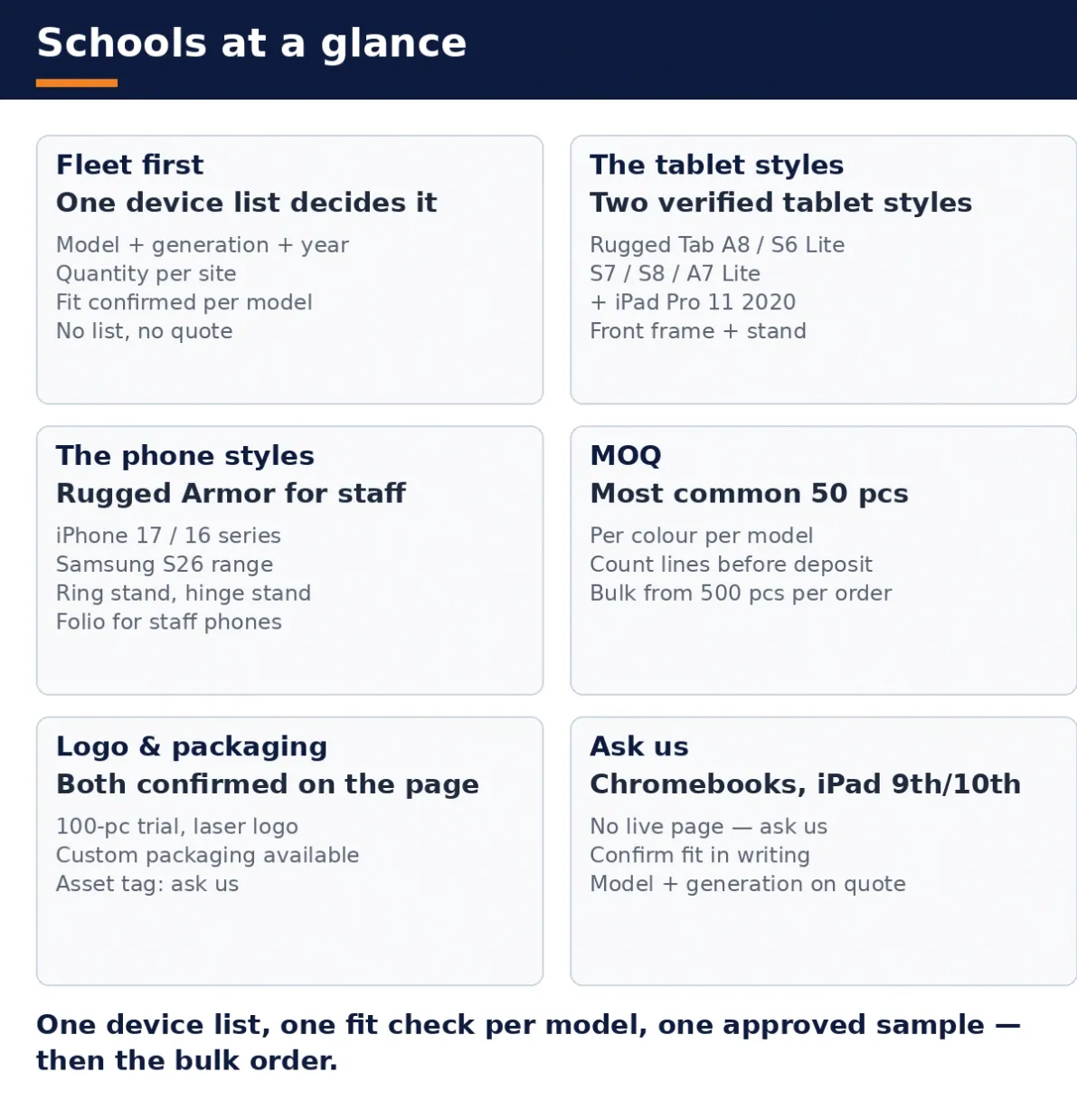
Schools at a glance
Check: What we hold — What to do
Exact-model fit: Galaxy Tab A8 / S6 Lite / S7 / S8 / A7 Lite + iPad Pro 11 2020 — Every other model: ask us, confirm in writing
The tablet style: Heavy Duty Rugged, TPU+PC, front frame + folding stand — Screen protector in the set; 5 colours
The phone styles: Rugged Armor builds for iPhone 17/16 + S26 range — Ring stand, hinge stand, airbag corners
Colours: Uniform per year group or school — One colour per site keeps the fleet readable
MOQ: Most common 50 pcs per colour per model — Count lines before the deposit
Bulk threshold: 500 pcs per order in total — One order, one PI, one freight
Logo & packaging: Logo customisation + custom packaging confirmed — 100-pc trial, laser logo; asset tag: ask us
Sample: Fee charged, refundable on orders of 500+ pcs — Approve the sample in writing before the bulk order.
- What does a school order actually look like?
A school order is a fleet order. One device model runs across a year group, or several models run across a district, and the cases have to match every device on the list — not most of them. The scale is the first thing to understand, because it is what makes a school order different from a shop order. In North Carolina in 2024–25, every traditional public school district in the state had reached a one-to-one device-to-student ratio — 1,190,045 devices in total, according to the state Department of Public Instruction's report on student digital learning access — and 90.3% of those devices were Chrome devices. In Utah, a 2021 inventory by the Utah Education and Telehealth Network counted more than 888,800 student devices, about 1.32 per student, and 65% of them were Chromebooks — 577,690 deployed — with iOS tablets second at 100,710. In New York City, 350,000 new Chromebooks went to K-12 public school students across 1,700 public schools in 2025. The pattern is the same in all three: the fleet is large, it is mostly Chromebooks, and it is bought as a fleet — one specification, one order, one delivery, one set of cases.
What that means for the case order. The honest starting point is that no single supplier holds a case for every device in a school fleet, and this guide does not pretend otherwise. Most of the devices in the three fleets above are Chromebooks, and we hold no Chromebook case on a live product page — that is a question to ask us, not a line on the quote. The iPads in a fleet are spread across generations — 7th, 8th, 9th, 10th, A16, Air, mini — and we hold a case for exactly one of them, the iPad Pro 11 from 2020. The Galaxy Tabs in a fleet are spread across the A and S ranges, and we hold a case for five of them: the Tab A8, S6 Lite, S7, S8 and A7 Lite. A school buyer who starts from the device list, and lets the fit check decide the order, gets a clean order. A school buyer who starts from a catalogue and assumes the fit gets a mixed delivery and a term of returns.
The device list comes first. Before any style is chosen, send the device list: the model, the generation and the year for every device, the quantity per site, and which devices are shared and which are assigned to one student. A list that says "iPad" is not a list — it is a family name that now spans a dozen incompatible case sizes, and a quote written against it cannot be checked. A list that says "iPad Pro 11, 2020, 120 units, Year 9" is a list a factory can answer. The same applies to the phones: "iPhone 17" is a family, and the case for the iPhone 17 Pro Max does not fit the iPhone 17. And the same applies to the tablets: the Galaxy Tab S7 and the Galaxy Tab S8 are different sizes, and a case cut for one does not fit the other. Send the list first, get the fit confirmed per model in writing, and only then talk about colours, logos and packaging — because every decision after the fit depends on the fit being right.
What to ask. Ask for the fit to be confirmed per model, in writing, against the device list — model, generation and year for each line. Ask which models on the list are held on a live product page and which are not, and ask for the unheld models to be confirmed separately, with a sample, before they are added to the bulk order. And ask for the per-line MOQ in writing, counted line by line, because a fleet order is many lines — one per model, per colour — and a distributor who counts it as one order has not counted it at all
- Which styles fit a school fleet?
The styles that fit a school fleet are the ones that survive being handled every day by many hands — and the range we hold has three of them, plus
two that fit the staff around the fleet. None of them is described on its product page as a school case. No live product page mentions schools, education, tenders, classrooms or students at all, and this guide does not claim any of them was designed for schools. What it does is say, plainly, which verified styles a school buyer can order from the range we hold, and which models each one fits.
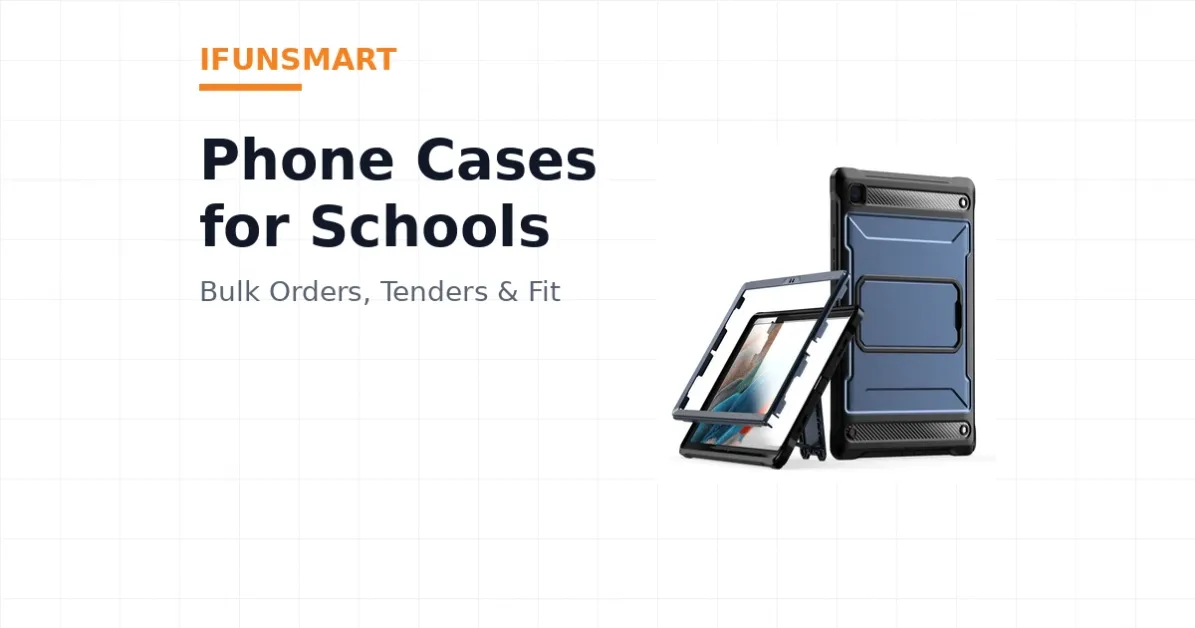
The rugged tablet case. The Heavy Duty Rugged Tablet Case is the main tablet style, and it is the one the cover of this guide shows. It is a TPU and PC build with a front frame, a screen protector in the set and a folding stand, in five colours, and it fits the Galaxy Tab A8, S6 Lite, S7, S8 and A7 Lite. The three features that matter for a fleet are the ones the page states: the front frame and the screen protector in the set, which protect the two surfaces a shared tablet damages first; the folding stand, which holds the tablet at a desk angle for classroom work; and the TPU and PC build, which is the same two-material construction as the rugged phone cases — a soft bumper that absorbs the knock and a hard back that holds the shape. The most common MOQ is 50 pcs per colour per model, and logo customisation and custom packaging are both confirmed on the page. One caution belongs here and not in a footnote: the page says "S6 Lite" with no year, and the S6 Lite was sold in more than one generation — ask us to confirm the generation in writing before you order for it, because a case cut for one generation of the S6 Lite is a question, not a certainty, for the other.
The iPad stand case. The second tablet style is the Invisible Stand Case for the iPad Pro 11 from 2020 — a clear anti-bend cover with a stepless hover holder and an airbag corner, in three colours. It fits the iPad Pro 11 (2020) only: 247.6 by 178.5 by 5.9 millimetres, 471 grams for the Wi-Fi model, A12Z Bionic, according to Apple Support. The stand is the feature that matters here — a stepless holder that props the tablet at any angle for desk work, rather than a fixed-angle kickstand — and the clear back is the feature that matters for a fleet, because the device's own serial number and asset label stay visible through it. But the fit is narrow by design: it is one model, one generation, one year. If the fleet runs the iPad Pro 11 from 2020, this is the style. If it runs any other iPad, it is not — ask us, and do not order it for a different generation.
The rugged phone cases. Three rugged phone builds cover the staff and field-team phones in a school fleet. The Explorer is a heavy-duty rugged MagSafe case with a metal hinge stand for the iPhone 17 Pro Max, in TPU and PC with a zinc alloy stand, with N52 magnets stated on the page at 2500 to 2800 Gauss, in six colours. The Heavy Duty Armor MagSafe case, model IB25-015, is a hard PC back with a soft TPU bumper and a 360-degree rotatable ring stand, for the iPhone 17 and 16 series and the Samsung S26, in seven colours. The Shockproof Armor MagSafe case is a 1.5-millimetre hard PC back with a soft TPU bumper, airbag corners and raised edges — 1.4 millimetres over the camera and the screen — for the Samsung S26, S26 Plus and S25 and the iPhone 17 and 16 series. All three carry the same caution: the product pages use drop-protection language — one page claims a 16-foot military drop figure, another claims it absorbs 99% of shock, a third claims a steel-ball test passed — and this guide repeats none of those figures as fact. A drop figure belongs on a test report, not in a guide. Ask for the test report in writing if you need one, and judge the case on the sample, not on the claim.
The folio and the earbuds. Two more styles fit the people around the fleet rather than the students. The Magnetic Closure Folio is a PU leather and TPU wallet case with card slots, a cash pocket, a kickstand and a hand grip, for the iPhone 17 series, Samsung Galaxy, Xiaomi and Google Pixel — a staff phone case, and the hand grip is the feature that matters for a phone carried all day. The Leather Wallet Magnetic Case for the Samsung Galaxy A27, A37 and A57 is a textured PU leather wallet in seven colours — the budget Samsung range, which is the range a school's own staff phones most often sit in. And the Armor Shockproof AirPods Pro 2 case — TPU and PC with a metal hook, a one-click lock and a carabiner, in eight colours — fits shared earbuds in a lab or a language room, where the case is the thing that keeps the earbuds together and the carabiner is the thing that keeps them on the pegboard. All eight styles carry the same terms: the most common MOQ is 50 pcs per colour per model, and logo customisation and custom packaging are confirmed on the page.
What we do not hold. The list of what we do not hold is as important as the list of what we do, and it is longer. There is no Chromebook case on any live product page, and Chromebooks are the majority of the devices in the three fleets above. There is no case for the iPad 9th generation, 10th generation, A16, Air or mini, and no case for the Galaxy Tab S9, S10 or A9. There is no EVA or kids' case, no keyboard case and no case for a shared-device charging cart. Every one of those is a question to ask us — with the model, the generation and the quantity on the enquiry — not a line to add to the quote and hope for. A supplier who adds an unheld model to a quote without a sample has not checked the fit, and a school buyer who pays for it has bought a return.
What to ask. Ask for the per-model fit list in writing, with the generation and the year for each style, and ask for the unheld models to be confirmed separately with a sample. Ask which colours each style is held in, and whether the colour is uniform across the fleet — one colour per year group or per school keeps the fleet readable at a glance. And ask for the test report in writing if the order needs a drop figure: the guide will not invent one, and the page's own figure is a page claim, not a verified fact.
3. Fit: the generation problem
The generation problem is the mistake that costs a school order a whole term. Two tablets can share a screen size, a brand and a name, and still take different cases — because the case is cut to the body, not to the screen, and the body changes between generations. The iPad is the clearest example: "iPad" on a quote is not a model, it is a family that now spans the 7th, 8th, 9th and 10th generations, the A16, the Air and the mini, the Pro 11 and the Pro 12.9 — and a case cut for one of them does not fit the next. The iPad Pro 11 from 2020, which this guide's stand case fits, measures 247.6 by 178.5 by 5.9 millimetres; the iPad Pro 11 from a later year is a different body, and the same clear cover will not sit on it. The Galaxy Tab range is the same story in a different shape: the Tab A8, the Tab S7 and the Tab S8 are three different sizes, and the rugged tablet case that fits all three does so because it is cut per model, not because one case fits all three. A quote that lists a style without the generation it was cut for cannot be checked, and a bulk order written against it cannot be trusted.
The S6 Lite caution. The rugged tablet page lists the Galaxy Tab S6 Lite among the models it fits, and it lists no year. The S6 Lite was sold in more than one generation — the original and a later refresh — and the two share the same dimensions according to the specification sites, but a shared dimension is not a confirmed fit. This guide says plainly: ask us to confirm the generation in writing before you order for the S6 Lite. A supplier who answers "S6 Lite" without asking which year has not checked the fit, and a school buyer who orders on that answer has bought a sample that may not fit the fleet. The same rule applies to every model on the device list where the generation is not stated: the year is part of the model, and a quote without it is incomplete.
What the quote must carry. Every style on the quote should carry four things: the model, the generation, the year, and the quantity — per site, if the fleet is spread across sites. "Heavy Duty Rugged Tablet Case, Galaxy Tab A8, 120 pcs, Site A" is a line a factory can cut against. "Rugged tablet case, 120 pcs" is not. The same applies to the phones: "The Explorer, iPhone 17 Pro Max, 40 pcs" is a line; "rugged iPhone case, 40 pcs" is not, because the iPhone 17 Pro Max case does not fit the iPhone 17, and the iPhone 16 case does not fit the iPhone 17. And the same applies to the earbuds: the Armor case fits the AirPods Pro 2 only — the Pro 3 case is larger, at 47.2 by 62.2 by 21.8 millimetres against 45.2 by 60.6 by 21.7 millimetres for the Pro 2, and a Pro 2 case will not close cleanly on it. The generation is the fit, and the fit is the order.
What to ask. Ask for the model, the generation and the year on the quote for every style, and ask for the dimensions the mould was cut to — per style, in writing. Ask which generation the S6 Lite line refers to, and ask for the fit to be confirmed against the device's own published dimensions before the sample is made. And ask, for every model that is not on a live product page, whether the style is tooled, sampled or only planned — because "we can make it" and "we hold the mould" are two different answers, and only the second one belongs on a quote.
4. What should the sample prove before the bulk order?
Everything the listing claims, on the bench, in the colours you intend to order — and nothing the listing does not claim. A sample is not a formality. It is the one chance to find out, before hundreds of cases are on the water, whether the case fits the device, closes the way it should, and looks the way your schools will issue it. The checks below are factory checks, not consumer anecdotes: they are done on the bench, on the sample, with the case in hand — not by wearing the case in a pocket or dropping it on a road.
The fit checks. Seat the tablet in the rugged case and close the front frame: it should seat fully, with no gap at any corner, and the frame should sit flush, with no lift at the hinge. Open the folding stand and set the tablet on a desk: it should hold the angle without slipping, and the stand should fold flat again without catching. Check the screen protector in the set against the tablet's own screen: it should cover the display without lifting at the edges, and the touch response should be the same with it on as with it off. Check the port and button openings against the tablet: the charging port, the volume buttons and the headphone socket, where the tablet has one, should line up with the openings, not sit behind the case. Do the same checks on the phone cases — seat the phone, check the camera opening against the lens, check the charging port, press the ring stand or the hinge stand and check it holds — and on the AirPods case, where the lid should close flush and the one-click lock should engage with one press. These are the checks that decide whether the case works. Do them on the sample, in writing, with the sample reference, the model, the style and the colours stated.
The fleet checks. A school sample has to prove more than a single case, because a school order is a fleet, not a single unit. Order the sample in the colours you intend to order, not in one colour only, and check the batch tolerance across them: the blue sample and the black sample should be the same shell, the same stand and the same frame, in different colours — not different shells in different colours. Check the colour itself against the page, and check it against the fleet plan: a uniform colour per year group or per school is only useful if the colour on the sample is the colour on the bulk delivery. Check the finish where hands will touch it every day: the parting lines should be clean, with no flash and no sharp edge where the two halves of the mould met, and the coating adhesion on the trim should be even, with no lifting at the edges. Check the surfaces a school cleans: the case should wipe down without the finish lifting or the colour transferring — a qualitative check on the bench, not a chemical claim, and no cleaning product is named in this guide because none was verified. And check the stand and the frame after repeated use on the bench: cycle the folding stand and the front frame on the sample and check they still sit flush, because a stand that loosens after a term is a stand that does not work for a school.
What to ask. Ask for the sample in the colours you intend to order, and ask for one sample per model — not one sample for the whole fleet, because a sample for the Tab A8 proves nothing about the Tab S7. Ask for the sample fee in writing — samples carry a fee that is refundable on orders of 500+ pcs, and the amount is confirmed per style. Approve the sample in writing, with the sample reference, the model, the style, the colours and the logo method stated. And ask what happens if the sample fails: the answer should be a revised sample, not a bulk order with a note.
5. Logo, asset tags & packaging
A school fleet is identified by its logo and its asset tags, and the case is where both of them live — which is why the logo question is asked before the bulk order, not after it. The product pages confirm logo customisation for every verified style in this guide, and a 100-pc trial order can already carry a logo by laser engraving. Laser is permanent, where silk-screen fades and needs a higher MOQ — and permanence is the point for a school, because a logo that fades after a term is a logo that has to be re-done. The per-piece charge and the artwork position are confirmed in writing on the quote, not assumed: the artwork position matters, because a logo on the back of a tablet case is visible on a desk and a logo on a phone case is visible in a hand, and the two are not the same decision. Approve the sample with the logo in place, in writing, before the bulk order — a logo approved on a screen is not a logo approved on a case.
The asset tag. The asset tag is the second identifier, and it is the one this guide is careful about — because it is not confirmed on any live product page. A school that asset-tags its fleet needs to know, before the order, whether the tag goes on the case, under the case, or on the device itself — and whether the case leaves the device's own serial number and asset label visible. The clear iPad Pro 11 stand case leaves the back visible, which keeps a device label readable through it; the rugged tablet case does not, because its back is a solid colour. Ask us to confirm in writing whether the case can carry an asset-tag label or an engraving, where it sits, and whether the device's own label stays visible with the case on. Do not assume the tag fits because the case fits — the tag is a separate specification, and it belongs on the quote as one.
The packaging. Custom packaging is confirmed on the page for every verified style, and it matters for a school order for a different reason than it matters for a shop order: a school delivery is received, checked and issued, often by site, and the packaging is what makes that possible. Ask for the packaging specification in writing — whether the cases arrive in retail boxes or in bulk polybags, whether the box carries the logo, whether the carton is marked per site or per year group, and whether the barcode and the artwork position are agreed before the bulk order. A carton marked per site is a delivery that can be checked at the door; a carton marked only with the total is a delivery that has to be counted by hand. The dieline, the barcode and the artwork position are agreed before the bulk order, not after the goods ship — and the packing list must match the invoice line by line, because a fleet order is many lines and a packing list that does not match the invoice is a shipment that waits at the port.
What to ask. Ask for the logo method, the per-piece charge and the artwork position in writing, and ask whether the 100-pc trial order is available for each style on the order. Ask for the asset-tag position to be confirmed in writing — on the case, under the case, or on the device — and ask whether the device's own label stays visible. And ask for the packaging specification per site, with the carton marking and the barcode agreed before the bulk order.
6. Tender paperwork, PO & payment
A school order usually travels with paperwork, and the paperwork is part of the order — not an afterthought. This guide does not invent tender thresholds, framework names or public-sector buying rules, because none were verified in the research for it, and a guide that invents them is worse than a guide that says "ask us". What it does say is what the paperwork should contain, and what to ask for in writing, so that the quote a school receives can be checked against the specification the school wrote.
What the enquiry should carry. Send the device list first — model, generation, year and quantity per site — and then the specification, written from the verified page facts: the style per model, the materials as stated on the page, the colours, the MOQ per line, the logo method and position, the packaging, the delivery address per site, and the documents that must travel with the goods. Write the specification from what the page states, and mark everything else as a question: the tender-ready wording is "TPU and PC, front frame, screen protector in the set, folding stand" for the rugged tablet case, because that is what the page states — not "school-grade protection", because no page states that. A specification that promises a model we do not hold — a Chromebook case, an iPad 9th generation case — is a specification that cannot be fulfilled, and a supplier who accepts it without a sample has not read it.
The purchase order. Whether a purchase order is accepted is a question to ask us, because it was not verified on any live product page. Ask it early, in writing, and ask what the purchase order must carry — the device list, the per-line quantities, the delivery addresses, the logo and packaging specification, and the payment terms — so that the order, when it is placed, matches the quote line by line. A purchase order that does not match the quote is a dispute waiting to happen, and a dispute over a fleet order is a term of devices without cases.
The payment. Payment is T/T and Western Union only. New customers may pay a 30% deposit first. After the goods are ready, the factory sends photos and video and the packing list; the customer pays the balance, then the goods ship. Ask for the current production window in writing on the quote — no day figure in this guide, because no day figure was verified — and ask which documents travel with the goods and which your broker must arrange. The packing list must match the invoice line by line — same model, same style, same colours, same quantities — because a fleet order is many lines, and a packing list that does not match the invoice is a shipment that waits.
What to ask. Ask for the payment terms on the quote: T/T and Western Union only, 30% deposit for new customers, photos and video and the packing list after the goods are ready, then the balance, then the goods ship. Ask whether a purchase order is accepted, and what it must carry. And ask which documents travel with the goods and which your broker must arrange.
7. What are the red flags before you pay?
Five red flags, and each one is a reason to stop and ask, not a reason to argue. The first is the "universal fit" claim: a listing that says one case fits all iPads, or all Galaxy Tabs, has not measured anything — the iPad Pro 11 from 2020 and the iPad from any other year are different bodies, and a case that fits both does not exist as a hard shell. The second is a case with no dimensions on the quote: a supplier who cannot state the dimensions its mould was cut to has not cut a mould for your model, and an order from that supplier is an order for a sample that does not exist yet. The third is a price far below the quote breakdown: a quote that shows no line items — no material, no colour count, no logo charge, no packaging — cannot be checked, and a price that is far below every other quote is a price that has left something out. The fourth is a sample that does not match the bulk: a sample in one colour and one finish, followed by a bulk order in five colours and a different finish, is not a sample at all — it is a photograph. The fifth is a supplier who promises a model with no live page and no sample: a Chromebook case, an iPad 9th generation case, a Tab S9 case — promised on the quote, with no page and no sample behind it, is a promise the factory has not kept yet. Ask for the sample first, and compare the bulk delivery against the approved sample, line by line, before the balance is paid.
Two more checks that cost nothing. Ask for the factory address and the mould list in writing — a factory that can name its moulds can name your model, and a supplier that cannot name either is a trader, not a factory. And ask for the payment terms in writing before the deposit: T/T and Western Union only, 30% deposit for new customers, photos and video and the packing list after the goods are ready, then the balance, then the goods ship. A supplier who asks for a large upfront payment beyond the 30% deposit, or who asks for payment by a method that is not on that list, is asking for something the factory does not ask for — and that is a reason to stop, not to negotiate.
What to ask. Ask for the model, the generation and the year on the quote, per style. Ask for the factory address and the mould list. Ask for the sample in the colours you intend to order, and ask for the payment terms in writing before the deposit. A supplier who answers all four, in writing, is a supplier you can order from. A supplier who answers none of them is a supplier you should not pay.
Frequently asked questions
What is the minimum order for school phone cases?
The most common MOQ is 50 pcs per colour per model, and it varies by product line — the rugged tablet case, the iPad Pro 11 stand case, the rugged phone cases and the AirPods Pro 2 case are all 50 pcs per colour per model on their live product pages. Each colour is a line of 50, so a five-colour tablet order for one model is five lines. Bulk and distributor orders start at 500 pcs per order in total. Count the lines before the deposit, and ask for the per-line MOQ in writing for every model that is not on a live page, because no other model's MOQ is stated anywhere.
Can one order mix phone and tablet models?
Yes — a fleet order is a mixed order by definition, and it is built the same way as any bulk order: one line per model, per colour, with the fit confirmed per model in writing. Send the device list first — model, generation, year and quantity per site — and let the fit check decide which lines are held and which need a sample. A mixed order that is counted as one order of 500 pcs has not been counted at all; count it line by line, and check the packing list against the invoice line by line when the goods arrive.
Do you have cases for iPad 9th generation or Chromebooks?
Not on a live product page. The site holds exactly two tablet styles: the Heavy Duty Rugged Tablet Case for the Galaxy Tab A8, S6 Lite, S7, S8 and A7 Lite, and the stand case for the iPad Pro 11 from 2020. There is no case for the iPad 9th generation, 10th generation, A16, Air or mini, no case for the Galaxy Tab S9, S10 or A9, and no Chromebook case on any live page. Ask us for the full model list, with the generation and the year for each style, before you order for any of those models — and ask for a sample before a bulk order, because a model without a live page is a model without a confirmed fit.
Can cases carry a school logo or asset tag?
Yes for the logo: every verified style in this guide confirms logo customisation on its product page, and a 100-pc trial order can already carry a logo by laser engraving. Laser is permanent, where silk-screen fades and needs a higher MOQ. Ask for the logo method, the per-piece charge and the artwork position in writing on the quote, and approve the sample — with the logo in place — in writing before the bulk order. For the asset tag, ask us to confirm in writing whether the case can carry a label or an engraving, where it sits, and whether the device's own serial number and asset label stay visible with the case on — that is not confirmed on any live page. Custom packaging is also confirmed on the page for every verified style.
How does a school pay for a first order?
Payment is T/T and Western Union only. New customers may pay a 30% deposit first. After the goods are ready, the factory sends photos and video and the packing list; the customer pays the balance, then the goods ship. Ask for the current production window in writing on the quote — no day figure in this guide, because no day figure was verified. Whether a purchase order is accepted is a question to ask us, because it was not verified on any live product page; ask it early, and ask what the purchase order must carry, so that it matches the quote line by line.
About iFunSmart
iFunSmart — Ifun Electronics Technology Co., Ltd, Guangzhou, China — has made phone cases as an OEM and ODM manufacturer since 2010, with 1000+ designs, 500+ models and 500K+ pcs a month capacity, exported to 30+ countries. The factory is at Yongning Street, Zengcheng District, Guangzhou, Guangdong 511340. The most common MOQ is 50 pcs per colour per model and it varies by product line. Bulk and distributor orders start at 500 pcs per order in total. Samples carry a fee, refundable on orders of 500+ pcs — ask us to confirm the amount per style in writing. A 100-pc trial order can carry a logo by laser engraving. Payment is T/T and Western Union only, with a 30% deposit for new customers, photos and video and the packing list after the goods are ready, then the balance, then the goods ship. We reply within 24 hours.
To start a school case order, send the device list — model, generation, year and quantity per site — plus the styles, colours and quantities: contact@ifunsmart.com or WhatsApp +86 13632248734.
Read more
- iPad & Tablet Cases: What Distributors Order First — https://www.ifunsmart.com/posts/ipad-tablet-cases-what-distributors-order-first
- Rugged Phone Cases: Armor Builds for Field Teams — https://www.ifunsmart.com/posts/rugged-phone-cases-armor-builds-field-teams
- Phone Case Sampling: How to Evaluate a Sample Before a Bulk Order — https://www.ifunsmart.com/posts/phone-case-sampling-how-to-evaluate-a-sample-before-bulk
- Phone Cases as Corporate Gifts: Logo & First Order — https://www.ifunsmart.com/posts/phone-cases-as-corporate-gifts-logo-first-order
- Phone Case RFQ: What to Send a Factory in Your First Enquiry — https://www.ifunsmart.com/posts/phone-case-rfq-what-to-send-a-factory-in-your-first-enquiry
- Bulk Phone Case Orders: How Volume Changes the Order — https://www.ifunsmart.com/posts/bulk-phone-case-orders-volume-guide
- Reordering Phone Cases: Keep Best Sellers in Stock — https://www.ifunsmart.com/posts/reordering-phone-cases-keep-best-sellers-in-stock
- Phone Case Warranty & Returns: What to Ask Before Ordering — https://www.ifunsmart.com/posts/phone-case-warranty-returns-what-to-ask-before-ordering