Business Solutions
Phone Cases in Portugal: Import, VAT & EPR Checks
Portugal charges 23% IVA plus 6.5% duty on phone cases from China, and the Portuguese importer holds the packaging EPR. The border, VAT, EPR and labelling checks to agree before your first order.
BLUF
Portugal charges 23% IVA plus 6.5% duty on phone cases from China, and the Portuguese importer — not the factory — holds the packaging registration. Agree the border cost, the EPR registration and the Portuguese label in writing before your first order.
Short answer
Importing phone cases into Portugal follows standard EU customs architecture, with two critical domestic requirements: a 23% standard IVA on the mainland and compulsory national packaging EPR registration. Plain plastic cases classify under CN code 3926 90 97, at 6.5% MFN customs duty on the CIF value, with IVA assessed on the duty-inclusive subtotal. Since the EU €150 de minimis customs threshold ended on 1 July 2026 (Council Regulation (EU) 2026/382), small-parcel imports no longer bypass tariffs — making scheduled B2B shipments through a registered Portuguese importer the lowest landed-cost route. The importer who first places the packaged goods on the Portuguese market is the "producer" for packaging EPR: it must register in the national producer register and join a licensed producer responsibility organisation, with no small-producer exemption — even one parcel triggers the duty. The EU General Product Safety Regulation has applied since 13 December 2024, and it requires an EU-established responsible economic operator for each product — for a Chinese factory selling through a Portuguese importer, the importer normally fills that role. The seven sections below work through each of these in turn, then the stocking question, the paperwork and the label. Every figure in this guide comes from a public source read on 26 November 2026 — a European Commission or Portuguese authority source, the TARIC tariff database, or an EU regulation — and every figure that could not be verified is marked as one to confirm with your broker, not stated as a fact.
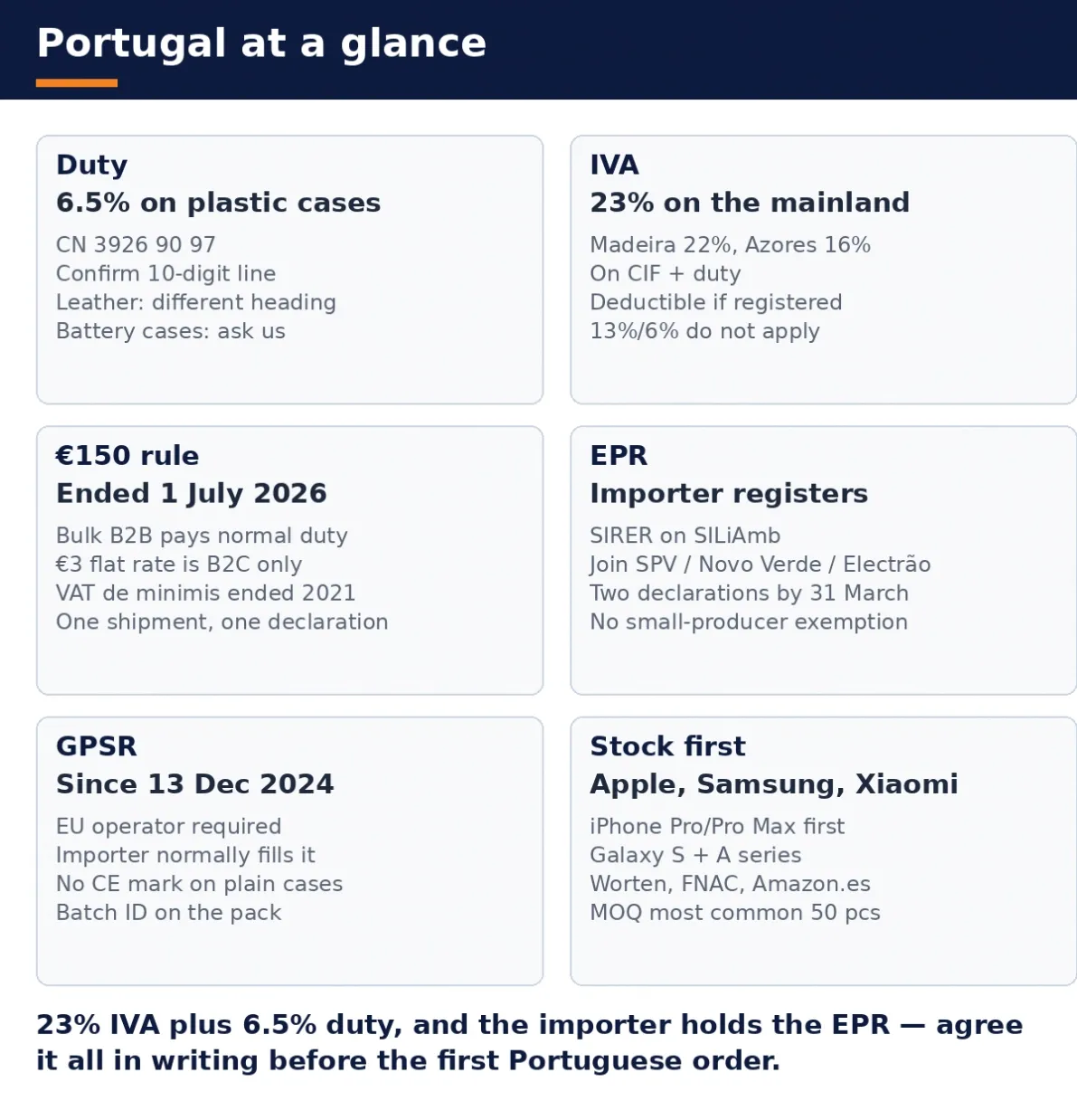
Portugal at a glance
Check | Portugal |
|---|---|
EU member? | Yes — EU customs, VAT, EPR and product-safety law applies directly |
Duty, plastic phone cases | 6.5% MFN, CN 3926 90 97 — confirm the 10-digit TARIC line per SKU |
Import IVA | 23% standard on the mainland (Madeira 22%, Azores 16%) |
€150 de minimis | Ended 1 July 2026 — bulk B2B pays normal duty on every unit |
HS code, plastic cases | 3926 90 97 — confirm per SKU in TARIC; leather and battery cases differ |
Packaging EPR | Importer is the "producer": register in SIRER/SILiAmb + join a PRO (SPV, Novo Verde, Electrão) |
GPSR | Applies since 13 Dec 2024 — EU-established responsible operator required |
Plain case CE mark? | No — CE applies only to cases with electronics |
Labelling | Safety information in Portuguese (GPSR Art. 19, in practice) |
Main channels | Worten, FNAC, MediaMarkt, El Corte Inglés, Amazon.es, MEO/NOS/Vodafone |
1. What you pay at the border: 23% IVA plus 6.5% duty
The first question is what a bulk order actually costs at the Portuguese border, and the answer is two lines, in a fixed order: duty first, then IVA on the duty-inclusive value. Duty is a customs tariff charged on the product type and origin. IVA is Portugal's value-added tax, charged at the destination country's rate on the customs value plus the duty. Never accept a lump-sum landed quote. Insist on separate line items for CIF value, HS code, duty, and IVA — a quote that quotes a duty figure without a tariff code cannot be checked, because the duty depends on the code.
The duty: 6.5% on a plain plastic case. A plain plastic phone case — the moulded shell, the TPU bumper, the clear magnetic back — classifies under CN code 3926 90 97, "other articles of plastics, other". The MFN, or third-country, duty for that code is 6.5%. That figure was read in the TARIC tariff database on 24 November 2026, and a UK advance tariff ruling (600009917, valid 22 February 2024 to 21 February 2027) classifies a plastic smartphone case under 3926 90 97 90, the same subheading. The duty base is the customs value: the goods plus the freight and insurance to the EU border — the CIF value. So the duty on a bulk order is 6.5% of the CIF value, and the IVA is then charged on the CIF value plus the duty. The order of the calculation matters: IVA is not charged on the goods value alone, and it is not charged before the duty. Ask for the code and the rate on the quote, per case type, in writing — and ask whether the code is a TARIC reading or a binding tariff information (BTI) ruling, because a BTI ruling is the only answer that binds customs.
The code is per case type, not per shipment. The 6.5% figure is the rate for the generic "other articles of plastics" lines. It is not a rate for every phone case. A leather wallet or folio case falls under a different heading — Chapter 42, articles of leather — and the duty for that heading was not verified in the research for this guide, so this guide states no leather-case duty rate: confirm it in TARIC or with your broker. A case with electronics — an LED, a battery, wireless-charging circuitry — may classify elsewhere again, in the electronics headings, where the rate can be different. A mixed order that contains plastic cases, leather folios and one battery style cannot be cleared on a single code. The practical consequence is that the quote should list the code and the duty per case type, not one blended figure for the whole order. A supplier who quotes a single duty rate for a mixed order has not classified the order.
The IVA: 23% on the mainland. Portugal's standard IVA rate is 23% on mainland Portugal — one of the highest standard VAT rates in the EU. The autonomous regions have lower rates: Madeira 22% and the Azores 16%. The intermediate rate of 13% and the reduced rate of 6% cover food, books, medicines, passenger transport and hotels — they do not apply to phone cases. Import IVA applies to goods from outside the EU on the customs value plus the duty, so on a bulk order the IVA base is the CIF value plus the 6.5% duty. A Portuguese VAT-registered importer can deduct the import IVA in its periodic VAT return, so for a registered distributor the 23% is a cash-flow item, not a cost — but only if the importer is registered and the import is declared correctly. A non-registered importer pays the 23% at the border and cannot recover it. Monthly VAT filers may also opt to pay the import IVA in their periodic return instead of at the border, under Article 27(8) of the Portuguese VAT Code — ask your adviser whether your importer uses that option, because it changes when the cash leaves the business, not how much is due.
What to ask. Ask for the tariff code, the duty rate and the IVA rate for each case type, in writing, on the quote — and ask whether the code is a TARIC reading or a binding tariff information ruling. Ask who is the importer of record and whether the import IVA will be deducted in the periodic return. And ask how the freight and insurance to the EU border are stated on the invoice, because they form part of both the duty base and the IVA base. The answers belong on the quote, before the deposit.
2. The €150 change: why bulk B2B beats small parcels now
Until recently, a small parcel of phone cases could enter the EU without duty if its value was €150 or less. That rule ended on 1 July 2026, and the change matters more for a distributor than for a single-case buyer — because it removes the one route that made small, frequent orders cheaper than a bulk order, and it makes the bulk order the cheaper way to buy.
What ended, and what replaced it. The EU customs-duty exemption for consignments of intrinsic value of €150 or less ended on 1 July 2026, under Council Regulation (EU) 2026/382. In its place, a temporary flat customs duty of €3 per item applies to qualifying low-value distance sales — business-to-consumer sales — of €150 or less, running until 1 July 2028, when normal tariff rates are expected to apply. The €3 flat rate is a consumer-parcel rule. It does not apply to a low-value business-to-business import: a B2B shipment of €150 or less pays the normal duty rate — 6.5% for a plastic case — not the €3 flat rate. And the VAT de minimis ended even earlier: since 1 July 2021 every commercial import pays VAT regardless of value, so there has been no VAT-free small parcel for years. A supplier who still quotes the €150 duty-free threshold for a 2026 order is quoting a rule that no longer exists. A supplier who quotes the €3 flat rate for a B2B bulk shipment is quoting a consumer rule for a business order.
Why this favours the bulk order. A distributor's shipment is far above €150, so the end of the de minimis changes nothing about the duty rate on a bulk order — it was always 6.5% on the CIF value. What changes is the comparison. Before July 2026, a buyer could split an order into small parcels and pay no duty on any of them. Now every parcel pays duty, and every parcel pays its own freight, its own clearance and its own IVA — while a single bulk shipment pays one freight, one clearance and one duty calculation. The bulk order was already the cheaper way to buy per unit; after July 2026 it is the cheaper way to buy at the border too. That is the commercial case for ordering in bulk through a Portuguese importer rather than in small parcels direct: one shipment, one declaration, one duty line, one IVA line, and the per-unit freight spread across hundreds of units instead of dozens.
One figure this guide does not state. Some secondary guides report a €2 Union handling fee per item from 1 November 2026, with mandatory product-identifier data for low-value business-to-consumer imports. That figure was not verified against the European Commission text in the research for this guide, so this guide does not state it as a fact. If your broker mentions it, ask for the legal basis and whether it applies to a B2B bulk shipment at all — it is a low-value consumer-parcel measure, and a bulk B2B order is not a low-value consumer parcel. The same discipline applies to any new fee a supplier quotes: ask for the regulation number and the scope, in writing, before the deposit.
What to ask. Ask whether the quote's duty figure assumes the old €150 exemption, the €3 flat rate, or the normal 6.5% rate — and ask for the regulation that supports it. Ask for the duty and IVA calculated on the full bulk shipment, not on a single case, so the landed cost is the cost of the order you are actually placing. And ask your broker whether the shipment will be declared as a single commercial consignment in Portal das Alfândegas, with one declaration and one duty line.
3. Packaging EPR: the importer registers, not the factory
Packaging is the part of a Portuguese order where the obligation falls on the buyer, not the factory — and it falls on the buyer from the very first parcel. Portugal's extended producer responsibility regime for packaging makes the entity that first places packaged goods on the Portuguese market the "producer". For a Chinese factory selling to a Portuguese importer, that producer is the Portuguese importer. For a factory selling direct to Portuguese consumers by distance selling, the producer is the factory — and it must appoint an authorised representative in Portugal. Either way, somebody has to register, and the registration has to exist before the goods are placed on the market, not after.
The three obligations. The legal basis is Decree-Law 152-D/2017, the unified EPR regime, as amended, with the general waste regime in Decree-Law 102-D/2020 and the producer register in Portaria 20/2022. The obligations are three. First, register in the national producer register — SIRER — on the Portuguese Environment Agency's SILiAmb platform, within one month of becoming a producer, and report any change within 30 days. Second, join a licensed producer responsibility organisation — a PRO — or run an APA-authorised individual system. The licensed PROs are Sociedade Ponto Verde, established in 1997 and the largest, Novo Verde and Electrão. Third, file two declarations in SILiAmb by 31 March each year — the actual quantities placed on the market in the previous year and the estimate for the current year — and pay the eco-contributions to the PRO by material and weight. Since 1 January 2025 all packaging is covered, including non-reusable industrial and commercial packaging — so the shipping carton counts as well as the retail box.
There is no small-producer exemption. This is the point most often missed, and it is the point that matters most for a first order. Portugal's packaging EPR has no threshold: even a single parcel triggers registration. Some PROs offer simplified flat fees for very small volumes — under one tonne a year, for example — but the registration itself is not waived. A first order of a few hundred cases is well under one tonne of packaging, and it still has to be registered. A supplier who tells you packaging registration "does not apply to small orders" is wrong, and a distributor who places a first order without registering is placing it unregistered. The registration is the importer's, not the factory's — but a factory that can tell you which PRO its Portuguese customers use, and what packaging weight per shipment looks like, is a factory that has done this before.
The 2026 change: the PPWR applies directly. The EU Packaging and Packaging Waste Regulation — Regulation (EU) 2025/40 — generally applies from 12 August 2026, and because it is a regulation it applies directly in Portugal without transposition. From that date the general recyclability requirement and the PFAS limits for food-contact packaging apply, and packaging must carry technical documentation and an EU Declaration of Conformity. Harmonised material labelling follows from 12 August 2028, and most other substantive requirements phase in between 2028 and 2038. The Portuguese Decree-Law regime and the PPWR now run together: the Decree-Law tells you who registers and pays, the PPWR tells you what the packaging itself must be. The questions to agree in writing now are the ones both regimes will ask later: what the retail box and the shipping carton are made of, whether they are designed for recycling, how much recycled content they carry, and whether the supplier can state the packaging weight per shipment. A supplier who cannot answer those questions today is not breaking the law — the PPWR's design rules phase in over years — but a supplier who can answer them is the one whose packaging will still be compliant when the design rules arrive. Do not accept a promise of "fully recyclable packaging" as a fact without a material specification: recyclable means a specific material in a specific recycling stream, and the claim belongs in the specification, not in a chat message.
What to ask. Ask, in writing, who is the producer for your shipment — you, your importer, or your distributor — and whether that producer is already registered in SIRER on SILiAmb and joined to a PRO. Ask which PRO, and ask for the packaging weight breakdown per shipment, by material, so the eco-contribution can be calculated. And ask who will hold the take-back and reporting duties as the PPWR phases in — you, your importer, or your distributor — and get the answer in writing before the first order, so a 2028 requirement does not arrive as a surprise on a shipment that is already on the water.
4. GPSR: the responsible operator, and what it means for a plain case
The EU General Product Safety Regulation — Regulation (EU) 2023/988 — has applied since 13 December 2024, replacing the old General Product Safety Directive. It covers almost all non-food consumer products, including phone cases, whether new, used, repaired or reconditioned. It is the regulation a Portuguese distributor will be asked about first, and it is also the regulation most often misunderstood — because its most important requirement is not a mark on the box, but a person in the EU.
The responsible economic operator. The GPSR requires that a responsible economic operator established in the EU exists for each product — an EU manufacturer, an EU importer, an authorised representative, or a fulfilment service provider. A non-EU factory cannot fill this role. For a Chinese factory selling through a Portuguese importer, the importer normally fills it. That operator's name, postal address and electronic address must appear on the product, the packaging or an accompanying document, together with the manufacturer's details and a type, batch or serial identifier for the product. The operator must also hold the technical documentation, including a risk assessment, available to the market surveillance authorities. Distance-selling offers — a listing on a marketplace, a webshop page — must show the manufacturer details, the responsible operator's details where the manufacturer is outside the EU, the product identification and any warnings or safety information, in a language easily understood in the member state. For Portugal, that means Portuguese — section 7 takes the language question up in full.
What this means for a plain case. A plain phone case — plastic, leather or silicone, with no electronics and no battery — needs no CE marking. CE marking applies to products within the scope of a CE directive, and a plain case is in the scope of none of them. A battery or wireless-charging case is different: it may fall under the radio-equipment or electromagnetic-compatibility rules, and that is a question for the importer and the test house, not for a guide. The GPSR itself is not a certification, and this guide does not claim iFunSmart holds GPSR, REACH or RoHS certifications — it does not. The GPSR is buyer education: it tells you what to ask for in writing — a named responsible operator, a risk assessment, technical documentation, and the identifiers on the product — not a mark to look for on the box. Do not let a supplier put a CE mark on a plain case to make it look compliant: a mark that does not apply is worse than no mark, because it invites a question nobody can answer.
The chemical side, in one paragraph. The chemical rules that touch a phone case sit in REACH, not in the GPSR. Annex XVII entry 50 restricts eight polycyclic aromatic hydrocarbons in rubber and plastic parts of articles that come into prolonged or repetitive contact with the skin. The exact limit was not verified against the European Chemicals Agency text in the research for this guide, so this guide states no limit figure: ask your importer or adviser for the current entry-50 text, and ask the factory for the material specification for each style. A material specification is a document, not a claim — and it is the document a Portuguese distributor will ask for before listing a case that touches skin all day.
What to ask. Ask, in writing, who is the responsible economic operator for your shipment, and whether that operator's details and the batch or type identifier will appear on the product or the packaging. Ask for the technical documentation and the risk assessment to be available on request, and ask who holds them. And ask, per style, whether the case is a plain case or a battery or charging case — because a mixed order that contains one battery style cannot be cleared as if it were all plain cases.
5. What to stock first, and where it sells
Portugal is a small market that buys like a larger one. The population is about 10.4 million, with 16.9 million cellular mobile connections — 162% of the population — and 9.35 million internet users, 90% of the population. The market is structurally import-dependent: Portugal makes very few phones, so every case a Portuguese shop sells was imported, and a distributor who can land cases at 6.5% duty and deduct the 23% IVA has a cost position that a direct-to-consumer parcel seller does not have. The question is not whether Portugal is worth stocking. It is what to stock, and where it sells.
The vendor ranking. Apple leads the Portuguese smartphone market, followed by Samsung and then Xiaomi, on StatCounter GlobalStats mobile web traffic for 2026 — with Oppo also in the top five. The secondary roundup that reports the figures puts them at around 37% for Apple, around 31% for Samsung and around 13% for Xiaomi as of August 2026; those percentages are approximate, from a secondary source citing StatCounter, and this guide states them as "around" for that reason. The ranking itself is the reliable part, and it is enough to build a first order on: iPhone cases are the volume line, Samsung Galaxy cases second, Xiaomi third. The safe reading is the one your Portuguese importer gives you: ask which models their shops actually move, and build the first order from that list. What the range itself should contain is a question the earlier guides in this series already answer: a first order that covers the current iPhone Pro and Pro Max, the standard iPhone, and the Samsung Galaxy S and A series, in clear magnetic, rugged, leather wallet and card-holder styles, with the most common MOQ of 50 pcs per colour per model — and it varies by product line, so count the lines before the deposit. A wide range in a small market is a lot of lines at the MOQ, and breadth has a cost: the bulk threshold of 500 pcs per order in total does not change the per-line MOQ.
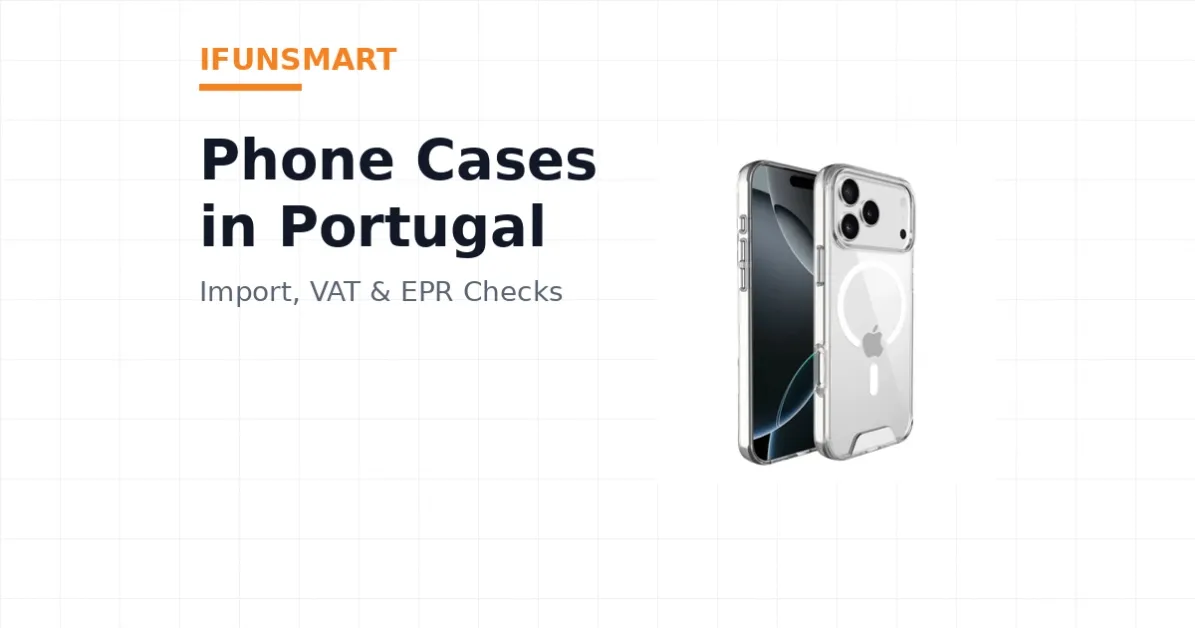
Where the cases sell. Worten is Portugal's largest technology retailer, part of the Sonae group, with its worten.pt marketplace alongside its stores. FNAC Portugal, MediaMarkt, El Corte Inglés, Radio Popular and PCDiga are the other large specialist and generalist chains. Online, Amazon reaches Portugal through amazon.es — there is no amazon.pt — alongside the KuantoKusta price comparator and marketplace and the OLX classifieds. The mobile operators MEO, NOS and Vodafone Portugal sell phones, and accessories, bundled with contracts. A distributor sells into these channels, not around them: the listing, the language and the packaging have to fit Worten and FNAC first, and the import paperwork has to be right before the listing goes live. The cover product for this guide is one example of what a Portuguese first order can carry: a Clear MagSafe Case for the iPhone 18 Pro Max, N52H magnetic, with a 99% high-transmittance anti-yellow PC back and a shockproof TPU bumper, MOQ 50 pcs per colour per model, and logo customisation and custom packaging available — confirm the model, the style and the colours in writing for your own order, because the cover is an example, not a quotation.
What to ask. Ask your importer which models their shops actually move, and build the first order from that list — not from a claimed market share. Ask which channels the first order is for, because a Worten listing, an operator bundle and a marketplace listing have different packaging and labelling needs. And ask for the per-line MOQ in writing, counted line by line, before the deposit — because a first order that covers three phone brands in four styles is already a dozen lines, and a dozen lines at the most common MOQ is a real order.
6. The paperwork: EORI, invoice, packing list, ENS and the declaration
A Portuguese import is one shipment, but it carries a set of documents that must agree with each other line by line. The documents are the importer's responsibility to file, and the factory's responsibility to supply correctly — and a document that is missing at the port is a shipment that waits at the port.
The importer: EORI. The Portuguese importer needs a valid EORI number — the Economic Operators Registration and Identification number — issued by the Autoridade Tributária e Aduaneira, the AT, which handles tax and customs in one body. The EORI is valid EU-wide, and it is the importer's identity on the customs declaration. A distributor without an EORI cannot clear a commercial shipment. Ask who holds the EORI for your shipment, and whether it is the same entity that will deduct the import IVA — because the importer of record, the EORI holder and the VAT registrant should be the same business, and if they are not, ask why.
The factory: invoice and packing list. The core document set for clearance is the commercial invoice, the packing list, the bill of lading or air waybill, the EORI number and the customs import declaration. The commercial invoice must state the CIF value, the HS code, the Incoterm and the shipper and consignee. The packing list must match the invoice line by line — same models, same styles, same colours, same quantities. A packing list that does not match the invoice is the most common reason a shipment is held, and it is the easiest reason to prevent: check the two documents against each other before the goods leave the factory, not after they arrive in Lisbon. The customs declaration is filed in Portugal's Portal das Alfândegas, the customs portal, and an Entry Summary Declaration — the ENS — must be filed in ICS2 before the goods arrive, for sea and air alike. Portugal moved to the DAIN declaration system in October 2025; your broker files in Portal das Alfândegas, and if your broker is still filing in the old system, ask when it migrates, before the first order.
Wood packaging and the certificate of origin. Wood packaging — pallets and crates from China — must comply with ISPM-15, the international standard for wood packaging material. A certificate of origin is not routinely needed for phone cases from China, because no EU free-trade agreement gives Chinese phone cases a lower duty — the 6.5% MFN rate applies regardless — and it is needed only where a preferential claim or a specific customs request arises. Ask your broker whether a certificate of origin is needed for your shipment, and do not pay for one that is not.
What to ask. Ask for the commercial invoice and the packing list before the goods ship, and check them against each other line by line. Ask who files the ENS in ICS2 and who files the declaration in Portal das Alfândegas, and whether the broker has migrated to the DAIN system. Ask for the EORI holder's name in writing, and ask which documents travel with the goods and which your broker must arrange. A document that is missing at the port is a shipment that waits at the port.
7. The label in Portuguese — and the first-order checklist
The labelling rule is the one most likely to surprise a first-time Portuguese buyer, because it is not a Portuguese decree you can look up for phone cases — it is a requirement in the GPSR, applied in practice. Under Article 19 of the GPSR, warnings and safety information in distance-selling offers must be in a language easily understood by consumers in the member state. For Portugal, that means Portuguese. No Portugal-specific decree mandating Portuguese-language labelling on phone cases as such was found in the research for this guide, so this guide does not cite one — but the practice is clear: safety information in Portuguese on the pack or the insert, with the manufacturer and responsible-operator details and the batch or type identifier alongside it. A retail pack with only English text is not enough for mandatory safety information, and many brands use a multilingual sticker or leaflet for Portugal. The practical answer is to agree the label with your importer before the first order: which languages, on the box or on a leaflet, and who prints it. A label that is agreed after the goods ship is a label that is applied by hand at the warehouse, and that is where mistakes happen.
The first-order checklist. A Portuguese first order is one shipment, but it carries four kinds of paperwork: customs, VAT, packaging and labelling. The checklist below is the whole guide in one page. Agree each item in writing before the deposit, and the shipment has a chance of clearing, selling and being reordered. Skip an item and the shipment will wait — at the border, at the register, or on the shelf.
1. The tariff code and the duty, per case type. Plastic cases CN 3926 90 97 at 6.5% MFN — confirm the full 10-digit TARIC line per SKU, and confirm the code and the rate for leather and battery styles separately. A broker who quotes one duty rate for a mixed order has not classified the order.
2. The IVA treatment. Import IVA is 23% on the mainland on the CIF value plus the duty. Ask who holds the Portuguese VAT number, whether the import IVA is deducted in the periodic return, and who is the importer of record. If the factory sells direct to Portuguese consumers as well as to you, ask whether it is registered and who its authorised representative is.
3. The EPR registration. The producer — normally your Portuguese importer — must be registered in SIRER on SILiAmb and joined to a PRO (Sociedade Ponto Verde, Novo Verde or Electrão), with two declarations by 31 March each year. There is no small-producer exemption. Get the registration position in writing before the first order.
4. The GPSR answer, per style. Ask who is the responsible economic operator for your shipment, and whether that operator's details and the batch or type identifier will appear on the product or the packaging. Plain cases need no CE mark; battery and charging cases may need one, and that is a question for the importer and the test house.
5. The label, in Portuguese. Safety information in a language Portuguese consumers easily understand — in practice, Portuguese on the pack or the insert. Agree the label artwork before the goods ship — not after they arrive.
6. The sample and the approval, before the deposit. The sample proves the case fits the phone: check it on the bench — the case seats fully with no gap at any corner, the buttons click cleanly, the camera cutout does not intrude into the lens field, the magnetic ring holds a charger firmly with the pull force the product page states for that style, the parting lines are clean, the coating adheres and the batch tolerance is even. Samples carry a fee that is refundable on orders of 500+ pcs — ask us to confirm the amount per style in writing. A 100-pc trial order can carry a logo by laser engraving — ask for the per-piece charge and the artwork position in writing. Approve the sample in writing, with the sample reference, the model, the style, the colours and the logo method stated.
7. The payment and the shipment, in writing. Payment is T/T and Western Union only. New customers may pay a 30% deposit first. After the goods are ready, the factory sends photos and video and the packing list; the customer pays the balance, then the goods ship. Ask for the current production window in writing on the quote — no day figure in this guide, because no day figure was verified — and ask which documents travel with the goods and which your broker must arrange. A document that is missing at the port is a shipment that waits at the port.
Frequently asked questions
What is the import VAT on phone cases in Portugal?
23% on mainland Portugal — the standard IVA rate — charged on the customs value plus the customs duty. Madeira charges 22% and the Azores 16%. The reduced rates of 13% and 6% cover food, books, medicines, passenger transport and hotels; they do not apply to phone cases. A Portuguese VAT-registered importer can deduct the import IVA in its periodic VAT return, so for a registered distributor the 23% is a cash-flow item, not a cost. Monthly filers may opt to pay the import IVA in their periodic return instead of at the border.
How much customs duty do phone cases pay into Portugal?
6.5% on a plain plastic phone case, under CN code 3926 90 97 — the MFN rate for "other articles of plastics". The duty is charged on the CIF value, and the IVA is then charged on the CIF value plus the duty. Confirm the exact 10-digit TARIC line per SKU before the first order: leather cases fall under a different heading, and cases with electronics may classify elsewhere. The €150 duty-free threshold ended on 1 July 2026, so a bulk B2B shipment pays the normal duty on every unit — the €3 flat rate that replaced it applies only to low-value business-to-consumer distance sales.
Who has to register for packaging EPR in Portugal?
The entity that first places packaged goods on the Portuguese market — the "producer". For a Chinese factory selling to a Portuguese importer, that is the Portuguese importer. It must register in SIRER on the APA's SILiAmb platform within one month, join a licensed producer responsibility organisation — Sociedade Ponto Verde, Novo Verde or Electrão — and file two declarations by 31 March each year, paying eco-contributions by material and weight. There is no small-producer exemption: even one parcel triggers registration. The EU Packaging and Packaging Waste Regulation, Regulation (EU) 2025/40, generally applies from 12 August 2026 and adds recyclability, documentation and labelling requirements that phase in through 2038.
Do phone cases need a CE mark or a responsible operator in Portugal?
No CE mark on a plain case — a plain phone case is not in the scope of any CE directive. A battery or wireless-charging case may fall under the radio-equipment or electromagnetic-compatibility rules, and that is a question for the importer and the test house. The GPSR does require an EU-established responsible economic operator for each product — for a Chinese factory selling through a Portuguese importer, the importer normally fills that role — and the operator's details, the manufacturer's details and a batch or type identifier must appear on the product, the packaging or an accompanying document. This guide does not claim iFunSmart holds GPSR, REACH or RoHS certifications — it does not.
Which phone cases should I stock first in Portugal?
Apple leads the Portuguese smartphone market, followed by Samsung and then Xiaomi, on StatCounter GlobalStats 2026 — so iPhone cases are the volume line, Samsung Galaxy cases second, Xiaomi third. Build the first order from the list your Portuguese importer actually moves: the current iPhone Pro and Pro Max, the standard iPhone, and the Samsung Galaxy S and A series, in clear magnetic, rugged, leather wallet and card-holder styles, with the most common MOQ of 50 pcs per colour per model — and it varies by product line, so count the lines before the deposit. The cases sell through Worten, FNAC, MediaMarkt, El Corte Inglés, Amazon.es and the mobile operators MEO, NOS and Vodafone Portugal.
About iFunSmart
iFunSmart — Ifun Electronics Technology Co., Ltd, Guangzhou, China — has made phone cases as an OEM and ODM manufacturer since 2010, with 1000+ designs, 500+ models and 500K+ pcs a month capacity, exported to 30+ countries. The factory is at Yongning Street, Zengcheng District, Guangzhou, Guangdong 511340. The most common MOQ is 50 pcs per colour per model and it varies by product line. Bulk and distributor orders start at 500 pcs per order in total. Samples carry a fee, refundable on orders of 500+ pcs — ask us to confirm the amount per style in writing. A 100-pc trial order can carry a logo by laser engraving. Payment is T/T and Western Union only, with a 30% deposit for new customers, photos and video and the packing list after the goods are ready, then the balance, then the goods ship. We reply within 24 hours.
To start a Portuguese order, send the models, the styles, the colours and the quantities, and the destination in Portugal: contact@ifunsmart.com or WhatsApp +86 13632248734.
Read more
- Phone Case Factory in China: Find, Check & Compare — https://www.ifunsmart.com/posts/phone-case-factory-in-china-find-check-compare
- How to Verify a Phone Case Factory Before Ordering — https://www.ifunsmart.com/posts/how-to-verify-a-phone-case-factory-before-ordering
- Phone Cases in Switzerland: Import, VAT & EPR Checks — https://www.ifunsmart.com/posts/phone-cases-in-switzerland-import-vat-epr-checks
- Phone Cases in the Nordics: Import, VAT & EPR Checks — https://www.ifunsmart.com/posts/phone-cases-in-nordics-import-vat-epr-checks
- Phone Cases in Belgium: Import, VAT & EPR Checks — https://www.ifunsmart.com/posts/phone-cases-in-belgium-import-vat-epr-checks
- Phone Cases in Poland: Import, VAT & EPR Checks — https://www.ifunsmart.com/posts/phone-cases-in-poland-import-vat-epr-checks
- Importing Phone Cases: Documents & Checks First — https://www.ifunsmart.com/posts/importing-phone-cases-documents-checklist
- Phone Case Payment Terms: What to Agree Before the First Order — https://www.ifunsmart.com/posts/phone-case-payment-terms-first-order