Custom Phone Cases OEM/ODM: Logo, Colour and Packaging — What to Prepare Before You Ask for a Quote
A custom phone case quote is only as good as the files behind it. Prepare your logo file, colour reference, model list and packaging spec first — and know what "custom" changes versus a stock style.
The short answer: Before you ask for a custom quote, prepare four things: your logo as a proper file, a colour reference the factory can match, your exact model list, and your packaging specification. "Custom" can mean three different things — your logo on a stock style, your colour on a stock style, or your own packaging — and each one changes the order in a different way. The more of the four you send in your first message, the faster the quote is real and the fewer sample rounds you will need. Send the files on WhatsApp https://wa.me/8613632248734 — we reply within 24 hours with MOQ, sample cost and lead time for that model.
1. What "custom" actually changes — and what it does not
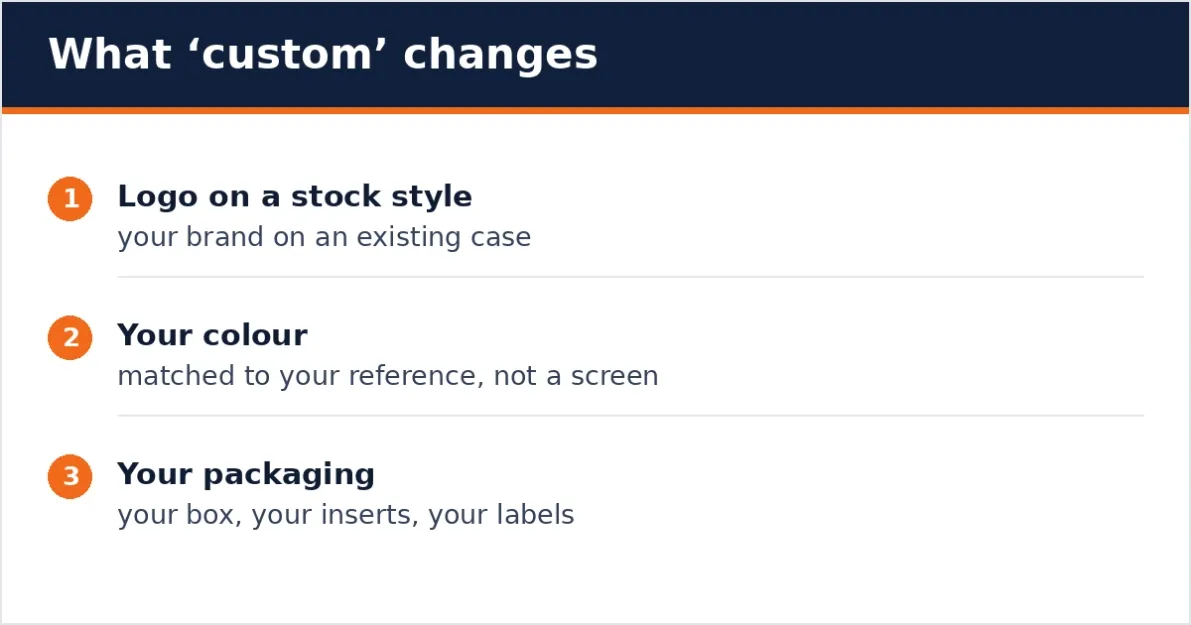
The word "custom" covers three different jobs, and buyers get the wrong quote when they do not say which one they mean.
| Custom job | What changes | What stays the same |
|---|---|---|
| Logo on a stock style | Your logo printed or engraved on an existing case design | The case shape, material, colours and mould — all stock |
| Your colour on a stock style | The case produced in your colour instead of a stock colour | The case shape, material and mould — only the colour run changes |
| Your own packaging | A retail box, insert or label designed for your brand | The case itself can stay stock; the packaging is a separate print run |
A logo-only order is the lightest custom job: the case is already made, and only the print step is yours. A custom colour is heavier, because each colour is a separate production run with its own material batch and setup. Custom packaging is a separate job altogether: the box is designed, printed and cut on its own line, with its own approval step. A new mould — a case shape that does not exist yet — is the heaviest job of all: ask for it by name, with a drawing or a reference sample, and expect the factory to confirm what is possible in writing before any quote.
Say which job you want in your first message, in plain words: "logo on your stock MagSafe style, in our two brand colours, with our retail box." One sentence like that saves a week of back-and-forth. Read more: https://www.ifunsmart.com/posts/phone-case-wholesale-china-buying-direct-manufacturer
2. Your logo: the file that decides everything
The single most common delay in a custom order is a logo file the factory cannot use. A small image copied from a website, a screenshot, or a logo inside a presentation slide will print blurry, and the factory will have to stop and ask for the real file. Send the logo properly the first time.
The best file is a vector file — AI, EPS or SVG — because it scales to any size without losing sharpness, from a small print on a case back to a large print on a retail box. If you do not have one, send the highest-resolution PNG with a transparent background, and say so honestly. Also send the exact placement: where the logo goes, how large it should be — "centred on the back, below the camera" is worth more than three rounds of sample corrections.
Also decide, before you ask for the quote, whether the logo should be printed in one colour or several, and whether it needs to survive daily handling. A logo printed on a soft silicone surface behaves differently from one printed on a hard clear back, and the factory will confirm the right method for your style in writing. What you must not do is approve a logo position from a phone screen and then change it after the sample is made: every change after sample approval is a new sample round.
3. Your colour: a reference, not a description
Colour is the part of a custom order where words fail. "Dark blue," "our brand pink," or "like the one on our website" cannot be matched, because every screen shows colour differently and every printer reads it differently. A colour needs a reference the factory can hold next to the sample.
The strongest reference is a physical sample: an existing product, a colour chip, or a previous case in the exact colour you want. The next best is a colour code from a recognised system, written out in full. If you only have a screen image, say so, and expect the factory to send a colour sample to approve before production — that step is part of the order, not an extra. Ask the factory to confirm in writing how colour approval works for your order, and what happens if the colour is not right.
One more thing to decide early: how many colours you actually need. Every colour is a separate production run, so a first order in six colours is six runs before a single case is packed. Start with the colours that already sell in your market, prove them, and add the experimental colour to the second order.
4. Your packaging: the box is a product too
Many buyers treat packaging as an afterthought and discover it is a second production line. A custom retail box needs its own artwork, approval and print run — and it cannot be designed from a description. Before you ask for the quote, decide the packaging type: a polybag with a header card, a retail box, or a gift box with an insert. Then prepare the box artwork as you did the logo — vector files where possible — and write down what must appear on it: your brand name, the model, the barcode, and any warnings your market requires.
If you sell in the EU, the labelling belongs in the packaging specification from the start: the manufacturer name and address, the EU responsible person's details, the model and batch identification, and the warnings in the language of the country of sale. Getting that right after the boxes are printed means reprinting them. Read more: https://www.ifunsmart.com/posts/selling-phone-cases-eu-2026-gpsr-reach-rohs-documents. If you sell on Amazon, say so now: the FNSKU and box labels must be right before dispatch. Read more: https://www.ifunsmart.com/posts/selling-iphone-18-cases-amazon-2026-landed-cost-fba
5. The approval gates: nothing moves without your written yes
A custom order has four gates, and nothing passes a gate without your written approval. First, the artwork proof: the logo, the placement and the packaging artwork, approved as a drawing. Second, the colour sample: the colour matched to your reference, approved by holding it next to the reference. Third, the pre-production sample: the finished case, with logo, colour and packaging together, tested on a real handset. Fourth, the bulk order itself, confirmed line by line — model, style, colour, quantity per colour, packaging, labels.
Each gate exists so a mistake is caught when it is cheap: a logo in the wrong place caught at the proof stage costs a corrected file; caught after production, it costs the whole run. Check the proof on a large screen, compare the colour sample against your reference in daylight, and test the pre-production sample on your own phone — fit, buttons, magnet hold on your own charger, and wireless charging. For MagSafe styles, run the three magnet tests on your own accessories first. Read more: https://www.ifunsmart.com/posts/magsafe-cases-2026-n52-2700-gauss-test-magnet. When you approve a gate, write "approved" with the date, and name what you approved.
6. What to send in your first message
Put it all in one written message, and keep a copy:
- The custom job, in one line: logo only, custom colour, custom packaging, or a combination.
- The logo file (vector preferred, or high-resolution PNG with a transparent background), with placement and size.
- The colour reference: a physical sample, a colour code, or a clear note that you need a colour sample to approve.
- The exact model list, one by one, and the quantity per colour per model. MOQ is 50 pcs per colour per model.
- The packaging specification: box type, artwork files, and what must appear on it.
- The destination country and delivery type, and your launch date if you have one.
Send that, and the factory can quote your order instead of guessing at it. Ask us for MOQ, sample cost and lead time for this model, with the files attached, and we confirm in writing.
FAQ
What do I need before asking for a custom phone case quote?
Four things: your logo file, a colour reference, your exact model list, and your packaging specification. Send them in one written message with the custom job described in one line.
What logo file should I send?
A vector file (AI, EPS or SVG) is best. If you do not have one, send the highest-resolution PNG with a transparent background, and include the placement and size.
Can I get my own colour on a stock style?
Yes — but every colour is a separate production run, so send a physical sample or a colour code as the reference, and expect a colour sample to approve before production.
Is custom packaging included in the case price?
No — a custom retail box is a separate print run with its own artwork and approval. Send the box type and artwork files with your first message so it is quoted properly.
How many approval steps are there?
Four: artwork proof, colour sample, pre-production sample, and the final bulk confirmation. Nothing moves past a gate without your written approval — a mistake caught at the proof stage costs a file, not a production run.
About iFunSmart
Ifun Electronics Technology Co., Ltd, Guangzhou, since 2010. 1,000+ designs, 500+ models, 500K+ pcs/month, exported to 30+ countries. MOQ 50 pcs per colour per model. We make OEM/ODM cases with custom logo, colour and packaging — send your logo file, colour reference and model list and we confirm what is possible for your order. WhatsApp https://wa.me/8613632248734 — Email contact@ifunsmart.com