Business Solutions
Selling iPhone 18 Cases on Amazon in 2026: Landed Cost, FBA Labels, and the First 500 Units
If you sell iPhone 18 cases on Amazon, the factory price is not your cost — the landed cost is. How duty, freight and FBA prep stack, what labels Amazon needs, and how to plan a first 500-unit order.
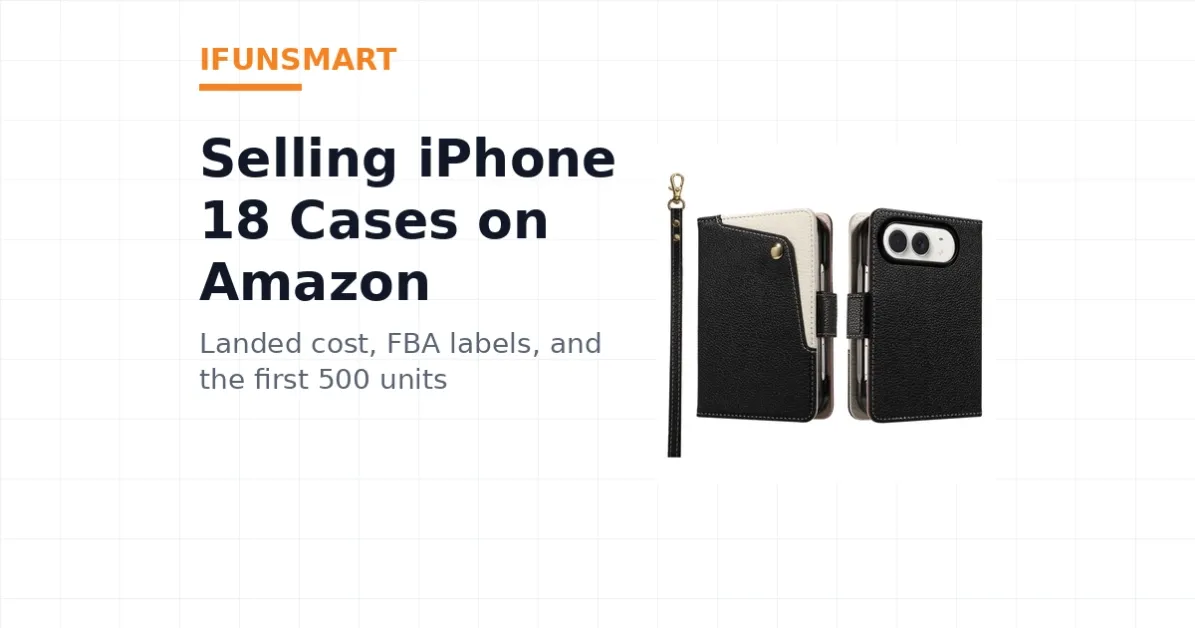
The short answer: In 2026 there is no $800 de minimis allowance for commercial imports into the US — every shipment to an Amazon warehouse is a formal, dutiable entry from the first dollar. Your cost per unit is landed cost, not factory price: factory price + freight + duty + broker + FBA prep, divided by sellable units. Plan the first order narrow — 3 to 5 styles, no more than 4 colours — approve samples first, and ask the factory to apply FNSKU labels before the goods leave China. Send model, style, quantity and country on WhatsApp https://wa.me/8613632248734 — we reply within 24 hours with MOQ, sample cost and lead time for that model.
- Landed cost — the only number that matters Landed cost per unit = (factory cost + freight + insurance + duty + broker fee + FBA prep) / sellable units. Duty is assessed on CIF — goods cost plus freight plus insurance — not on the factory invoice alone. That is why a cheap factory price with expensive freight can cost more than a higher factory price with cheaper freight. Compare suppliers on landed cost, not on unit price. Work through one order with real numbers before you commit: write down the factory quote, the freight quote, the duty line and the FBA prep fee, and add them up per unit.
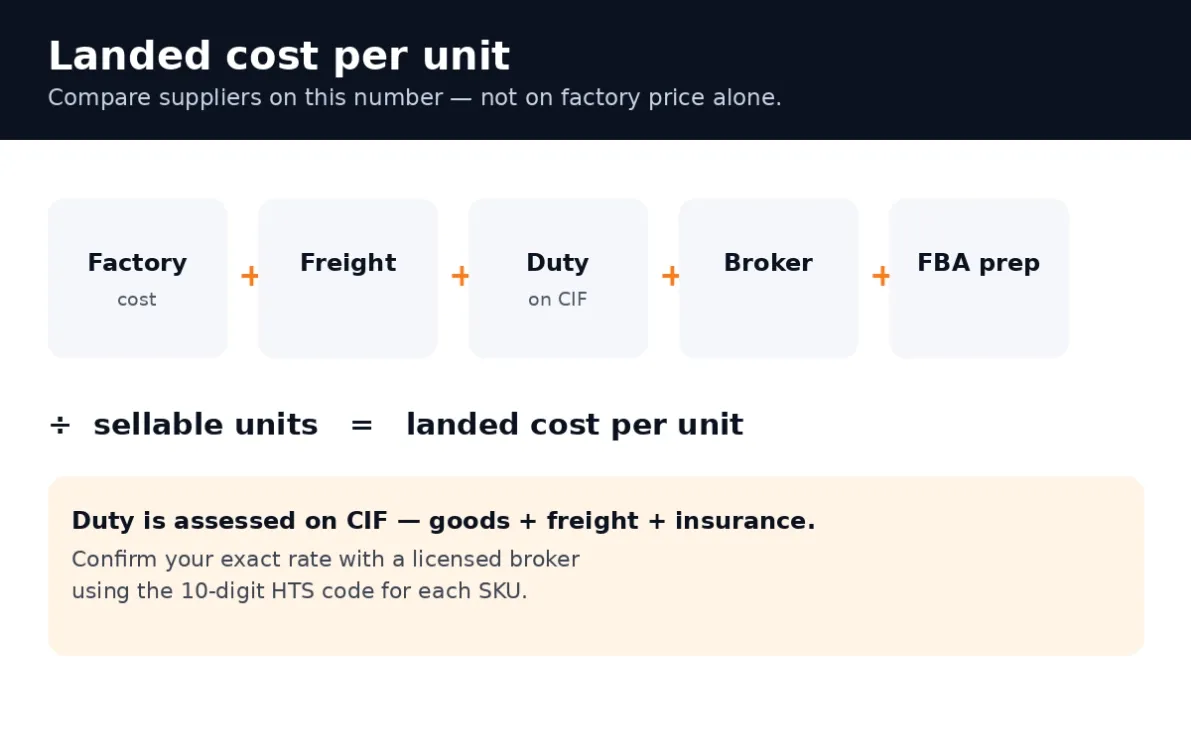
- Duty in 2026 — a stack, not a single rate US duty on Chinese-origin goods is a stack: the MFN base rate for the product's HTS code, plus the Section 301 surcharge for China, plus other applicable layers. For a plastic phone case, public guides put the HTS line at 3926.90, with a low single-digit MFN rate and a Section 301 List 3 surcharge that is materially larger — public FBA tariff guides describe the all-in effective rate for consumer electronics accessories as roughly 20-30% of declared value in 2026, as an indicative planning range. That range is NOT a quote for your product. Your exact rate depends on the precise 10-digit HTS code of each SKU, so confirm the classification with a licensed customs broker before you price or pay. One wrong digit can move the rate by ten points or more. Sources: https://www.dutycalc.online/fba-import-guide and https://union-delta.com/blog/amazon-fba-tariff-rates-2026/
- FBA labels — Amazon will not fix them for you Every sellable unit needs an FNSKU barcode. Every box needs a unique FBA Box ID label, within Amazon's weight limit. Since 1 January 2026 Amazon no longer applies unit labels for US FBA shipments, and AWD does not label or relabel either — the labels have to be right before arrival, or the shipment can be refused. Ask your supplier, in writing, before you pay: "Can you apply FNSKU labels at origin, and can you confirm the box and pallet labels?" If the answer is vague, do not ship. Ask for a photo of a labelled carton before dispatch.
- Air or sea — use air for the first order Air express is roughly 5-7 days door to door and is the right choice for a launch, an emergency restock, or a test order of 100-500 units. Sea freight is 25-40 days and is cheaper per kilo above roughly 100 kg — the right choice for a full season's stock once you know what sells. Phone cases are light and bulky, so freight is usually priced on volumetric weight, not actual weight. Ask for the carton dimensions and the volumetric divisor before you compare freight quotes.
- The first 500 units — narrow beats broad Pick 3 to 5 styles and no more than 4 colours. A narrow first order does three things: it keeps the MOQ honest (MOQ is per style and per colour), it lets you see which colour actually sells, and it limits the loss if one style is wrong. Order 1-5 samples first. Test them on a real handset: fit, button cutouts, magnet hold on your own charger and car mount, and wireless charging. It is much cheaper to reject a sample than a production run. Read more: https://www.ifunsmart.com/posts/phone-case-moq-explained and https://www.ifunsmart.com/posts/sample-order-list
- What to ask the factory before you pay Ask for these five things in writing, not in a chat message:
- A written quotation stating unit price, currency, Incoterm, MOQ, lead time and quote validity.
- A model and SKU list with piece counts.
- A build specification — material, magnet grade, finish.
- A production schedule with dates for artwork approval, production start, inspection and dispatch.
- Confirmation that FNSKU labels will be applied at origin, with a photo of a labelled carton before dispatch. If a supplier resists any of these, that tells you something useful. Read more: https://www.ifunsmart.com/posts/factory-or-trading-company
FAQ
What is the landed cost of a phone case from China? Landed cost per unit = factory cost + freight + duty + broker + FBA prep, divided by sellable units. Duty is assessed on CIF. Confirm your exact duty with a licensed broker using the 10-digit HTS code.
Do I still get the $800 de minimis allowance?
No — for commercial imports to the US, the $800 Section 321 allowance was suspended from 29 August 2025. Every commercial shipment is dutiable from the first dollar.
Can the factory apply FNSKU labels? Ask in writing before you pay. We can confirm labelling at origin for your order — send the model list and quantities and we confirm in writing.
What is the MOQ for iPhone 18 Pro Max cases? Ask us for MOQ & lead time for this model, with the exact model, style and colour count. Product: https://www.ifunsmart.com/phone-cases/2700gs-magnetic-case-iphone-18-pro-max
About iFunSmart
Ifun Electronics Technology Co., Ltd, Guangzhou, since 2010. 1,000+ designs, 500+ models, 500K+ pcs/month, exported to 30+ countries. Our 2700GS Magnetic Case for iPhone 18 Pro Max uses up to 2700 Gauss, N52 magnets. WhatsApp https://wa.me/8613632248734 — Email contact@ifunsmart.com