Business Solutions
MagSafe Cases: Magnet Grades, Arrays & What to Check
A magnetic case is decided by its grade, its array and its figure — not by one headline number. The N52, N50 and N52H grades, the Gauss and pull-force figures style by style, and five sample checks.
BLUF
A magnetic case is decided by three things — the magnet grade, the array inside the case, and the figure the product page states for that style. Ask for the grade and the figure in writing, per style, and check the sample against both.
Short answer
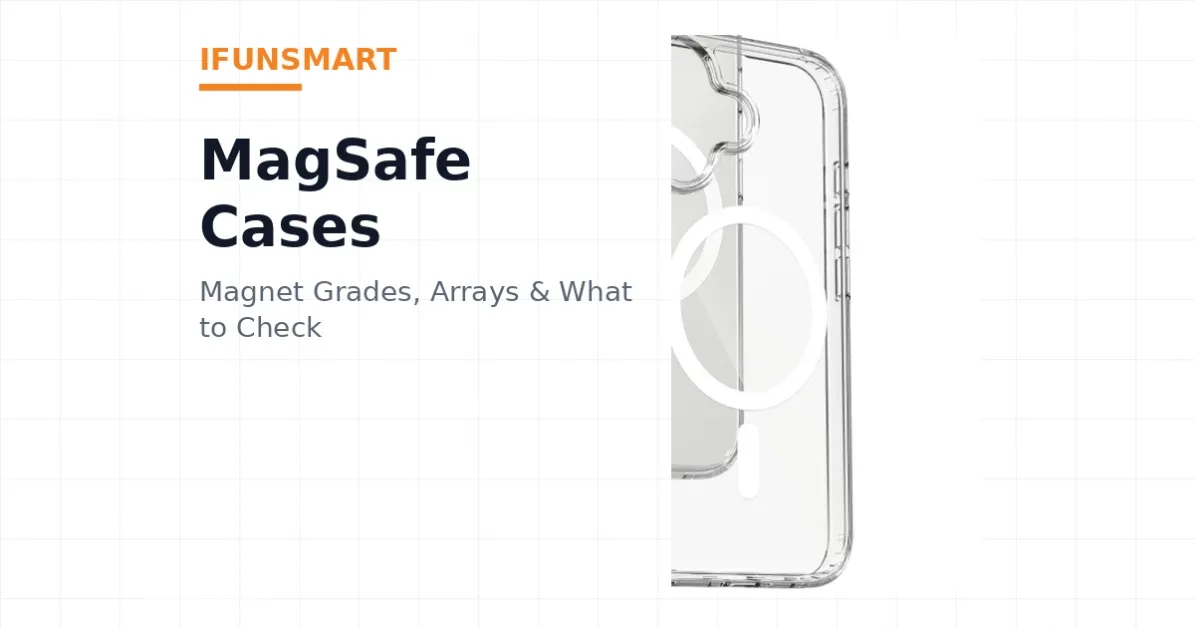
Every magnetic case in a product photo looks the same: a clear or coloured back, a ring you can see through the case, a charger that snaps on.
The grade is the first thing to ask for. N52 is the highest grade of neodymium magnet in common production — a material grade, measured as maximum energy product, about 49–53 MGOe depending on the table. N50 is one step below it. N52H is N52 with a heat class of about 120 °C. The grade describes the magnet material, not the finished case: two cases can both say N52 and hold very differently, because the ring size, the thickness, the magnet count, the placement and the gap to the charger all matter. A grade on its own is not a hold figure, and "strong magnets" is not a specification at all.
The figure is the second thing to ask for — and it comes in two different units that cannot be compared with each other. Gauss measures magnetic flux density at one point, read with a gaussmeter. Pull force, in grams-force or newtons, measures the force needed to separate the case from a defined target. A "2600 Gauss" case and a "2800gf" case are stating two different quantities, and no conversion turns one into the other without the geometry and the test rig. Every figure in this guide is the figure the product page states for that style, and only for that style. No blanket figure is applied to the whole range.
The third thing is what is inside the case: a ring of small magnets around the charging coil, plus a short tail below the ring that stops an accessory rotating; an alignment ring that centres the charger over the coil; a shielding layer that keeps the field away from the phone's compass and, on Samsung Ultra models, the S Pen; and the adhesive and carrier that hold the assembly flat against the back panel. None of these is visible in a product photo, and none of them is stated on most product pages — which is why they are asked for in writing, and checked on the sample.
The rest of this guide works through each of those three things in order, then the naming — "MagSafe", "MagSafe-compatible" or just "magnetic" — then charging speeds, then the styles that say "magnetic" but not "MagSafe", then the five sample tests, then what to ask in writing and what the first order looks like. The most common MOQ is 50 pcs per colour per model, and it varies by product line. Bulk and distributor orders start at 500 pcs per order in total. Samples carry a fee, refundable on orders of 500+ pcs — ask us to confirm the amount per style in writing. A 100-pc trial order can carry a logo by laser engraving. Payment is T/T and Western Union only, with a 30% deposit for new customers, photos and video and the packing list after the goods are ready, then the balance, then the goods ship.
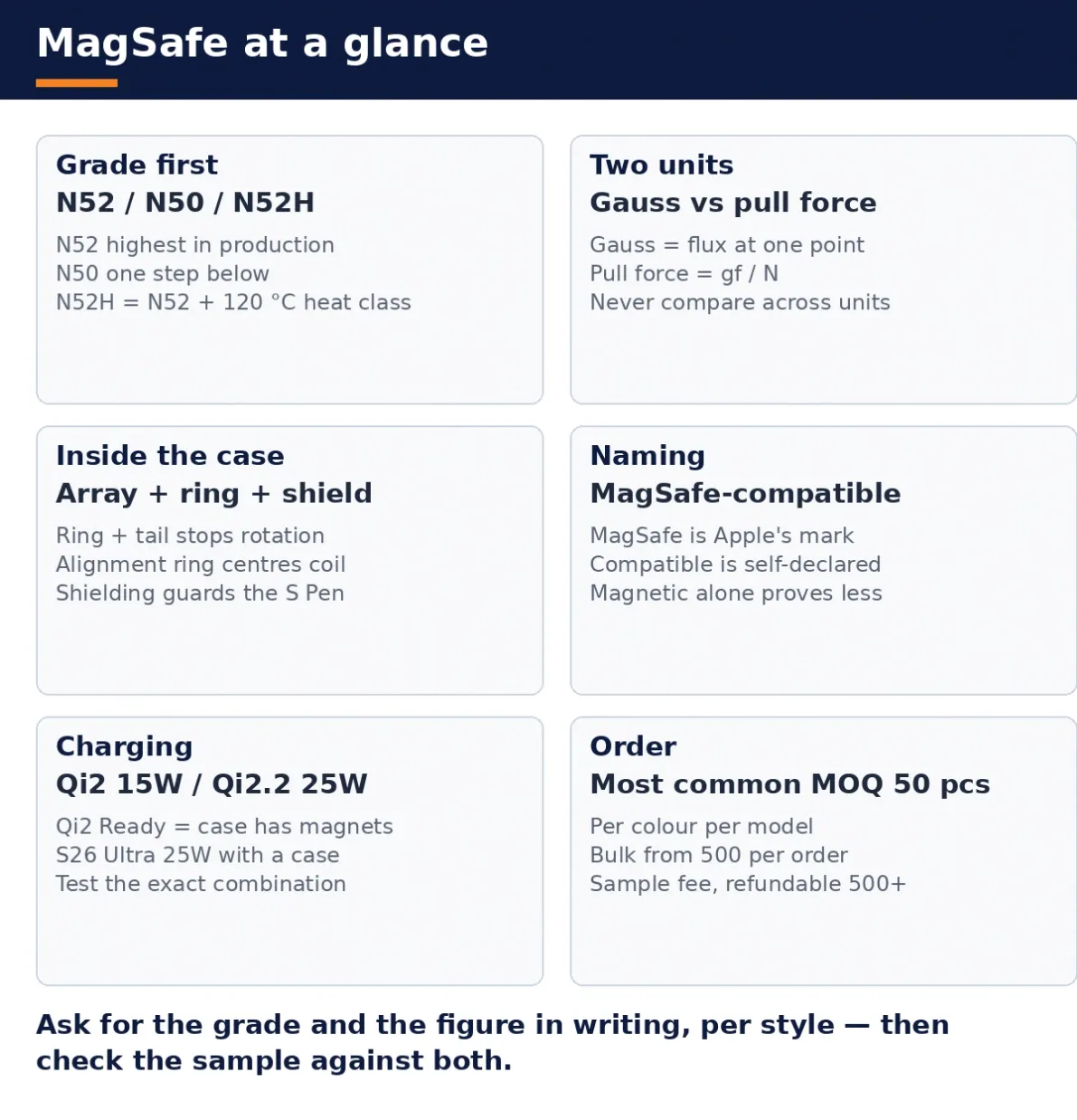
MagSafe at a glance
Check | What applies to the magnetic range |
|---|---|
Grades in the range | N52 (highest in common production), N50 (one step below), N52H (N52 + heat class about 120 °C) — grade is the material, not the finished-case hold |
Figures stated per style | Gauss (flux density at one point) or pull force in gf/N (separation force) — two different quantities, never compared across units |
What is inside | Magnet array (ring + tail), alignment ring, shielding layer, adhesive + carrier — none visible in a product photo |
Naming | "MagSafe" is Apple's trademark; third-party cases are "MagSafe-compatible" (self-declared); "magnetic" alone only says magnets are present |
Charging | Qi2 = 15W; Qi2 25W / Qi2.2 = 25W; Qi2 Ready phones have no built-in magnets — the case provides them |
MOQ | Most common 50 pcs per colour per model, varies by product line; 360° Full Protective is MOQ 100 |
Sample | Fee charged, refundable on orders of 500+ pcs — ask us to confirm the amount per style in writing |
Logo trial | 100-pc trial order can carry a logo by laser engraving — ask for the per-piece charge in writing |
Not on the shelf | Aramid — ask us; no per-style charging wattage stated; no plating, shielding or ring-diameter figures stated per style |
1. Which magnet grade should I ask for — N52, N50 or N52H?
The first question in a magnetic-case order is the grade, and it is the question most buyers never ask — because the grade is invisible. A charger snaps on, or it does not, and the buyer assumes the magnet is the same in every case that snaps. It is not. The grade is the specification that decides how much hold the same size of magnet can give, and it is the easiest specification to downgrade without anyone noticing, because nothing in the finished case shows it.
Neodymium magnets — NdFeB, neodymium-iron-boron — are the strongest class of permanent magnet in commercial production. The grade code is the letter N, a number, and sometimes a suffix letter. The number is the material's maximum energy product, (BH)max, in mega-gauss-oersteds (MGOe): N35 is about 33–36 MGOe, N42 about 40–43, N48 about 46–49, and N52 about 49–53, with the exact range depending on the table. N52 is the highest grade in common commercial production; standard commercial grades run from N35 to N55. The suffix letter is a temperature class, not a strength: no suffix means a maximum operating temperature of about 80 °C, M about 100 °C, H about 120 °C, SH about 150 °C. So N52H is N52 energy product with H-class heat resistance — about 120 °C — and it is a real, standard grade designation. N50 is a real standard grade one step below N52.
The grade ladder, in one table:
Grade | What it means | Where it appears in the range |
N52 | Highest grade in common production, about 49–53 MGOe | Most magnetic styles in the range — Clear Glitter, 3D Color Bar, Bayer, IB25-019, IB25-027, Premium Armor, the Mech Armor builds, Silky Touch and more. |
N50 | One step below N52 | 360° Rotating Ring Stand (18N), 360° Magnetic Ring Lens Flip Cover (no figure stated) |
N52H | N52 energy product, H heat class about 120 °C | Clear MagSafe Case N52H for iPhone 18 Pro Max — grade stated, no Gauss figure on the page |
N52SH | N52 energy product, SH heat class about 150 °C | Micro-Matte page, as part of "N56/N52SH cores" — see the N56 flag below |
"N56" | Not a standard NdFeB grade | Translucent Matte and Micro-Matte pages state it — ask the factory what is actually inside; this guide does not present it as a verified grade |
Two warnings. The first is treating the grade as the hold. It is not. The grade describes the magnet material; the hold of a finished case also depends on the ring size, the thickness, the magnet count, the placement and the gap between the ring and the charger. Industry tables show that, for identical geometry, N52 holds roughly a fifth more than N42 and roughly half as much again as N35 — but those are tables for identical geometry, and no two cases share identical geometry. A small N52 ring can hold less than a large N50 ring. Ask for the grade AND the figure, never the grade alone.
The second warning is the N56 flag. Two pages in the range — the Translucent Matte MagSafe case and the Micro-Matte MagSafe Holder, both for the iPhone 18 Pro Max — state "N56 magnets" or "N56/N52SH cores" with an 18N figure. N56 does not appear in standard NdFeB grade tables, which run from N35 to N55, and N52 is the highest grade in common production. This guide quotes the page wording and flags it: do not present N56 as a verified grade, and do not order on it. Ask the factory what is actually inside those two styles, in writing, before the deposit. The 18N figure is the page's own figure and is quoted as such; the grade is the part that needs confirming.
The rule for the order, in one line: ask for the grade in writing on the quotation, per style, and never accept "strong magnets" as a specification. A supplier who cannot name the grade cannot be checked on it, and a grade that cannot be checked is a grade that can be changed without telling you.
2. What does the Gauss number actually measure — and why can't I compare it with gf?
If the grade is the first thing to ask for, the figure is the second — and it is the one that causes the most confusion, because the same range states figures in two different units, and the two units measure two different things.
Gauss measures magnetic flux density at one point — usually the surface field at the centre of a pole face, read with a gaussmeter or Hall probe. One tesla is 10,000 gauss. The reading depends on the material, the grade, the shape, the size, the measurement point, the probe angle, the temperature and any nearby steel. A surface-gauss figure is incomplete unless everyone measures the same point the same way — and in practice, no two suppliers measure it the same way.
Pull force measures the peak force needed to separate the magnet from a defined target — a thick flat steel plate, or a charger or mount — under a defined test. It is stated in newtons (N), grams-force (gf), kilograms-force (kgf) or pounds-force (lbf). It is a system measurement, not a material property: it depends on the face area, the volume, the air gap and the return path. Two magnets with the same gauss reading can differ in pull force by a large factor, because pull grows with size while surface gauss stays roughly the same for the same shape.
A buyer cannot convert one into the other without the geometry and the test rig. Comparing a "2600 Gauss" case with a "2800gf" case is comparing two different quantities, and ranking styles by mixing the two units is ranking by a number that does not mean what it looks like. This guide states each style's figure in the unit the page states it in, and never converts one unit into the other to make a ranking. The only conversions in this guide are unit arithmetic used to check a page's own conversion — and one page's conversion fails that check, as the next paragraph shows.
The wrong conversion on two pages. The Magnetic Silky-Frosted Shockproof case for the S26 range states "2400gf of adsorption force" and its spec table adds "(approx 14N)". The Cherry Color MagSafe case for the iPhone 18 Pro states "2400gf (14N Force)". Both conversions are wrong: by definition, 2400gf is 2.4 kilograms-force, which is about 23.5 newtons — not 14. This guide quotes 2400gf only, and never repeats the 14N. A buyer who checks a sample against "14N" would be checking against a figure that is not what the page's own gram-force figure means. Check the sample against the gram-force figure, and ask us for the figure in writing per style.
The Gauss-figure styles — flux density, as the page states it:
Style | Figure as stated on the page | Models on the page |
2700GS Magnetic Case | Up to 2700 Gauss — no grade stated on the page | iPhone 18 Pro / Pro Max |
Clear Glitter MagSafe | 2600 Gauss, N52 magnets | S26 Ultra (featured), S25/S24, iPhone 11–17 |
Lanyard Corners MagSafe | 2600 Gauss, N52 grade | iPhone 17 & Samsung |
2400G Magnetic Stand | 2400 Gauss (Super Strong) — no grade stated | iPhone 17 & Samsung |
3D Color Bar Clear MagSafe | N52, 2600 Gauss, 12N attraction force | iPhone 17 (featured), 16/15, Samsung |
Clear MagSafe Integrated Stand | N52, 2600 Gauss, 12N attraction force (same wording as the 3D Color Bar design, second page) | iPhone 17 Air (featured), 16/15, Samsung |
Bayer Crystal Clear MagSafe | 2300–2600 Gauss, N52 grade (a range, not a single figure) | iPhone & Samsung series |
"The Explorer" Rugged MagSafe | N52, 2500–2800Gs | iPhone 17 Pro Max; iPhone & Samsung series |
The pull-force styles — separation force, as the page states it:
Style | Figure as stated on the page | Models on the page |
Magnetic Silky-Frosted Shockproof | 2400gf adsorption force, N52 (the page's "14N" conversion is wrong — quoted as 2400gf only) | S26 / S26+ / S26 Ultra |
Clear Magnetic Case | 12N (MagSafe Optimized) — no grade stated | iPhone 17 & Samsung, Moto, Google |
360° Rotating Ring Stand MagSafe | N50 magnets, 18N magnetic force | iPhone 17 & Samsung |
Matte Clear MagSafe Ring Stand | N52 magnets, 2800gf suction force | iPhone 17 Air |
Clear Acrylic Invisible Stand IB25-019 | N52, 1500g force (the lowest pull-force figure on the site) | iPhone Air / 17 / 16 / 15; Samsung S26/S25/A; Moto & Google |
Clear MagSafe Invisible Ring Stand | N52, 2800gf suction force | iPhone 16 / 16 Pro / 16 Pro Max |
Camera Lens Stand IB25-027 | N52, 2800gf suction | iPhone & Samsung series |
Premium MagSafe Armor | N52 magnetic ring, 18N magnetic force | iPhone 18 Pro Max |
Translucent Matte MagSafe | 18N, page states "N56 magnets" — N56 is not a standard grade; ask the factory what is inside | iPhone 18 Pro / Pro Max |
Micro-Matte MagSafe Holder | 18N, page states "N56/N52SH cores" — same N56 flag | iPhone 18 Pro Max |
Cherry Color MagSafe | 2400gf (the page's "14N" conversion is wrong — quoted as 2400gf only) | iPhone 18 Pro |
Three notes on these two tables. First, the same number appears on different styles: 2800gf is stated for the Matte Clear Ring Stand, the iPhone 16 Invisible Ring Stand and the IB25-027 — the same number, three different styles, and it must be stated per style, never carried across. Second, the lowest pull-force figure on the site is the IB25-019 at 1500g, about 14.7N — but do not rank styles by this number alone, because the geometries differ and the figure is only one part of the hold. Third, the 2700GS is the highest Gauss figure on the site, and its page states no grade at all — do not attribute N52 to it from the page. Our own MagSafe test guide works with the 2700 Gauss figure and its own three tests; the page figure is quoted here as the page states it.
The grade-only styles — grade stated, no figure.
A long list of styles states a grade with no figure at all: the Mech Armor builds IB25-017 and IB25-018, the Heavy Duty Armor IB25-016 and IB25-015, the Heavy Duty Mecha IB25-028 for the S25 Ultra, the Cloud Mirror IB25-014, the 360° Rotating MagSafe Case for iPhone 17 & Samsung, the Silky Touch, the Silky Matte with Ring Stand for the S26 Ultra, the Matte MagSafe Mechanical Gear Ring Stand for the 17 Pro Max, the Matte MagSafe Rotating Stand IB25-021 for the S25 Edge, the 12FT Drop Clear MagSafe, the Pure Collection Clear MagSafe, the Crystal Clear MagSafe Color Bumper, the Silky Matte MagSafe Shockproof, the Detachable Metal Buttons case for the 18 Pro Max, the MagSafe Metal Kickstand Clear for the 18 Pro, the MagSafe Invisible Stand Duo, the Smoke MagSafe Duo 360° Ring Stand, the Electroplated Fold Cover for the Z Fold 7 and Huawei Mate X, and the Qiying Gen 1 for the iPhone Duo — which states its array differently, as "over 38 N52 magnetic rings inside the back panel", a ring count rather than a force figure, and the clearest live example of an array in the range. For every one of these styles, the figure is "ask us": the grade is confirmed, the hold figure is not, and the sample is checked against the figure the factory confirms in writing — never against a figure borrowed from another style.
3. What is inside the case besides the magnet?
A magnetic case is not one magnet glued to a back panel. It is four components working together, and a failure in any one of them shows up as a case that "doesn't hold" even when the grade is right. None of the four is visible in a product photo, and none of them is stated on most product pages — which is why this section exists, and why each component is asked for in writing rather than assumed.
The four components, what each does, and what goes wrong when it is cheap:
Component | What it does | What goes wrong when it is cheap |
Magnet array | A ring of small NdFeB magnets arranged around the charging coil, plus a short vertical tail below the ring | Missing or shortened tail — a wallet or mount spins freely around the ring; ring diameter off by a millimetre or two — the charger attaches but the coil sits off-centre, so charging is slower and hotter |
Alignment ring | Centres the charger over the coil so it snaps to the right place on its own | A charger you have to slide into place is not aligned; the coil sits off-centre and the phone throttles the charge |
Shielding layer | Keeps the magnetic field away from the phone's internals | Compass interference; S Pen tracking errors on Samsung Ultra models, where the pen digitizer sits near the pen silo |
Adhesive and carrier | Holds the assembly flat against the back panel | A plate that lifts or rattles after months of use is a carrier or adhesive failure, not a grade failure |
The array is the component the range itself corroborates: the Qiying Gen 1 page for the iPhone Duo states "over 38 N52 magnetic rings inside the back panel" — a ring of many small magnets, not one magnet. The tail is the part buyers never ask about and should: the tail below the ring is what stops an accessory rotating around the ring axis, and a wallet or car mount that spins freely is usually a tail problem, not a grade problem. Ask whether the array has a tail, and how long it is, in writing.
The shielding layer matters most on Samsung Ultra models. The S Pen digitizer sits near the pen silo at the lower-left of the body, and an array placed over it — or a case with no shielding between the array and the phone — can cause tracking errors when the pen is used. The mitigation is either shielding or array placement that clears the silo. Our own product pages do not state shielding presence, ring diameter or tail length for any style — all of it is "ask us" — and the sample check in section 7 tests for the S Pen effect directly, on the bench, with the pen in hand.
The adhesive and carrier are the quiet failure. A case that holds perfectly on day one and rattles after three months has not lost its grade — the magnets do not age that way. It has lost its fixing: the plate has lifted from the back panel, or the carrier has flexed. The bench check for this is time, not force: keep one sample on a charger for a week, take it on and off daily, and check whether the ring sits flat and silent at the end of it. A case that cannot survive a week on the bench will not survive a season in a shop.
One more thing the pages do not state: plating. Neodymium magnets are normally plated — nickel-copper-nickel is the common stack — because the bare material corrodes. No iFunSmart page states the plating on its rings, and this guide does not claim one. Ask for it in writing if the channel sells into a humid market, and check the sample for corrosion at the ring edge after the week-long bench test.
- Is this case “MagSafe”, “MagSafe-compatible” or just “magnetic”?
MagSafe is Apple's trademarked magnetic attachment and wireless-charging system, introduced with the iPhone 12 in October 2020 (the name dates to the 2006 MacBook charger). Only Apple, or companies specifically licensed by Apple under the “Made for MagSafe” programme, can legally call a product “MagSafe”. Third-party magnetic accessories that use the same ring geometry are “MagSafe-compatible”. That is a self-declared word — no certification body policies it — and it is not the same as being an officially licensed MagSafe accessory. A compatible charger, for example, may only deliver 7.5W where a real MagSafe charger delivers 15W, and there is no guarantee of interoperability. “Magnetic” alone proves even less: it only says magnets are present. It may be a charging ring, a ring stand, a clasp, or a wallet closure — and the magnet's job is different in each case.
This guide describes iFunSmart cases as “MagSafe-compatible magnetic cases” or “magnetic cases with an N52 ring”. It never claims iFunSmart holds a MagSafe licence or certification, because no such claim was verified. Note that many iFunSmart product-page titles say “MagSafe” — that is the site's wording, not a certification claim, and this guide does not repeat it as one. On an order, the wording should say “magnetic case, N52 ring, Qi2 Ready” for a Samsung model, rather than “MagSafe” — because the wording on the order is the wording the buyer is held to.
The own-text test.
The reliable way to tell what a page actually claims is to read the page's own text — its title, description and spec table — and ignore the navigation, the footer and the related-products carousel, which mention MagSafe site-wide. By that test, a long list of styles in the range say “magnetic” but never say “MagSafe” for the product itself. The Star Grid R2 has a magnetic 360° ring stand and no figure. The Star Origin R2 Magnetic Stand has a built-in magnet ring and no figure. The Bear Hug 2.3 for the S26 Ultra has a centred magnetic ring and no figure. The Liquid Silicone Magnetic cases for the 18 Pro Max and the Duo, the Tech Fabric Magnetic case, the Cloud Feel Airbag Magnetic for the 18 Pro Max, the Hidden 360° Rotating Bracket Magnetic, the Gold Shield Skin-Feel Magnetic Duo, the Skin-Feel Magnetic Ring Duo, the Magnetic Ring Stand Armor for the 18 Pro with its sliding camera cover, the Starry Magnetic for the 18 Pro Max with its card holder and slide camera cover, the Space Shell Magnetic and Space Shell Magnetic Mid-Axis for the Duo, the Wing R2 Bracket Magnetic and Wing B Pivot Magnetic, and the three S27 matte cases — all state a magnet ring and no figure, and none of them uses the word MagSafe for the product itself.
The clasp is not a charging ring.
A second distinction matters as much as the first. The leather wallet and folio styles — the Calfskin Magnetic Folio, the Dreamy Magnetic Folio, the Litchi Premium and Litchi Two-Tone Magnetic Wristlet Folios, the R20 Leather Wallet with its magnetic clasp, the Magnetic Closure Folio Leather Wallet, the Leather Wallet for the A27/A37/A57 range, the Microfiber Leather Wallet for the 18 Pro, and the RFID Leather Wallet for the A07/A17/A37/A57 range — all use a magnet as a clasp, to hold the folio shut. That magnet does not charge a phone, does not hold a charger, and must never be listed as a magnetic-charging case. A buyer who orders a folio expecting a charging ring has ordered the wrong product, and a supplier who lists a clasp magnet alongside charging rings without saying so is listing two different jobs under one word.
The Spring Hinge correction.
The brief for this article assumed the Spring Hinge pages said “magnetic” only. The live pages say otherwise: the two skin-feel Spring Hinge pages do say “Compatible with MagSafe” in their body text, with the line “a magnet ring in the back lines up with the coil, so magnetic chargers, wallets and mounts attach firmly”. Only the two other Spring Hinge pages — the Crystal Clear Magnetic Duo and the Skin-Feel Magnetic Ring Duo — say “magnetic” only in their own text. The distinction is worth stating plainly, because it is the kind of detail a distributor checks on the page before the order, and a guide that gets it wrong loses the buyer's trust on everything else in it.
Does the naming matter to the end buyer? It matters to the buyer who sells a charger alongside the case. A “MagSafe-compatible” case and a “Made for MagSafe” charger will work together in most combinations — but the wattage, the alignment and the interoperability are not guaranteed by the word, and the sample test in section 7 is the check that replaces the guarantee. Sell the combination, not the word.
- Will it charge at 25W? Qi2, Qi2.2 and Qi2 Ready
The magnet ring and the charging speed are related, but they are not the same thing — and the confusion between them is the second most common mistake in a magnetic-case order, after the Gauss-versus-pull-force confusion in section 2.
Qi2 is the Wireless Power Consortium's standard, launched in November 2023, built on Apple's MagSafe magnetic profile: the Magnetic Power Profile (MPP), a ring of magnets that auto-aligns the coils. Qi2 charges at 15W. Qi2 25W — Qi version 2.2.1, branded “Qi2.2” — charges at 25W, under a WPC release dated 23 July 2025, described as nearly 70% more power than the original Qi2, reaching 0–50% in about 30 minutes with matching equipment. “Qi2” does not mean 25W: 25W needs a Qi2.2 or Qi2 25W charger and a matching phone — the iPhone 17 and 18 Pro models reach 25W with a Qi2.2 charger, and the Pixel 10 Pro XL reaches 25W.
“Qi2 Ready” is Samsung's term, and it means the phone has no built-in magnets — the magnet lives in the case. Galaxy S26 phones are listed at the baseline BPP profile; their magnet cases carry the MPP25 profile. The S26 Ultra charges at 25W Qi2.2 with a magnetic case — verified in our own S26 and S26 Ultra magnetic guides. The case's magnet ring does not by itself certify a charging speed. The phone, the case, the charger and the adapter together decide the wattage, and the exact combination is tested on the sample.
That is the practical rule for a distributor: never sell a wattage on the strength of the case alone. A case with an N52 ring and a 2800gf figure does not make a phone charge at 25W — the phone and the charger have to be 25W parts too, and the ring has to centre the coil over the phone's coil. The sample test in section 7 checks the alignment and the heat, which are the two things the case actually controls. Everything else is the phone's and the charger's job, and the listing should say so.
Two things this guide does not state. First, no per-style charging wattage through the case is stated on any iFunSmart page, so none is stated here — ask us, and test the exact combination. Second, one Qi2.2 OEM guide reports that the MPP specification requires a minimum magnet-array diameter of 45.7 mm and 2.5–6.5 N of snap force. That is vendor-reported, not primary-source verified, and it is not stated here as a WPC fact. If a buyer asks for the array diameter, the answer is to ask us for the figure per style in writing.
- The styles with no figure at all — and what to do about them
Not every magnetic style in the range states a figure. A long list states a grade — usually N52 — and no figure, and a second long list states a magnet ring and neither a grade nor a figure. These are not bad styles. They are styles whose hold has not been written down, and a distributor orders them differently from a style whose figure is on the page.
The grade-only styles are listed in section 2: the Mech Armor builds, the Heavy Duty Armor builds, the Cloud Mirror, the Silky Touch, the Silky Matte with Ring Stand, the 12FT Drop Clear MagSafe, the Pure Collection Clear MagSafe, the Crystal Clear MagSafe Color Bumper, the Detachable Metal Buttons case, the Metal Kickstand Clear, the Invisible Stand Duo, the Smoke MagSafe Duo ring stand, the Electroplated Fold Cover and others. For each of them, the grade is confirmed and the figure is “ask us”. The order asks for the figure in writing before the deposit, and the sample is checked against the figure the factory confirms — never against a figure borrowed from another style, and never against the 2700 Gauss N52 figure, which belongs to the test guide and to no style’s page as a range-wide claim.
The no-grade-no-figure styles are the “magnetic, not MagSafe” list from section 4 — the Star Grid R2, the Star Origin R2, the Bear Hug 2.3, the Liquid Silicone Magnetic cases, the Tech Fabric Magnetic, the Cloud Feel Airbag Magnetic, the Hidden 360° Rotating Bracket Magnetic, the Gold Shield and Skin-Feel Magnetic Duo styles, the Magnetic Ring Stand Armor, the Starry Magnetic, the Space Shell Magnetic pair, the Wing R2 and Wing B, and the three S27 matte cases. For these, both the grade and the figure are “ask us”. They are ordered on the strength of the sample test in section 7, not on the strength of a number — and the sample test is the whole order, because there is no number to check against.
One more gap to state plainly. No aramid case exists anywhere on the site, for any model. The Carbon-Fibre Texture Magnetic case with its 360° rotating ring stand is a texture, not aramid fibre — if a buyer asks for an aramid magnetic case, the answer is to ask us, not to order the texture case as aramid. The same discipline applies to the “MagFit Compatible” wording on two pages (the Crystal Clear MagSafe Color Bumper and the Silky Matte MagSafe Shockproof): “MagFit” is a vendor term, not a standard and not a certification, and this guide does not explain it as one.
- How to test the magnet on a sample — five bench checks
No first order becomes a bulk order without a sample, and no sample is approved without a bench check. The magnet is the part of the case the end buyer tests every day, so the sample is tested the way the end buyer will test it — with a charger, a mount and a wallet, on the bench, in factory QC language, not as a consumer using the phone.
The five bench checks, in order:
- The alignment snap. Put the case on the exact model ordered, hold a MagSafe charger a few millimetres above the back, and let go. The charger should snap to centre on its own, with no sliding and no nudging. A charger you have to slide into place is not aligned, and a coil that sits off-centre charges slower and hotter. Check it with the charger the channel actually sells, not with a different charger — the alignment is a property of the combination, and a case that aligns with one charger may not align with another.
- The rotation twist. With the charger attached, twist it gently around the ring axis. It should resist the twist and return to centre. A wallet or mount that spins freely around the ring is a tail problem — the short vertical tail below the ring is missing or shortened — and it is reported with the style and the accessory named. Test it with a wallet as well as a charger, because the wallet is the accessory that spins first in the shop.
- The hang test. Attach the charger, hold the phone by the charger cable, and let the phone hang. It should hold. Then attach a magnetic car mount, hold the case by the mount, and shake it once, gently, on the bench. A case that drops the phone on the bench will drop it in the car. Check the sample against the per-style figure where the page states one — 2800gf for the Matte Clear Ring Stand, the iPhone 16 Invisible Ring Stand and the IB25-027; 2400gf for the Silky-Frosted and the Cherry Color; 1500g for the IB25-019; 12N for the Clear Magnetic Case; 18N for the 360° Rotating Ring Stand and the Premium Armor — and against no figure at all where the page states none. Never apply one style’s figure to another style.
- The vibration and heat check. Put the case on the phone, attach the charger, and charge from 20% to 50% on the bench, with the phone resting on the charger and the room at normal temperature. Check two things at the end: that the charger is still centred, and that the back of the case is not hot to the touch. A charger that has drifted off-centre during the charge, or a case that runs hot, is a case whose array is not holding the coil where it belongs. Do not measure the wattage from the case alone — the phone, the charger and the adapter decide it together — but do check that the case is not the reason the charge throttled.
- The S Pen and compass check. On a Samsung Ultra model, take the S Pen out and draw a slow line across the screen with the case on, then take the case off and draw the same line. If the line wavers or breaks with the case on and runs clean with it off, the array is interfering with the pen digitizer — report it with the model and the style named, and ask for the shielding or the array placement in writing. On any model, open the compass app with the case on and turn the phone slowly through a full circle; a compass that jumps or sticks with the case on is a shielding problem. These two checks take two minutes and save a return.
Samples carry a fee, refundable on orders of 500+ pcs — ask us to confirm the amount per style in writing. Approve the sample in writing, with the sample reference, the model, the style, the colours and the logo method stated. A sample approved by message is a sample that cannot be traced; a sample approved in writing is the reference for the bulk run. Keep one sample on a charger for a week, taking it on and off daily, and check at the end of the week whether the ring sits flat and silent — a plate that lifts or rattles after a week on the bench is a carrier or adhesive failure, and it is reported before the bulk order, not after it.
- What to ask in writing — and what the first order looks like
A magnetic-case order is agreed in writing before the deposit, not after it. The quotation is the document that carries the magnet specification, and a quotation that does not state the grade and the figure cannot be checked — which is the same reason a quotation that shows a single lump-sum price with no line items cannot be checked. Ask for the quotation line by line: the model, the style, the colour, the quantity, the MOQ per line, the magnet grade, the magnet figure and how it was measured, the sample fee, the logo method and its per-piece charge, the packaging, and the payment terms.
The eight questions to ask in writing, before the deposit:
- What is the magnet grade for this style, in writing on the quotation? N52, N50 or N52H — per style, not for the range. If the page states no grade, the quotation states it.
- What is the figure for this style, and how was it measured? Gauss or pull force, in the unit the page states it in, with the measurement point or the target named. If the page states no figure, the quotation states it — never a figure borrowed from another style.
- What is inside the case — array, alignment ring, shielding, carrier? Ring count or ring diameter, tail length, shielding presence, and how the assembly is fixed to the back panel. If the page does not state them, the quotation states what was agreed.
- Is the case “MagSafe-compatible” or “magnetic”, and what does the wording on the order say? The order wording should say “magnetic case, N52 ring, Qi2 Ready” for a Samsung model, rather than “MagSafe” — because the wording on the order is the wording the buyer is held to.
- What charging speed does the exact combination reach? The phone, the case, the charger and the adapter together — tested on the sample, not promised from the case alone.
- Will the magnets affect the S Pen or the compass on this model? Asked per model, and checked on the sample with the pen in hand.
- What is the MOQ per line, and what is the sample fee? The most common MOQ is 50 pcs per colour per model, and it varies by product line — the 360° Full Protective is MOQ 100, not 50, and it is the only magnetic case page with MOQ 100. Samples carry a fee, refundable on orders of 500+ pcs — ask us to confirm the amount per style in writing.
- What does the logo trial cost, and what packaging travels with the order? A 100-pc trial order can carry a logo by laser engraving, which is permanent — silk-screen fades and needs a higher MOQ. The per-piece charge for the laser engraving is confirmed in writing per order; this guide states no figure, because the figure is confirmed per order. Neutral packaging is usually in stock, and a logo sticker can be added to it. Custom packaging is available — ask us to confirm the packaging options and the packaging MOQ per style in writing.
The first-order shape.
Start with the styles whose figures are on the page, because those are the styles the sample can be checked against: the Clear Glitter at 2600 Gauss N52, the 3D Color Bar at 2600 Gauss and 12N, the Clear Magnetic Case at 12N, and one 2800gf style — the Matte Clear Ring Stand, the iPhone 16 Invisible Ring Stand or the IB25-027 — in three or four colours on the model the channel moves first. Add the 2700GS for the 18 Pro Max buyer who asks for the highest Gauss figure on the site, with the grade asked for in writing. Add one grade-only style — a Mech Armor build, for the rugged buyer — with the figure asked for in writing before the deposit. Count the lines before the deposit, because the line count is the order size: four styles in four colours on one model is already sixteen lines at the most common MOQ, and a range that runs two models deep multiplies fast. Bulk and distributor orders start at 500 pcs per order in total, so a first order built this way is a bulk order from the first carton — which is the point: the magnetic case is a volume line, and the order should look like one.
Payment and shipment, agreed in writing.
The payment terms are agreed in writing before the deposit — not after it. Payment is T/T and Western Union only. New customers may pay a 30% deposit first. After the goods are ready, the factory sends photos and video and the packing list. The customer pays the balance, then the goods ship. No other payment methods are offered, and no other sequence is used. Ask which documents travel with the goods and which your broker must arrange, before the goods ship. The commercial invoice, the packing list and the certificate of origin travel with the goods, and the packing list should match the invoice line by line — model, style, colour, quantity, weight — because a mismatch between the packing list and the declaration is the most common reason a shipment is held for inspection. A document that is missing at the port is a shipment that waits at the port.
Frequently asked questions
What magnet grade should I ask for in a MagSafe case?
Ask for N52, and ask for it in writing on the quotation, per style. N52 is the highest grade of neodymium magnet in common production, about 49–53 MGOe, and it is the grade stated on most magnetic styles in the range. N50 is one step below it, and N52H is N52 with a heat class of about 120 °C. But the grade is the material, not the finished-case hold — the ring size, thickness, magnet count, placement and gap to the charger all matter too — so always ask for the grade AND the figure, never the grade alone, and never accept “strong magnets” as a specification.
What is the difference between a Gauss figure and a pull-force figure?
Gauss measures magnetic flux density at one point, read with a gaussmeter. Pull force, in grams-force or newtons, measures the force needed to separate the case from a defined target. They are two different quantities and cannot be converted into each other without the geometry and the test rig. A “2600 Gauss” case and a “2800gf” case cannot be ranked against each other, and this guide states each style’s figure in the unit its product page states it in. One more thing to watch: two pages in the range convert 2400gf to “14N”, which is wrong — 2400gf is about 23.5 newtons — so check the sample against the gram-force figure, never the 14N.
What is the MOQ for MagSafe cases?
The most common MOQ is 50 pcs per colour per model, and it varies by product line — ask us to confirm the MOQ per style in writing before the deposit. The one exception in the magnetic range is the 360° Full Protective case, which is MOQ 100 pcs per colour per model. Bulk and distributor orders start at 500 pcs per order in total. Count the lines before the deposit: four styles in four colours on one model is already sixteen lines at the most common MOQ.
Can I put my logo on a 100-pc MagSafe case trial order?
Yes. A 100-pc trial order can already carry a logo by laser engraving, which is permanent — silk-screen fades and needs a higher MOQ. Ask for the per-piece charge and the artwork position in writing on the order; this guide states no figure, because the figure is confirmed per order. Neutral packaging is usually in stock, and a logo sticker can be added to it. Approve the sample in writing first, with the logo method stated, and the trial runs with the first production run.
What should a MagSafe case quote show — and what does it cost?
A quote should show, line by line: the model, the style, the colour, the quantity, the MOQ per line, the magnet grade, the magnet figure and how it was measured, the sample fee, the logo method and its per-piece charge, the packaging, and the payment terms. The price for an order is confirmed per style, per model, per colour and per quantity, in writing, on the quote — and this guide states no price anywhere, because no price was confirmed for these styles. A quote that shows a single lump-sum price with no line items is a quote that cannot be checked. Ask for the current production window in writing on the quote — no day figure in this guide, because no day figure was verified.
About iFunSmart
iFunSmart — Ifun Electronics Technology Co., Ltd, Guangzhou, China — has made phone cases as an OEM and ODM manufacturer since 2010, with 1000+ designs, 500+ models and 500K+ pcs a month capacity, exported to 30+ countries. The factory is at Yongning Street, Zengcheng District, Guangzhou, Guangdong 511340. The most common MOQ is 50 pcs per colour per model and it varies by product line. Bulk and distributor orders start at 500 pcs per order in total. Samples carry a fee, refundable on orders of 500+ pcs — ask us to confirm the amount per style in writing. A 100-pc trial order can carry a logo by laser engraving. Payment is T/T and Western Union only, with a 30% deposit for new customers, photos and video and the packing list after the goods are ready, then the balance, then the goods ship. We reply within 24 hours.
To start a MagSafe case order, send the models, the styles, the colours and the quantities, and the destination: contact@ifunsmart.com or WhatsApp +86 13632248734.
Read more