Business Solutions
TPU vs PC vs Liquid Silicone vs Leather — Which Phone Case Material Should You Order?
TPU, PC, liquid silicone or leather? Feel, protection, yellowing and print options compared — so you order the material your customers actually want.
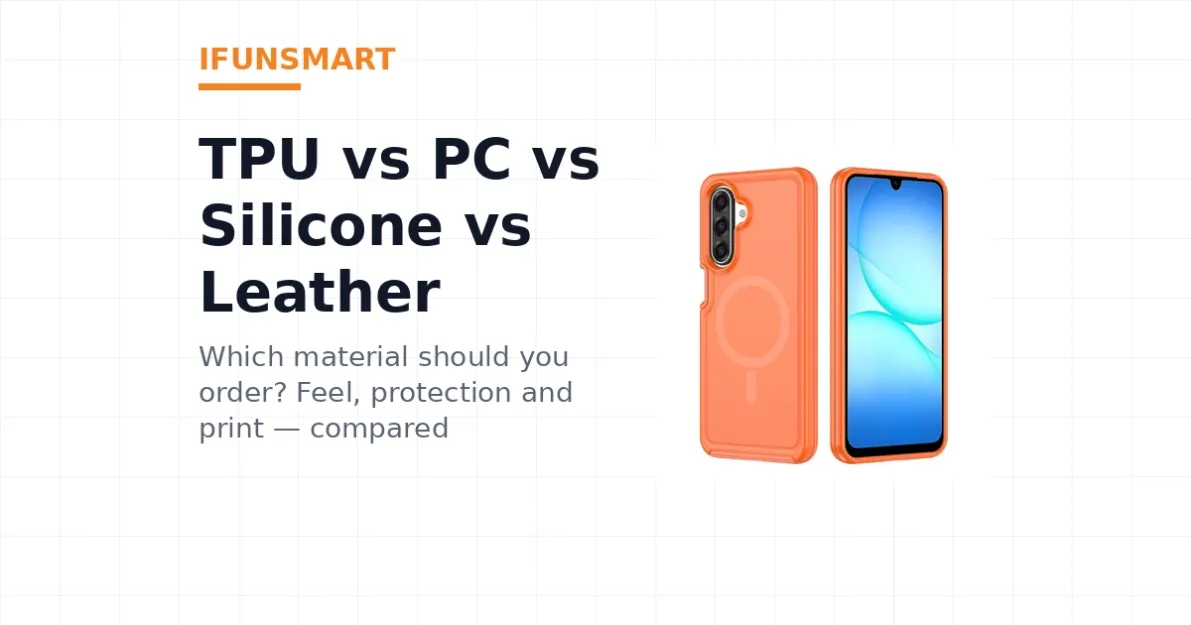
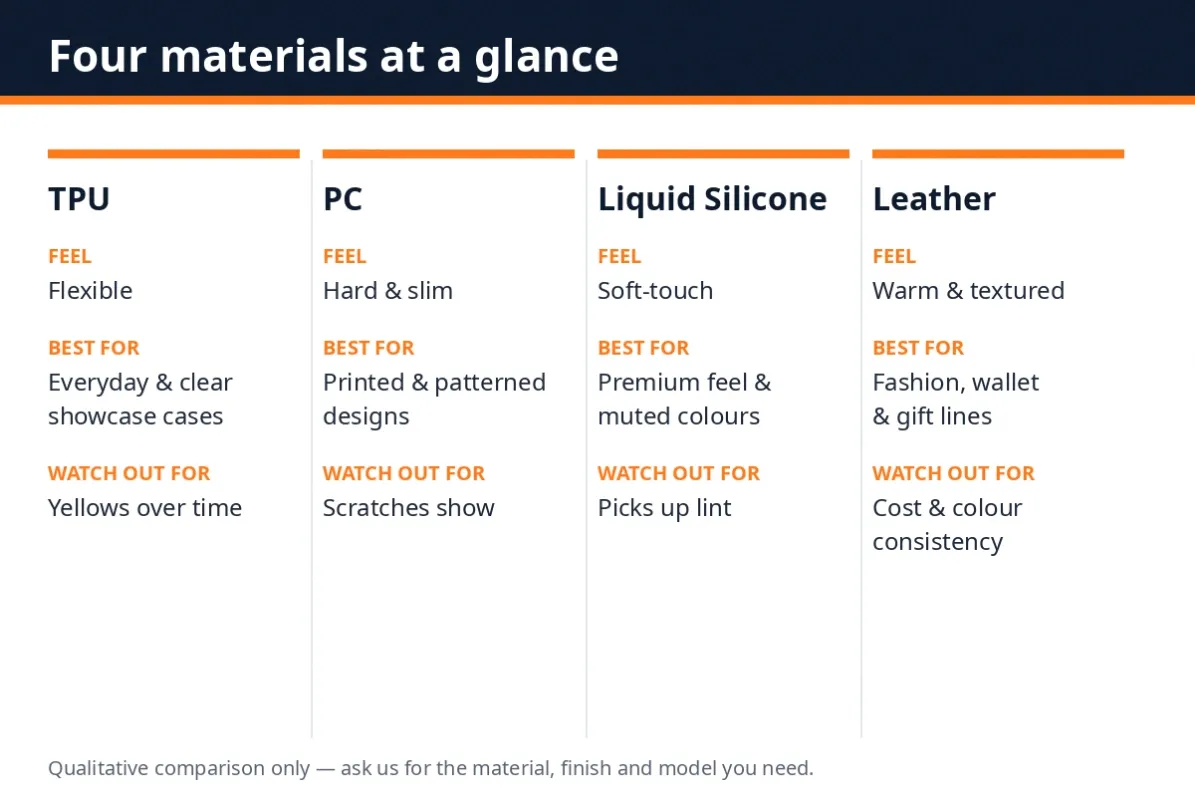
The short answer: No single material is best — the best one depends on your customer. TPU is the flexible all-rounder that shows off the phone and takes colour well, but clear TPU yellows over time. PC is the hard, slim shell for crisp prints and a clean look, but it is rigid and can scratch. Liquid silicone is the soft-touch premium feel buyers reach for again and again, but it picks up lint. Leather is the fashion and gift choice — warm, textured and premium-looking, but the most expensive to make well. Order the material that matches how your customer uses the case. Send the material and model list on WhatsApp https://wa.me/8613632248734 — we reply within 24 hours with MOQ, sample cost and lead time for that model.
1. TPU — the flexible all-rounder
TPU, thermoplastic polyurethane, is the workhorse of the phone case world. It is flexible, slightly soft to the touch, and it bends without cracking — the default for everyday clear and slim coloured cases. It goes on and off easily, grips well, and absorbs everyday knocks better than a hard shell, because the material gives a little on impact.
TPU takes colour and print well. Solid colours look deep and even, and clear TPU shows the phone itself, which is exactly what many buyers want: the phone's own design, protected but visible. That is why clear TPU is the go-to showcase style for new phone launches.
The one honest weakness is yellowing. Clear TPU discolours over time — sunlight, heat and everyday handling gradually turn it yellow. Good material and good production slow the change, but no clear TPU stays perfectly clear forever, and any supplier who promises otherwise is overselling. Tell your customers plainly: it is a material property, not a defect. Read more: https://www.ifunsmart.com/posts/clear-phone-case-anti-yellowing-test
2. PC — the hard, slim shell
PC, polycarbonate, is the hard plastic shell. It is rigid, thin and light, and it holds a precise shape — the right choice when design matters more than cushioning. A PC case feels firm and clean in the hand, it slides easily in and out of a pocket, and it keeps a slim profile even on a large phone.
PC is the best material for printing. Its hard, smooth surface takes full-colour prints, patterns and photo-quality designs with sharp edges and no distortion — which is why most printed, patterned and artwork cases are PC, or a PC back with a TPU frame.
The trade-offs are the mirror image of TPU. PC is rigid, so it does not absorb knocks the way a flexible material does — a hard shell transfers more of an impact, and it can crack under a sharp blow where TPU would bend. It also scratches: a glossy PC back shows fine scratches sooner than a matte or soft-touch finish, so ask for a matte or textured finish.
3. Liquid silicone — the premium soft touch
Liquid silicone is the soft-touch material buyers notice the moment they pick the case up. It feels smooth, warm and slightly grippy — not sticky, but secure in the hand — and it has a premium, almost velvety finish that photographs well and feels expensive. That feel is why silicone cases sell at the top of a range.
Inside, a good liquid silicone case has a soft lining — usually a microfibre layer — that protects the phone's back from scratches and stops the case from sticking to the phone. The material holds solid, muted colours beautifully: soft pastels and deep tones that look cheap in hard plastic look deliberate in silicone.
Liquid silicone has two honest weaknesses. It attracts lint and dust, especially in darker colours — a black silicone case will show pocket lint, and that is a material property, not a quality failure. And it is more expensive to produce than TPU or PC: the moulding and the lining add steps, so the unit cost is higher. If a supplier quotes liquid silicone at the same price as basic TPU, ask what has been left out.
It also pairs well with magnets — a silicone case with a built-in magnetic ring holds a MagSafe charger firmly while keeping the soft-touch feel. Read more: https://www.ifunsmart.com/posts/magsafe-cases-2026-n52-2700-gauss-test-magnet
4. Leather — the fashion and gift choice
Leather cases sell a different promise: warmth, texture and the look of something made to last. A leather case — genuine leather or a good PU leather — feels different from every plastic case on the shelf, and that difference is the whole point. It is the material for wallet cases, folio cases and premium gift lines.
Leather ages visibly. Genuine leather develops a patina — it darkens and softens with use, and for the right customer that is a feature, not a flaw. PU leather, the synthetic alternative, stays more consistent in colour and is easier to keep uniform across a production run, but it can peel at the edges over long use if the bonding is poor. Either way, ask the supplier which one you are getting — "leather" on a quotation can mean either, and the two are different products at different prices.
The trade-offs are cost and consistency. Leather is the most expensive of the four materials to make well, because the cutting, stitching and bonding are skilled work and the material itself varies. Colour matching across a batch is harder than with plastic, and card slots add stitching to check piece by piece. So leather works best in smaller, higher-value orders — gifts, corporate, premium ranges — not as a volume commodity.
5. How to choose: match the material to the buyer
Four questions decide the material faster than any comparison table.
First, who is the customer and how do they use the phone? Grip and cushioning — TPU or silicone. Print quality — PC. Feel and presentation for a gift — silicone or leather.
Second, what matters more: showing the phone, or showing the design? If the phone's own colour is the selling point, clear TPU. If the design on the case is the selling point, PC. If the feel is the selling point, silicone.
Third, what will the customer pay? TPU and PC are the volume materials — affordable and easy to produce in quantity. Silicone and leather cost more — they need a customer who pays for feel and finish.
Fourth, how long should the case look new? Every material ages — TPU yellows, PC scratches, silicone picks up lint, leather patinas. None of these is a defect; each is the material behaving the way that material behaves.
A practical starting order: clear TPU for the showcase, a printed PC for the design-led customer, and one liquid silicone colour range for the premium shelf. Our MOQ is 50 pcs per colour per model, so a small test across materials is affordable before you commit to volume. Read more: https://www.ifunsmart.com/posts/phone-case-moq-50-per-colour-first-order
6. What to send so you get the right material quoted
Suppliers quote the material you describe, not the material you imagined. Send five things in one message and the quote that comes back will match the case you want.
First, the material by name — TPU, PC, liquid silicone or leather — and whether you want a combination, such as a PC back with a TPU frame. Second, the finish — clear, matte, glossy or soft-touch — because the same material in two finishes is two different products. Third, the colour or print — solid colours by name, or the artwork file if the design is printed. Fourth, the phone models, one line each. Fifth, the extras — magnetic ring, card slots, kickstand, lanyard hole — because each changes the mould.
Send that message with your logo and packaging requirements, and ask for a sample in the exact material before you confirm a bulk order. A sample tells you more than any description: pick it up, bend it, put it in a pocket. Read more: https://www.ifunsmart.com/posts/custom-phone-case-oem-odm-logo-colour-packaging
FAQ
Which phone case material is best for wholesale?
There is no single best material — it depends on your customer. TPU is the flexible all-rounder and the safest first order; PC is best for printed designs; liquid silicone is the premium soft-touch choice; leather is for fashion, wallet and gift lines.
Does clear TPU always turn yellow?
Clear TPU yellows gradually over time — sunlight, heat and everyday handling all contribute. Good material slows the change but no clear TPU stays perfectly clear forever. It is a property of the material, not a defect.
Is liquid silicone better than TPU?
It feels more premium and holds muted colours beautifully, but it costs more to produce and attracts lint, especially in dark colours. Choose silicone when feel is the selling point; choose TPU when price and volume matter more.
Can I get a case that combines two materials?
Yes — the most common combination is a hard PC back with a flexible TPU frame, which gives you print quality and grip in one case. Ask for the combination by name when you request a quote.
What should I check on a sample before ordering in bulk?
Feel, fit, colour against your artwork, finish after a few days in a pocket, and extras such as the magnetic ring. A sample in the exact material tells you more than any description.
About iFunSmart
Ifun Electronics Technology Co., Ltd, Guangzhou, since 2010. 1,000+ designs, 500+ models, 500K+ pcs/month, exported to 30+ countries. MOQ 50 pcs per colour per model. TPU, PC, liquid silicone and leather cases, with custom logo, colour and packaging (OEM/ODM) — ask us for lead time and sample cost for your material and model. WhatsApp https://wa.me/8613632248734 — Email contact@ifunsmart.com